Visit Your Local PBS Station PBS Home PBS Home Programs A-Z TV Schedules Watch Video Support PBS Shop PBS Search PBS
 
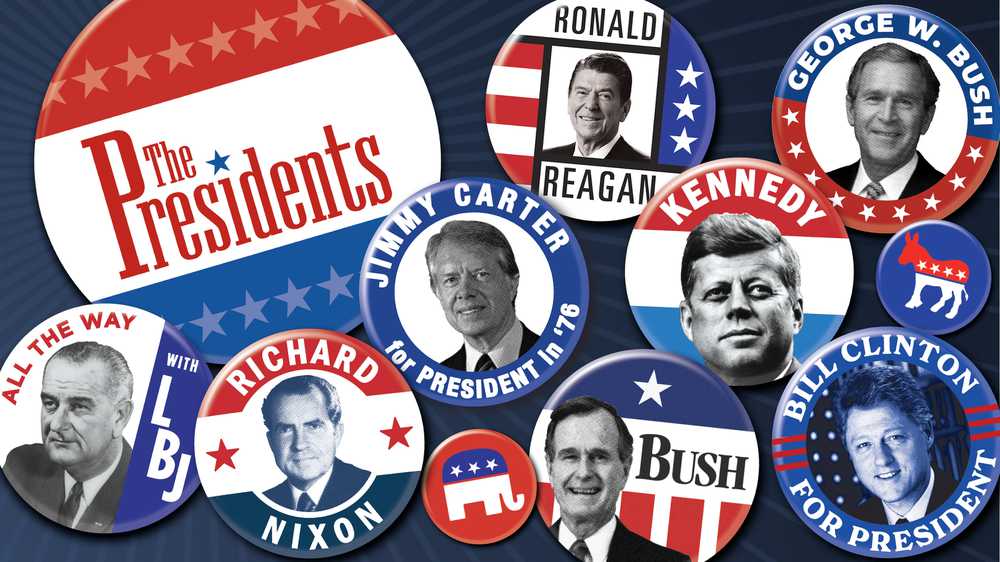
The Presidents Connect today's election issues with the past


Chapter:

The Important Thing is to Win (5:58)
Nixon attends law school, marries, and serves in World War II. In 1946, he uses aggressive tactics to win a seat in Congress.
FDR
Truman
LBJ

Now
Playing

Nixon
Carter
Reagan
G H W Bush

Related Clips


FDR, Chapter 8

Denial (10:52)
Roosevelt escapes to a Florida houseboat, the Larocco. Eleanor tends to his political interests but also develops independence.
Watch Now

TRUMAN, Chapter 6

Marriage and Politics (13:12)
After the war, Truman marries Bess Wallace and runs for public office.
Watch Now

LBJ, Chapter 2

A Politician from Birth (7:57)
Johnson grows up in poor, rural Texas hill country. Campaigning on a New Deal platform, he wins a seat in the U.S. House of Representatives.
Watch Now

CARTER, Chapter 5

Politics and Integrity (8:19)
Carter challenges election fraud and wins a seat in the state senate. He becomes known for his integrity. In 1966 he narrowly loses the governor's race to a segregationist.
Watch Now

REAGAN, Chapter 5

Political Apprenticeship (9:26)
Reagan hones his speaking skills as a television host and spokesman for General Electric. He becomes known for his conservative views.
Watch Now

GHW_BUSH, Chapter 4

A New Republican Party (9:25)
Financially secure, Bush enters Texas politics. To build the Republican Party, he welcomes ideological radicals and segregationists.
Watch Now

TRUMAN, Chapter 24

The Conventions (6:41)
Despite Democrats' misgivings, President Truman is nominated at a dispirited Democratic Convention.
Watch Now

GHW_BUSH, Chapter 2

Combat Pilot (9:26)
Born into wealth, Bush volunteers as a combat pilot in World War II. He marries Barbara Pierce in 1945.
Watch Now

Chapter 1

Introduction (4:04)
A biography of Richard Nixon, the 37th president.
Watch Now

Chapter 2

The Silent Majority (7:20)
Born to a Quaker family of modest means, Nixon grows up in a small California town. He shows an early ambition and interest in politics.
Watch Now

Chapter 3

The Important Thing is to Win (5:58)
Nixon attends law school, marries, and serves in World War II. In 1946, he uses aggressive tactics to win a seat in Congress.
Watch Now

Chapter 4

The Concealed Enemy (6:47)
Nixon serves on the House Committee on Un-American Activities and investigates government official Alger Hiss as a Communist and spy.
Watch Now

Chapter 5

The Pink Lady (3:52)
Implying that his opponent Helen Gahagan Douglas is a Communist, Nixon wins a seat in the Senate in 1950.
Watch Now

Chapter 6

A Nixon Republican (9:28)
In 1952, Nixon weathers a hostile press and partisan attacks to position himself as the next Republican presidential nominee.
Watch Now

Chapter 7

Eisenhower's Point Man (4:47)
Nixon handles political assignments as vice president. He governs cautiously for two months while Eisenhower recovers from a heart attack. In 1956, the team is re-elected in a landslide.
Watch Now

Chapter 8

The Bronze Warrior (8:58)
In 1960, with the first televised presidential debates, Nixon loses a close presidential race to a tanned, charming Democratic senator, John F. Kennedy.
Watch Now

Chapter 9

Oblivion (2:57)
When Nixon loses his California gubernatorial bid in 1962, his political career looks finished. He tells reporters, "you don't have Nixon to kick around anymore."
Watch Now

Chapter 10

Triumph (15:19)
Nixon works as a Wall Street lawyer but keeps active in politics. In a remarkable comeback, he wins the presidency in 1968.
Watch Now

Chapter 11

Peacemaker (6:47)
After assembling a loyal staff, Nixon sets out ambitious foreign policy goals with National Security Adviser Henry Kissinger.
Watch Now

Chapter 12

Mr. Nixon's War (8:56)
The country remains bitterly divided over the Vietnam War as Nixon escalates attacks into Cambodia, trying to reach "an honorable end."
Watch Now

Chapter 13

Living in a Bunker (9:19)
After National Guardsmen kill four students at Kent State University, tensions flare over the war. Nixon begins secretly taping White House conversations.
Watch Now

Chapter 14

Enemies (6:41)
Nixon responds to negative press by creating an "enemies list." His staff and their agents target enemies with illegal measures.
Watch Now

Chapter 15

To the Summit (7:44)
Nixon achieves foreign policy successes in China and the Soviet Union. Burglars working for Nixon's re-election committee break into the Watergate offices of the Democratic National Committee.
Watch Now

Chapter 16

The Fall (9:36)
Nixon is re-elected in a landslide while the investigation into Watergate burglaries begins. After Nixon orders intensive bombing in Vietnam, peace talks lead to a cease-fire.
Watch Now

Chapter 17

Secrets Unraveled (11:34)
After months of a White House cover-up, counsel John Dean reveals to federal prosecutors the administration's involvement in break-ins.
Watch Now

Chapter 18

"I Am Not a Crook" (7:58)
In his testimony to the Senate Watergate Committee, John Dean charges Nixon with obstruction of justice. Congress subpoenas the White House tape recordings.
Watch Now

Chapter 19

Constitutional Crisis (8:19)
Nixon refuses to comply with subpoenas. His vice president, charged with tax evasion, resigns. Nixon's attorney general refuses to fire the special Watergate prosecutor, and many call for Nixon's impeachment.
Watch Now

Chapter 20

The Last Campaign (9:38)
Congress impeaches President Nixon, charging him with obstruction of justice, abuse of power and contempt of Congress.
Watch Now

Chapter 21

The Judgment of History (6:32)
Nixon resigns from office. His successor Gerald Ford grants him a full pardon, but over 70 others are convicted of crimes.
Watch Now

Chapter 22

Credits (1:43)
Production credits for part two of the television program.
Watch Now

  • NIXON: Chapter 1
  • NIXON: Chapter 2
  • NIXON: Chapter 3
  • NIXON: Chapter 4
  • NIXON: Chapter 5
  • NIXON: Chapter 6
  • NIXON: Chapter 7
  • NIXON: Chapter 8
  • NIXON: Chapter 9
  • NIXON: Chapter 10
  • NIXON: Chapter 11
  • NIXON: Chapter 12
  • NIXON: Chapter 13
  • NIXON: Chapter 14
  • NIXON: Chapter 15
  • NIXON: Chapter 16
  • NIXON: Chapter 17
  • NIXON: Chapter 18
  • NIXON: Chapter 19
  • NIXON: Chapter 20
  • NIXON: Chapter 21
  • NIXON: Chapter 22
Choose a format

Choose a Video Format

Quicktime | Windows Media

Download a free player
QuickTime | Windows Media

Related Links


NIXON
Learn more about Richard Nixon.

More on World War II
Learn more, from D-Day to the Holocaust.

Going Negative?
Watch a video about negative campaigning.

Purchase Videos & DVDs

• See Comments

Loading comments...

You must log in to submit a comment. If you don't have an account at American Experience, you will need to register to comment. It's fast and easy to do!

Post a Comment (Limit 5000 Characters)

• View Transcripts •


Title Card: The Important Thing Is To Win

NARRATOR: Duke Law School was Nixon's next training ground in persistence, success and frustration. His classmates called him "Gloomy Gus." He lived frugally, studied endlessly and never walked away from a classroom confrontation.

LYMAN BROWNFIELD, Duke Classmate: We had a professor of torts, Douglas Maggs who was so intimidating that most people backed down. The first person in our class that I remembered that stood up to him and kind of barked back was Nixon. And he had the ... he'd stand there, kind of flat-footed and you could just see he was dug in. And he was just standing up to Maggs, kind of almost shaking in his shoes, but by gosh, he wasn't going to back down.

NARRATOR: Nixon graduated third in his class, hoping for a job with an East Coast law firm or the FBI, but his applications were rejected. He went back home to Whittier. Nixon's mother helped him get a job in a friend's law office, but small-town law bored him and he was still too young and inexperienced for state politics.

Then, while auditioning for a local play, he fell in love. Pat Ryan was a truck farmer's red-haired daughter, ten months older than he and even more accustomed to hard work and hardship. She had worked her way through college as a switchboard operator, salesgirl and movie extra before taking a teaching job at Whittier High. "Don't laugh," Nixon told her, even before their first date, "but someday I'm going to marry you." He pursued Pat for over two years, even driving her to Los Angeles on weekends when she had dates with other men, then waiting around to take her home again. He married her in June of 1940, but his political ambitions would have to wait five more years. The world was at war.

Eight months after Pearl Harbor, Nixon joined the Navy and as a lieutenant commander, was sent to the Solomon Islands. He was best remembered for his skill at scrounging food and liquor and supplies for the grateful men, who called him "Nick." And he learned to play poker, not just to fill the time, but to make some extra money.

JAMES STEWART, Navy Officer, World War II: He said to me, "Do you think that there's any sure way to win?" And I said, "Well, if you don't think you have the best hand going in, get out. Drop. Don't ante up." I said, "The trouble with that is that you'll probably drop three or four hands out of five and it's very boring and I haven't got the patience to do it." Well, to our intense surprise, he did exactly that. And he won quite ... more frequently than he lost and he sent home to California a fair amount of money, I have no idea exactly how much, but my estimate was between $6,000 and $7,000.

NARRATOR: It was his poker winnings that helped finance Nixon's first political campaign. At war's end, he was approached by a group of Republican bankers and businessmen from Whittier who sought a candidate to unseat the five-term Democratic congressman, Jerry Voorhis. Voorhis, a Yale graduate from a wealthy family, was anathema to Whittier Republicans. He supported labor, opposed big oil and big banking and championed the social welfare programs of the New Deal. Lieutenant Commander Nixon jumped at the opportunity to run against him.

Leading Republicans around Whittier were confident they finally had found the man to defeat Jerry Voorhis. "Nixon comes from good Quaker stock," a local banker wrote, "He is a very aggressive individual." Another partisan said, "This man is saleable merchandise." In his first campaign, Nixon developed an approach that remained remarkably consistent through nearly three decades. The candidate presented himself as a family man from a long tradition of work and service, a firm believer in individual initiative, a champion of the forgotten man. And at the same time, he proved to be a fierce, no-holds-barred combatant, accusing Voorhis of ties to Communist organizations distorting Voorhis' record in Congress.

JERRY VOORHIS: [1971 Interview] Just before the election, a good many people came and told me, "Do you know about the telephone calls that were being made?" and I said no, I didn't. "Well," they said, "I was called on the phone by an unidentified person, who simply said that, "Do you know that Jerry Voorhis is a Communist?" and "You should vote for Mr. Nixon because of this fact."

NARRATOR: The character of Nixon's campaign surprised many of his friends. "Of course, I knew Jerry Voorhis wasn't a Communist," he later told a Voorhis aide, "but I had to win. That's the thing you don't understand. The important thing is to win."

Mr. VOORHIS: All the stops were pulled and Mr. Nixon beat me. He was a good debater, he was a clever debater. I wouldn't deny that at all, but I still feel that there were a good many below-the-belt blows struck in the campaign.

NARRATOR: Nixon was swept into office with 60 percent of the vote, part of a nationwide Republican surge. His boyhood goal to enter politics had been achieved.


Major funding provided by the National
Endowment for the Humanities and the Corporation for Public Broadcasting

NEH Corporation for Public Broadcasting


Any views, findings, conclusions, or recommendations expressed in this Web site do not necessarily represent those of the National Endowment for the Humanities.