Visit Your Local PBS Station PBS Home PBS Home Programs A-Z TV Schedules Watch Video Support PBS Shop PBS Search PBS
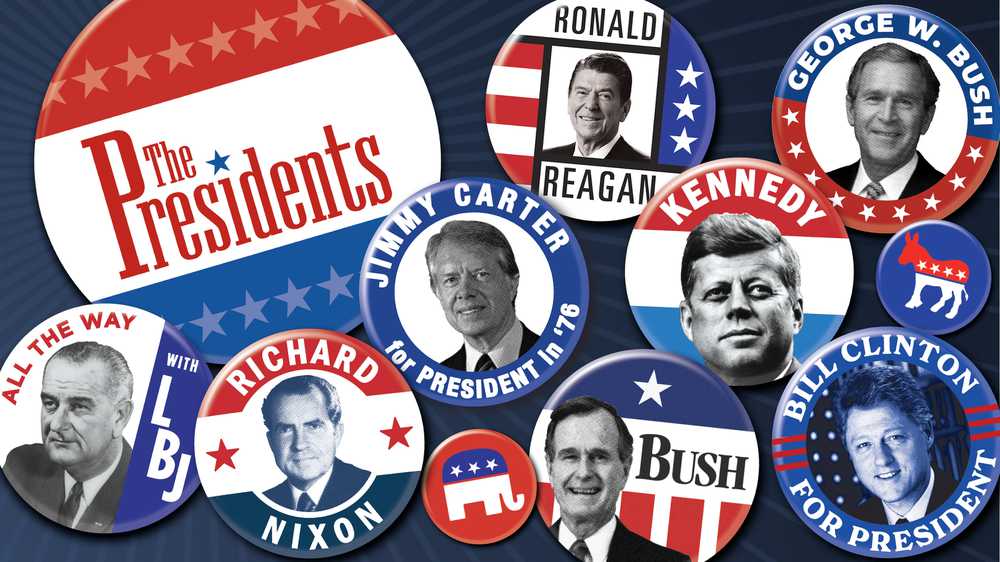
The Presidents Connect today's election issues with the past


Chapter:

A Nixon Republican (9:28)
In 1952, Nixon weathers a hostile press and partisan attacks to position himself as the next Republican presidential nominee.
FDR
Truman
LBJ

Now
Playing

Nixon
Carter
Reagan
G H W Bush

Related Clips


TRUMAN, Chapter 31

The Last Years (9:06)
With the lowest popularity rating in history, Truman decides not to seek re-election. He retires to Independence, Missouri.
Watch Now

GHW_BUSH, Chapter 8

A Race Horse Under Wraps (11:18)
Bush serves as ambassador to China, then CIA director. In the 1980 election, he becomes Ronald Reagan's running mate.
Watch Now

NIXON, Chapter 7

Eisenhower's Point Man (4:47)
Nixon handles political assignments as vice president. He governs cautiously for two months while Eisenhower recovers from a heart attack. In 1956, the team is re-elected in a landslide.
Watch Now

NIXON, Chapter 14

Enemies (6:41)
Nixon responds to negative press by creating an "enemies list." His staff and their agents target enemies with illegal measures.
Watch Now

NIXON, Chapter 19

Constitutional Crisis (8:19)
Nixon refuses to comply with subpoenas. His vice president, charged with tax evasion, resigns. Nixon's attorney general refuses to fire the special Watergate prosecutor, and many call for Nixon's impeachment.
Watch Now

Chapter 1

Introduction (4:04)
A biography of Richard Nixon, the 37th president.
Watch Now

Chapter 2

The Silent Majority (7:20)
Born to a Quaker family of modest means, Nixon grows up in a small California town. He shows an early ambition and interest in politics.
Watch Now

Chapter 3

The Important Thing is to Win (5:58)
Nixon attends law school, marries, and serves in World War II. In 1946, he uses aggressive tactics to win a seat in Congress.
Watch Now

Chapter 4

The Concealed Enemy (6:47)
Nixon serves on the House Committee on Un-American Activities and investigates government official Alger Hiss as a Communist and spy.
Watch Now

Chapter 5

The Pink Lady (3:52)
Implying that his opponent Helen Gahagan Douglas is a Communist, Nixon wins a seat in the Senate in 1950.
Watch Now

Chapter 6

A Nixon Republican (9:28)
In 1952, Nixon weathers a hostile press and partisan attacks to position himself as the next Republican presidential nominee.
Watch Now

Chapter 7

Eisenhower's Point Man (4:47)
Nixon handles political assignments as vice president. He governs cautiously for two months while Eisenhower recovers from a heart attack. In 1956, the team is re-elected in a landslide.
Watch Now

Chapter 8

The Bronze Warrior (8:58)
In 1960, with the first televised presidential debates, Nixon loses a close presidential race to a tanned, charming Democratic senator, John F. Kennedy.
Watch Now

Chapter 9

Oblivion (2:57)
When Nixon loses his California gubernatorial bid in 1962, his political career looks finished. He tells reporters, "you don't have Nixon to kick around anymore."
Watch Now

Chapter 10

Triumph (15:19)
Nixon works as a Wall Street lawyer but keeps active in politics. In a remarkable comeback, he wins the presidency in 1968.
Watch Now

Chapter 11

Peacemaker (6:47)
After assembling a loyal staff, Nixon sets out ambitious foreign policy goals with National Security Adviser Henry Kissinger.
Watch Now

Chapter 12

Mr. Nixon's War (8:56)
The country remains bitterly divided over the Vietnam War as Nixon escalates attacks into Cambodia, trying to reach "an honorable end."
Watch Now

Chapter 13

Living in a Bunker (9:19)
After National Guardsmen kill four students at Kent State University, tensions flare over the war. Nixon begins secretly taping White House conversations.
Watch Now

Chapter 14

Enemies (6:41)
Nixon responds to negative press by creating an "enemies list." His staff and their agents target enemies with illegal measures.
Watch Now

Chapter 15

To the Summit (7:44)
Nixon achieves foreign policy successes in China and the Soviet Union. Burglars working for Nixon's re-election committee break into the Watergate offices of the Democratic National Committee.
Watch Now

Chapter 16

The Fall (9:36)
Nixon is re-elected in a landslide while the investigation into Watergate burglaries begins. After Nixon orders intensive bombing in Vietnam, peace talks lead to a cease-fire.
Watch Now

Chapter 17

Secrets Unraveled (11:34)
After months of a White House cover-up, counsel John Dean reveals to federal prosecutors the administration's involvement in break-ins.
Watch Now

Chapter 18

"I Am Not a Crook" (7:58)
In his testimony to the Senate Watergate Committee, John Dean charges Nixon with obstruction of justice. Congress subpoenas the White House tape recordings.
Watch Now

Chapter 19

Constitutional Crisis (8:19)
Nixon refuses to comply with subpoenas. His vice president, charged with tax evasion, resigns. Nixon's attorney general refuses to fire the special Watergate prosecutor, and many call for Nixon's impeachment.
Watch Now

Chapter 20

The Last Campaign (9:38)
Congress impeaches President Nixon, charging him with obstruction of justice, abuse of power and contempt of Congress.
Watch Now

Chapter 21

The Judgment of History (6:32)
Nixon resigns from office. His successor Gerald Ford grants him a full pardon, but over 70 others are convicted of crimes.
Watch Now

Chapter 22

Credits (1:43)
Production credits for part two of the television program.
Watch Now

Related Links


NIXON
Learn more about Richard Nixon.

Vote on the Issues
Where would you have stood in 1952?

The Checkers Speech
Read Nixon's famous defense of his finances.

Purchase Videos & DVDs

• See Comments

Loading comments...

You must log in to submit a comment. If you don't have an account at American Experience, you will need to register to comment. It's fast and easy to do!

Post a Comment (Limit 5000 Characters)

• View Transcripts •


Title Card: A Nixon Republican

Fifth NEWSCASTER: Chicago is a city divided, as thousands of delegates and observers stream into the city for the 25th Republican Convention. Partisanship runs high and the trappings of the Grand Old Party dominate the scene before the serious business gets under way.

NARRATOR: After only a year and a half in the Senate, Nixon was a leading candidate for the vice presidential nomination.

Fifth NEWSCASTER: And here comes "Mr. Republican" himself, Senator Robert Taft.

NARRATOR: Taft partisans, mostly conservative and isolationist, applauded Nixon's fervent anti-Communism, while General Eisenhower's more liberal, internationalist backers were attracted to Nixon's support of the Marshall Plan, his commitment to rebuilding post-war Europe. The California delegation was pledged to its favorite son, Governor Earl Warren, but behind the scenes, Nixon lobbied hard for the nomination of Eisenhower.

Mr. de TOLEDANO: He was a man with no set ideology, no set ... real deep-down principles. He wasn't a Taft Republican, he wasn't an Eisenhower Republican, he was a Nixon Republican.

Sixth NEWSCASTER: With New York's big block of votes, the issue is no longer in doubt and a wildly-cheering convention hails its nominee, Dwight D. Eisenhower, soldier and statesman.

NARRATOR: Away from the convention floor, Eisenhower huddled with Nixon. The young senator represented the growing power of the West Coast and he was a rough-and-tumble campaigner. The general offered him the vice presidency.

Senator NIXON: [1952 Republican Convention] And as we contribute to the Republican cause, what we will do is to forge a great victory for the Republican Party next November, but a victory which will be a victory not only for the Republican Party, but what is more important, it will be a victory for America and for the cause of free peoples throughout the world.

NARRATOR: Eisenhower intended to keep to the high road, he told his new running mate. It was up to Nixon to flail the Democrats and their presidential candidate, Adlai Stevenson.

Senator NIXON: [campaigning] There is no question in my mind as to the loyalty of Mr. Stevenson, but the question is one as to his judgment.

Many good Americans are concerned by the way that President Truman and Governor Stevenson have both attempted to ridicule and pooh-pooh the Communist threat within the United States.

You read about another bribe, you read about another tax-fix, you read about another gangster getting favors from the government. The people are sick and tired of it. They're outraged and they want something done about it and they're tired of an administration, which, instead of cleaning up, is covering up the scandals in Washington at the present time.

NARRATOR: Suddenly, Nixon faced a scandal of his own. The New York Post reported that wealthy supporters had set up a secret fund for Nixon's personal use.

Senator NIXON: And if that were true, let me say, first of all, that I should never have accepted the nomination to the vice presidency of the United States and if it were true, I would get off the ticket right away, but it is not true.

NARRATOR: In fact, the fund was not secret and was earmarked exclusively for political expenses, but the damage had been done. Aides urged Eisenhower to drop Nixon from the ticket. Even Republican newspapers demanded he resign.

HANNAH NIXON, Mother: When those headlines first came in the paper, I just wanted to hide that paper. I didn't want anyone to see it. I couldn't eat and I knew that it wasn't true, but what could I do?

PATRICK HILLINGS, Campaign Staff: Well, when the world seemed the blackest and the whole Nixon campaign had halted in Portland, Oregon, I got a telegram from his mother. I took it into him and gave it to him and he was sitting in a large chair with his arms on the side, almost like the Lincoln statue that you see in Washington, the Lincoln Memorial. And I handed him the telegram and he read it and he dropped it on his... in the chair and his head fell forward and the tears came down his eyes. And it was obvious that he'd been terribly moved by what all this meant, that it was so important to him to prove to his mother that he'd never done anything wrong.

NARRATOR: Was Nixon on or off the ticket? General Eisenhower had been frustratingly silent. Finally, after three days of waiting, a weary, anxious Nixon received Eisenhower's phone call.

TED ROGERS, Nixon Television Adviser: And he said, "General," he said, "I'm just Richard Nixon." And he said, "I'm just a very young guy that doesn't know you very well. But," he said, "I must tell you, General, that there comes a time, even in your life, when you have to shit or get off the pot."

Mr. HILLINGS: And there was this dead silence and we didn't know whether the ballgame was over right then or not, but Eisenhower seemed to take it as it was meant to be given and came to the conclusion, as he told Nixon on the phone -- he reported to us after the conversation -- that Nixon should go to California and make a nationwide speech explaining all the details of this so-called "secret fund" and that he would authorize the National Committee to pay for the cost.

NARRATOR: Nixon secluded himself in Los Angeles and prepared to use the young medium of television as it had never been used before. He would bypass the press, bypass even Eisenhower and plead his case directly to the American people. This primetime broadcast would come to be known as the "Checkers" speech and widen the gap between Nixon's admirers and his detractors. To some, he seemed humble, honest, sincere; to others, self-righteous and shamelessly manipulative.

Senator NIXON: ["Checkers" speech] My fellow Americans, I come before you tonight as a candidate for the vice presidency and as a man whose honesty and integrity has been questioned. And so now, what I am going to do and incidentally, this is unprecedented in the history of American politics, I am going at this time to give to this television and radio audience a complete financial history, everything I've earned, everything I've spent, everything I owe.

KENNETH BALL, Whittier Neighbor: I don't remember talking to his mother, but his father, he thought that he really did all right. He said, "I hated to hear him say some of the things he said, but he told the truth and that's what the people wanted to hear and that did the job for him."

Senator NIXON: ["Checkers" speech] First of all, we've got a house in Washington which cost $41,000 and on which we owe $20,000. We have a house in Whittier, California, which cost $13,000 and on which we owe $3,000. My folks are living there at the present time.

NARRATOR: His wife asked him, "Why do you have to tell people how little we have and how much we owe?" "People in political life have to live in a goldfish bowl," he answered, "but I knew it was a weak explanation for the humiliation I was asking her to endure."

Senator NIXON: ["Checkers" speech] I should say this, that Pat doesn't have a mink coat, but she does have a respectable Republican cloth coat. And I always tell her that she'd look good in anything.

NARRATOR: The "cloth coat" remark was aimed at the Truman administration, then plagued by mink-coat bribery charges. Next, Nixon borrowed a technique from Franklin Roosevelt. He talked about his dog.

"Using the same ploy as FDR," he wrote in his memoirs, "would irritate my opponents and delight my friends."

Senator NIXON: ["Checkers" speech] We did get something, a gift after the election. It was a little cocker spaniel dog, black and white spotted. And our little girl Tricia, the six-year-old, named it "Checkers."

And you know, the kids, like all kids, love the dog and I just want to say this right now, that regardless of what they say about it, we're going to keep him.

[Republican Rally, Cleveland, Ohio] I would do nothing that would harm the possibility of Dwight Eisenhower to become president of the United States and for that reason, I am committed to the Republican National Committee, tonight through this television broadcast, the decision which is theirs to make. Wire and write the Republican National Committee whether you think I should stay on or whether I should get off and whatever their decision is, I will abide by it.

General DWIGHT DAVID EISENHOWER: [defending Nixon] I have been a warrior and I like courage. And tonight, I saw an example of courage.

GOP CHAIRMAN: [Cleveland Rally] All those in favor of Nixon continuing as a candidate will say aye!

AUDIENCE: Aye!

Mr. BROWNFIELD: I had called some Republican friends of mine and had asked them to send telegrams to Nixon, saying, "Don't drop off the ticket," and they had refused. And I was with some of them when I watched the "Checkers" speech and afterwards, every one of them sent a telegram to Nixon, saying, "Great job, stay on the ticket."

NARRATOR: Nixon stayed on the ticket that was swept into office in November, the first Republican administration in two decades.


Major funding provided by the National
Endowment for the Humanities and the Corporation for Public Broadcasting

NEH Corporation for Public Broadcasting


Any views, findings, conclusions, or recommendations expressed in this Web site do not necessarily represent those of the National Endowment for the Humanities.