Visit Your Local PBS Station PBS Home PBS Home Programs A-Z TV Schedules Watch Video Support PBS Shop PBS Search PBS
 
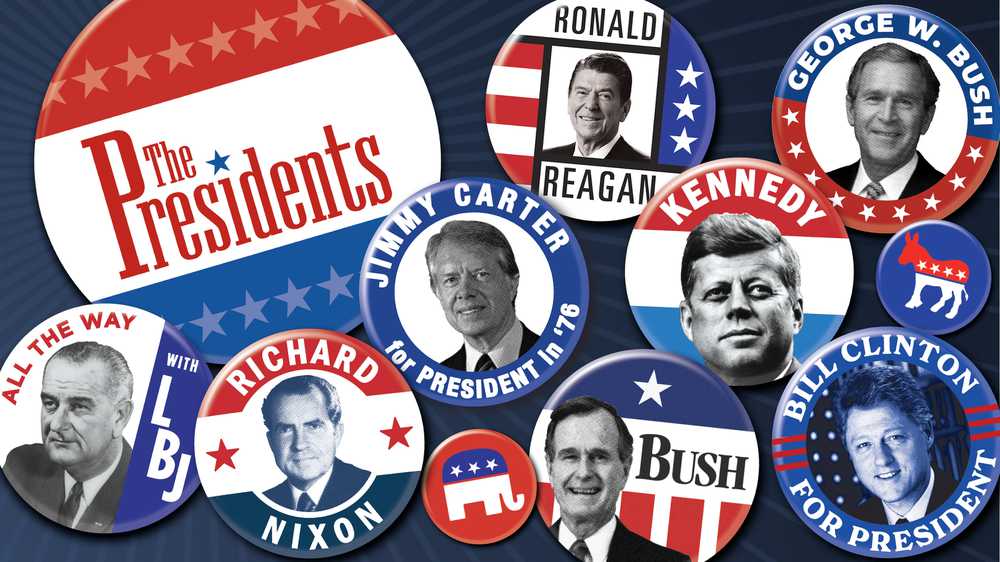
The Presidents Connect today's election issues with the past


Chapter:

To the Summit (7:44)
Nixon achieves foreign policy successes in China and the Soviet Union. Burglars working for Nixon's re-election committee break into the Watergate offices of the Democratic National Committee.
FDR
Truman
LBJ

Now
Playing

Nixon
Carter
Reagan
G H W Bush

Related Clips


TRUMAN, Chapter 28

Crossing the 38th Parallel (9:35)
MacArthur convinces Truman to fight the Chinese in Korea. Truman denies MacArthur's demand to use atomic weapons.
Watch Now

LBJ, Chapter 10

Prelude to War (6:48)
Following Robert McNamara's advice, Johnson okays covert commando attacks against North Vietnam to stop Communism.
Watch Now

GHW_BUSH, Chapter 8

A Race Horse Under Wraps (11:18)
Bush serves as ambassador to China, then CIA director. In the 1980 election, he becomes Ronald Reagan's running mate.
Watch Now

Chapter 1

Introduction (4:04)
A biography of Richard Nixon, the 37th president.
Watch Now

Chapter 2

The Silent Majority (7:20)
Born to a Quaker family of modest means, Nixon grows up in a small California town. He shows an early ambition and interest in politics.
Watch Now

Chapter 3

The Important Thing is to Win (5:58)
Nixon attends law school, marries, and serves in World War II. In 1946, he uses aggressive tactics to win a seat in Congress.
Watch Now

Chapter 4

The Concealed Enemy (6:47)
Nixon serves on the House Committee on Un-American Activities and investigates government official Alger Hiss as a Communist and spy.
Watch Now

Chapter 5

The Pink Lady (3:52)
Implying that his opponent Helen Gahagan Douglas is a Communist, Nixon wins a seat in the Senate in 1950.
Watch Now

Chapter 6

A Nixon Republican (9:28)
In 1952, Nixon weathers a hostile press and partisan attacks to position himself as the next Republican presidential nominee.
Watch Now

Chapter 7

Eisenhower's Point Man (4:47)
Nixon handles political assignments as vice president. He governs cautiously for two months while Eisenhower recovers from a heart attack. In 1956, the team is re-elected in a landslide.
Watch Now

Chapter 8

The Bronze Warrior (8:58)
In 1960, with the first televised presidential debates, Nixon loses a close presidential race to a tanned, charming Democratic senator, John F. Kennedy.
Watch Now

Chapter 9

Oblivion (2:57)
When Nixon loses his California gubernatorial bid in 1962, his political career looks finished. He tells reporters, "you don't have Nixon to kick around anymore."
Watch Now

Chapter 10

Triumph (15:19)
Nixon works as a Wall Street lawyer but keeps active in politics. In a remarkable comeback, he wins the presidency in 1968.
Watch Now

Chapter 11

Peacemaker (6:47)
After assembling a loyal staff, Nixon sets out ambitious foreign policy goals with National Security Adviser Henry Kissinger.
Watch Now

Chapter 12

Mr. Nixon's War (8:56)
The country remains bitterly divided over the Vietnam War as Nixon escalates attacks into Cambodia, trying to reach "an honorable end."
Watch Now

Chapter 13

Living in a Bunker (9:19)
After National Guardsmen kill four students at Kent State University, tensions flare over the war. Nixon begins secretly taping White House conversations.
Watch Now

Chapter 14

Enemies (6:41)
Nixon responds to negative press by creating an "enemies list." His staff and their agents target enemies with illegal measures.
Watch Now

Chapter 15

To the Summit (7:44)
Nixon achieves foreign policy successes in China and the Soviet Union. Burglars working for Nixon's re-election committee break into the Watergate offices of the Democratic National Committee.
Watch Now

Chapter 16

The Fall (9:36)
Nixon is re-elected in a landslide while the investigation into Watergate burglaries begins. After Nixon orders intensive bombing in Vietnam, peace talks lead to a cease-fire.
Watch Now

Chapter 17

Secrets Unraveled (11:34)
After months of a White House cover-up, counsel John Dean reveals to federal prosecutors the administration's involvement in break-ins.
Watch Now

Chapter 18

"I Am Not a Crook" (7:58)
In his testimony to the Senate Watergate Committee, John Dean charges Nixon with obstruction of justice. Congress subpoenas the White House tape recordings.
Watch Now

Chapter 19

Constitutional Crisis (8:19)
Nixon refuses to comply with subpoenas. His vice president, charged with tax evasion, resigns. Nixon's attorney general refuses to fire the special Watergate prosecutor, and many call for Nixon's impeachment.
Watch Now

Chapter 20

The Last Campaign (9:38)
Congress impeaches President Nixon, charging him with obstruction of justice, abuse of power and contempt of Congress.
Watch Now

Chapter 21

The Judgment of History (6:32)
Nixon resigns from office. His successor Gerald Ford grants him a full pardon, but over 70 others are convicted of crimes.
Watch Now

Chapter 22

Credits (1:43)
Production credits for part two of the television program.
Watch Now

  • NIXON: Chapter 1
  • NIXON: Chapter 2
  • NIXON: Chapter 3
  • NIXON: Chapter 4
  • NIXON: Chapter 5
  • NIXON: Chapter 6
  • NIXON: Chapter 7
  • NIXON: Chapter 8
  • NIXON: Chapter 9
  • NIXON: Chapter 10
  • NIXON: Chapter 11
  • NIXON: Chapter 12
  • NIXON: Chapter 13
  • NIXON: Chapter 14
  • NIXON: Chapter 15
  • NIXON: Chapter 16
  • NIXON: Chapter 17
  • NIXON: Chapter 18
  • NIXON: Chapter 19
  • NIXON: Chapter 20
  • NIXON: Chapter 21
  • NIXON: Chapter 22
Choose a format

Choose a Video Format

Quicktime | Windows Media

Download a free player
QuickTime | Windows Media

Related Links


NIXON
Learn more about Richard Nixon.

Nixon's China Game
A secret diplomatic breakthrough.

The Cold War in the Seventies
Learn about Nixon's historic arms reduction agreement.

Purchase Videos & DVDs

• See Comments

Loading comments...

You must log in to submit a comment. If you don't have an account at American Experience, you will need to register to comment. It's fast and easy to do!

Post a Comment (Limit 5000 Characters)

• View Transcripts •


Title Card: To the Summit

Eleventh NEWSCASTER: Good evening. The 37th president of the United States, Richard M. Nixon, is in China, the first American chief executive ever to visit the world's most populous country.

NARRATOR: On February 18, 1972, Richard Nixon began still another remarkable comeback, with a stunning foreign policy success.

Twelfth NEWSCASTER: President Nixon's motorcade is now sweeping toward the city of Peking.

Thirteenth NEWSCASTER: Here comes the motorcade now, as you see.

NARRATOR: The world watched as Richard Nixon drove through a city that few outsiders had seen for nearly a quarter of a century. "He knew," said The New York Times, "that for this journey, no matter what else occurred, he would always be remembered." That afternoon, Nixon was abruptly summoned to see Mao Tse Tung. American television was unaware of the meeting. The only coverage was by Chinese cameramen with black-and-white film. This encounter between Nixon, the career anti-Communist, and Chairman Mao, the leader of the largest Communist revolutionary movement in history, shocked Nixon's old conservative allies. They accused him of surrendering to international Communism. But for Nixon, it was all part of his global strategy. By visiting China, he was beginning to exploit the divisions in the Communist world.

WINSTON LORD, Kissinger Aide: One of Nixon's primary objectives in opening up with China was to give him more leverage with the Soviet Union. These relations were essentially stalled, but soon after the opening with China, the Soviet Union became much more flexible on several fronts. They agreed to a summit meeting with us in 1972 and they began to be more reasonable on various arms control issues.

Mr. COLSON: Nixon enjoyed the power game, probably as much as any president in modern times. He played it very hard and very cleverly and very carefully on the world scene. And he was always thinking strategically and that's one of the qualities that someone has to have in foreign policy.

I mean, you cannot make decisions in foreign policy based on today's circumstance. You've got to think about its ramifications for five, 10, 15, 20 years down the road. And it's like a chess player. You're anticipating six moves ahead if you're a good chess player.

NARRATOR: In the spring of 1972, the North Vietnamese suddenly launched a massive offensive. South Vietnam's forces were overwhelmed. Thousands fled.

If the offensive were not stopped, the war would be lost and with it, Nixon feared, the presidency. But if he ordered a U.S. counterattack, the Soviets might cancel the upcoming arms control summit in Moscow, a vital part of Nixon's grand design. Most of his advisers urged Nixon not to take any action that might jeopardize the summit. Once again, Nixon overruled them.

Mr. LORD: His view was that it would be embarrassing for him to go to Moscow without responding to the North Vietnamese aggression, that he would look weak -- he's talking to Soviet leaders who are providing arms to the North Vietnamese troops who are killing American troops -- so he didn't think the summit was worth it unless he could also show that he was strong within Vietnam itself.

NARRATOR: Nixon ordered the most drastic escalation of the war since 1968, massive sustained bombing of Hanoi and the mining of Haiphong Harbor, risking a full-scale confrontation with the Soviets by putting their supply ships in peril. After explaining his decision to the American people, he made a direct appeal to the Kremlin.

Pres. NIXON: [May 8, 1972] Our two nations have made significant progress in our negotiations in recent months. We are near major agreements on nuclear arms limitation, on trade, on a host of other issues. Let us not slide back toward the dark shadows of a previous age.

We do not ask you to sacrifice your principles or your friends, but neither should you permit Hanoi's intransigence to blot out the prospects we together have so patiently prepared.

NARRATOR: Nixon's gamble paid off. The Soviets did not cancel the summit. On May 22, 1972, Richard Nixon became the first American president ever to set foot inside the Kremlin. Nixon had done what none of his predecessors had been able to do. He had negotiated a treaty in which the two superpowers agreed to slow an arms race that had been accelerating for more than a quarter of a century. It was his greatest achievement.

Two days later, five burglars working for the Committee to Re-Elect Richard Nixon entered the Watergate complex in Washington. They broke into the office of the Democratic National Committee, placed bugs on the telephones and made their escape. But the microphones failed to work. They would have to go back.

Nixon returned from Moscow in triumph. He had almost completed the withdrawal of American forces from Vietnam, opened the door to China and signed the first nuclear arms limitation treaty since the dawn of the atomic age. He had often said that all he wanted was a life with one more victory than defeat. Now, that victory, a second term as president, seemed his for the asking.

GARRICK UTLEY: [June 17, 1972]Five men wearing white gloves and carrying cameras were caught early today in the headquarters of the Democratic National Committee in Washington. They apparently were unarmed and nobody knows yet why they were there. But I don't think that's the last we're going to hear of this story.


Major funding provided by the National
Endowment for the Humanities and the Corporation for Public Broadcasting

NEH Corporation for Public Broadcasting


Any views, findings, conclusions, or recommendations expressed in this Web site do not necessarily represent those of the National Endowment for the Humanities.