Visit Your Local PBS Station PBS Home PBS Home Programs A-Z TV Schedules Watch Video Support PBS Shop PBS Search PBS
 
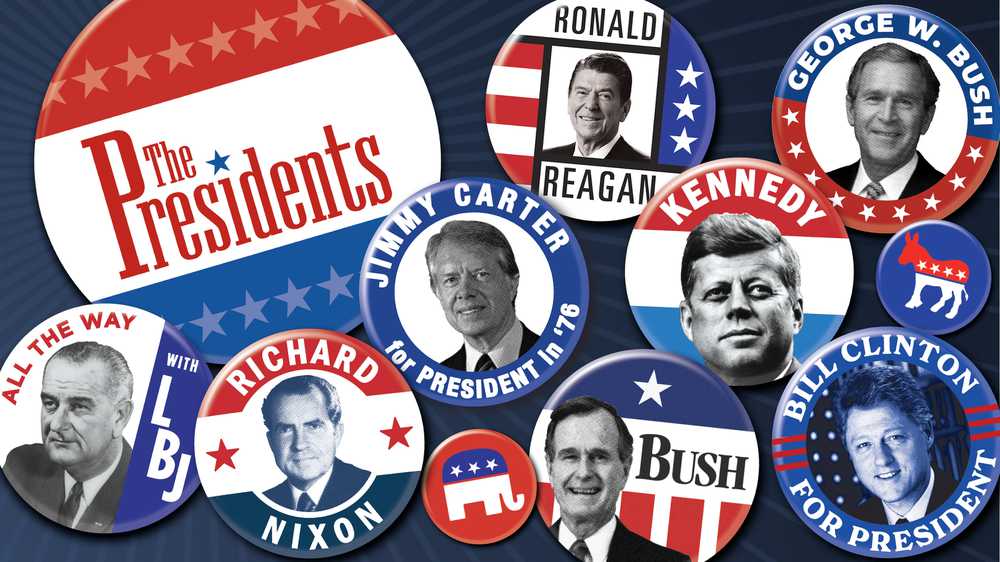
The Presidents Connect today's election issues with the past


Chapter:

Actor (8:39)
Starting out in radio and sportscasting, Reagan moves to California to pursue an acting career.
FDR
Truman
LBJ
Nixon
Carter

Now
Playing

Reagan
G H W Bush

Related Clips


FDR, Chapter 12

A Better Day (5:31)
As the Depression worsens, Roosevelt is elected president and promises "a new deal for the forgotten man."
Watch Now

TRUMAN, Chapter 6

Marriage and Politics (13:12)
After the war, Truman marries Bess Wallace and runs for public office.
Watch Now

REAGAN, Chapter 5

Political Apprenticeship (9:26)
Reagan hones his speaking skills as a television host and spokesman for General Electric. He becomes known for his conservative views.
Watch Now

LBJ, Chapter 3

In Washington (11:11)
Johnson networks in Washington and Texas. He loses a Senate bid and learns hard lessons in the dark side of politics.
Watch Now

NIXON, Chapter 3

The Important Thing is to Win (5:58)
Nixon attends law school, marries, and serves in World War II. In 1946, he uses aggressive tactics to win a seat in Congress.
Watch Now

CARTER, Chapter 3

Naval Career (4:36)
Carter marries Rosalynn Smith and they have three sons. He rises quickly in the Navy, becoming senior officer of a nuclear submarine.
Watch Now

Chapter 1

Introduction (5:50)
Part one of a biography of Ronald Reagan, the 40th president.
Watch Now

Chapter 2

The Lifeguard (11:21)
Ronald Reagan grows up in a small town and works as a lifeguard on the Rock River.
Watch Now

Chapter 3

Actor (8:39)
Starting out in radio and sportscasting, Reagan moves to California to pursue an acting career.
Watch Now

Chapter 4

Communists in Hollywood (9:43)
Reagan, an active anti-Communist, ends his first marriage. He meets and marries actress Nancy Davis.
Watch Now

Chapter 5

Political Apprenticeship (9:26)
Reagan hones his speaking skills as a television host and spokesman for General Electric. He becomes known for his conservative views.
Watch Now

Chapter 6

The First Campaign (6:03)
Incumbent California governor Pat Brown underestimates his opponent Ronald Reagan's appeal. Reagan cultivates a heroic cowboy image.
Watch Now

Chapter 7

Governor and National Figure (12:37)
Reagan gains political confidence in two terms as governor of California.
Watch Now

Chapter 8

A Surprising Presidential Bid (7:56)
Ronald Reagan campaigns for but loses the Republican nomination for president in 1976.
Watch Now

Chapter 9

Landslide Victory (7:34)
Ronald Reagan defeats incumbent Jimmy Carter and is elected president in 1980.
Watch Now

Chapter 10

A Plan for Economic Recovery (10:13)
Reagan works to pass his economic package.
Watch Now

Chapter 11

Assassination Attempt (10:54)
Reagan is seriously wounded in an assassination attempt. Congress enacts his conservative economic agenda.
Watch Now

Chapter 12

Reaganomics (11:17)
Dramatic rises in unemployment, inflation, and homelessness signal the failure of Reagan's economic program.
Watch Now

Chapter 13

CreditsProduction credits for part one of the television program.
Watch Now

Chapter 14

Introduction (2:26)
Part two of a biography of Ronald Reagan, the 40th president.
Watch Now

Chapter 15

Battle on Two Fronts (11:53)
As the recession deepens, Reagan dramatically increases military spending in his crusade against Communism.
Watch Now

Chapter 16

The Nuclear Freeze Movement (7:07)
Demonstrators, including Reagan's daughter, protest his plan to increase nuclear weapons.
Watch Now

Chapter 17

The Strategic Defense Initiative (8:03)
Reagan promotes his plan for a missile defense system.
Watch Now

Chapter 18

Peace Through Strength (6:26)
Reagan broadly states his anti-Soviet "crusade for freedom," but works quietly with the Soviets on human rights issues.
Watch Now

Chapter 19

Missile Deployment in Europe (12:02)
In a controversial speech, Reagan calls the Soviet Union an "evil empire." Some fear the arms race will end in nuclear Armageddon.
Watch Now

Chapter 20

Morning in America (9:11)
America's economy has improved and national confidence is renewed. Reagan wins a second term in a landslide.
Watch Now

Chapter 21

Transitions (10:40)
Reagan loses his oldest advisers. Mikhail Gorbachev becomes the new Soviet leader, and Reagan embarks on a fateful secret course with Iran.
Watch Now

Chapter 22

Personal Diplomacy (10:55)
Reagan and Gorbachev summit in Geneva. Reagan refuses to make concessions on SDI.
Watch Now

Chapter 23

Reagan's Changing Role (5:37)
Despite successes both symbolic and real, Reagan becomes less engaged as president.
Watch Now

Chapter 24

Summit at Reykjavik (10:44)
Reagan and Gorbachev reach for the abolition of nuclear weapons. Though their talks fail, they are a breakthrough.
Watch Now

Chapter 25

The Iran-Contra Crisis (14:11)
The government's secret arms-for-hostages dealings with Iran are uncovered. Reagan learns that his staff has diverted profits to support the anti-Communist Contras in Nicaragua.
Watch Now

Chapter 26

Highs and Lows (11:50)
Americans forgive Reagan for Iran-Contra. The stock market crashes, the gap between rich and poor grows and the AIDS epidemic hits. The U.S. and U.S.S.R. sign a historic weapons treaty.
Watch Now

Chapter 27

The End of the Cold War (10:32)
After his lifelong crusade, Reagan witnesses Communism's demise in Eastern Europe, Afghanistan, Nicaragua and the Soviet Union.
Watch Now

Chapter 28

Into the Sunset (6:28)
Ronald Reagan retires to his California ranch. He will be diagnosed with Alzheimer's disease.
Watch Now

Chapter 29

CreditsProduction credits for part two of the television program.
Watch Now

  • REAGAN: Chapter 1
  • REAGAN: Chapter 2
  • REAGAN: Chapter 3
  • REAGAN: Chapter 4
  • REAGAN: Chapter 5
  • REAGAN: Chapter 6
  • REAGAN: Chapter 7
  • REAGAN: Chapter 8
  • REAGAN: Chapter 9
  • REAGAN: Chapter 10
  • REAGAN: Chapter 11
  • REAGAN: Chapter 12
  • REAGAN: Chapter 13
  • REAGAN: Chapter 14
  • REAGAN: Chapter 15
  • REAGAN: Chapter 16
  • REAGAN: Chapter 17
  • REAGAN: Chapter 18
  • REAGAN: Chapter 19
  • REAGAN: Chapter 20
  • REAGAN: Chapter 21
  • REAGAN: Chapter 22
  • REAGAN: Chapter 23
  • REAGAN: Chapter 24
  • REAGAN: Chapter 25
  • REAGAN: Chapter 26
  • REAGAN: Chapter 27
  • REAGAN: Chapter 28
  • REAGAN: Chapter 29
Choose a format

Choose a Video Format

Quicktime | Windows Media

Download a free player
QuickTime | Windows Media

Related Links


REAGAN
Learn more about Ronald Reagan.

Target Tokyo
Reagan narrates this wartime film about the B-29 bomber.

Mary Pickford: The Long Decline
Fame was fickle for Hollywood's biggest silent film star.

Purchase Videos & DVDs

• See Comments

Loading comments...

You must log in to submit a comment. If you don't have an account at American Experience, you will need to register to comment. It's fast and easy to do!

Post a Comment (Limit 5000 Characters)

• View Transcripts •


Transcript: Chapter 03

Narrator: In 1928, at a time when few Americans went to college Reagan attended Eureka College, run by the Disciples of Christ. He majored in sociology and economics. "I got poor marks," Reagan later admitted. "[But] I copped off the lead in most plays. And in football I won three varsity sweaters."

Narrator: Reagan graduated from Eureka in 1932. It was the depths of the Great Depression. But it took Reagan only six weeks to find a job. At WOC Radio. Later he moved to Des Moines, to work as a sportscaster.

Life was easy for Ronald Reagan. He had money, independence and the time to learn to ride. For the next four summers, using only statistics coming through telegraph Reagan transported his listeners to the bleachers of Wrigley Field with his vivid recreations of baseball games he never saw.

Cannon: If you look at where Reagan is really a master communicator, it really is on radio. If you think about Reagan's career as an actor and as a president and as a speaker, just generally, he was a powerful recreator. He recreated our experiences.

Morris: I remember Hugh Sidey telling me that when he was a child in Iowa in the '30s, in the Dust Bowl years, he used to hear Ronald Reagan's voice coming over the airwaves, and he said – just doing baseball commentary, but he said there was something about that voice that gave me as a child the feeling that life was going to get better.

Narrator: Reagan had long dreamed of becoming an actor and in 1937 he went to Hollywood. He recalled the moment he stepped onto the set of his first film Love is on the Air. "I was ... surrounded by a wall of light (which) gave me a feeling of privacy that completely dispelled any nervousness I might have expected."

Morris: Reagan has always liked to be looked after. He likes to have a Jack Warner in charge of the finances. He likes to have a wardrobe mistress and a supporting cast. He likes to be surrounded by the busyness of a great commercial enterprise. And that's where I think Ronald Reagan became a corporate person.

Narrator: Ronald Reagan would make more than 50 films. And only in one did he play the villain.

Dallek: Reagan loved the hero's role because he fantasized himself as a heroic figure. The first time his mother sees him in the first film he plays in, she looks at the screen and she says, "that's my Dutch," and what she's speaking to is the idea that he's himself on the screen, that he's in a sense playing out the fantasy that he has, that he's very comfortable with.

Narrator: Reagan was becoming a box office draw. Guaranteed work and steady pay, he brought Nelle and Jack to California and bought them the only home they ever owned. In 1940 he married a promising young actress Jane Wyman.

Ron and Jane became the darlings of the Warner Bros. publicity machine -- a valuable asset for an industry preoccupied with its image.

Cannon: They were always worried, the people who ran the studios, that some whiff of scandal involving their bright stars would ah cause people to stop turning up en masse at the box office, or the Legion of Decency would turn on them or something like that. Reagan and Wyman were real, you know. They were, they were in love, they were wholesome, people liked to look at them. If they wanted to celebrate the marriage, Reagan was willing, so they did.

Narrator: With their daughter Maureen, and their adopted son Michael, the Reagans were promoted as the perfect Hollywood family.

Edwin Meese: Ronald Reagan came up from middle America. He came up in the movies in a time when most of the movies were designed to make people feel good when they left rather than feel sad. He reflected these kinds of qualities.

Narrator: Reagan was cast as football legend George Gipp in Knute Rockne All American. It was his first major film -- the one that earned him the nickname "The Gipper." In 1940, he played opposite screen giant Errol Flynn in Santa Fe Trail. But the height of his acting career was as Drake McHugh in King's Row. By the time King's Row opened, America was at war. And so was Ronald Reagan. But only on the screen. Reagan spent the war making training films at Culver City, less than ten miles from home.

Morris: He certainly loved -- learned and loved -- to wear a uniform, to act like a soldier, to salute properly. There was nothing he enjoyed more as President than saluting. As commander in chief, he would do that little extra flip to the salute, which you hardly ever see in the Armed Services anyway, it was a real Hollywood salute. But it meant a great deal to him.

Narrator: Hollywood emerged from World War II with a new understanding of the power of movies in shaping American views. Many who had mobilized in support of the war now turned their attention to other causes.

"I ... blindly joined every organization," Reagan wrote, "that would guarantee to save the world." As a liberal Democrat, he spoke on issues ranging from the dangers of atomic weapons to racial equality. If he knew some of his associates were Communists, he did not seem to care.

Cannon: He's involved in these, you know, leftist organizations where the Communists clearly were struggling for control. The Communists valued Hollywood. Reagan is one of these people who would dismiss this, who would dismiss the Communist conspiracy, the Communist threat. And then when he became convinced that it was real, he over-dramatized it and overreacted to it.

back to top


Major funding provided by the National
Endowment for the Humanities and the Corporation for Public Broadcasting

NEH Corporation for Public Broadcasting


Any views, findings, conclusions, or recommendations expressed in this Web site do not necessarily represent those of the National Endowment for the Humanities.