Visit Your Local PBS Station PBS Home PBS Home Programs A-Z TV Schedules Watch Video Support PBS Shop PBS Search PBS
 
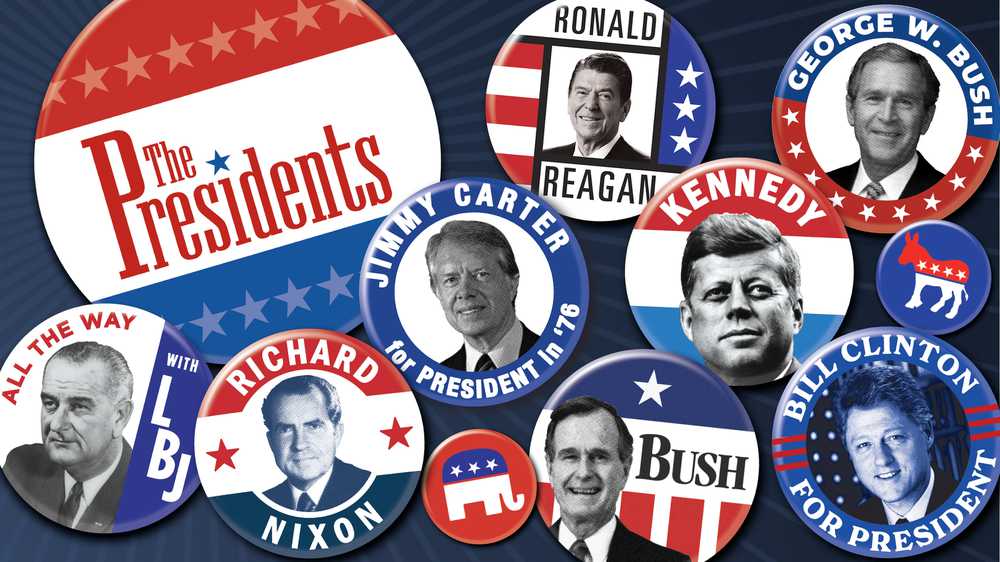
The Presidents Connect today's election issues with the past


Chapter:

The First Campaign (6:03)
Incumbent California governor Pat Brown underestimates his opponent Ronald Reagan's appeal. Reagan cultivates a heroic cowboy image.
FDR
Truman
LBJ
Nixon
Carter

Now
Playing

Reagan
G H W Bush

Related Clips


REAGAN, Chapter 16

The Nuclear Freeze Movement (7:07)
Demonstrators, including Reagan's daughter, protest his plan to increase nuclear weapons.
Watch Now

REAGAN, Chapter 2

The Lifeguard (11:21)
Ronald Reagan grows up in a small town and works as a lifeguard on the Rock River.
Watch Now

LBJ, Chapter 12

Gulf of Tonkin (9:11)
Johnson claims that North Vietnam has attacked a U.S. destroyer. He uses the incident as the basis for expanding the war against North Vietnam.
Watch Now

LBJ, Chapter 5

In the Senate (9:00)
Johnson becomes a power broker, developing a bargaining style known as "the Johnson treatment."
Watch Now

NIXON, Chapter 5

The Pink Lady (3:52)
Implying that his opponent Helen Gahagan Douglas is a Communist, Nixon wins a seat in the Senate in 1950.
Watch Now

CARTER, Chapter 5

Politics and Integrity (8:19)
Carter challenges election fraud and wins a seat in the state senate. He becomes known for his integrity. In 1966 he narrowly loses the governor's race to a segregationist.
Watch Now

Chapter 1

Introduction (5:50)
Part one of a biography of Ronald Reagan, the 40th president.
Watch Now

Chapter 2

The Lifeguard (11:21)
Ronald Reagan grows up in a small town and works as a lifeguard on the Rock River.
Watch Now

Chapter 3

Actor (8:39)
Starting out in radio and sportscasting, Reagan moves to California to pursue an acting career.
Watch Now

Chapter 4

Communists in Hollywood (9:43)
Reagan, an active anti-Communist, ends his first marriage. He meets and marries actress Nancy Davis.
Watch Now

Chapter 5

Political Apprenticeship (9:26)
Reagan hones his speaking skills as a television host and spokesman for General Electric. He becomes known for his conservative views.
Watch Now

Chapter 6

The First Campaign (6:03)
Incumbent California governor Pat Brown underestimates his opponent Ronald Reagan's appeal. Reagan cultivates a heroic cowboy image.
Watch Now

Chapter 7

Governor and National Figure (12:37)
Reagan gains political confidence in two terms as governor of California.
Watch Now

Chapter 8

A Surprising Presidential Bid (7:56)
Ronald Reagan campaigns for but loses the Republican nomination for president in 1976.
Watch Now

Chapter 9

Landslide Victory (7:34)
Ronald Reagan defeats incumbent Jimmy Carter and is elected president in 1980.
Watch Now

Chapter 10

A Plan for Economic Recovery (10:13)
Reagan works to pass his economic package.
Watch Now

Chapter 11

Assassination Attempt (10:54)
Reagan is seriously wounded in an assassination attempt. Congress enacts his conservative economic agenda.
Watch Now

Chapter 12

Reaganomics (11:17)
Dramatic rises in unemployment, inflation, and homelessness signal the failure of Reagan's economic program.
Watch Now

Chapter 13

CreditsProduction credits for part one of the television program.
Watch Now

Chapter 14

Introduction (2:26)
Part two of a biography of Ronald Reagan, the 40th president.
Watch Now

Chapter 15

Battle on Two Fronts (11:53)
As the recession deepens, Reagan dramatically increases military spending in his crusade against Communism.
Watch Now

Chapter 16

The Nuclear Freeze Movement (7:07)
Demonstrators, including Reagan's daughter, protest his plan to increase nuclear weapons.
Watch Now

Chapter 17

The Strategic Defense Initiative (8:03)
Reagan promotes his plan for a missile defense system.
Watch Now

Chapter 18

Peace Through Strength (6:26)
Reagan broadly states his anti-Soviet "crusade for freedom," but works quietly with the Soviets on human rights issues.
Watch Now

Chapter 19

Missile Deployment in Europe (12:02)
In a controversial speech, Reagan calls the Soviet Union an "evil empire." Some fear the arms race will end in nuclear Armageddon.
Watch Now

Chapter 20

Morning in America (9:11)
America's economy has improved and national confidence is renewed. Reagan wins a second term in a landslide.
Watch Now

Chapter 21

Transitions (10:40)
Reagan loses his oldest advisers. Mikhail Gorbachev becomes the new Soviet leader, and Reagan embarks on a fateful secret course with Iran.
Watch Now

Chapter 22

Personal Diplomacy (10:55)
Reagan and Gorbachev summit in Geneva. Reagan refuses to make concessions on SDI.
Watch Now

Chapter 23

Reagan's Changing Role (5:37)
Despite successes both symbolic and real, Reagan becomes less engaged as president.
Watch Now

Chapter 24

Summit at Reykjavik (10:44)
Reagan and Gorbachev reach for the abolition of nuclear weapons. Though their talks fail, they are a breakthrough.
Watch Now

Chapter 25

The Iran-Contra Crisis (14:11)
The government's secret arms-for-hostages dealings with Iran are uncovered. Reagan learns that his staff has diverted profits to support the anti-Communist Contras in Nicaragua.
Watch Now

Chapter 26

Highs and Lows (11:50)
Americans forgive Reagan for Iran-Contra. The stock market crashes, the gap between rich and poor grows and the AIDS epidemic hits. The U.S. and U.S.S.R. sign a historic weapons treaty.
Watch Now

Chapter 27

The End of the Cold War (10:32)
After his lifelong crusade, Reagan witnesses Communism's demise in Eastern Europe, Afghanistan, Nicaragua and the Soviet Union.
Watch Now

Chapter 28

Into the Sunset (6:28)
Ronald Reagan retires to his California ranch. He will be diagnosed with Alzheimer's disease.
Watch Now

Chapter 29

CreditsProduction credits for part two of the television program.
Watch Now

  • REAGAN: Chapter 1
  • REAGAN: Chapter 2
  • REAGAN: Chapter 3
  • REAGAN: Chapter 4
  • REAGAN: Chapter 5
  • REAGAN: Chapter 6
  • REAGAN: Chapter 7
  • REAGAN: Chapter 8
  • REAGAN: Chapter 9
  • REAGAN: Chapter 10
  • REAGAN: Chapter 11
  • REAGAN: Chapter 12
  • REAGAN: Chapter 13
  • REAGAN: Chapter 14
  • REAGAN: Chapter 15
  • REAGAN: Chapter 16
  • REAGAN: Chapter 17
  • REAGAN: Chapter 18
  • REAGAN: Chapter 19
  • REAGAN: Chapter 20
  • REAGAN: Chapter 21
  • REAGAN: Chapter 22
  • REAGAN: Chapter 23
  • REAGAN: Chapter 24
  • REAGAN: Chapter 25
  • REAGAN: Chapter 26
  • REAGAN: Chapter 27
  • REAGAN: Chapter 28
  • REAGAN: Chapter 29
Choose a format

Choose a Video Format

Quicktime | Windows Media

Download a free player
QuickTime | Windows Media

Related Links


REAGAN
Learn more about Ronald Reagan.

The Nation of Islam and Malcolm X
A controversial man and his message to black Americans.

The American West
Explore stories of American frontiers and legends.

Purchase Videos & DVDs

• See Comments

Loading comments...

You must log in to submit a comment. If you don't have an account at American Experience, you will need to register to comment. It's fast and easy to do!

Post a Comment (Limit 5000 Characters)

• View Transcripts •


Transcript: Chapter 06

Reagan: I've come to a decision that even a short time ago I would have thought impossible for me to make. And yet I make it with no lingering doubts or hesitation. As of now I am a candidate seeking the Republican nomination for governor.

Dallek: California in the 1960s is a society that is going through tumultuous change. He runs in 1966, as a staunch Goldwater conservative who will restore to the people their autonomy and freedom from government. And it strikes resonant chords with millions of people in California who were bothered by the welfare system, bothered by the high taxes, bothered by the radicalism of the students, bothered by the crime in the streets, bothered by the inner city explosions. And on all those counts, he was very effective and appealing to the mass of suburban voters in California.

Narrator: Democratic Governor Pat Brown underestimated Reagan and the revolt brewing in his state.

Brown: What have my opponent's contributions been to this growing, thriving state of ours. He's divided his time between propaganda pictures against everything from Medicare to the Tennessee Valley Authority and starring in such unforgettable screen epics as Bedtime for Bonzo.

Lyn Nofziger, Press Secretary: They looked at Ronald Reagan, that dumb actor and they said, oh man, this is the guy we want to run against. He has no political experience, he's not going to be able to handle himself well.

Stu Spencer: So we devised a technique where he would give his twenty-minute speech and incidentally Ronald Reagan wrote all his own speeches when he ran for governor in 1966. He'd give the twenty-minute speech and we'd open it to twenty minutes of Q and A for the people there at the meeting or the press, and if he could handle those questions we felt we could get over the hump of here's an empty person who doesn't know anything about government or doesn't have any real ideas.

Reporter: Ronnie, where do you stand on the death penalty?

Reagan: You just expressed a question which is also as much on the minds of the people in the state as Berkeley. This too is a question asked all over the state. And as I've answered to those other people, I would tell you I think all of us have wavered back and forth on this issue because of our Judeo-Christian background our questioning as to our right to take human life. But I believe we have the right to take human life in defense of our own.

Reporter: Do you discount the fact that many women may be influenced by the fact that you are a movie star, you're handsome and young and that sort of thing?

Reagan: Well now, you can't have it both ways. Some of the people on the other side have been suggesting before I became a candidate that I wasn't very acceptable as a movie star. So, no, I do believe that the people are aware of the issues.

Lou Cannon, Journalist: Here Reagan is. He's answering questions. And I came back and I called my editor and he said, what did you think of him. And, I said, I don't know. I said, I don't know why these, why anybody would want to run against this guy. Why would you want to run against somebody who everybody knows and likes and who is friendly and popular?

Narrator: As Reagan gained exposure, his aides began to shape his image.

Nofziger: A political reporter for KPIX in San Francisco said I want to do an interview with Reagan on horseback. And, I said that's a great idea; that really humanizes him. And he had a ranch out in Malibu Canyon -- about 25 miles from downtown Los Angeles. So, we went out there and he came out wearing jodhpurs. And I said, what in the hell are you doing in those jodhpurs. Well, he said, that's how I always ride around here, very huffily. And I said, Ron, we're trying to win an election here, you know. People in California, as they see you in those jodhpurs are going to think you're an Eastern sissy. He says well, this is what you wear when you're jumping horses. I said, we're not jumping horses, we're going for a ride. She wants you to be a cowboy. I want you to be a cowboy because that's what the people here will identify with. So, he said, well all right. So, he went back in and changed into jeans and boots.

Narrator: Reagan would come to embody the great myth of the American west -- the independent cowboy standing tall.

Dallek: It fits into the whole image of him as a kind of tough minded heroic figure someone who is coming to their rescue. And they see him as an honest man, they see him as an honest politician, as someone who speaks his mind.

Reagan: This small minority of beatniks and malcontents and filthy speech advocates have interfered with the primary purpose of that university, and they've brought shame on a great university, a university of which you and I have a right to be very proud and which for many years we have been very proud. The people of this state are entitled to an open hearing to reveal what has been taking place and to fix responsibility.

Smith: There was a sense that traditional values, traditional institutions were being challenged and so, people took a chance and they voted on a Hollywood movie actor against an established and relatively popular incumbent governor.

back to top


Major funding provided by the National
Endowment for the Humanities and the Corporation for Public Broadcasting

NEH Corporation for Public Broadcasting


Any views, findings, conclusions, or recommendations expressed in this Web site do not necessarily represent those of the National Endowment for the Humanities.