Visit Your Local PBS Station PBS Home PBS Home Programs A-Z TV Schedules Watch Video Support PBS Shop PBS Search PBS
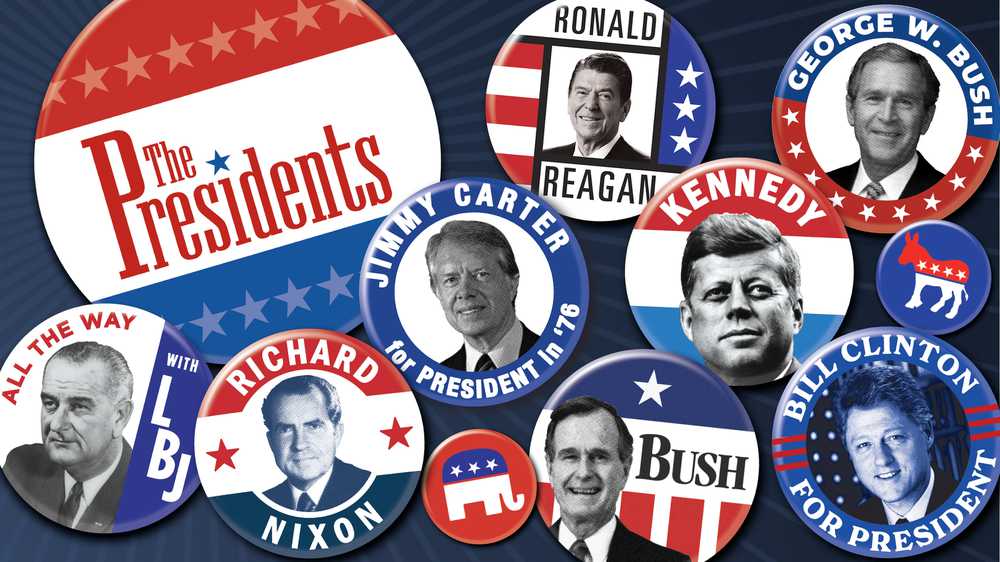
The Presidents Connect today's election issues with the past


Chapter:

Governor and National Figure (12:37)
Reagan gains political confidence in two terms as governor of California.
FDR
Truman
LBJ
Nixon
Carter

Now
Playing

Reagan
G H W Bush

Related Clips


REAGAN, Chapter 17

The Strategic Defense Initiative (8:03)
Reagan promotes his plan for a missile defense system.
Watch Now

FDR, Chapter 16

Above All, Try Something (13:43)
Roosevelt uses experimental Federal policies to try to end the Depression. Eleanor advocates for the needy, redefining the role of First Lady.
Watch Now

TRUMAN, Chapter 19

The Post War Economy (10:59)
Truman faces domestic challenges. He takes a tough stance against striking railroad workers.
Watch Now

LBJ, Chapter 24

The Tet Offensive (10:11)
The North Vietnamese bombing of South Vietnam over the Tet holiday becomes a turning point in the war.
Watch Now

NIXON, Chapter 10

Triumph (15:19)
Nixon works as a Wall Street lawyer but keeps active in politics. In a remarkable comeback, he wins the presidency in 1968.
Watch Now

Chapter 1

Introduction (5:50)
Part one of a biography of Ronald Reagan, the 40th president.
Watch Now

Chapter 2

The Lifeguard (11:21)
Ronald Reagan grows up in a small town and works as a lifeguard on the Rock River.
Watch Now

Chapter 3

Actor (8:39)
Starting out in radio and sportscasting, Reagan moves to California to pursue an acting career.
Watch Now

Chapter 4

Communists in Hollywood (9:43)
Reagan, an active anti-Communist, ends his first marriage. He meets and marries actress Nancy Davis.
Watch Now

Chapter 5

Political Apprenticeship (9:26)
Reagan hones his speaking skills as a television host and spokesman for General Electric. He becomes known for his conservative views.
Watch Now

Chapter 6

The First Campaign (6:03)
Incumbent California governor Pat Brown underestimates his opponent Ronald Reagan's appeal. Reagan cultivates a heroic cowboy image.
Watch Now

Chapter 7

Governor and National Figure (12:37)
Reagan gains political confidence in two terms as governor of California.
Watch Now

Chapter 8

A Surprising Presidential Bid (7:56)
Ronald Reagan campaigns for but loses the Republican nomination for president in 1976.
Watch Now

Chapter 9

Landslide Victory (7:34)
Ronald Reagan defeats incumbent Jimmy Carter and is elected president in 1980.
Watch Now

Chapter 10

A Plan for Economic Recovery (10:13)
Reagan works to pass his economic package.
Watch Now

Chapter 11

Assassination Attempt (10:54)
Reagan is seriously wounded in an assassination attempt. Congress enacts his conservative economic agenda.
Watch Now

Chapter 12

Reaganomics (11:17)
Dramatic rises in unemployment, inflation, and homelessness signal the failure of Reagan's economic program.
Watch Now

Chapter 13

CreditsProduction credits for part one of the television program.
Watch Now

Chapter 14

Introduction (2:26)
Part two of a biography of Ronald Reagan, the 40th president.
Watch Now

Chapter 15

Battle on Two Fronts (11:53)
As the recession deepens, Reagan dramatically increases military spending in his crusade against Communism.
Watch Now

Chapter 16

The Nuclear Freeze Movement (7:07)
Demonstrators, including Reagan's daughter, protest his plan to increase nuclear weapons.
Watch Now

Chapter 17

The Strategic Defense Initiative (8:03)
Reagan promotes his plan for a missile defense system.
Watch Now

Chapter 18

Peace Through Strength (6:26)
Reagan broadly states his anti-Soviet "crusade for freedom," but works quietly with the Soviets on human rights issues.
Watch Now

Chapter 19

Missile Deployment in Europe (12:02)
In a controversial speech, Reagan calls the Soviet Union an "evil empire." Some fear the arms race will end in nuclear Armageddon.
Watch Now

Chapter 20

Morning in America (9:11)
America's economy has improved and national confidence is renewed. Reagan wins a second term in a landslide.
Watch Now

Chapter 21

Transitions (10:40)
Reagan loses his oldest advisers. Mikhail Gorbachev becomes the new Soviet leader, and Reagan embarks on a fateful secret course with Iran.
Watch Now

Chapter 22

Personal Diplomacy (10:55)
Reagan and Gorbachev summit in Geneva. Reagan refuses to make concessions on SDI.
Watch Now

Chapter 23

Reagan's Changing Role (5:37)
Despite successes both symbolic and real, Reagan becomes less engaged as president.
Watch Now

Chapter 24

Summit at Reykjavik (10:44)
Reagan and Gorbachev reach for the abolition of nuclear weapons. Though their talks fail, they are a breakthrough.
Watch Now

Chapter 25

The Iran-Contra Crisis (14:11)
The government's secret arms-for-hostages dealings with Iran are uncovered. Reagan learns that his staff has diverted profits to support the anti-Communist Contras in Nicaragua.
Watch Now

Chapter 26

Highs and Lows (11:50)
Americans forgive Reagan for Iran-Contra. The stock market crashes, the gap between rich and poor grows and the AIDS epidemic hits. The U.S. and U.S.S.R. sign a historic weapons treaty.
Watch Now

Chapter 27

The End of the Cold War (10:32)
After his lifelong crusade, Reagan witnesses Communism's demise in Eastern Europe, Afghanistan, Nicaragua and the Soviet Union.
Watch Now

Chapter 28

Into the Sunset (6:28)
Ronald Reagan retires to his California ranch. He will be diagnosed with Alzheimer's disease.
Watch Now

Chapter 29

CreditsProduction credits for part two of the television program.
Watch Now

Related Links


REAGAN
Learn more about Ronald Reagan.

Vietnam Online
The costs and consequences of a controversial war.

Guerrilla: The Taking of Patty Hearst
In 1974, a militant, fringe political group kidnapped a teenage heiress in California.

Purchase Videos & DVDs

• See Comments

Loading comments...

You must log in to submit a comment. If you don't have an account at American Experience, you will need to register to comment. It's fast and easy to do!

Post a Comment (Limit 5000 Characters)

• View Transcripts •


Transcript: Chapter 07

Narrator: On January 2, 1967, Ronald Reagan took the oath of office as governor of the State of California. He had not only beaten Brown. He had beaten him by one million votes.

Reagan: I do.

Judge: That you take this obligation freely, without mental reservation or purpose of evasion and that you will well and faithfully discharge...

Patti Davis: I was hysterical when I found out that my father had been elected Governor. The Vietnam war was going on. Berkeley was going on. The, you know, the one place I wanted to be if I hadn't been 14 years old and at a boarding school in Arizona was on the streets of Haight-Ashbury, braiding flowers into my hair. I mean, this was my goal in life. And now my Gover-, my father was Governor of California. So this was, this was, I just didn't think it was a good image for me, you know?

Narrator: Patti was not the only Reagan facing an image problem. Her mother drew the attention of the press when she refused to live in the governor's Victorian mansion -- an historic landmark.

Nancy Reagan: I have to translate everything into being the mother of an eight year old. You are right on a busy corner. I love old houses I'll start with that. And I love old things and I love tradition. I don't think there has ever been a governor with an eight-year-old child before.

Narrator: Nancy moved her family to an exclusive Sacramento suburb becoming the target of criticism. She was devastated when writer Joan Didion called her actress smile "a study in frozen insincerity." The governor too raised a few eyebrows with his talk about biblical prophecy.

The Reverend Billy Graham had stirred Reagan's interest when he told him that judgment day was near. Reagan would repeat Graham's warning adding: "for the first time ever everything is in place for the battle of Armageddon." One sign was what he called "the Communist takeover of Libya."

With no experience, Reagan faced the task of running the State of California. When a reporter asked what kind of a governor he would make, he quipped, "I don't know. I never played governor."

Cannon: He faced an enormous challenge, because Reagan really didn't know anything about politics or governments and, and he had a lot of people around him who arguably knew even less. I mean, I remember Lyn Nofziger once said, you know, we weren't just amateurs. We were novice amateurs.

Narrator: Reagan's first decision, designed to reduce the size of government proved a disaster.

William Hauck, Speaker's Staff, California Legislature: He decides that in his naiveté; about running state government that you could just do a 10 percent across-the-board cut, and that would be easy to accomplish. Well, he found out that it was not easy to accomplish and that it probably wasn't equitable.

Narrator: Announced at a time of growing campus unrest, the cuts pitted the governor against students at the University of California. They would be required to pay tuition for the first time.

Reagan: "I'm going get out. I don't care. Let's go outside. Okay. Now."

Narrator: After years of playing the hero, Reagan found himself cast as the villain.

Nofziger: We were down at the University of California campus in Santa Barbara and all of the students were all mad at him. We'd come back from lunch, to go back to where they were having the meeting and the students just kind of lined up along the pathway and they all gave him the silent treatment, you know, and nobody said hello, nobody waved, nobody did anything. They just stood and stared at him. So, he walked through this gauntlet of people, very nonchalantly, got up to the doorway where we're going, turned around and he said, Shhh -- everybody broke out laughing and he walked on in.

Narrator: Reagan struck a chord with Americans nationwide who were becoming fed up with the radical '60s.

Man: When I saw him make a speech in 1964 for Goldwater, I said there's the man that should be running for president and there's the man we need for president.

Woman: I like the way he takes a firm stand on things and the way he goes about them.

Man: I think his views agree with mine.

Woman: He has the same type of feeling with the people that John Kennedy had, I think.

Man: He's the hope of America.

Archive Reagan draft montage song: "Ronald Reagan he is the one. He is the one to beat. He's the leader of the GOP... "

Narrator: A Reagan draft initiative caught fire. When the Republicans gathered in Miami in 1968, Reagan, after only eighteen months in elected office, was the choice for president among conservatives. By then, former Vice President Richard Nixon had a lock on the nomination.

Reagan: I hereby proudly move on behalf of my fellow Californians that this convention declare itself as unanimously and united behind the candidate Richard Nixon as the next president of the United States, and I so move.

Nofziger: Reagan was not upset. He told me "Lyn, I just didn't think I was ready for it." So, you know, he knew it himself very well and he'd obviously, he'd have taken it if there been this great demand for him but, but he knew that he would be better off waiting.

Narrator: Reagan returned to California to face the first true crisis of his governorship. The student revolt which had begun in 1964 reached its climax at Berkeley in the spring of 1969. The university was paralyzed by a student strike, which was joined by members of the Black Panther Party and even some professors.

Morris: There was a spellbinding moment when he was governor confronting a bunch of Berkeley University profs. He suddenly recognizes in their midst a radical from his Hollywood days, his name was I think Popski.

And he said, "You, Popski, I know you and I know what you stand for." Lost his cool. There was a direct connection there, the anarchy that prevailed on the Berkeley campus in 1969 with the anarchy that he saw immediately after World War II outside the gates of Warner Brothers.

Narrator: When the police failed to break the strike, Reagan sent in the California Highway Patrol. That only heightened tensions.

Reagan: I believe that where any group's rights are being imposed upon, or any individual's rights, by any others, it is the obligation of government to protect those constitutional rights at the point of bayonet if necessary.

Narrator: The National Guard descended on Berkeley replete with bayonets. It occupied the city for seventeen days. Most Californians regarded Reagan as a hero for restoring the peace at Berkeley. Others felt he had acted as a trigger happy extremist.

The following year Reagan ran for re-election with little to show for his first term. He had promised to lower taxes but they had increased. And he had failed to curb the growth of government.

Reagan: Some of the things they've said about me and education, this may get you expelled.

Narrator: Reagan won in November and launched a new initiative to cut back government spending.

Reagan: Welfare is the biggest single outlay of public funds at three different levels of government: federal, state and county. And welfare is adrift without rudder or compass.

Narrator: In his first term Reagan had governed through confrontation. Now he needed to collaborate with the Democratic controlled assembly if he wanted his welfare bill to pass.

Hauck: Reagan was beginning to think about his own legacy. He was beginning to think about the accomplishments that he would be looked back on when he left the governorship, and I'm sure that people would argue that Reagan was also beginning to build or try to build a record, to run for president for a second time.

Narrator: The bill passed. Reagan saved taxpayers two billion dollars and learned an important lesson.

Michael K. Deaver, Aide to Governor Reagan: He proved to himself that he could make some changes that he could not only talk about and move people to get things done but he could actually move the mechanics of government to get things done and I think that confidence that it gave Reagan was more important than most people realize.

Edwin Meese, Chief of Staff to Governor Reagan: And so when he left with a kind of a groundswell of approval in the state, and a great deal of interest throughout the country among many people that he go on, and perhaps run for the presidency in the future.

Reagan: Now, wait a minute, wait a minute, hold it. You are all asking the same question and you are all going to get the same answer. So we might as well do it once. No, I've made no change whatsoever. I've said repeatedly, and I repeat again. I have a decision to make. I don't know what that decision will be. When the time comes I will announce it. Yes or no. And I assume that that will be sometime before the end of this year.

Maureen Reagan: That summer, I had everybody over to my house for dinner and we were playing charades and uhm ... I've forgotten exactly how it happened but I guess it was a book title and my father was the one doing it and he ... and finally he just stood there and just went like this. You know like it's me and we all screamed "Making of a President."

back to top


Major funding provided by the National
Endowment for the Humanities and the Corporation for Public Broadcasting

NEH Corporation for Public Broadcasting


Any views, findings, conclusions, or recommendations expressed in this Web site do not necessarily represent those of the National Endowment for the Humanities.