Visit Your Local PBS Station PBS Home PBS Home Programs A-Z TV Schedules Watch Video Support PBS Shop PBS Search PBS
 
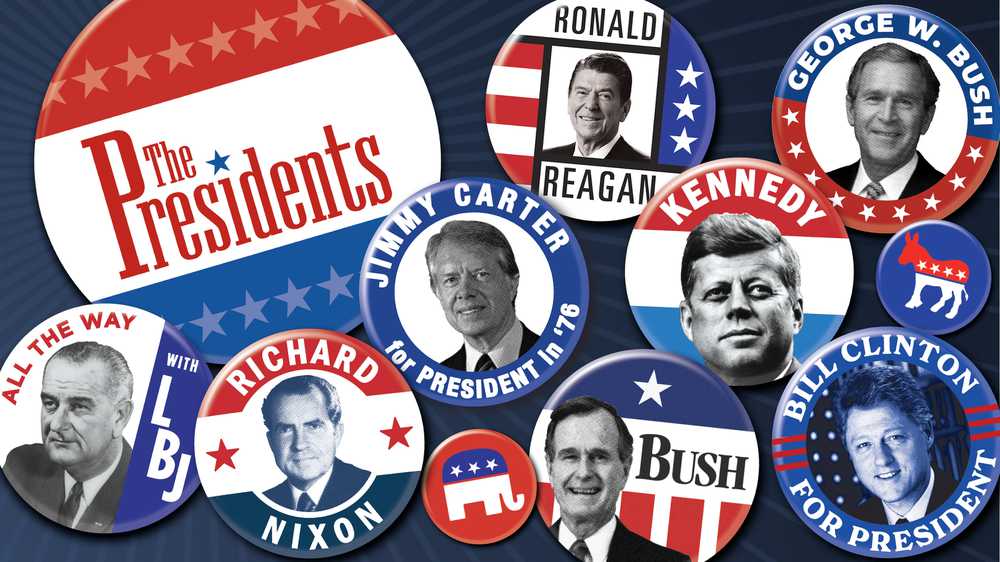
The Presidents Connect today's election issues with the past


Chapter:

Battle on Two Fronts (11:53)
As the recession deepens, Reagan dramatically increases military spending in his crusade against Communism.
FDR
Truman
LBJ
Nixon
Carter

Now
Playing

Reagan
G H W Bush

Related Clips


REAGAN, Chapter 5

Political Apprenticeship (9:26)
Reagan hones his speaking skills as a television host and spokesman for General Electric. He becomes known for his conservative views.
Watch Now

TRUMAN, Chapter 29

Under Pressure (6:22)
Truman persists with a "limited war." Pressure on him grows intense as casualties mount and U.S. troops are repelled by Chinese forces.
Watch Now

FDR, Chapter 25

Coming to an End (10:48)
Lonely and unwell, Roosevelt seeks out an old flame. After his reelection, he meets Stalin and Churchill at Yalta to discuss the postwar world.
Watch Now

LBJ, Chapter 22

A Miasma of Trouble (15:14)
Johnson struggles to keep his dream of the Great Society alive while the country spins out of control.
Watch Now

NIXON, Chapter 15

To the Summit (7:44)
Nixon achieves foreign policy successes in China and the Soviet Union. Burglars working for Nixon's re-election committee break into the Watergate offices of the Democratic National Committee.
Watch Now

LBJ, Chapter 10

Prelude to War (6:48)
Following Robert McNamara's advice, Johnson okays covert commando attacks against North Vietnam to stop Communism.
Watch Now

Chapter 1

Introduction (5:50)
Part one of a biography of Ronald Reagan, the 40th president.
Watch Now

Chapter 2

The Lifeguard (11:21)
Ronald Reagan grows up in a small town and works as a lifeguard on the Rock River.
Watch Now

Chapter 3

Actor (8:39)
Starting out in radio and sportscasting, Reagan moves to California to pursue an acting career.
Watch Now

Chapter 4

Communists in Hollywood (9:43)
Reagan, an active anti-Communist, ends his first marriage. He meets and marries actress Nancy Davis.
Watch Now

Chapter 5

Political Apprenticeship (9:26)
Reagan hones his speaking skills as a television host and spokesman for General Electric. He becomes known for his conservative views.
Watch Now

Chapter 6

The First Campaign (6:03)
Incumbent California governor Pat Brown underestimates his opponent Ronald Reagan's appeal. Reagan cultivates a heroic cowboy image.
Watch Now

Chapter 7

Governor and National Figure (12:37)
Reagan gains political confidence in two terms as governor of California.
Watch Now

Chapter 8

A Surprising Presidential Bid (7:56)
Ronald Reagan campaigns for but loses the Republican nomination for president in 1976.
Watch Now

Chapter 9

Landslide Victory (7:34)
Ronald Reagan defeats incumbent Jimmy Carter and is elected president in 1980.
Watch Now

Chapter 10

A Plan for Economic Recovery (10:13)
Reagan works to pass his economic package.
Watch Now

Chapter 11

Assassination Attempt (10:54)
Reagan is seriously wounded in an assassination attempt. Congress enacts his conservative economic agenda.
Watch Now

Chapter 12

Reaganomics (11:17)
Dramatic rises in unemployment, inflation, and homelessness signal the failure of Reagan's economic program.
Watch Now

Chapter 13

CreditsProduction credits for part one of the television program.
Watch Now

Chapter 14

Introduction (2:26)
Part two of a biography of Ronald Reagan, the 40th president.
Watch Now

Chapter 15

Battle on Two Fronts (11:53)
As the recession deepens, Reagan dramatically increases military spending in his crusade against Communism.
Watch Now

Chapter 16

The Nuclear Freeze Movement (7:07)
Demonstrators, including Reagan's daughter, protest his plan to increase nuclear weapons.
Watch Now

Chapter 17

The Strategic Defense Initiative (8:03)
Reagan promotes his plan for a missile defense system.
Watch Now

Chapter 18

Peace Through Strength (6:26)
Reagan broadly states his anti-Soviet "crusade for freedom," but works quietly with the Soviets on human rights issues.
Watch Now

Chapter 19

Missile Deployment in Europe (12:02)
In a controversial speech, Reagan calls the Soviet Union an "evil empire." Some fear the arms race will end in nuclear Armageddon.
Watch Now

Chapter 20

Morning in America (9:11)
America's economy has improved and national confidence is renewed. Reagan wins a second term in a landslide.
Watch Now

Chapter 21

Transitions (10:40)
Reagan loses his oldest advisers. Mikhail Gorbachev becomes the new Soviet leader, and Reagan embarks on a fateful secret course with Iran.
Watch Now

Chapter 22

Personal Diplomacy (10:55)
Reagan and Gorbachev summit in Geneva. Reagan refuses to make concessions on SDI.
Watch Now

Chapter 23

Reagan's Changing Role (5:37)
Despite successes both symbolic and real, Reagan becomes less engaged as president.
Watch Now

Chapter 24

Summit at Reykjavik (10:44)
Reagan and Gorbachev reach for the abolition of nuclear weapons. Though their talks fail, they are a breakthrough.
Watch Now

Chapter 25

The Iran-Contra Crisis (14:11)
The government's secret arms-for-hostages dealings with Iran are uncovered. Reagan learns that his staff has diverted profits to support the anti-Communist Contras in Nicaragua.
Watch Now

Chapter 26

Highs and Lows (11:50)
Americans forgive Reagan for Iran-Contra. The stock market crashes, the gap between rich and poor grows and the AIDS epidemic hits. The U.S. and U.S.S.R. sign a historic weapons treaty.
Watch Now

Chapter 27

The End of the Cold War (10:32)
After his lifelong crusade, Reagan witnesses Communism's demise in Eastern Europe, Afghanistan, Nicaragua and the Soviet Union.
Watch Now

Chapter 28

Into the Sunset (6:28)
Ronald Reagan retires to his California ranch. He will be diagnosed with Alzheimer's disease.
Watch Now

Chapter 29

CreditsProduction credits for part two of the television program.
Watch Now

  • REAGAN: Chapter 1
  • REAGAN: Chapter 2
  • REAGAN: Chapter 3
  • REAGAN: Chapter 4
  • REAGAN: Chapter 5
  • REAGAN: Chapter 6
  • REAGAN: Chapter 7
  • REAGAN: Chapter 8
  • REAGAN: Chapter 9
  • REAGAN: Chapter 10
  • REAGAN: Chapter 11
  • REAGAN: Chapter 12
  • REAGAN: Chapter 13
  • REAGAN: Chapter 14
  • REAGAN: Chapter 15
  • REAGAN: Chapter 16
  • REAGAN: Chapter 17
  • REAGAN: Chapter 18
  • REAGAN: Chapter 19
  • REAGAN: Chapter 20
  • REAGAN: Chapter 21
  • REAGAN: Chapter 22
  • REAGAN: Chapter 23
  • REAGAN: Chapter 24
  • REAGAN: Chapter 25
  • REAGAN: Chapter 26
  • REAGAN: Chapter 27
  • REAGAN: Chapter 28
  • REAGAN: Chapter 29
Choose a format

Choose a Video Format

Quicktime | Windows Media

Download a free player
QuickTime | Windows Media

Related Links


REAGAN
Learn more about Ronald Reagan.

John Kennedy and Foreign Policy
Explore the history of anti-Communist foreign policy.

Fidel Castro and the Cold War
Trace the Cold War from 1961 to its end.

Purchase Videos & DVDs

• See Comments

Loading comments...

You must log in to submit a comment. If you don't have an account at American Experience, you will need to register to comment. It's fast and easy to do!

Post a Comment (Limit 5000 Characters)

• View Transcripts •


Transcript: Chapter 15

Title Card: REAGAN Part Two: An American Crusade

Narrator: Ronald Reagan had been optimistic in 1980 that he could revitalize the economy and restore national confidence.

Reagan: I am not frightened by what lies ahead and I don't believe the American people are frightened by what lies ahead.

Narrator: Two years later Reagan realized many Americans were frightened. They had lived through a recession for more than a year.

Voice: They tell you we got hundreds of people laid off, and we're not taking applications. That's scary, too, because ...

Second Voice: We got people in the shop that voted for him, and they think it's the biggest mistake they ever made.

Man: Reagonomics is right on, but, look at me, I used to work for these people, and now I've got to stand in line to get a box of cheese.

Narrator: His blue collar supporters were defecting. There might not be a second term. Reagan's defense buildup had triggered protests at home by those who feared his finger on the nuclear trigger and demonstrations in Europe that threatened the NATO alliance. If Reagan's presidency failed, his personal crusade against Communism and the Soviet Union would fail with it -- the passions that had consumed him since 1946 when he battled Communists in Hollywood and an anonymous caller threatened to disfigure his face, the passions that animated his presidency from the very start, 35 years later.

Reagan: I know of no leader of the Soviet Union since the revolution, including the present leadership, that has not more than once repeated in the various Communist congresses they hold their determination that their goal must be the promotion of world revolution and a one world socialist or communist state. Now as long as they reserve unto themselves the right to commit any crime, to lie, to cheat, in order to attain that, I think when you do business with them, even at a détente, you keep that in mind.

Narrator: Reagan rejected détente, the efforts of three presidents in the 1970s to lessen the tensions of the nuclear age through treaties. Treaties that allowed each side to build thousands more strategic nuclear warheads. He saw the Soviets projecting their power in Afghanistan, Africa and Central America -- filling the void when America's resolve weakened after the failure in Vietnam. He decided to confront them.

Edmund Morris, Official Biographer: He was not afraid of this monolith. I think he felt that Jimmy Carter was afraid and that Gerald Ford was, and who knows else. Reagan was never afraid of the Soviet Union and he hated it very much. It's about the only powerful negative emotion he's had in his life was that animus against this totalitarian system.

Narrator: Within days of saying the Soviets lied and cheated, Reagan greeted their ambassador Anatoli Dobrynin. The "truth is, he and his wife are most likable," Reagan wrote, "and very much in love ... after forty years of marriage. ... You wonder how they can stick with the Soviet system."

Reagan approved an across the board military buildup, the most massive in peacetime history. He told his secretary of defense to order what was needed and not to worry about the budget. Pentagon spending would reach $34 million per hour.

From a position of strength, Reagan said, he would negotiate arms reductions. He would build up to build down. That was the stated goal. The unstated goal was more ambitious.

Richard Allen, National Security Adviser: He did not want an arms race, but if there was to be an arms race, we were not going to lose it. And that was the message he wanted to convey to the Soviets, namely that we would be willing to spend them into oblivion. And it would be done peacefully, although the major expression of this spending race, so to speak, would be military.

Morris: He had this overriding conviction that a strong military face presented by the United States for a year or two would bring this hostile system to its knees.

Narrator: In his campaign Reagan had told reporters the Soviet economy could not sustain an arms race. William Casey, his new CIA director, confirmed this.

Herb Meyer, Special Assistant to CIA Director: What we realized is that the CIA was monitoring Soviet strengths. It was not looking at Soviet weaknesses. And we felt that there were weaknesses. Now you can simultaneously be strengthening your armor and also dying of cancer. And we started to look at that. The result is we came up with a very different perception of the Soviet Union than the conventional wisdom subscribed to.

Narrator: Reagan and Casey decided to push the Soviet Union to the point of collapse.

Meyer: It's very dangerous. And there were a lot of people who said, oh dear, you're right, the bear is wounded, don't poke sticks at a wounded bear. Ah, the Casey and Reagan approach was hey, my enemy is on his knees, it's a good time to break his head. It's a very gutsy decision.

They decided, not just those two, but among others, that they wanted to win the Cold War. And their definition of winning the Cold War was that the Soviet state would cease to exist.

Polish Workers: "Democratzia"

Narrator: In 1981, Reagan saw a chance to strike at the heart of the Soviet empire. The Polish workers movement, Solidarity, marched for democratic freedoms. When the government declared martial law, Reagan was determined to keep Solidarity alive.

He met Pope John Paul II a few months later in June 1982. Like Reagan the Polish Pope had also survived an assassin's bullets in 1981. He too believed God had spared him for a special mission.

The pope would turn the Catholic Church in Poland into an underground Solidarity network. Reagan imposed economic sanctions and committed the CIA to undermine the government and keep Solidarity alive. If Poland were freed, they felt all Eastern Europe would follow.

Other covert actions were less peaceful. In Afghanistan Reagan continued President Carter's policy of backing the factions fighting a Soviet invasion. In Central America, the CIA began to train forces to harass the Sandinistas, the Soviet backed government in Nicaragua. The "Contras" became one of Reagan's favorite causes.

Reagan: They are the moral equal of our Founding Fathers and the brave men and women of the French resistance. We cannot turn away from them. (applause) All they need is proof that we care as much about the fight for freedom 700 miles from our shores as the Soviets care about the fight against freedom 5,000 miles from theirs.

Narrator: Reagan spoke to the hopes of people the world over who feared Communism. The "Great Communicator" had the actor's gift of connecting with his audience in a deeply personal way. But in private he held himself apart.

Lyn Nofziger, Reagan Adviser: I don't think anybody absolutely knows Ronald Reagan. There always seemed to be a kind of a veil between Reagan and the rest of the world. And you know, not obvious or anything, but you kind of didn't get that last quarter of an inch through there.

Patti Davis, Daughter: My father's very shy emotionally. So I would say he is probably not as demonstrative as other people.

Ronald Prescott Reagan, Son: I don't think in my life that I've ever had a real conversation with him.

Narrator: Ron Reagan dropped out of Yale in 1976 and after four years of rigorous training became a professional ballet dancer.

Ron Reagan: I remember once they had come to see me dance, and a little while later Mike Deaver came up to me and said you know, I was talking to your dad the other day and he said to me, I wonder if. I wonder if Ron knows how proud of him I am. And I said, well, did he delegate you to come and tell me? [LAUGHS] You know. I, you know, I don't know, he's never told me and I think, in effect, it was Mike Deaver sort of being assigned the task of you know, I don't think he put it in so many words, but you know, go tell my son I'm proud of him. But I think he would have found it very difficult to say that himself.

back to top


Major funding provided by the National
Endowment for the Humanities and the Corporation for Public Broadcasting

NEH Corporation for Public Broadcasting


Any views, findings, conclusions, or recommendations expressed in this Web site do not necessarily represent those of the National Endowment for the Humanities.