Visit Your Local PBS Station PBS Home PBS Home Programs A-Z TV Schedules Watch Video Support PBS Shop PBS Search PBS
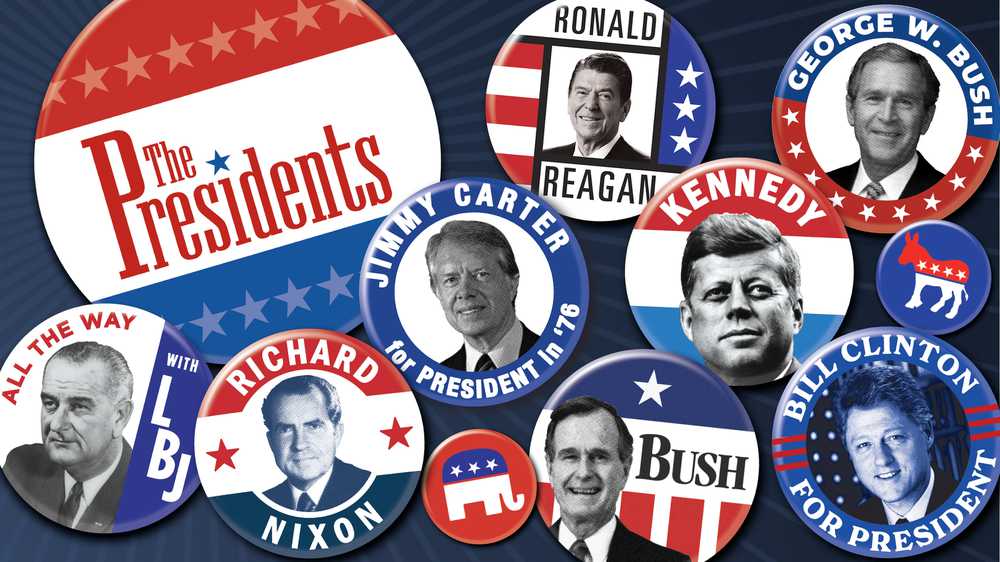
The Presidents Connect today's election issues with the past


Chapter:

Missile Deployment in Europe (12:02)
In a controversial speech, Reagan calls the Soviet Union an "evil empire." Some fear the arms race will end in nuclear Armageddon.
FDR
Truman
LBJ
Nixon
Carter

Now
Playing

Reagan
G H W Bush

Related Clips


REAGAN, Chapter 7

Governor and National Figure (12:37)
Reagan gains political confidence in two terms as governor of California.
Watch Now

REAGAN, Chapter 5

Political Apprenticeship (9:26)
Reagan hones his speaking skills as a television host and spokesman for General Electric. He becomes known for his conservative views.
Watch Now

TRUMAN, Chapter 14

Nuclear Diplomacy (7:06)
Truman takes a tougher stance at Potsdam after receiving news of a successful atomic bomb test in New Mexico.
Watch Now

NIXON, Chapter 11

Peacemaker (6:47)
After assembling a loyal staff, Nixon sets out ambitious foreign policy goals with National Security Adviser Henry Kissinger.
Watch Now

Chapter 1

Introduction (5:50)
Part one of a biography of Ronald Reagan, the 40th president.
Watch Now

Chapter 2

The Lifeguard (11:21)
Ronald Reagan grows up in a small town and works as a lifeguard on the Rock River.
Watch Now

Chapter 3

Actor (8:39)
Starting out in radio and sportscasting, Reagan moves to California to pursue an acting career.
Watch Now

Chapter 4

Communists in Hollywood (9:43)
Reagan, an active anti-Communist, ends his first marriage. He meets and marries actress Nancy Davis.
Watch Now

Chapter 5

Political Apprenticeship (9:26)
Reagan hones his speaking skills as a television host and spokesman for General Electric. He becomes known for his conservative views.
Watch Now

Chapter 6

The First Campaign (6:03)
Incumbent California governor Pat Brown underestimates his opponent Ronald Reagan's appeal. Reagan cultivates a heroic cowboy image.
Watch Now

Chapter 7

Governor and National Figure (12:37)
Reagan gains political confidence in two terms as governor of California.
Watch Now

Chapter 8

A Surprising Presidential Bid (7:56)
Ronald Reagan campaigns for but loses the Republican nomination for president in 1976.
Watch Now

Chapter 9

Landslide Victory (7:34)
Ronald Reagan defeats incumbent Jimmy Carter and is elected president in 1980.
Watch Now

Chapter 10

A Plan for Economic Recovery (10:13)
Reagan works to pass his economic package.
Watch Now

Chapter 11

Assassination Attempt (10:54)
Reagan is seriously wounded in an assassination attempt. Congress enacts his conservative economic agenda.
Watch Now

Chapter 12

Reaganomics (11:17)
Dramatic rises in unemployment, inflation, and homelessness signal the failure of Reagan's economic program.
Watch Now

Chapter 13

CreditsProduction credits for part one of the television program.
Watch Now

Chapter 14

Introduction (2:26)
Part two of a biography of Ronald Reagan, the 40th president.
Watch Now

Chapter 15

Battle on Two Fronts (11:53)
As the recession deepens, Reagan dramatically increases military spending in his crusade against Communism.
Watch Now

Chapter 16

The Nuclear Freeze Movement (7:07)
Demonstrators, including Reagan's daughter, protest his plan to increase nuclear weapons.
Watch Now

Chapter 17

The Strategic Defense Initiative (8:03)
Reagan promotes his plan for a missile defense system.
Watch Now

Chapter 18

Peace Through Strength (6:26)
Reagan broadly states his anti-Soviet "crusade for freedom," but works quietly with the Soviets on human rights issues.
Watch Now

Chapter 19

Missile Deployment in Europe (12:02)
In a controversial speech, Reagan calls the Soviet Union an "evil empire." Some fear the arms race will end in nuclear Armageddon.
Watch Now

Chapter 20

Morning in America (9:11)
America's economy has improved and national confidence is renewed. Reagan wins a second term in a landslide.
Watch Now

Chapter 21

Transitions (10:40)
Reagan loses his oldest advisers. Mikhail Gorbachev becomes the new Soviet leader, and Reagan embarks on a fateful secret course with Iran.
Watch Now

Chapter 22

Personal Diplomacy (10:55)
Reagan and Gorbachev summit in Geneva. Reagan refuses to make concessions on SDI.
Watch Now

Chapter 23

Reagan's Changing Role (5:37)
Despite successes both symbolic and real, Reagan becomes less engaged as president.
Watch Now

Chapter 24

Summit at Reykjavik (10:44)
Reagan and Gorbachev reach for the abolition of nuclear weapons. Though their talks fail, they are a breakthrough.
Watch Now

Chapter 25

The Iran-Contra Crisis (14:11)
The government's secret arms-for-hostages dealings with Iran are uncovered. Reagan learns that his staff has diverted profits to support the anti-Communist Contras in Nicaragua.
Watch Now

Chapter 26

Highs and Lows (11:50)
Americans forgive Reagan for Iran-Contra. The stock market crashes, the gap between rich and poor grows and the AIDS epidemic hits. The U.S. and U.S.S.R. sign a historic weapons treaty.
Watch Now

Chapter 27

The End of the Cold War (10:32)
After his lifelong crusade, Reagan witnesses Communism's demise in Eastern Europe, Afghanistan, Nicaragua and the Soviet Union.
Watch Now

Chapter 28

Into the Sunset (6:28)
Ronald Reagan retires to his California ranch. He will be diagnosed with Alzheimer's disease.
Watch Now

Chapter 29

CreditsProduction credits for part two of the television program.
Watch Now

Related Links


REAGAN
Learn more about Ronald Reagan.

The Atomic Age
A film, a speech, and more pro-nuclear artifacts from the 1950s.

Nuclear Stockpiles and Tests
Compare U.S. and Soviet arsenals from 1945 to 1997.

Purchase Videos & DVDs

• See Comments

Loading comments...

You must log in to submit a comment. If you don't have an account at American Experience, you will need to register to comment. It's fast and easy to do!

Post a Comment (Limit 5000 Characters)

• View Transcripts •


Transcript: Chapter 19

Narrator: It was not Reagan the negotiator but Reagan the crusading ideologue who addressed evangelical supporters a few weeks later. Congress was about to vote on the freeze resolution which could jeopardize his deployment of missiles in Europe. And Reagan was about to give his most controversial speech.

Reagan: So in your discussions of the nuclear freeze proposals, I urge you to beware the temptation of pride, the temptation of blithely declaring yourselves above it all and label both sides equally at fault, to ignore the facts of history and the aggressive impulses of an evil empire, to simply call the arms race a giant misunderstanding and thereby remove yourself from the struggle between right and wrong and good and evil. Let us be aware that while they preach the supremacy of the state, declare its omnipotence over individual man, and predict its eventual domination of all peoples on the earth, they are the focus of evil in the modern world.

George Will, Columnist: People recoiled in horror. They said, you can't talk this way. Reagan said I'm doing it on purpose because the whole thrust of détente had been to demoralize, D hyphen moralize our foreign policy. Ronald Reagan wanted to remoralize it. Let's tell them that we think they are thugs and that they are a focus of evil in the modern world and let's get the American people back into the Cold War as a moral, I'll say, crusade.

Morris: He saw a lack of freedom. He saw social degradation. He hated what he saw. He at least understood and was courageous enough to articulate to the rest of the world that what there is over there is despicable. It's evil. One of the oldest words in any language -- evil.

Dallek: This was the rhetoric of the 1950s that you cannot have compromise with evil. You cannot have compromise with a Soviet system that is intent upon our destruction. And Reagan is harking back to this early Cold War rhetoric and thinking, you see. And people find it frightening, they find it chilling.

Thomas Watson: The danger we face today warrants laying aside all other matters. Even staying in session day and night if that is required.

Averill Harriman: The dangers are great. And therefore any negotiations that could be started, I'm for.

Senator Tsongas: You're going to be the only administration going back to the '50s that either did not negotiate a treaty with the Soviets or met with them.

Shultz: So be it. I don't think we want to get ourselves in the position where we don't want to be the only administration that didn't make an arms control agreement, and so therefore let's go make one. That's no way to approach it.

Narrator: Early in the morning of September 1, 1983, a Korean airliner strayed into Soviet air space. It was shot down with the loss of 269 lives. Newsweek wrote: "The world witnessed the Soviet Union that Ronald Reagan had always warned against."

Reagan: This was the Soviet Union against the world and the moral precepts which guide human relations among people everywhere. It was an act of barbarism, born of a society which wantonly disregards individual rights and the value of human life and seeks constantly to expand and dominate other nations.

Narrator: Reagan's rhetoric was tough, but when Weinberger urged him to break off arms talks with the Soviets, he resisted. He sided with Shultz who urged him to remain engaged. In the Kremlin the rhetoric was also harsh. The Soviets compared Reagan to Hitler. Called him mad. The question for Soviet leader Yuri Andropov was how to engage Ronald Reagan.

Morris: The latter months of 1983 when Andropov had to come to terms with the knowledge that he was a dying man, plus the knowledge that Ronald Reagan was a much more formidable adversary than had originally been assumed, that he was not an old stupid ideologue, but that he was actually a very canny and determined warrior, the combination of these two realizations, these two perceptions on Andropov's part, brought about, I believe, the selection of Mikhail Gorbachev to be his successor. Andropov started grooming Gorbachev in 1983 as the only likely Soviet leader who would be able to handle this formidable, adamantine anti-Communist on the other side of the Atlantic.

Narrator: On November 20, 1983, 100 million Americans watched The Day After, a television movie which portrayed the effects of a nuclear war on Lawrence, Kansas. Reagan saw a preview. "It was a scenario," he wrote, "that could lead to the end of civilization as we knew it." The film aired on the eve of the deployment of American missiles in Germany. The inveterate optimist confided: it "left me greatly depressed." But undeterred, Reagan dispatched the missiles to Europe on schedule. Reagan's goal was to negotiate from strength.

Shultz: The deployment of INF missiles in Germany particularly, but Britain and Italy too, showing the strength and cohesion of the NATO alliance was a Cold War turning point. You have to have -- show the strength before you can have effective diplomacy.

George Will: There was a whole generation of people who were always haunted by the prospect that our amiable, undisciplined democracy wouldn't have the staying power, it would just get outlasted. We said well maybe they're just tougher than we are and stupidity armed with discipline will win after all. And that was what at issue in the early 1980s was whether or not democracies would crack. If NATO had decided upon a deployment and had then been unable to follow through on it, the Soviet Union could have had a new burst of confidence, the Atlantic Alliance would have been cracked, and who knows what would have happened. It didn't turn out to be the case in large measure again, because the president was staying the course internationally as well as domestically.

Palazchenko: The present round of the negotiations is discontinued. Without any date set for their resumption.

Narrator: Soviet delegates walked out of the arms control negotiations. For the first time in more than 20 years there were no superpower talks.

Helen Thomas: Senator Byrd says that our relations with Soviet Union have reached the lowest point in 20 years. And six eminent world leaders today said that we are headed for global suicide? What are you going to do about it with this arms race?

Reagan: I don't think we are, and I don't think we're any closer or as close as we might have been in the past to a possible conflict or confrontation that could lead to a nuclear conflagration.

Narrator: Some in the Kremlin also worried about Reagan's intentions.

Tarasenko: First Deputy Foreign Minister Kornienko asked me to come to his office. He showed me a Politburo paper informing us that the United States have plans all prepared and in place for first strike against the Soviet Union with first priority to destroying all command center and structures of the country. And Kornienko asked me to prepare some paper which would send a signal that ah, we know about these plans and we will not be caught unprepared.

Narrator: When Reagan read intelligence reports indicating the Soviets had feared a first strike, he turned to his National Security Adviser Bud McFarlane and said, "Do you suppose they really believe that? I don't see how they would believe that. But it's something to think about." Later that day he worried about Armageddon.

Robert C. McFarlane, National Security Adviser: When he talked about it he would be genuinely anguished and would physically withdraw and lean forward and with quiet passion explain his fear that Armageddon was at hand and that unless he tried to move us away from this incredible nuclear threat of each other, that it could happen in his life time and he was determined to do something about it.

back to top


Major funding provided by the National
Endowment for the Humanities and the Corporation for Public Broadcasting

NEH Corporation for Public Broadcasting


Any views, findings, conclusions, or recommendations expressed in this Web site do not necessarily represent those of the National Endowment for the Humanities.