Visit Your Local PBS Station PBS Home PBS Home Programs A-Z TV Schedules Watch Video Support PBS Shop PBS Search PBS
 
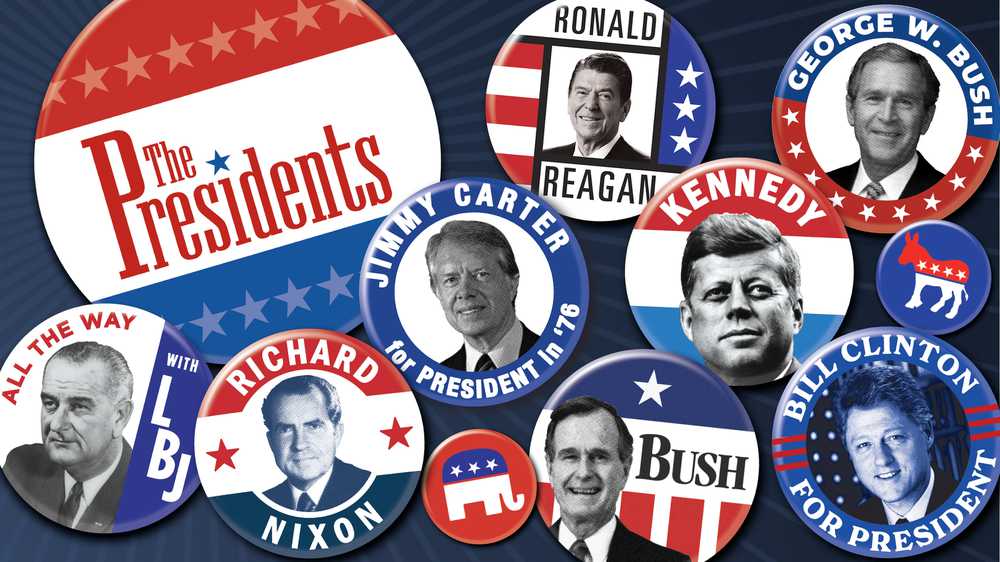
The Presidents Connect today's election issues with the past


Chapter:

Into the Sunset (6:28)
Ronald Reagan retires to his California ranch. He will be diagnosed with Alzheimer's disease.
FDR
Truman
LBJ
Nixon
Carter

Now
Playing

Reagan
G H W Bush

Related Clips


FDR, Chapter 26

Laid to Rest (9:14)
After Roosevelt dies, mourners line the tracks to see his funeral train. The man who inspired them with his optimism is buried at his childhood home.
Watch Now

TRUMAN, Chapter 31

The Last Years (9:06)
With the lowest popularity rating in history, Truman decides not to seek re-election. He retires to Independence, Missouri.
Watch Now

LBJ, Chapter 25

A Continuous Nightmare (12:04)
Johnson decides not to run for re-election. His legislation has carried New Deal liberalism to its peak, but the war in Vietnam has defeated him.
Watch Now

NIXON, Chapter 21

The Judgment of History (6:32)
Nixon resigns from office. His successor Gerald Ford grants him a full pardon, but over 70 others are convicted of crimes.
Watch Now

CARTER, Chapter 18

The 1980 Presidential Election (7:26)
Carter survives a brutal primary fight against Ted Kennedy to be defeated by Ronald Reagan.
Watch Now

Chapter 1

Introduction (5:50)
Part one of a biography of Ronald Reagan, the 40th president.
Watch Now

Chapter 2

The Lifeguard (11:21)
Ronald Reagan grows up in a small town and works as a lifeguard on the Rock River.
Watch Now

Chapter 3

Actor (8:39)
Starting out in radio and sportscasting, Reagan moves to California to pursue an acting career.
Watch Now

Chapter 4

Communists in Hollywood (9:43)
Reagan, an active anti-Communist, ends his first marriage. He meets and marries actress Nancy Davis.
Watch Now

Chapter 5

Political Apprenticeship (9:26)
Reagan hones his speaking skills as a television host and spokesman for General Electric. He becomes known for his conservative views.
Watch Now

Chapter 6

The First Campaign (6:03)
Incumbent California governor Pat Brown underestimates his opponent Ronald Reagan's appeal. Reagan cultivates a heroic cowboy image.
Watch Now

Chapter 7

Governor and National Figure (12:37)
Reagan gains political confidence in two terms as governor of California.
Watch Now

Chapter 8

A Surprising Presidential Bid (7:56)
Ronald Reagan campaigns for but loses the Republican nomination for president in 1976.
Watch Now

Chapter 9

Landslide Victory (7:34)
Ronald Reagan defeats incumbent Jimmy Carter and is elected president in 1980.
Watch Now

Chapter 10

A Plan for Economic Recovery (10:13)
Reagan works to pass his economic package.
Watch Now

Chapter 11

Assassination Attempt (10:54)
Reagan is seriously wounded in an assassination attempt. Congress enacts his conservative economic agenda.
Watch Now

Chapter 12

Reaganomics (11:17)
Dramatic rises in unemployment, inflation, and homelessness signal the failure of Reagan's economic program.
Watch Now

Chapter 13

CreditsProduction credits for part one of the television program.
Watch Now

Chapter 14

Introduction (2:26)
Part two of a biography of Ronald Reagan, the 40th president.
Watch Now

Chapter 15

Battle on Two Fronts (11:53)
As the recession deepens, Reagan dramatically increases military spending in his crusade against Communism.
Watch Now

Chapter 16

The Nuclear Freeze Movement (7:07)
Demonstrators, including Reagan's daughter, protest his plan to increase nuclear weapons.
Watch Now

Chapter 17

The Strategic Defense Initiative (8:03)
Reagan promotes his plan for a missile defense system.
Watch Now

Chapter 18

Peace Through Strength (6:26)
Reagan broadly states his anti-Soviet "crusade for freedom," but works quietly with the Soviets on human rights issues.
Watch Now

Chapter 19

Missile Deployment in Europe (12:02)
In a controversial speech, Reagan calls the Soviet Union an "evil empire." Some fear the arms race will end in nuclear Armageddon.
Watch Now

Chapter 20

Morning in America (9:11)
America's economy has improved and national confidence is renewed. Reagan wins a second term in a landslide.
Watch Now

Chapter 21

Transitions (10:40)
Reagan loses his oldest advisers. Mikhail Gorbachev becomes the new Soviet leader, and Reagan embarks on a fateful secret course with Iran.
Watch Now

Chapter 22

Personal Diplomacy (10:55)
Reagan and Gorbachev summit in Geneva. Reagan refuses to make concessions on SDI.
Watch Now

Chapter 23

Reagan's Changing Role (5:37)
Despite successes both symbolic and real, Reagan becomes less engaged as president.
Watch Now

Chapter 24

Summit at Reykjavik (10:44)
Reagan and Gorbachev reach for the abolition of nuclear weapons. Though their talks fail, they are a breakthrough.
Watch Now

Chapter 25

The Iran-Contra Crisis (14:11)
The government's secret arms-for-hostages dealings with Iran are uncovered. Reagan learns that his staff has diverted profits to support the anti-Communist Contras in Nicaragua.
Watch Now

Chapter 26

Highs and Lows (11:50)
Americans forgive Reagan for Iran-Contra. The stock market crashes, the gap between rich and poor grows and the AIDS epidemic hits. The U.S. and U.S.S.R. sign a historic weapons treaty.
Watch Now

Chapter 27

The End of the Cold War (10:32)
After his lifelong crusade, Reagan witnesses Communism's demise in Eastern Europe, Afghanistan, Nicaragua and the Soviet Union.
Watch Now

Chapter 28

Into the Sunset (6:28)
Ronald Reagan retires to his California ranch. He will be diagnosed with Alzheimer's disease.
Watch Now

Chapter 29

CreditsProduction credits for part two of the television program.
Watch Now

  • REAGAN: Chapter 1
  • REAGAN: Chapter 2
  • REAGAN: Chapter 3
  • REAGAN: Chapter 4
  • REAGAN: Chapter 5
  • REAGAN: Chapter 6
  • REAGAN: Chapter 7
  • REAGAN: Chapter 8
  • REAGAN: Chapter 9
  • REAGAN: Chapter 10
  • REAGAN: Chapter 11
  • REAGAN: Chapter 12
  • REAGAN: Chapter 13
  • REAGAN: Chapter 14
  • REAGAN: Chapter 15
  • REAGAN: Chapter 16
  • REAGAN: Chapter 17
  • REAGAN: Chapter 18
  • REAGAN: Chapter 19
  • REAGAN: Chapter 20
  • REAGAN: Chapter 21
  • REAGAN: Chapter 22
  • REAGAN: Chapter 23
  • REAGAN: Chapter 24
  • REAGAN: Chapter 25
  • REAGAN: Chapter 26
  • REAGAN: Chapter 27
  • REAGAN: Chapter 28
  • REAGAN: Chapter 29
Choose a format

Choose a Video Format

Quicktime | Windows Media

Download a free player
QuickTime | Windows Media

Related Links


REAGAN
Learn more about Ronald Reagan.

Reagan's Legacy
The Great Communicator was also known as the Teflon president.

Reagan on Alzheimer's Disease
Read a letter Reagan wrote the American people.

Purchase Videos & DVDs

• See Comments

Loading comments...

You must log in to submit a comment. If you don't have an account at American Experience, you will need to register to comment. It's fast and easy to do!

Post a Comment (Limit 5000 Characters)

• View Transcripts •


Transcript: Chapter 28

NARRATOR: When he left the White House in January 1989 Reagan had time to work on his ranch. There were still gophers to plink and brush to clear and vistas to open. He was almost 78 years old.

Dennis LeBlanc, Ranch Manager: Probably when he was 80, 81 he was still using the chain saws. But I believe he started concentrating more on the pole saw. You know, I don't know if age entered into it or not or if he just liked reaching high.

Narrator: There's a rock at the ranch where Reagan carved his initials and Nancy's and those of his married children, and Patti's name.

"We've reached out to Patti since I left the White House," he wrote, "but so far she's made it plain to me that she thinks I am wrong and that she is against everything I stand for." On February 4, 1994, five years after he left the White House, Patti called on her father to wish him a happy 83rd birthday.

Patti Davis: I sort of got this overwhelming feeling that I should go see my father. I had started to write Angels Don't Die, about the spiritual gifts that he had imparted to me throughout my life.

And, so he was very much on my mind. And I didn't even know if my parents were in town or, or, you know, if they were around, or if they were home.

And I called and, uh, he answered the phone and he was there alone. And I went up and saw him and told him about the book that I was writing, told him how much he had, um, enriched my life with, um, his spirituality and by teaching me, really quite simply, to talk to God. Um, and he was very moved by my telling him that because he had always wondered, as he said, what my faith was.

Narrator: Patti made peace with her father the day after his 83rd birthday tribute. There was no time to spare. At that event others began to notice him falter.

Margaret Thatcher, British Prime Minister: I remember we met beforehand to do all the photographs, which we usually do. And he was very quiet and not very communicative at all. And Nancy had to lead him to the platform holding him by the hand. And when she put up her hand to wave, immediately, uh, she said to Ron, "Wave." And he did. And I had thought that he was probably very tired.

Dr. John Hutton: When his time came there seemed to be a hesitancy, and his voice was not its usual strong, exacting voice.

Reagan: Frankly, for a minute there I was a bit concerned that after all these years away from Washington, you all would not recognize me.

Dr. Hutton: And then suddenly it was as if a switch had gone on, and his old elegance was right back.

Reagan: I can't tell you how thrilled Nancy and I are to be here with you tonight to celebrate as Margaret said the 44th anniversary of my 39th birthday.

Dr. Hutton: After this was all over we went back to the hotel, and he said, I, I'm going to have to have a little help. I, I'm a little confused. I, I don't know where I am. And with just a little bit of a reminder, ah, he was fine, but Mrs. Reagan had said, "There, now do you see what I mean?" she said. And she said this is, "this is happening more and more often."

Ron Reagan: I think all of us went through some period in our lives where we missed him while he was still there. And you know, kind of banged our head against that wall, you know, why can't we get any closer. Why can't there be more of a rapport. Um, but after you accept that you know, there just isn't going to be, you know, then... then you make your peace with that and... and ah, you know, now I mean it's... it's an awful tragedy of course, Alzheimer's is a terrible thing, um, and you know, you wouldn't wish it on your worst enemy. But some of the pain, maybe is lessened by the fact that ... things haven't changed that much in a way. You know, he's not. You know, we're not missing something that we had to begin with.

Dr. Hutton: The president was very frustrated and I remember one time when he was trying to explain something to me, he simply couldn't go on with whatever it was he was trying to get across to me and said, you know, I'm, John, I'm just bewildered. Finally, he realized that it was, that it was becoming even difficult to make tapes which he used to make for political friends, etc. and we finally had to abandon doing, ah, making those, at which time he said I've got to somehow reach out and tell people that I can't do this anymore.

Narrator: This time there was no denial. "My Fellow Americans. I have recently been told that I am one of the millions of Americans who will be afflicted with Alzheimer's disease. "Upon hearing this news Nancy and I had to decide whether as private citizens we would keep this a private matter or whether we would make this news known in a public way.

"We feel it is important to share it with you. In opening our hearts, we hope this might promote a greater awareness of this condition."

Morris: I can't think of anything that I've seen that was so transparently honest, courageous and articulate. The writing had the ultimate quality of good writing which is unblinking acceptance of the truth.

Narrator: "Unfortunately as Alzheimer's disease progresses the family often bears a heavy burden. I only wish there was some way I could spare Nancy from this painful experience. "When the Lord calls me home whenever that may be, I will leave with the greatest love for this country of ours and eternal optimism for its future."

Morris: I find it very difficult to think emotionally about Ronald Reagan. But that is one thing he did that catches me in the heart, is the courage with which he left his conscious life. The courage with which he stopped. He simply stopped.

Narrator: "I now begin the journey that will lead me into the sunset of my life.

"I know that for America there will always be a bright dawn ahead.

"Thank you my friends. May God always bless you. Sincerely, Ronald Reagan."

back to top


Major funding provided by the National
Endowment for the Humanities and the Corporation for Public Broadcasting

NEH Corporation for Public Broadcasting


Any views, findings, conclusions, or recommendations expressed in this Web site do not necessarily represent those of the National Endowment for the Humanities.