Visit Your Local PBS Station PBS Home PBS Home Programs A-Z TV Schedules Watch Video Support PBS Shop PBS Search PBS
 
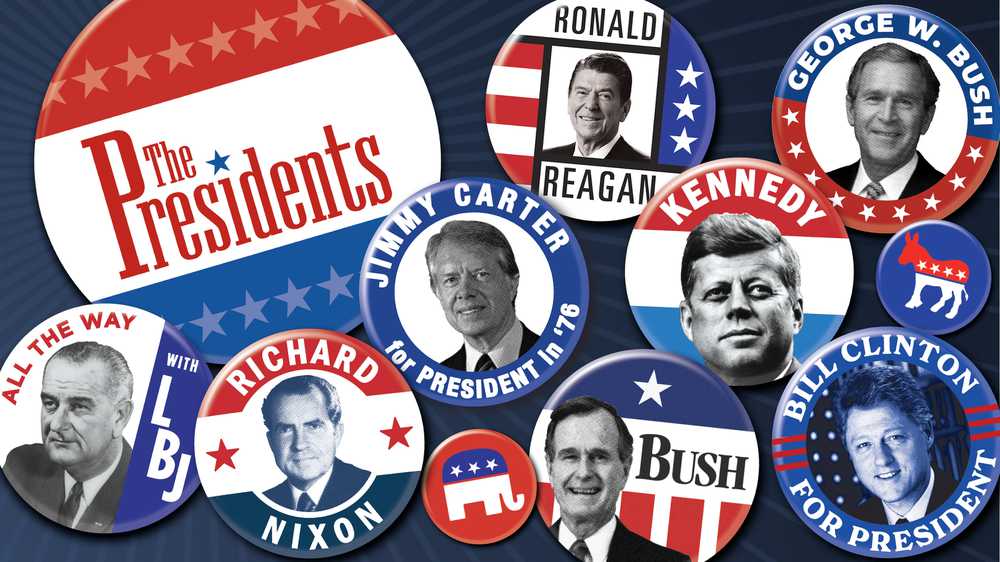
The Presidents Connect today's election issues with the past


Chapter:

The Family Farm (10:22)
After working office jobs in Kansas City, Truman returns to the family farm to help his father. He woos Elizabeth Wallace.
FDR

Now
Playing

Truman
LBJ
Nixon
Carter
Reagan
G H W Bush

Related Clips


CARTER, Chapter 4

Finding a Community (7:08)
When his father dies, Carter leaves the Navy. The Carters return to Plains to run the family business, and are thrust into the turmoil of Southern race relations.
Watch Now

REAGAN, Chapter 3

Actor (8:39)
Starting out in radio and sportscasting, Reagan moves to California to pursue an acting career.
Watch Now

TRUMAN, Chapter 6

Marriage and Politics (13:12)
After the war, Truman marries Bess Wallace and runs for public office.
Watch Now

Chapter 1

Introduction (2:58)
Part one of a biography of Harry Truman, the 33rd president.
Watch Now

Chapter 2

Early Years (14:11)
Harry Truman grows up in Independence, Missouri. He gets his first taste of politics at the 1900 Democratic National Convention.
Watch Now

Chapter 3

The Family Farm (10:22)
After working office jobs in Kansas City, Truman returns to the family farm to help his father. He woos Elizabeth Wallace.
Watch Now

Chapter 4

Love and Death (10:23)
Bess Wallace rejects Truman. After his father dies, Truman leaves the farm to make his fortune, but fails in business.
Watch Now

Chapter 5

World War I (9:52)
Truman shows leadership as the captain of Battery D, fighting in World War I's bloodiest battles.
Watch Now

Chapter 6

Marriage and Politics (13:12)
After the war, Truman marries Bess Wallace and runs for public office.
Watch Now

Chapter 7

Senator Truman, (6:45)
With the help of Kansas City political boss Tom Pendergast, Truman wins a seat in the U.S. Senate.
Watch Now

Chapter 8

Truman Proves Himself (9:07)
Truman works hard to understand the workings of the Senate and finds sucess.
Watch Now

Chapter 9

The 1944 Election (11:21)
Truman becomes the Democrats' compromise choice for vice president.
Watch Now

Chapter 10

Vice President for 82 Days (5:25)
Roosevelt keeps Truman out of his inner circle. When the president dies, Truman is nervous and unprepared.
Watch Now

Chapter 11

A Man of the People (10:27)
As president, Truman makes a show of energy and confidence. Americans warm to his straightforward manner.
Watch Now

Chapter 12

Endgame in Japan (10:04)
After the war in Europe ends, Truman focuses on the bitter battle with Japan. Bess Truman is uncomfortable as first lady.
Watch Now

Chapter 13

On the World Stage (10:27)
Truman meets with Winston Churchill and Joseph Stalin to decide the fate of Europe. In New Mexico the atomic bomb is successfully tested.
Watch Now

Chapter 14

Nuclear Diplomacy (7:06)
Truman takes a tougher stance at Potsdam after receiving news of a successful atomic bomb test in New Mexico.
Watch Now

Chapter 15

Hiroshima and Nagasaki (7:32)
The U.S. drops atomic bombs on two Japanese cities. The Japanese surrender and World War II ends.
Watch Now

Chapter 16

CreditsProduction credits for part one of the television program.
Watch Now

Chapter 17

CreditsHead credits for part two of the television program.
Watch Now

Chapter 18

Introduction (2:16)
Part two of a biography of Harry Truman, the 33rd president.
Watch Now

Chapter 19

The Post War Economy (10:59)
Truman faces domestic challenges. He takes a tough stance against striking railroad workers.
Watch Now

Chapter 20

The Mid-Term Elections of 1946 (4:47)
The Republicans gain majorities in both houses of Congress.
Watch Now

Chapter 21

The Truman Doctrine (9:04)
As the Soviets control Eastern Europe, Truman acts to stop Communism in Greece and Turkey.
Watch Now

Chapter 22

American Power (6:50)
Truman establishes the Marshall Plan and prepares the country for a new kind of war -- the Cold War.
Watch Now

Chapter 23

A Stand for Human Rights (11:21)
Before the election of 1948, Truman boldly calls for civil rights for African Americans and for Israel to be recognized.
Watch Now

Chapter 24

The Conventions (6:41)
Despite Democrats' misgivings, President Truman is nominated at a dispirited Democratic Convention.
Watch Now

Chapter 25

Truman Defeats Dewey (9:47)
Taking his "New Deal" message on a whistlestop campaign across the country, Truman defeats New York governor Thomas Dewey.
Watch Now

Chapter 26

Fighting Communism (10:10)
Facing the Communist threat, Truman shows U.S. strength with an airlift to blockaded Berlin and air strikes and infantry in Korea.
Watch Now

Chapter 27

The Korean War (5:29)
U.S. troops in Korea retreat until Douglas MacArthur's surprise attack on Inchon forces the North Koreans to pull back to the 38th Parallel.
Watch Now

Chapter 28

Crossing the 38th Parallel (9:35)
MacArthur convinces Truman to fight the Chinese in Korea. Truman denies MacArthur's demand to use atomic weapons.
Watch Now

Chapter 29

Under Pressure (6:22)
Truman persists with a "limited war." Pressure on him grows intense as casualties mount and U.S. troops are repelled by Chinese forces.
Watch Now

Chapter 30

Dismissing MacArthur (6:58)
In a controversial move, Truman removes General Douglas MacArthur from his command for insubordination.
Watch Now

Chapter 31

The Last Years (9:06)
With the lowest popularity rating in history, Truman decides not to seek re-election. He retires to Independence, Missouri.
Watch Now

Chapter 32

CreditsProduction credits for part two of the television program.
Watch Now

  • TRUMAN: Chapter 1
  • TRUMAN: Chapter 2
  • TRUMAN: Chapter 3
  • TRUMAN: Chapter 4
  • TRUMAN: Chapter 5
  • TRUMAN: Chapter 6
  • TRUMAN: Chapter 7
  • TRUMAN: Chapter 8
  • TRUMAN: Chapter 9
  • TRUMAN: Chapter 10
  • TRUMAN: Chapter 11
  • TRUMAN: Chapter 12
  • TRUMAN: Chapter 13
  • TRUMAN: Chapter 14
  • TRUMAN: Chapter 15
  • TRUMAN: Chapter 16
  • TRUMAN: Chapter 17
  • TRUMAN: Chapter 18
  • TRUMAN: Chapter 19
  • TRUMAN: Chapter 20
  • TRUMAN: Chapter 21
  • TRUMAN: Chapter 22
  • TRUMAN: Chapter 23
  • TRUMAN: Chapter 24
  • TRUMAN: Chapter 25
  • TRUMAN: Chapter 26
  • TRUMAN: Chapter 27
  • TRUMAN: Chapter 28
  • TRUMAN: Chapter 29
  • TRUMAN: Chapter 30
  • TRUMAN: Chapter 31
  • TRUMAN: Chapter 32
Choose a format

Choose a Video Format

Quicktime | Windows Media

Download a free player
QuickTime | Windows Media

Related Links


TRUMAN
Learn more about Harry S. Truman.

Boyhood on the Farm
Jimmy Carter's rural Georgia childhood.

Troublesome Creek
One family's effort to hold on to their farm.

Purchase Videos & DVDs

• See Comments

Loading comments...

You must log in to submit a comment. If you don't have an account at American Experience, you will need to register to comment. It's fast and easy to do!

Post a Comment (Limit 5000 Characters)

• View Transcripts •


Transcript: Chapter 03

NARRATOR: For a seventeen-year-old boy just starting out in life, Kansas City was brimming with possibilities.

DAVID MCCULLOUGH: It's a big, rough, boisterous, overgrown cow town. It's got everything, including lots of opportunity for sin if that's what you wanted. Prostitution, gambling, and wide-open, all night hell-raising. To what extent Harry experienced any of that we'll never know. My suspicion is not at all. He was a good boy.

CHARLES BABCOCK: Harry was a nice guy. And his mother had raised him very well. I don't think he was about to get in trouble in Kansas City even though a lot of people did in those days, you know. Harry didn't have a lot of money so he worked all the time, so he couldn't get in very much trouble that way because his time was spent working.

NARRATOR: Mailroom boy for a newspaper, timekeeper for a railroad construction company, bank clerk -- Harry took what jobs came his way, and made the most of them. Kansas City, Harry reported, was a place with "things doing." He went to concerts, theater and vaudeville, saw the Four Cohans and Sara Bernhardt. Once he heard Theodore Roosevelt speak from the back of a railroad car. The president, Harry thought, appeared to be surprisingly short. He joined the National Guard and enjoyed the company of other young men. Women, though, were another matter. "I was always afraid of girls," he once wrote.

After four years, Harry was drawing a good salary as a bank clerk and finding new friends. He was 21 years old, just beginning to make a life for himself, when once again his father thwarted his ambitions.

Down on his luck, John Truman had been forced to sell his house, all his livestock, and had even taken a job as a night watchman. He saw his chance to get back on his feet when his wife's mother asked him to take over the family farm 15 miles south of Independence. But he knew he couldn't run the huge 600-acre farm without the help of both his sons. He told Harry to quit his job and come home. Again, without complaint, Harry did as he was told.

CHARLES BABCOCK: I don't think he was by nature a farmer. I think he liked people better. So it was tough on him. He didn't want to do it, I'm sure.

DAVID MCCULLOUGH: It was hard work, hard, hard work, and blistering heat in the summer time in western Missouri. And cold, cold winters where the whole landscape turned to iron. And he'd never done this before, this was new to him. He'd grown up in town, he'd gone to work in the bank, he had clerks jobs, he looked like a clerk.

ALONZO HAMBY: He remembered in later years friends who told him he wouldn't last six months. And he'd be back at work at the bank.

NARRATOR: John Truman was a stern taskmaster. "If a crooked row, or a blank space showed in the cornfield or wheat," Harry remembered, "I'd hear about it for a year."

ALONZO HAMBY: He's working for his father, and working for John Truman wouldn't have been easy ... but he was determined to prove he could do it. I think he was still dissatisfied with his relationship with his father and thought that maybe this was his last opportunity to repair it.

NARRATOR: For nearly eight years, Harry worked at his father's side. "We were real partners," Harry remembered. "He thought I was about right. I knew he was."

"Dear Bessie, I've been sowing oats all week, and hauled about six tons of hay yesterday. ... You know the wind blew something fierce last Tuesday and Wednesday and the sun also had some effect. Between them I look like raw beef."

To escape the drudgery of his daily life, Harry stole time to write a young woman from his high school graduating class -- Elizabeth Wallace -- Bess.

SUE GENTRY, Editor, The Independence Examiner: The story he tells, they were in Sunday school together when they were six years old. There was a year's difference in their age. And from that moment on, he thought of no one else but that blue-eyed, golden haired little girl.

NARRATOR: It took five years, Harry said, before he could summon the courage even to talk to her. He would remain in awe of Bess for the rest of his life.

Bess was popular, outgoing and a great athlete, a superb tennis player, the best female fencer in town, and a terrific third baseman.

SUE GENTRY: She belonged to a special family in Independence. A family that was prominent and recognized. Of course Harry was from a farm family.

DAVID MCCULLOUGH: Bess Wallace and her family lived in one of the biggest houses in Independence. They had a servant to wait on the tables, there were lace curtains in the windows and Brussels carpets on the floor.

And you walked up those steps onto the Wallace front porch and you rang the doorbell and when you crossed the threshold into that house, if you were Harry Truman, you were stepping into a different world, where people didn't work with their hands, where to all that he knew at least, they had no such thing as debt or worry, or concern about weather and insects and all the- all the burdens of farm life. And he courted her with a determination that is very expressive of the kind of man he was. It was his first campaign. And he didn't give up.

NARRATOR: He wrote her letter after letter, day after day.

"Dear Bessie, I don't care what kind of paper you write on. I should be just as pleased to get a letter from you on wrapping paper as on the finest stationery."

... You certainly did write me one fine letter (put the emphasis on fine, not on one, because they're all fine)..."

"Dear Bess, I shall sure be glad to go to Salisbury's for dinner Sunday. But don't you think I am a terrible tightwad if we walk?"

Harry was in love, but Bess held herself aloof.

SUE GENTRY: She had lots of beaux. And her mother always thought, so I'm told, that Bess could do better than Harry, a farm boy.

DAVID MCCULLOUGH: I once asked Mae Wallace, Harry Truman's sister-in-law, if it was true that Mrs. Wallace, her mother-in-law Madge Wallace, didn't think that Harry was good enough for Bess. And she said, "Oh, yes, that's right. She didn't think Harry was good enough for Bess, but she didn't think anyone was good enough for Bess."

NARRATOR: Madge Wallace would never think Harry was good enough. Once a beautiful girl from a much admired family, she had become a reclusive troubled woman, grown more and more dependent on her only daughter, ever since the tragic death of her husband.

ALONZO HAMBY: Precisely why David Wallace got up very early one morning, climbed into the family bath tub, put a gun to his head and pulled the trigger we don't really know. Some accounts have it he was depressed because he was heavily in debt. But why would such a fine man do this?

DAVID MCCULLOUGH: Bess' father was an extremely popular, charming man who often rode the horse at the head of political parades. But he was an alcoholic. And like the character in the poem Richard Cory he went home one night and put a bullet through his head. And his wife, Bess' mother, came apart. She never was able to cope again.

NARRATOR: Her husband's suicide scandalized the small town. Madge Wallace became, someone said, "a prisoner of shame."

ALONZO HAMBY: It cast a pall over the rest of her life. Mrs. Wallace gave Bess the impression that it was Bess' duty to take care of her. Her mother became very reliant on her.

NARRATOR: Bess was just 18. A neighbor remembered how, in the hours immediately following her father's suicide, "Bess was walking up and down in back of the house with clenched fists."

back to top


Major funding provided by the National
Endowment for the Humanities and the Corporation for Public Broadcasting

NEH Corporation for Public Broadcasting


Any views, findings, conclusions, or recommendations expressed in this Web site do not necessarily represent those of the National Endowment for the Humanities.