Visit Your Local PBS Station PBS Home PBS Home Programs A-Z TV Schedules Watch Video Support PBS Shop PBS Search PBS
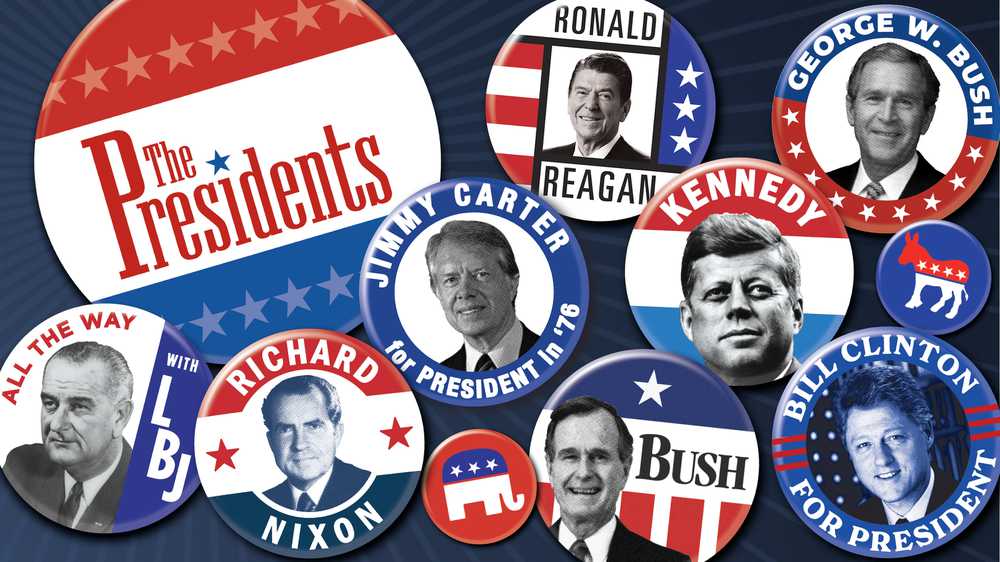
The Presidents Connect today's election issues with the past


Chapter:

Love and Death (10:23)
Bess Wallace rejects Truman. After his father dies, Truman leaves the farm to make his fortune, but fails in business.
FDR

Now
Playing

Truman
LBJ
Nixon
Carter
Reagan
G H W Bush

Related Clips


FDR, Chapter 4

Eleanor is an Angel (13:17)
Roosevelt marries his distant cousin Eleanor, the niece of his hero Theodore Roosevelt. They move next door to his mother in New York.
Watch Now

REAGAN, Chapter 4

Communists in Hollywood (9:43)
Reagan, an active anti-Communist, ends his first marriage. He meets and marries actress Nancy Davis.
Watch Now

Chapter 1

Introduction (2:58)
Part one of a biography of Harry Truman, the 33rd president.
Watch Now

Chapter 2

Early Years (14:11)
Harry Truman grows up in Independence, Missouri. He gets his first taste of politics at the 1900 Democratic National Convention.
Watch Now

Chapter 3

The Family Farm (10:22)
After working office jobs in Kansas City, Truman returns to the family farm to help his father. He woos Elizabeth Wallace.
Watch Now

Chapter 4

Love and Death (10:23)
Bess Wallace rejects Truman. After his father dies, Truman leaves the farm to make his fortune, but fails in business.
Watch Now

Chapter 5

World War I (9:52)
Truman shows leadership as the captain of Battery D, fighting in World War I's bloodiest battles.
Watch Now

Chapter 6

Marriage and Politics (13:12)
After the war, Truman marries Bess Wallace and runs for public office.
Watch Now

Chapter 7

Senator Truman, (6:45)
With the help of Kansas City political boss Tom Pendergast, Truman wins a seat in the U.S. Senate.
Watch Now

Chapter 8

Truman Proves Himself (9:07)
Truman works hard to understand the workings of the Senate and finds sucess.
Watch Now

Chapter 9

The 1944 Election (11:21)
Truman becomes the Democrats' compromise choice for vice president.
Watch Now

Chapter 10

Vice President for 82 Days (5:25)
Roosevelt keeps Truman out of his inner circle. When the president dies, Truman is nervous and unprepared.
Watch Now

Chapter 11

A Man of the People (10:27)
As president, Truman makes a show of energy and confidence. Americans warm to his straightforward manner.
Watch Now

Chapter 12

Endgame in Japan (10:04)
After the war in Europe ends, Truman focuses on the bitter battle with Japan. Bess Truman is uncomfortable as first lady.
Watch Now

Chapter 13

On the World Stage (10:27)
Truman meets with Winston Churchill and Joseph Stalin to decide the fate of Europe. In New Mexico the atomic bomb is successfully tested.
Watch Now

Chapter 14

Nuclear Diplomacy (7:06)
Truman takes a tougher stance at Potsdam after receiving news of a successful atomic bomb test in New Mexico.
Watch Now

Chapter 15

Hiroshima and Nagasaki (7:32)
The U.S. drops atomic bombs on two Japanese cities. The Japanese surrender and World War II ends.
Watch Now

Chapter 16

CreditsProduction credits for part one of the television program.
Watch Now

Chapter 17

CreditsHead credits for part two of the television program.
Watch Now

Chapter 18

Introduction (2:16)
Part two of a biography of Harry Truman, the 33rd president.
Watch Now

Chapter 19

The Post War Economy (10:59)
Truman faces domestic challenges. He takes a tough stance against striking railroad workers.
Watch Now

Chapter 20

The Mid-Term Elections of 1946 (4:47)
The Republicans gain majorities in both houses of Congress.
Watch Now

Chapter 21

The Truman Doctrine (9:04)
As the Soviets control Eastern Europe, Truman acts to stop Communism in Greece and Turkey.
Watch Now

Chapter 22

American Power (6:50)
Truman establishes the Marshall Plan and prepares the country for a new kind of war -- the Cold War.
Watch Now

Chapter 23

A Stand for Human Rights (11:21)
Before the election of 1948, Truman boldly calls for civil rights for African Americans and for Israel to be recognized.
Watch Now

Chapter 24

The Conventions (6:41)
Despite Democrats' misgivings, President Truman is nominated at a dispirited Democratic Convention.
Watch Now

Chapter 25

Truman Defeats Dewey (9:47)
Taking his "New Deal" message on a whistlestop campaign across the country, Truman defeats New York governor Thomas Dewey.
Watch Now

Chapter 26

Fighting Communism (10:10)
Facing the Communist threat, Truman shows U.S. strength with an airlift to blockaded Berlin and air strikes and infantry in Korea.
Watch Now

Chapter 27

The Korean War (5:29)
U.S. troops in Korea retreat until Douglas MacArthur's surprise attack on Inchon forces the North Koreans to pull back to the 38th Parallel.
Watch Now

Chapter 28

Crossing the 38th Parallel (9:35)
MacArthur convinces Truman to fight the Chinese in Korea. Truman denies MacArthur's demand to use atomic weapons.
Watch Now

Chapter 29

Under Pressure (6:22)
Truman persists with a "limited war." Pressure on him grows intense as casualties mount and U.S. troops are repelled by Chinese forces.
Watch Now

Chapter 30

Dismissing MacArthur (6:58)
In a controversial move, Truman removes General Douglas MacArthur from his command for insubordination.
Watch Now

Chapter 31

The Last Years (9:06)
With the lowest popularity rating in history, Truman decides not to seek re-election. He retires to Independence, Missouri.
Watch Now

Chapter 32

CreditsProduction credits for part two of the television program.
Watch Now

Related Links


TRUMAN
Learn more about Harry S. Truman.

Woodrow Wilson
The president who set a course for the 20th century.

Red Emma on the Road
Emma Goldman's 1911 cross-country lecture tour.

Purchase Videos & DVDs

• See Comments

Loading comments...

You must log in to submit a comment. If you don't have an account at American Experience, you will need to register to comment. It's fast and easy to do!

Post a Comment (Limit 5000 Characters)

• View Transcripts •


Transcript: Chapter 04

Narrator: "Dear Bessie, I certainly enjoyed myself the evening I was there and you may be assured that I shall repeat the offense as often as I can or you will allow me. The cake and coffee couldn't be beat. ... There's nothing better than cake but more cake.

Bess was 25 when Harry first began to court her. She was a young woman on the verge of spinsterhood, the bonds forged by maternal need and filial duty drawing ever more tightly around her.

But Harry idolized her. All through elementary and high school, he had shyly loved her -- from afar. Even as a young man in Kansas City, he had dreamed always and only of Bess. Now he was 26. And he had never had a girlfriend.

ALONZO HAMBY: Truman from the time he was a kid had always been somewhat uneasy with the opposite sex. Maybe Bess' distance and his idealization of her provided an excuse for not getting involved with women for a long time. He's been hooked on this woman ever since he met her at the age of five, and he has never been able to get interested in any other women since.

NARRATOR: Harry saw Bess whenever he could, nearly every Sunday. They enjoyed concerts, plays, and continued to exchange letters:

"Dear Bessie, You may be very, very sure that your letters cannot possibly come too often or too regular for me ..."

"Dear Bessie, My voice is somewhat weary from yelling at the horses. Please write me when you have the time as I enjoy your letters very much ..."

Finally Harry drew up his courage and proposed -- in a letter:

"Dear Bessie, You may not have guessed it but I've been crazy about you ever since we went to Sunday school together. But I never had the nerve to think you'd even look at me. I don't think so now but I can't help from telling you what I think of you."

Were I an Italian or a poet I would use all the luscious language of two continents. I am not either but only a kind of good-for-nothing American farmer. ... If you turn me down, I'll not be thoroughly disappointed, for it's no more than I expect. Please write as soon as you feel that way. The sooner, the better pleased I am.

More than sincerely,

Harry

It took Bess three weeks to respond. She refused. And Harry wrote to thank her for not ridiculing him.

"You know you turned me down so easy I am almost happy anyway. I was never fool enough to think that a girl like you could ever care for a fellow like me.

NARRATOR: But Harry wouldn't give up. He bought a second-hand Stafford touring car to take Bess courting. When he learned that she liked tennis, Harry built her a grass tennis court out behind the farmhouse and threw a tennis party in her honor. She didn't come.

"I really worked all day Sunday getting that court ready for you," he wrote her. "We also had a supply of watermelons on hand. But you can make it some Saturday, and Mamma says you must come to dinner next time."

DAVID MCCULLOUGH: Persistence is a very strong theme in Harry Truman. He doesn't give up very easily. He really set his mind that Bess was the one. And she always would be. Never any variation in that. He just kept at it --

NARRATOR: Two years after she had turned him down, Bess began to change her mind. She told Harry that if she ever married anyone, it would be him.

"Dear Bess, It doesn't seem real that you should care for me ... I've always thought that the best man in the world is hardly good enough for any woman. But when it comes to the best girl in all the universe caring for an ordinary gink like me -- well, you just have to let me get used to it. I'm all puffed up and hilarious and happy."

But Bess would never marry a farmer. The farm was $12,000 in debt, and Harry was still working for his father. Then, in 1914, John Truman, straining to remove a boulder from a road, severely injured himself. X-rays revealed a tumor blocking his intestine. Doctors recommended surgery, but held out little hope. The operation failed. Harry saw his father grow weaker and weaker. Near death, the wiry, once ambitious man looked back on his life. "I have been," he told his son, "a failure." On the evening of November 2, 1914, Harry rested at his father's bedside. "I had been sitting with him and watching a long time," Truman said later. "When I woke up he was dead." Years later, when a writer asked Truman if his father had been a failure, Harry told him, "How could he be a failure if his son became president of the United States?"

ALONZO HAMBY: The death of John Truman was a liberation for Harry.

Once he gets past the point of grief and shock at his father's death, he is finally free to set out in directions of his own. And he decides pretty quickly that those directions are going to be away from the farm.

NARRATOR: After hearing tales of easy money to be made in Oklahoma, Harry headed south.

DAVID MCCULLOUGH: He's going to do as his father had done, only make what his father had tried, work. His father gambled. His father gambled and lost. He was going to gamble and win.

NARRATOR: Harry borrowed several thousand dollars against his livestock, and gambled it on a zinc mine.

CHARLES BABCOCK: He decided he'd get rich quick to catch up with Bess, because Bess was well to do.

NARRATOR: "Dear Bess, Our foreman says we have a much better mine than he expected ... When I see you I hope to tell you that we are going full blast and making ore so fast it makes our heads swim."

ALONZO HAMBY: He seems to assume that things are not going to go wrong, you work hard, lady luck will be on your side and you'll make it. But what Harry doesn't understand and what he's never good at is that you buy low and you sell high.

NARRATOR: "Dear Bess, The mine has gone by the board. I have lost out on it entirely. There was never one of our name who had sense enough to make money. I am no exception. ... You would do better perhaps if you pitch me into the ash heap and pick someone with more sense and ability and not such a soft head."

But he sank another $5,000 in an oil well company and convinced Bess to risk some money too.

"Dear Bess, People seem to think our ... project has some merit. We got $225 yesterday. ... Hope to see you Sunday, and be so full of oil that I'll float."

ALONZO HAMBY: He is always optimistic. He comes out of this culture that says people can get ahead if they work hard. And then it also says if they have a little luck too.

NARRATOR: Harry's company ran out of money and went bust. Bess lost everything she had invested. Harry sold his stake to a better-financed outfit. The new company kept drilling, and struck it rich. If Harry had hung on, drilled just a little deeper, he would have been a millionaire.

"Dear Bess, I seem to have a grand and admirable ability for calling tails when heads come up. My luck should surely change. Sometime I should win. I have tried to stick. Worked, really did, like thunder for ten years to get that old farm in line ... and I have had a crop failure every year. Thought I'd change my luck and see [where it's got me]."

Harry Truman was thirty-three years old and had failed at everything he had tried. But Harry didn't feel sorry for himself for long. He closed his letter by asking Bess, "Can I come over Tuesday night? Just remember how crazy I am about you and forget all the rest."

back to top


Major funding provided by the National
Endowment for the Humanities and the Corporation for Public Broadcasting

NEH Corporation for Public Broadcasting


Any views, findings, conclusions, or recommendations expressed in this Web site do not necessarily represent those of the National Endowment for the Humanities.