Visit Your Local PBS Station PBS Home PBS Home Programs A-Z TV Schedules Watch Video Support PBS Shop PBS Search PBS
 
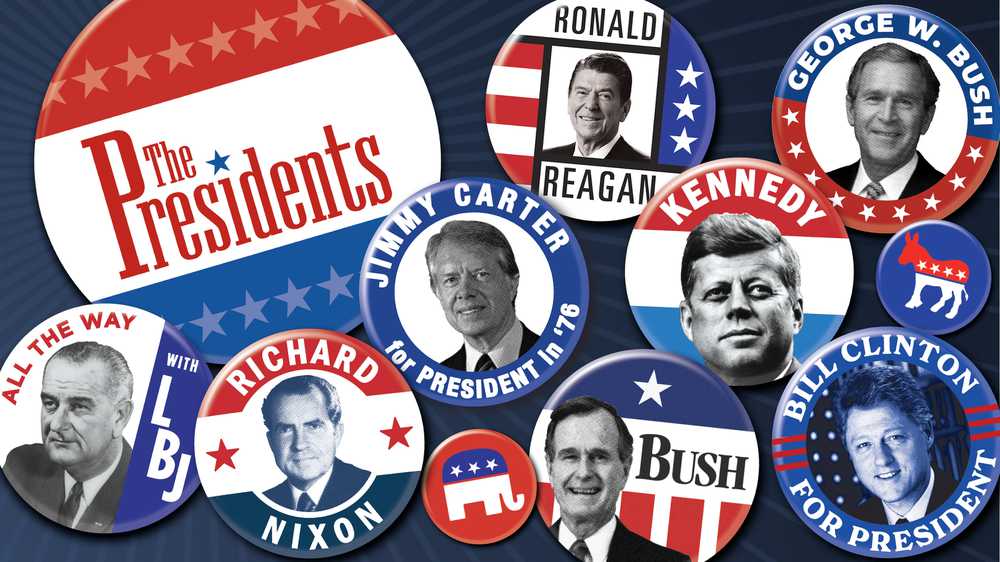
The Presidents Connect today's election issues with the past


Chapter:

Senator Truman, (6:45)
With the help of Kansas City political boss Tom Pendergast, Truman wins a seat in the U.S. Senate.
FDR

Now
Playing

Truman
LBJ
Nixon
Carter
Reagan
G H W Bush

Related Clips


FDR, Chapter 11

Government's Duty (6:28)
Governor Roosevelt's bold Depression relief programs position him to challenge President Herbert Hoover.
Watch Now

FDR, Chapter 12

A Better Day (5:31)
As the Depression worsens, Roosevelt is elected president and promises "a new deal for the forgotten man."
Watch Now

LBJ, Chapter 4

The Senate Campaign of 1948 (12:30)
Johnson runs a flamboyant campaign in a tough race. He wins the seat, dogged by rumors of fraud.
Watch Now

NIXON, Chapter 3

The Important Thing is to Win (5:58)
Nixon attends law school, marries, and serves in World War II. In 1946, he uses aggressive tactics to win a seat in Congress.
Watch Now

Chapter 1

Introduction (2:58)
Part one of a biography of Harry Truman, the 33rd president.
Watch Now

Chapter 2

Early Years (14:11)
Harry Truman grows up in Independence, Missouri. He gets his first taste of politics at the 1900 Democratic National Convention.
Watch Now

Chapter 3

The Family Farm (10:22)
After working office jobs in Kansas City, Truman returns to the family farm to help his father. He woos Elizabeth Wallace.
Watch Now

Chapter 4

Love and Death (10:23)
Bess Wallace rejects Truman. After his father dies, Truman leaves the farm to make his fortune, but fails in business.
Watch Now

Chapter 5

World War I (9:52)
Truman shows leadership as the captain of Battery D, fighting in World War I's bloodiest battles.
Watch Now

Chapter 6

Marriage and Politics (13:12)
After the war, Truman marries Bess Wallace and runs for public office.
Watch Now

Chapter 7

Senator Truman, (6:45)
With the help of Kansas City political boss Tom Pendergast, Truman wins a seat in the U.S. Senate.
Watch Now

Chapter 8

Truman Proves Himself (9:07)
Truman works hard to understand the workings of the Senate and finds sucess.
Watch Now

Chapter 9

The 1944 Election (11:21)
Truman becomes the Democrats' compromise choice for vice president.
Watch Now

Chapter 10

Vice President for 82 Days (5:25)
Roosevelt keeps Truman out of his inner circle. When the president dies, Truman is nervous and unprepared.
Watch Now

Chapter 11

A Man of the People (10:27)
As president, Truman makes a show of energy and confidence. Americans warm to his straightforward manner.
Watch Now

Chapter 12

Endgame in Japan (10:04)
After the war in Europe ends, Truman focuses on the bitter battle with Japan. Bess Truman is uncomfortable as first lady.
Watch Now

Chapter 13

On the World Stage (10:27)
Truman meets with Winston Churchill and Joseph Stalin to decide the fate of Europe. In New Mexico the atomic bomb is successfully tested.
Watch Now

Chapter 14

Nuclear Diplomacy (7:06)
Truman takes a tougher stance at Potsdam after receiving news of a successful atomic bomb test in New Mexico.
Watch Now

Chapter 15

Hiroshima and Nagasaki (7:32)
The U.S. drops atomic bombs on two Japanese cities. The Japanese surrender and World War II ends.
Watch Now

Chapter 16

CreditsProduction credits for part one of the television program.
Watch Now

Chapter 17

CreditsHead credits for part two of the television program.
Watch Now

Chapter 18

Introduction (2:16)
Part two of a biography of Harry Truman, the 33rd president.
Watch Now

Chapter 19

The Post War Economy (10:59)
Truman faces domestic challenges. He takes a tough stance against striking railroad workers.
Watch Now

Chapter 20

The Mid-Term Elections of 1946 (4:47)
The Republicans gain majorities in both houses of Congress.
Watch Now

Chapter 21

The Truman Doctrine (9:04)
As the Soviets control Eastern Europe, Truman acts to stop Communism in Greece and Turkey.
Watch Now

Chapter 22

American Power (6:50)
Truman establishes the Marshall Plan and prepares the country for a new kind of war -- the Cold War.
Watch Now

Chapter 23

A Stand for Human Rights (11:21)
Before the election of 1948, Truman boldly calls for civil rights for African Americans and for Israel to be recognized.
Watch Now

Chapter 24

The Conventions (6:41)
Despite Democrats' misgivings, President Truman is nominated at a dispirited Democratic Convention.
Watch Now

Chapter 25

Truman Defeats Dewey (9:47)
Taking his "New Deal" message on a whistlestop campaign across the country, Truman defeats New York governor Thomas Dewey.
Watch Now

Chapter 26

Fighting Communism (10:10)
Facing the Communist threat, Truman shows U.S. strength with an airlift to blockaded Berlin and air strikes and infantry in Korea.
Watch Now

Chapter 27

The Korean War (5:29)
U.S. troops in Korea retreat until Douglas MacArthur's surprise attack on Inchon forces the North Koreans to pull back to the 38th Parallel.
Watch Now

Chapter 28

Crossing the 38th Parallel (9:35)
MacArthur convinces Truman to fight the Chinese in Korea. Truman denies MacArthur's demand to use atomic weapons.
Watch Now

Chapter 29

Under Pressure (6:22)
Truman persists with a "limited war." Pressure on him grows intense as casualties mount and U.S. troops are repelled by Chinese forces.
Watch Now

Chapter 30

Dismissing MacArthur (6:58)
In a controversial move, Truman removes General Douglas MacArthur from his command for insubordination.
Watch Now

Chapter 31

The Last Years (9:06)
With the lowest popularity rating in history, Truman decides not to seek re-election. He retires to Independence, Missouri.
Watch Now

Chapter 32

CreditsProduction credits for part two of the television program.
Watch Now

  • TRUMAN: Chapter 1
  • TRUMAN: Chapter 2
  • TRUMAN: Chapter 3
  • TRUMAN: Chapter 4
  • TRUMAN: Chapter 5
  • TRUMAN: Chapter 6
  • TRUMAN: Chapter 7
  • TRUMAN: Chapter 8
  • TRUMAN: Chapter 9
  • TRUMAN: Chapter 10
  • TRUMAN: Chapter 11
  • TRUMAN: Chapter 12
  • TRUMAN: Chapter 13
  • TRUMAN: Chapter 14
  • TRUMAN: Chapter 15
  • TRUMAN: Chapter 16
  • TRUMAN: Chapter 17
  • TRUMAN: Chapter 18
  • TRUMAN: Chapter 19
  • TRUMAN: Chapter 20
  • TRUMAN: Chapter 21
  • TRUMAN: Chapter 22
  • TRUMAN: Chapter 23
  • TRUMAN: Chapter 24
  • TRUMAN: Chapter 25
  • TRUMAN: Chapter 26
  • TRUMAN: Chapter 27
  • TRUMAN: Chapter 28
  • TRUMAN: Chapter 29
  • TRUMAN: Chapter 30
  • TRUMAN: Chapter 31
  • TRUMAN: Chapter 32
Choose a format

Choose a Video Format

Quicktime | Windows Media

Download a free player
QuickTime | Windows Media

Related Links


TRUMAN
Learn more about Harry S. Truman.

Nazis in the News
Track the Nazis' rise in U.S. reports.

Carving a Mountain
See how Mount Rushmore was made.

Purchase Videos & DVDs

• See Comments

Loading comments...

You must log in to submit a comment. If you don't have an account at American Experience, you will need to register to comment. It's fast and easy to do!

Post a Comment (Limit 5000 Characters)

• View Transcripts •


Transcript: Chapter 07

NARRATOR: In 1932, when Harry went with Pendergast to the Democratic Convention in Chicago, he saw Franklin Roosevelt for the first time.

FDR: Give me your help in this crusade to restore America to its own people.

NARRATOR: In accepting his party's nomination, the fifty-one year old Roosevelt achieved a lifelong ambition.

Harry S. Truman was 48, unknown outside of Missouri. Now for the first time, he began to reveal his own ambitions. He let it be known that he wanted to run for Governor, or Congress. But Pendergast had other candidates in mind. Then, in 1934, when Pendergast was looking for a new senator, some of the boss's aides recommended Harry.

"Do you mean to tell me," Pendergast bellowed "you actually believe that Harry Truman can be elected to the United States Senate?"

After three other men turned him down, Pendergast settled for Harry Truman and backed him in the Missouri primary. Truman's opponents called him Pendergast's bellhop. The election turned on Kansas City, where Pendergast made certain that Truman got all but 11,000 of its 148,000 votes.

KEN HECHLER: Pendergast actually stuffed the ballot boxes with illegal votes and people that weren't registered.

NARRATOR: The new United States senator from Missouri was 50 years old -- and had never been to Washington for more than a few days.

DAVID MCCULLOUGH: So off he goes to Washington and Tom Pendergast's parting words to the new senator from Missouri are, "Keep your mouth shut and answer your mail." And he arrives in Washington with a shadow over him, a cloud over him as the "Senator from Pendergast." And there are certain senators who won't even speak to him because he has such a stigma attached to him.

NARRATOR: Harry, Bess and Margaret settled into the nation's capital, moving into an inexpensive, four-room apartment. But Bess wasn't happy there. She lasted just five months before she returned to Independence. Her mother wanted her home.

She and Margaret shuttled back and forth to Washington, where the Trumans rented one small apartment after another. Throughout Harry's years in the Senate, Bess spent much of her time in Independence, leaving Senator Truman heartsick and lonely.

Dear Bess, I've been wandering around like a lost soul this morning. ... It's a wrench to be without you. I never missed you so much before ...

Dear Bess, Your card was a lifesaver this morning. I never in my life spent such a lonesome night.

Dear Bess, Your letter came on the second mail so everything is all right...

Dear Bess, Your letter was in the first mail

Dear Bess, I do wish you'd let me hear at least every other day.

Dear Bess, Dreamed about you last night. Thought we were going through a flood together. We got through without disaster. The weather has been fine.

Dear Bess, It was good to hear your voice last night, but not half as good as really seeing and talking to you --

Dear Bess, I was so lonesome last night ... even if my combination of words makes you sick sometimes...

Dear Bess, Happy Birthday! ... If your dress doesn't fit you, send it back and we'll get a larger one.

Dear Bess, You don't know how much I appreciated the letter that came in the morning's mail. I was so devilishly homesick ... I could see you standing out there in the yard watching me drive away and I don't think you kissed me goodbye ...

NARRATOR: It would be years before Senator Truman gained enough confidence to work himself out from under Pendergast's shadow.

"He came in," a friend remembered, "with a real inferiority complex."

"I was as timid," Truman later wrote "as a country boy arriving on the campus of a great university."

With America caught in the grips of the Depression -- Truman fell in line with Franklin Roosevelt's New Deal programs. He called Roosevelt "the greatest of the greats."

But Roosevelt himself had no use for the junior senator from Missouri. It took five months before the White House summoned Truman for a 15-minute meeting. After just seven minutes, Truman was shown the door.

DAVID MCCULLOUGH: Roosevelt would have nothing to do with him. Roosevelt really gave him the back of his hand. People on the White House staff gave him the back of their hands. He couldn't get appointments. He wasn't somebody that they took very seriously.

NARRATOR: Truman sat for months in the Senate Chamber without making a single speech. He was known as "Go-along, get-along Harry."

DAVID MCCULLOUGH: He has to prove to the people in the Senate, that he's somebody to be taken seriously, that he's a hard worker and that he's honest and that he's going to do the job. And he gave it everything he had. He would work longer days, harder days than anybody. He was in there before anybody showed up. He was assigned to committees and he would show up when nobody else would show up for dreary committee sessions and dreary committee hearings, very often the only one there listening to hours and hours of deadly testimony about deadly subjects, but he was going to do the job. He was going to learn the business. And, as time went by, in a matter of about three or four years, they began to realize what kind of a fellow they had on their hands.

back to top


Major funding provided by the National
Endowment for the Humanities and the Corporation for Public Broadcasting

NEH Corporation for Public Broadcasting


Any views, findings, conclusions, or recommendations expressed in this Web site do not necessarily represent those of the National Endowment for the Humanities.