Visit Your Local PBS Station PBS Home PBS Home Programs A-Z TV Schedules Watch Video Support PBS Shop PBS Search PBS
 
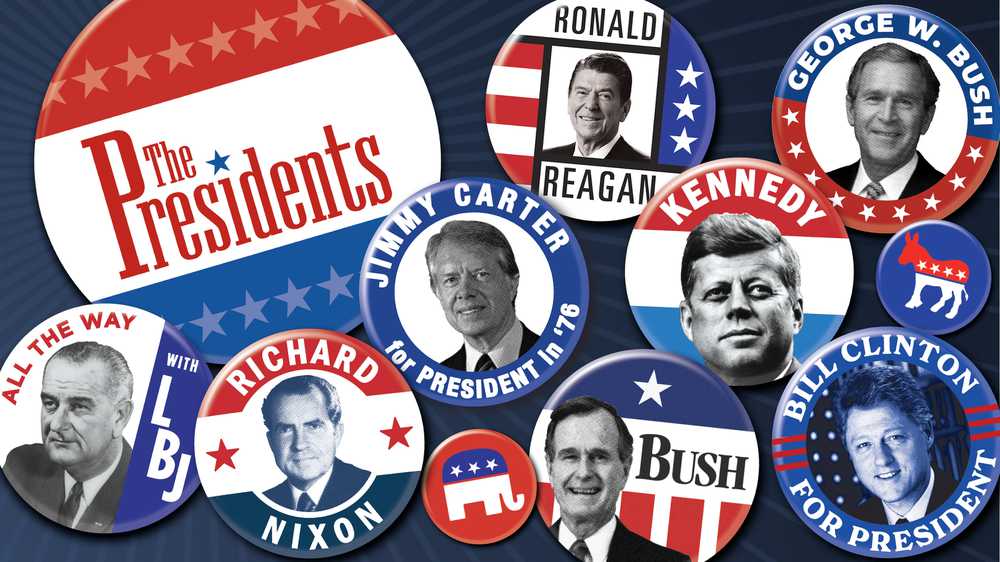
The Presidents Connect today's election issues with the past


Chapter:

The 1944 Election (11:21)
Truman becomes the Democrats' compromise choice for vice president.
FDR

Now
Playing

Truman
LBJ
Nixon
Carter
Reagan
G H W Bush

Related Clips


FDR, Chapter 22

America Goes to War (13:12)
Provoking an incident with a German U-boat, FDR leads the U.S. into World War II. The Japanese attack the U.S. fleet at Pearl Harbor.
Watch Now

LBJ, Chapter 7

Johnson Becomes Vice President (9:09)
Johnson loses the 1960 Democratic nomination but is named Senator John Kennedy's running mate. He becomes president in 1963 after Kennedy is shot.
Watch Now

NIXON, Chapter 7

Eisenhower's Point Man (4:47)
Nixon handles political assignments as vice president. He governs cautiously for two months while Eisenhower recovers from a heart attack. In 1956, the team is re-elected in a landslide.
Watch Now

Chapter 1

Introduction (2:58)
Part one of a biography of Harry Truman, the 33rd president.
Watch Now

Chapter 2

Early Years (14:11)
Harry Truman grows up in Independence, Missouri. He gets his first taste of politics at the 1900 Democratic National Convention.
Watch Now

Chapter 3

The Family Farm (10:22)
After working office jobs in Kansas City, Truman returns to the family farm to help his father. He woos Elizabeth Wallace.
Watch Now

Chapter 4

Love and Death (10:23)
Bess Wallace rejects Truman. After his father dies, Truman leaves the farm to make his fortune, but fails in business.
Watch Now

Chapter 5

World War I (9:52)
Truman shows leadership as the captain of Battery D, fighting in World War I's bloodiest battles.
Watch Now

Chapter 6

Marriage and Politics (13:12)
After the war, Truman marries Bess Wallace and runs for public office.
Watch Now

Chapter 7

Senator Truman, (6:45)
With the help of Kansas City political boss Tom Pendergast, Truman wins a seat in the U.S. Senate.
Watch Now

Chapter 8

Truman Proves Himself (9:07)
Truman works hard to understand the workings of the Senate and finds sucess.
Watch Now

Chapter 9

The 1944 Election (11:21)
Truman becomes the Democrats' compromise choice for vice president.
Watch Now

Chapter 10

Vice President for 82 Days (5:25)
Roosevelt keeps Truman out of his inner circle. When the president dies, Truman is nervous and unprepared.
Watch Now

Chapter 11

A Man of the People (10:27)
As president, Truman makes a show of energy and confidence. Americans warm to his straightforward manner.
Watch Now

Chapter 12

Endgame in Japan (10:04)
After the war in Europe ends, Truman focuses on the bitter battle with Japan. Bess Truman is uncomfortable as first lady.
Watch Now

Chapter 13

On the World Stage (10:27)
Truman meets with Winston Churchill and Joseph Stalin to decide the fate of Europe. In New Mexico the atomic bomb is successfully tested.
Watch Now

Chapter 14

Nuclear Diplomacy (7:06)
Truman takes a tougher stance at Potsdam after receiving news of a successful atomic bomb test in New Mexico.
Watch Now

Chapter 15

Hiroshima and Nagasaki (7:32)
The U.S. drops atomic bombs on two Japanese cities. The Japanese surrender and World War II ends.
Watch Now

Chapter 16

CreditsProduction credits for part one of the television program.
Watch Now

Chapter 17

CreditsHead credits for part two of the television program.
Watch Now

Chapter 18

Introduction (2:16)
Part two of a biography of Harry Truman, the 33rd president.
Watch Now

Chapter 19

The Post War Economy (10:59)
Truman faces domestic challenges. He takes a tough stance against striking railroad workers.
Watch Now

Chapter 20

The Mid-Term Elections of 1946 (4:47)
The Republicans gain majorities in both houses of Congress.
Watch Now

Chapter 21

The Truman Doctrine (9:04)
As the Soviets control Eastern Europe, Truman acts to stop Communism in Greece and Turkey.
Watch Now

Chapter 22

American Power (6:50)
Truman establishes the Marshall Plan and prepares the country for a new kind of war -- the Cold War.
Watch Now

Chapter 23

A Stand for Human Rights (11:21)
Before the election of 1948, Truman boldly calls for civil rights for African Americans and for Israel to be recognized.
Watch Now

Chapter 24

The Conventions (6:41)
Despite Democrats' misgivings, President Truman is nominated at a dispirited Democratic Convention.
Watch Now

Chapter 25

Truman Defeats Dewey (9:47)
Taking his "New Deal" message on a whistlestop campaign across the country, Truman defeats New York governor Thomas Dewey.
Watch Now

Chapter 26

Fighting Communism (10:10)
Facing the Communist threat, Truman shows U.S. strength with an airlift to blockaded Berlin and air strikes and infantry in Korea.
Watch Now

Chapter 27

The Korean War (5:29)
U.S. troops in Korea retreat until Douglas MacArthur's surprise attack on Inchon forces the North Koreans to pull back to the 38th Parallel.
Watch Now

Chapter 28

Crossing the 38th Parallel (9:35)
MacArthur convinces Truman to fight the Chinese in Korea. Truman denies MacArthur's demand to use atomic weapons.
Watch Now

Chapter 29

Under Pressure (6:22)
Truman persists with a "limited war." Pressure on him grows intense as casualties mount and U.S. troops are repelled by Chinese forces.
Watch Now

Chapter 30

Dismissing MacArthur (6:58)
In a controversial move, Truman removes General Douglas MacArthur from his command for insubordination.
Watch Now

Chapter 31

The Last Years (9:06)
With the lowest popularity rating in history, Truman decides not to seek re-election. He retires to Independence, Missouri.
Watch Now

Chapter 32

CreditsProduction credits for part two of the television program.
Watch Now

  • TRUMAN: Chapter 1
  • TRUMAN: Chapter 2
  • TRUMAN: Chapter 3
  • TRUMAN: Chapter 4
  • TRUMAN: Chapter 5
  • TRUMAN: Chapter 6
  • TRUMAN: Chapter 7
  • TRUMAN: Chapter 8
  • TRUMAN: Chapter 9
  • TRUMAN: Chapter 10
  • TRUMAN: Chapter 11
  • TRUMAN: Chapter 12
  • TRUMAN: Chapter 13
  • TRUMAN: Chapter 14
  • TRUMAN: Chapter 15
  • TRUMAN: Chapter 16
  • TRUMAN: Chapter 17
  • TRUMAN: Chapter 18
  • TRUMAN: Chapter 19
  • TRUMAN: Chapter 20
  • TRUMAN: Chapter 21
  • TRUMAN: Chapter 22
  • TRUMAN: Chapter 23
  • TRUMAN: Chapter 24
  • TRUMAN: Chapter 25
  • TRUMAN: Chapter 26
  • TRUMAN: Chapter 27
  • TRUMAN: Chapter 28
  • TRUMAN: Chapter 29
  • TRUMAN: Chapter 30
  • TRUMAN: Chapter 31
  • TRUMAN: Chapter 32
Choose a format

Choose a Video Format

Quicktime | Windows Media

Download a free player
QuickTime | Windows Media

Related Links


TRUMAN
Learn more about Harry S. Truman.

Did You Know?
Fast facts about the D-Day invasion.

Maps of the Holocaust
Learn about Nazi massacres of European Jews.

Purchase Videos & DVDs

• See Comments

Loading comments...

You must log in to submit a comment. If you don't have an account at American Experience, you will need to register to comment. It's fast and easy to do!

Post a Comment (Limit 5000 Characters)

• View Transcripts •


Transcript: Chapter 09

On July 18, 1944, when the Democrats convened in Chicago, the rumors that Harry Truman was going to be the next vice president were still just rumors. He had, in fact, arrived at the convention prepared to nominate another man.

"I don't want to be vice president," he would tell anyone who asked.

He was convinced that the president did not like him. But in 1944, the president would not dictate the choice for vice president. In the next few days, Harry Truman's fate would be decided by a group of powerful Democrats meeting behind closed doors.

DAVID MCCULLOUGH: The future of the country and his own immediate future and fate are all in the hands of forces beyond his control ... and he can't be anything but a kind of a chip on the surface of the water being swept along.

NARRATOR: As the convention got underway, the Democrats prepared to give their nomination for the fourth time to Franklin Roosevelt. Many of them already knew it would be the last.

The president was ill. Diagnosed with heart disease, he had never asked, and was never told, the extent of his illness. But those close to him were frightened by the deathlike pallor that shadowed the once ebullient face.

PAT HANNEGAN, Daughter of Democratic Party Chairman: It was not spoken of, the fact that Roosevelt might die. That was a deep, dark secret.

It was war time and no one wanted to talk about the president failing in any way....[but] I think that had to be behind everybody's minds.

HARRY BYRD, Senator: It was in the minds of many delegates that whoever was nominated for vice president could very well become president within the next four years. The entire focus of that convention was on who would be nominated for the vice presidency.

NARRATOR: The current vice president, Henry Wallace, was the man to beat. A champion of civil rights and labor, he was immensely popular with liberals, but conservative Democrats opposed him. Many of them turned to Jimmy Byrnes from South Carolina, a former senator and Supreme Court Justice. An avowed segregationist, he was unacceptable to liberals. With the democrats divided, party leaders were searching for a compromise. Party Chairman Bob Hannegan wanted neither Wallace nor Byrnes.

PAT HANNEGAN: My father and the other political advisors felt that Jimmy Byrnes would be a liability to the ticket. Southerners were a drawback at that time. Labor was not particularly fond of him. And my father was very concerned about Wallace as a possible president. He felt that he was sort of flaky. And from a politician's standpoint my father couldn't control him. So, my father felt that Truman would be somewhat blameless. That he would have no real drawbacks.

ALONZO HAMBY: So he emerges as a compromise candidate. "The Missouri Compromise," some people say. He has conservative friends.

Southerners like him. But he's been a good New Dealer. He's got labor union contacts. He emerges as the person everyone can agree on.

KEN HECHLER: It was simply, actually a dipping into almost the bottom of the barrel, you could almost say, to appoint as vice president, and to select as Vice president on the ticket, a man who didn't have anything against him.

CONVENTION SPEAKER: Ladies and gentlemen of the convention ...

NARRATOR: Unknown to the delegates, the party bosses were determined to make Truman vice president. Two weeks before, they had made a trip to the White House.

DAVID MCCULLOUGH: One July night in 1944, the big bosses met with Franklin Roosevelt and it was a very hot night, very humid with the long French doors open to the air and the curtain blowing and what little breeze there was, and they all sat around in their shirt sleeves, perspiring, talking about who ought to be the vice presidential choice. And the bosses all said it could not be Wallace, it could not be Byrnes, and it ought to be Truman. Roosevelt later told his son Jimmy that, in fact, he really didn't care. He was a tired, sick, ill man and his mind and what energy he had was all concentrated on the war.

PAT HANNEGAN: I think my father and other party leaders did the choosing and Roosevelt went along with it. I don't think he cared at this point. I think it was, I don't think it was a matter of great concern to him. If it had been, he would have known very well how to put the matter to rest.

NARRATOR: The most important Democrats were now lined up behind Truman, and at the convention, Bob Hannegan told the senator the vice presidential nomination was his.

PAT HANNEGAN: Once my father and his friends had pretty much set Truman up, then they had to convince Truman that he was going to run. And he was very much opposed to it, and he said he wouldn't do it.

PAT HANNEGAN: He didn't want to be president and he certainly didn't want to be president after Franklin Roosevelt. He didn't want to come in and try and have to fill those enormous shoes. He didn't think he was qualified to be the president of the United States. He was very happy where he was, in the Senate. He had gone through the trauma of the Pendergast years where his name had been rubbed in the mud along with Pendergast machine, and it hurt his family. He was a very devoted family man.

DAVID MCCULLOUGH: Bess had none of that kind of political ambition. She had no desire to see her husband become president. She certainly had no desire to be the First Lady. She didn't like the limelight and one of the reasons that they didn't want the nomination was a fear that her father's suicide would become public, that the country would find out that this disgraceful thing had happened in her past.

NARRATOR: But the momentum was building toward a Truman vice presidency, and Bess Truman would have to stand aside. On July 20, the party bosses summoned Truman to a suite in the Blackstone Hotel to listen in on a phone call that, unknown to the senator, they had rehearsed in advance with the president.

PAT HANNEGAN: My father got the president himself, President Roosevelt, to call him on the line and while he was on the line, he let Truman listen.

NARRATOR: The president's voice boomed so loud everyone in the room could hear:

"Have you got that fellow lined up yet?" the president asked.

"No," the president was told. "He is the contrariest goddamn mule from Missouri I ever dealt with."

"You tell the senator," Roosevelt said, "that if he wants to break up the Democratic party in the middle of the war, that's his responsibility." And then he banged down the phone.

"Well," Truman said, pacing up and down the floor, "if that's the situation I'll have to say yes. But why the hell didn't he tell me in the first place?"

ARCHIVAL SOUND ON FILM, CONVENTION ANNOUNCER: Harry Truman has received more than a majority. I do now declare him to be the nominee of the Democratic Party for vice president and the next vice president of the United States.

NARRATOR: On Friday, July 21, 1944, Harry Truman accepted his party's nomination for vice president.

PAT HANNEGAN: I think he was somewhat excited. I don't think Mrs. Truman was happy at all. I don't recall her ever smiling the whole time.

She was in a box not too far from us, and I don't recall any smiles down there. I think she was very unhappy about it.

ARCHIVAL SOUND ON FILM,TRUMAN: There's not much more that I can say to you except that I accept the honor with all the humility that a senator of the United States can assume in this position. Thank you very much.

NARRATOR: "After Dad's speech," Margaret Truman later wrote, "we were besieged by hordes of shouting, sweating photographers. Everyone wanted to touch us. Thankfully, the police formed a kind of phalanx around us, and we were able to get into a waiting car outside, where Mom looked at Dad, glared at him, and said, "Are we going to have to go through this for all the rest of our lives?"

As they headed back to Independence, Bess Truman refused to speak to anyone.

NEWSREEL OF TRUMANS READING LETTERS: Margaret: Dad, here's a nice letter from Marion.

TRUMAN: Oh, that's nice of Marion. You know I think Marion had a good time in Chicago. Here's one from your teacher, Miss Carr.

Margaret: Oh, Miss Carr.

TRUMAN: And here's one from Mr. Buger from St. Louis. Listen to what he says, "Please convey my congratulations to your loyal wife, charming daughter and dear mother -- whose great joy and happiness is shared by thousands of Americans. Isn't that nice?

Margaret: Certainly is.

PAT HANNEGAN: Once he was in it, he was all the way in it.

NEWSREEL OF TRUMANS READING LETTERS (SOF):

Margaret: Say Daddy, don't you wish you'd gone fishing last week.

TRUMAN: Well, I did go on a sort of fishing trip to Chicago, or at least it resulted that way.

PAT HANNEGAN: He was too much of a politician himself not to go for it all the way.

NARRATOR: Truman campaigned with his usual energy and determination, traveling thousands of miles, skipping meals, washing his socks in the basin of his sleeping car.

ALONZO HAMBY: He's designated as the party work horse. "This duty has been inflicted on me and I'm going to do it. But I'm apprehensive about the future."

NARRATOR: The night that Roosevelt and Truman were elected, Harry Truman could hardly sleep.

back to top


Major funding provided by the National
Endowment for the Humanities and the Corporation for Public Broadcasting

NEH Corporation for Public Broadcasting


Any views, findings, conclusions, or recommendations expressed in this Web site do not necessarily represent those of the National Endowment for the Humanities.