Visit Your Local PBS Station PBS Home PBS Home Programs A-Z TV Schedules Watch Video Support PBS Shop PBS Search PBS
 
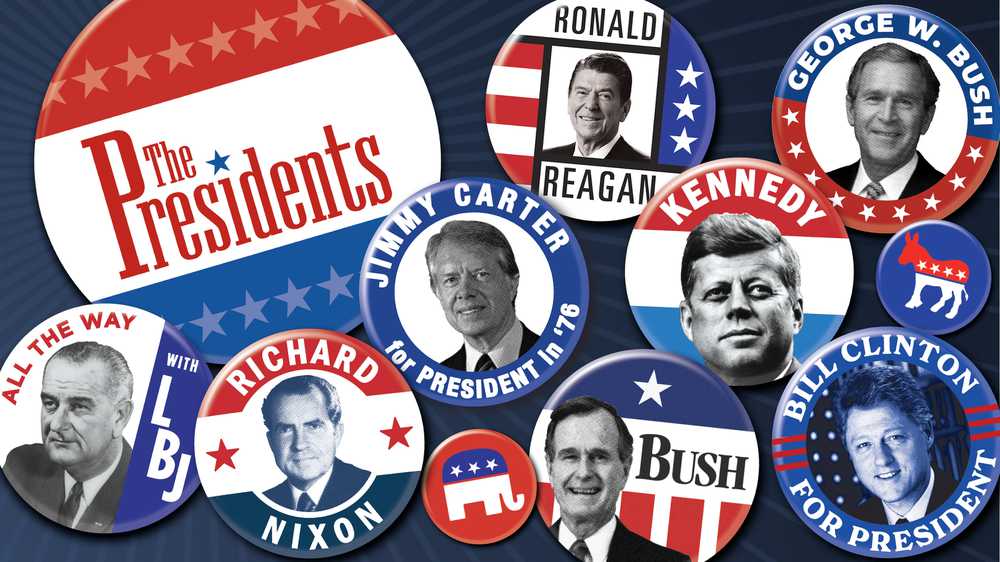
The Presidents Connect today's election issues with the past


Chapter:

Vice President for 82 Days (5:25)
Roosevelt keeps Truman out of his inner circle. When the president dies, Truman is nervous and unprepared.
FDR

Now
Playing

Truman
LBJ
Nixon
Carter
Reagan
G H W Bush

Related Clips


FDR, Chapter 23

The Allies Wage War (13:36)
With Americans fighting the Germans in North Africa, Roosevelt and Churchill plan an invasion of continental Europe.
Watch Now

LBJ, Chapter 7

Johnson Becomes Vice President (9:09)
Johnson loses the 1960 Democratic nomination but is named Senator John Kennedy's running mate. He becomes president in 1963 after Kennedy is shot.
Watch Now

TRUMAN, Chapter 15

Hiroshima and Nagasaki (7:32)
The U.S. drops atomic bombs on two Japanese cities. The Japanese surrender and World War II ends.
Watch Now

NIXON, Chapter 7

Eisenhower's Point Man (4:47)
Nixon handles political assignments as vice president. He governs cautiously for two months while Eisenhower recovers from a heart attack. In 1956, the team is re-elected in a landslide.
Watch Now

Chapter 1

Introduction (2:58)
Part one of a biography of Harry Truman, the 33rd president.
Watch Now

Chapter 2

Early Years (14:11)
Harry Truman grows up in Independence, Missouri. He gets his first taste of politics at the 1900 Democratic National Convention.
Watch Now

Chapter 3

The Family Farm (10:22)
After working office jobs in Kansas City, Truman returns to the family farm to help his father. He woos Elizabeth Wallace.
Watch Now

Chapter 4

Love and Death (10:23)
Bess Wallace rejects Truman. After his father dies, Truman leaves the farm to make his fortune, but fails in business.
Watch Now

Chapter 5

World War I (9:52)
Truman shows leadership as the captain of Battery D, fighting in World War I's bloodiest battles.
Watch Now

Chapter 6

Marriage and Politics (13:12)
After the war, Truman marries Bess Wallace and runs for public office.
Watch Now

Chapter 7

Senator Truman, (6:45)
With the help of Kansas City political boss Tom Pendergast, Truman wins a seat in the U.S. Senate.
Watch Now

Chapter 8

Truman Proves Himself (9:07)
Truman works hard to understand the workings of the Senate and finds sucess.
Watch Now

Chapter 9

The 1944 Election (11:21)
Truman becomes the Democrats' compromise choice for vice president.
Watch Now

Chapter 10

Vice President for 82 Days (5:25)
Roosevelt keeps Truman out of his inner circle. When the president dies, Truman is nervous and unprepared.
Watch Now

Chapter 11

A Man of the People (10:27)
As president, Truman makes a show of energy and confidence. Americans warm to his straightforward manner.
Watch Now

Chapter 12

Endgame in Japan (10:04)
After the war in Europe ends, Truman focuses on the bitter battle with Japan. Bess Truman is uncomfortable as first lady.
Watch Now

Chapter 13

On the World Stage (10:27)
Truman meets with Winston Churchill and Joseph Stalin to decide the fate of Europe. In New Mexico the atomic bomb is successfully tested.
Watch Now

Chapter 14

Nuclear Diplomacy (7:06)
Truman takes a tougher stance at Potsdam after receiving news of a successful atomic bomb test in New Mexico.
Watch Now

Chapter 15

Hiroshima and Nagasaki (7:32)
The U.S. drops atomic bombs on two Japanese cities. The Japanese surrender and World War II ends.
Watch Now

Chapter 16

CreditsProduction credits for part one of the television program.
Watch Now

Chapter 17

CreditsHead credits for part two of the television program.
Watch Now

Chapter 18

Introduction (2:16)
Part two of a biography of Harry Truman, the 33rd president.
Watch Now

Chapter 19

The Post War Economy (10:59)
Truman faces domestic challenges. He takes a tough stance against striking railroad workers.
Watch Now

Chapter 20

The Mid-Term Elections of 1946 (4:47)
The Republicans gain majorities in both houses of Congress.
Watch Now

Chapter 21

The Truman Doctrine (9:04)
As the Soviets control Eastern Europe, Truman acts to stop Communism in Greece and Turkey.
Watch Now

Chapter 22

American Power (6:50)
Truman establishes the Marshall Plan and prepares the country for a new kind of war -- the Cold War.
Watch Now

Chapter 23

A Stand for Human Rights (11:21)
Before the election of 1948, Truman boldly calls for civil rights for African Americans and for Israel to be recognized.
Watch Now

Chapter 24

The Conventions (6:41)
Despite Democrats' misgivings, President Truman is nominated at a dispirited Democratic Convention.
Watch Now

Chapter 25

Truman Defeats Dewey (9:47)
Taking his "New Deal" message on a whistlestop campaign across the country, Truman defeats New York governor Thomas Dewey.
Watch Now

Chapter 26

Fighting Communism (10:10)
Facing the Communist threat, Truman shows U.S. strength with an airlift to blockaded Berlin and air strikes and infantry in Korea.
Watch Now

Chapter 27

The Korean War (5:29)
U.S. troops in Korea retreat until Douglas MacArthur's surprise attack on Inchon forces the North Koreans to pull back to the 38th Parallel.
Watch Now

Chapter 28

Crossing the 38th Parallel (9:35)
MacArthur convinces Truman to fight the Chinese in Korea. Truman denies MacArthur's demand to use atomic weapons.
Watch Now

Chapter 29

Under Pressure (6:22)
Truman persists with a "limited war." Pressure on him grows intense as casualties mount and U.S. troops are repelled by Chinese forces.
Watch Now

Chapter 30

Dismissing MacArthur (6:58)
In a controversial move, Truman removes General Douglas MacArthur from his command for insubordination.
Watch Now

Chapter 31

The Last Years (9:06)
With the lowest popularity rating in history, Truman decides not to seek re-election. He retires to Independence, Missouri.
Watch Now

Chapter 32

CreditsProduction credits for part two of the television program.
Watch Now

  • TRUMAN: Chapter 1
  • TRUMAN: Chapter 2
  • TRUMAN: Chapter 3
  • TRUMAN: Chapter 4
  • TRUMAN: Chapter 5
  • TRUMAN: Chapter 6
  • TRUMAN: Chapter 7
  • TRUMAN: Chapter 8
  • TRUMAN: Chapter 9
  • TRUMAN: Chapter 10
  • TRUMAN: Chapter 11
  • TRUMAN: Chapter 12
  • TRUMAN: Chapter 13
  • TRUMAN: Chapter 14
  • TRUMAN: Chapter 15
  • TRUMAN: Chapter 16
  • TRUMAN: Chapter 17
  • TRUMAN: Chapter 18
  • TRUMAN: Chapter 19
  • TRUMAN: Chapter 20
  • TRUMAN: Chapter 21
  • TRUMAN: Chapter 22
  • TRUMAN: Chapter 23
  • TRUMAN: Chapter 24
  • TRUMAN: Chapter 25
  • TRUMAN: Chapter 26
  • TRUMAN: Chapter 27
  • TRUMAN: Chapter 28
  • TRUMAN: Chapter 29
  • TRUMAN: Chapter 30
  • TRUMAN: Chapter 31
  • TRUMAN: Chapter 32
Choose a format

Choose a Video Format

Quicktime | Windows Media

Download a free player
QuickTime | Windows Media

Related Links


TRUMAN
Learn more about Harry S. Truman.

Albert Einstein and Roosevelt
A 1939 letter describing the possibility of atomic bombs.

Letter from the Secretary of War
Truman learns about the Manhattan Project two weeks after Roosevelt's death.

Purchase Videos & DVDs

• See Comments

Loading comments...

You must log in to submit a comment. If you don't have an account at American Experience, you will need to register to comment. It's fast and easy to do!

Post a Comment (Limit 5000 Characters)

• View Transcripts •


Transcript: Chapter 10

NARRATOR: The vice president, Truman would say, is a "political eunuch." He presided over the Senate, writing letters home during the long senatorial debates, dropping by for a late afternoon drink with his old friends in Congress.

He seemed wholly unaffected by his new title -- "homespun as ever," one senator remarked. One afternoon, at a luncheon at the National Press Club, the vice president sat down at the piano to play the Missouri Waltz.

ALONZO HAMBY: Suddenly a young beautiful actress, Lauren Bacall, perches herself on top of the piano for some publicity portraits, showing a rather daring amount of leg by 1945 standards. Truman doesn't quite know how to react to this. He does what is probably the only intelligent thing to do, which is to keep smiling and keep playing the piano.

NARRATOR: Flashbulbs exploded. The audience cheered. The photos were an international sensation. Bess was furious.

ALONZO HAMBY: It did have kind of a loose association with the idea of the vice president being the piano player in a house of ill-repute.

Throughout his vice presidency, Truman was always kept outside Roosevelt's inner circle. FDR never took Truman into his confidence. The vice president met alone with the president just two times. He could never shake, Truman said, the feeling that the Roosevelt White House considered him "small potatoes."

Alonzo Hamby: He has what you might almost call a love-hate relationship with Roosevelt by this time. He admires him on the one-hand, doesn't quite trust him on the other hand. And the fact is that Roosevelt didn't pay much attention to his new vice president.

NARRATOR: Even when they had met for a private luncheon at the White House during the campaign, Roosevelt told Truman nothing of importance, posing for photographers and making small talk.

DAVID MCCULLOUGH: And it was as that point that Truman saw Roosevelt close-up for the first time. And saw how badly he looked. Saw the circles under his eyes, saw the droop of his shoulders, and noticed that when Roosevelt went to pour his cream into his coffee that his hand trembled so he could hardly do it.

NARRATOR: "I had been afraid for many weeks that something might happen," Truman admitted. "But I didn't allow myself to think about it."

ROBERT LIFTON, Biographer: I think Truman and everybody else at one level knew that Roosevelt wouldn't live out his term. But there was a shared denial that was overwhelming. It came from Roosevelt and from Truman. So that the result was that there was absolutely no preparation of the vice president by a very sick president for the presidency. And Truman, he didn't take the most modest kind of effort toward imagining himself as president and preparing himself for the presidency.

ALONZO HAMBY: He tells a friend in Missouri that Roosevelt has the pallor death on his face. He's very worried that he's going to have the presidency thrust on him and that it might happen at any moment.

NARRATOR: On April 12, 1945, Truman rushed to the White House. Franklin Roosevelt was dead. Vice president for just 82 days, Harry S. Truman was now president of the United States. He was frightened and insecure. "I'm not big enough for this job," Truman said. After taking the oath, Truman gathered his cabinet around him. He barely knew these men.

Now he asked for their support. Secretary of War Henry Stimson remained while the rest silently drifted away. "He wanted me to know about an immense project," Truman wrote later, "to develop a new explosive of almost unbelievable destructive power. That was all he felt free to say at the time, and his statement left me puzzled." Harry Truman was president, and he knew nothing about the atomic bomb.

back to top


Major funding provided by the National
Endowment for the Humanities and the Corporation for Public Broadcasting

NEH Corporation for Public Broadcasting


Any views, findings, conclusions, or recommendations expressed in this Web site do not necessarily represent those of the National Endowment for the Humanities.