Visit Your Local PBS Station PBS Home PBS Home Programs A-Z TV Schedules Watch Video Support PBS Shop PBS Search PBS
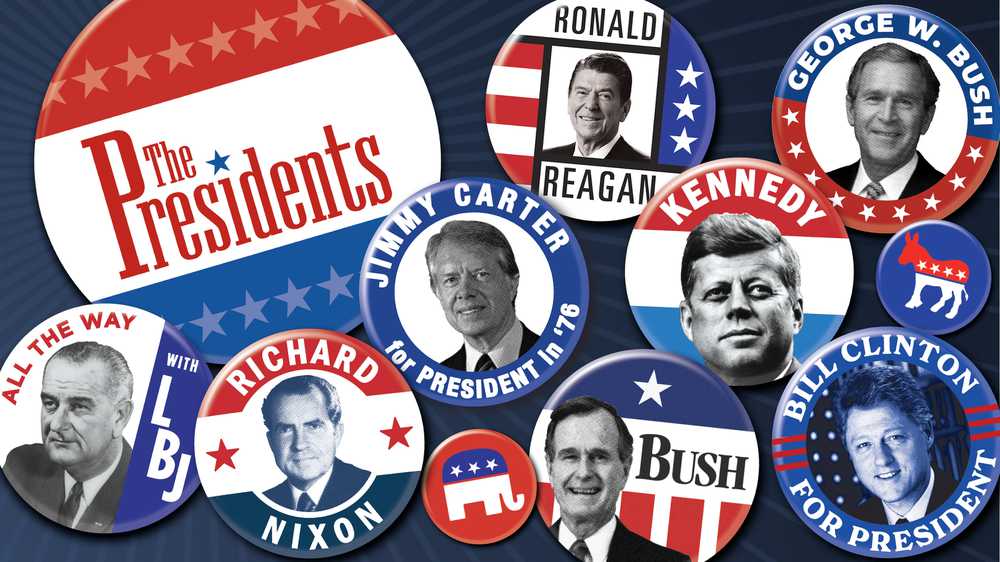
The Presidents Connect today's election issues with the past


Chapter:

American Power (6:50)
Truman establishes the Marshall Plan and prepares the country for a new kind of war -- the Cold War.
FDR

Now
Playing

Truman
LBJ
Nixon
Carter
Reagan
G H W Bush

Related Clips


Watch here for related video from this and other Presidential biographies.

Chapter 1

Introduction (2:58)
Part one of a biography of Harry Truman, the 33rd president.
Watch Now

Chapter 2

Early Years (14:11)
Harry Truman grows up in Independence, Missouri. He gets his first taste of politics at the 1900 Democratic National Convention.
Watch Now

Chapter 3

The Family Farm (10:22)
After working office jobs in Kansas City, Truman returns to the family farm to help his father. He woos Elizabeth Wallace.
Watch Now

Chapter 4

Love and Death (10:23)
Bess Wallace rejects Truman. After his father dies, Truman leaves the farm to make his fortune, but fails in business.
Watch Now

Chapter 5

World War I (9:52)
Truman shows leadership as the captain of Battery D, fighting in World War I's bloodiest battles.
Watch Now

Chapter 6

Marriage and Politics (13:12)
After the war, Truman marries Bess Wallace and runs for public office.
Watch Now

Chapter 7

Senator Truman, (6:45)
With the help of Kansas City political boss Tom Pendergast, Truman wins a seat in the U.S. Senate.
Watch Now

Chapter 8

Truman Proves Himself (9:07)
Truman works hard to understand the workings of the Senate and finds sucess.
Watch Now

Chapter 9

The 1944 Election (11:21)
Truman becomes the Democrats' compromise choice for vice president.
Watch Now

Chapter 10

Vice President for 82 Days (5:25)
Roosevelt keeps Truman out of his inner circle. When the president dies, Truman is nervous and unprepared.
Watch Now

Chapter 11

A Man of the People (10:27)
As president, Truman makes a show of energy and confidence. Americans warm to his straightforward manner.
Watch Now

Chapter 12

Endgame in Japan (10:04)
After the war in Europe ends, Truman focuses on the bitter battle with Japan. Bess Truman is uncomfortable as first lady.
Watch Now

Chapter 13

On the World Stage (10:27)
Truman meets with Winston Churchill and Joseph Stalin to decide the fate of Europe. In New Mexico the atomic bomb is successfully tested.
Watch Now

Chapter 14

Nuclear Diplomacy (7:06)
Truman takes a tougher stance at Potsdam after receiving news of a successful atomic bomb test in New Mexico.
Watch Now

Chapter 15

Hiroshima and Nagasaki (7:32)
The U.S. drops atomic bombs on two Japanese cities. The Japanese surrender and World War II ends.
Watch Now

Chapter 16

CreditsProduction credits for part one of the television program.
Watch Now

Chapter 17

CreditsHead credits for part two of the television program.
Watch Now

Chapter 18

Introduction (2:16)
Part two of a biography of Harry Truman, the 33rd president.
Watch Now

Chapter 19

The Post War Economy (10:59)
Truman faces domestic challenges. He takes a tough stance against striking railroad workers.
Watch Now

Chapter 20

The Mid-Term Elections of 1946 (4:47)
The Republicans gain majorities in both houses of Congress.
Watch Now

Chapter 21

The Truman Doctrine (9:04)
As the Soviets control Eastern Europe, Truman acts to stop Communism in Greece and Turkey.
Watch Now

Chapter 22

American Power (6:50)
Truman establishes the Marshall Plan and prepares the country for a new kind of war -- the Cold War.
Watch Now

Chapter 23

A Stand for Human Rights (11:21)
Before the election of 1948, Truman boldly calls for civil rights for African Americans and for Israel to be recognized.
Watch Now

Chapter 24

The Conventions (6:41)
Despite Democrats' misgivings, President Truman is nominated at a dispirited Democratic Convention.
Watch Now

Chapter 25

Truman Defeats Dewey (9:47)
Taking his "New Deal" message on a whistlestop campaign across the country, Truman defeats New York governor Thomas Dewey.
Watch Now

Chapter 26

Fighting Communism (10:10)
Facing the Communist threat, Truman shows U.S. strength with an airlift to blockaded Berlin and air strikes and infantry in Korea.
Watch Now

Chapter 27

The Korean War (5:29)
U.S. troops in Korea retreat until Douglas MacArthur's surprise attack on Inchon forces the North Koreans to pull back to the 38th Parallel.
Watch Now

Chapter 28

Crossing the 38th Parallel (9:35)
MacArthur convinces Truman to fight the Chinese in Korea. Truman denies MacArthur's demand to use atomic weapons.
Watch Now

Chapter 29

Under Pressure (6:22)
Truman persists with a "limited war." Pressure on him grows intense as casualties mount and U.S. troops are repelled by Chinese forces.
Watch Now

Chapter 30

Dismissing MacArthur (6:58)
In a controversial move, Truman removes General Douglas MacArthur from his command for insubordination.
Watch Now

Chapter 31

The Last Years (9:06)
With the lowest popularity rating in history, Truman decides not to seek re-election. He retires to Independence, Missouri.
Watch Now

Chapter 32

CreditsProduction credits for part two of the television program.
Watch Now

Related Links


TRUMAN
Learn more about Harry S. Truman.

How Do You Save Europe?
Historian Walter LaFeber on postwar aid.

Women and Work
Explore women's roles after the war.

Purchase Videos & DVDs

• See Comments

Loading comments...

You must log in to submit a comment. If you don't have an account at American Experience, you will need to register to comment. It's fast and easy to do!

Post a Comment (Limit 5000 Characters)

• View Transcripts •


Transcript: Chapter 22

NARRATOR: The president would resist Communist aggression abroad. He had issued a declaration of Cold War. But in Western Europe, there was more to fear from starvation and chaos than from the Red Army. It had been the worst winter in living memory. The war had been over for more than two years, and Western Europe seemed on the verge of collapse.

WALTER LAFEBER: If Western Europe was not helped and quickly, mass starvation would break out and there was the real danger that Western Europe would begin moving to the left very rapidly. The analysis made within the State Department at this point indicated that the way to deal with this was not militarily. The way to deal with this was economically, to pump in between eight and $17 billion so that the Europeans would have the money to buy food from the United States, food and other resources.

NARRATOR: Truman had already managed to persuade a reluctant Congress to give him $400 million for the Truman Doctrine. Now he convinced Congress to give him $13 billion more. No president had ever received so much money to aid people who weren't Americans. He called his economic aide program -- the Marshall Plan, after his secretary of state George Marshall, a man who commanded the respect of the entire country.

GEORGE ELSEY: Some of the White House staff suggested to President Truman they didn't much like this idea of General Marshall getting credit for it. Truman was very firm on that. "The Congress will do anything George Marshall wants. If my name is on it, it probably will become controversial. I don't want it to become controversial. I want it to succeed. It's the Marshall Plan. We'll have no more talk about changing the name."

WALTER LAFEBER: Truman would later say that the Truman Doctrine and the Marshall Plan were two halves of the same walnut. The Truman Doctrine was the military and political commitment. The Marshall Plan was the $13 billion finally in economic commitment to rebuild what Truman called the "free peoples of the world".

LUCIUS BATTLE: It became very popular, very quickly. No one expected that sort of altruism, that sort of sweeping thing coming out of us ... this was much bigger than anybody had realized.

ROBERT DONOVAN: A great appeal of the Marshall Plan was that these billions that were being appropriated were being spent in the United States to farmers and manufacturers. That money wasn't spent in Europe. It was spent here, and that was a great appeal to Congress.

VICTOR REUTHER: This was a terribly important decision, also it was a compassionate one, and understood as such. It was a real badge of honor for Harry Truman.

NARRATOR: While the president was rescuing Europe and mobilizing Americans to fight Communism overseas, Republicans charged that there were Communists here at home -- in Truman's own administration. In the 30s, Republicans had claimed that there were Communists in Roosevelt's New Deal. Now they were demanding that Truman take action.

CLARK CLIFFORD: There were lots of pressures developing about Communists infiltrating our whole system. And he felt obliged to do something. He did not believe there were disloyal employees. He did not believe that. He said on a number of occasions, "Our enemy is abroad. Our enemy is not here at home."

WALTER LAFEBER: Truman is in a terrible position here because, if he had not done anything, he would have been open to the accusation that he was tough on Communism abroad, but he was overlooking Communists within his own government, whatever few there were.

NARRATOR: On March 21, 1947, against his own better judgment, the president issued an extraordinary executive order: he established a loyalty program, making the political beliefs of every federal employee subject to investigation by the FBI.

ELLEN SCHRECKER, Historian: Truman, trying to mobilize public opinion for the Cold War, exaggerated the Communist menace. He presented, the Cold War as a kind of crusade against Communist totalitarianism. And you don't break up your crusade into "This is the European part. We'll focus on this. And let's not look at the American part. It was a total crusade.

NARRATOR: Harry Truman was leading America in a new kind of war. And he prepared the country as it had never been prepared before. He created the Department of Defense; he established the National Security Council, and the CIA -- the Central Intelligence Agency, putting the United States in the business of peacetime spying for the first time in its history. Soon there would be another first: NATO, America's first peacetime alliance -- a bulwark set in Western Europe against Communism. Truman was changing the way Americans looked at the world, and at themselves.

WALTER LAFEBER: I think Truman's great contribution to American politics was to figure out how to get Americans to commit themselves to a war which was cold rather than hot, a war which had not been declared, a war which is extremely complex, and yet which Truman defined as a rather "simple" war between the enslaved and the free peoples. This is how he got Americans to commit themselves to the Cold War, in which Russian and American soldiers were beginning to peer across boundaries at each other.

NARRATOR: The Cold War had begun, and it would last for the next half-century.

back to top


Major funding provided by the National
Endowment for the Humanities and the Corporation for Public Broadcasting

NEH Corporation for Public Broadcasting


Any views, findings, conclusions, or recommendations expressed in this Web site do not necessarily represent those of the National Endowment for the Humanities.