Visit Your Local PBS Station PBS Home PBS Home Programs A-Z TV Schedules Watch Video Support PBS Shop PBS Search PBS
 
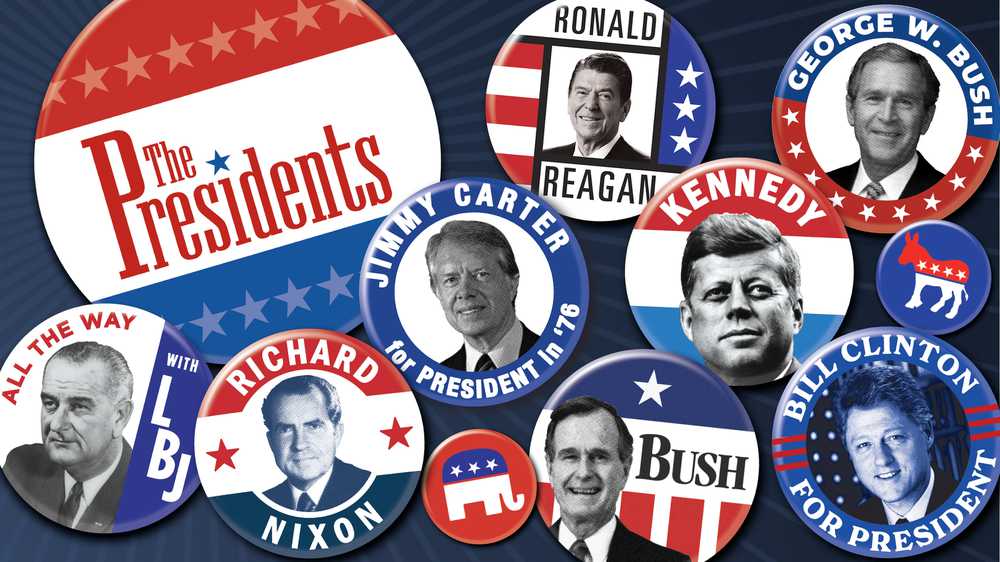
The Presidents Connect today's election issues with the past


Chapter:

The Conventions (6:41)
Despite Democrats' misgivings, President Truman is nominated at a dispirited Democratic Convention.
FDR

Now
Playing

Truman
LBJ
Nixon
Carter
Reagan
G H W Bush

Related Clips


FDR, Chapter 10

The Return (7:25)
After learning to appear to be walking, Roosevelt returns to politics and is elected governor of New York.
Watch Now

LBJ, Chapter 6

The Civil Rights Act of 1957 (6:47)
Setting the stage for a presidential run, Johnson builds consensus to protect African Americans' voting rights.
Watch Now

LBJ, Chapter 7

Johnson Becomes Vice President (9:09)
Johnson loses the 1960 Democratic nomination but is named Senator John Kennedy's running mate. He becomes president in 1963 after Kennedy is shot.
Watch Now

REAGAN, Chapter 8

A Surprising Presidential Bid (7:56)
Ronald Reagan campaigns for but loses the Republican nomination for president in 1976.
Watch Now

NIXON, Chapter 8

The Bronze Warrior (8:58)
In 1960, with the first televised presidential debates, Nixon loses a close presidential race to a tanned, charming Democratic senator, John F. Kennedy.
Watch Now

NIXON, Chapter 10

Triumph (15:19)
Nixon works as a Wall Street lawyer but keeps active in politics. In a remarkable comeback, he wins the presidency in 1968.
Watch Now

Chapter 1

Introduction (2:58)
Part one of a biography of Harry Truman, the 33rd president.
Watch Now

Chapter 2

Early Years (14:11)
Harry Truman grows up in Independence, Missouri. He gets his first taste of politics at the 1900 Democratic National Convention.
Watch Now

Chapter 3

The Family Farm (10:22)
After working office jobs in Kansas City, Truman returns to the family farm to help his father. He woos Elizabeth Wallace.
Watch Now

Chapter 4

Love and Death (10:23)
Bess Wallace rejects Truman. After his father dies, Truman leaves the farm to make his fortune, but fails in business.
Watch Now

Chapter 5

World War I (9:52)
Truman shows leadership as the captain of Battery D, fighting in World War I's bloodiest battles.
Watch Now

Chapter 6

Marriage and Politics (13:12)
After the war, Truman marries Bess Wallace and runs for public office.
Watch Now

Chapter 7

Senator Truman, (6:45)
With the help of Kansas City political boss Tom Pendergast, Truman wins a seat in the U.S. Senate.
Watch Now

Chapter 8

Truman Proves Himself (9:07)
Truman works hard to understand the workings of the Senate and finds sucess.
Watch Now

Chapter 9

The 1944 Election (11:21)
Truman becomes the Democrats' compromise choice for vice president.
Watch Now

Chapter 10

Vice President for 82 Days (5:25)
Roosevelt keeps Truman out of his inner circle. When the president dies, Truman is nervous and unprepared.
Watch Now

Chapter 11

A Man of the People (10:27)
As president, Truman makes a show of energy and confidence. Americans warm to his straightforward manner.
Watch Now

Chapter 12

Endgame in Japan (10:04)
After the war in Europe ends, Truman focuses on the bitter battle with Japan. Bess Truman is uncomfortable as first lady.
Watch Now

Chapter 13

On the World Stage (10:27)
Truman meets with Winston Churchill and Joseph Stalin to decide the fate of Europe. In New Mexico the atomic bomb is successfully tested.
Watch Now

Chapter 14

Nuclear Diplomacy (7:06)
Truman takes a tougher stance at Potsdam after receiving news of a successful atomic bomb test in New Mexico.
Watch Now

Chapter 15

Hiroshima and Nagasaki (7:32)
The U.S. drops atomic bombs on two Japanese cities. The Japanese surrender and World War II ends.
Watch Now

Chapter 16

CreditsProduction credits for part one of the television program.
Watch Now

Chapter 17

CreditsHead credits for part two of the television program.
Watch Now

Chapter 18

Introduction (2:16)
Part two of a biography of Harry Truman, the 33rd president.
Watch Now

Chapter 19

The Post War Economy (10:59)
Truman faces domestic challenges. He takes a tough stance against striking railroad workers.
Watch Now

Chapter 20

The Mid-Term Elections of 1946 (4:47)
The Republicans gain majorities in both houses of Congress.
Watch Now

Chapter 21

The Truman Doctrine (9:04)
As the Soviets control Eastern Europe, Truman acts to stop Communism in Greece and Turkey.
Watch Now

Chapter 22

American Power (6:50)
Truman establishes the Marshall Plan and prepares the country for a new kind of war -- the Cold War.
Watch Now

Chapter 23

A Stand for Human Rights (11:21)
Before the election of 1948, Truman boldly calls for civil rights for African Americans and for Israel to be recognized.
Watch Now

Chapter 24

The Conventions (6:41)
Despite Democrats' misgivings, President Truman is nominated at a dispirited Democratic Convention.
Watch Now

Chapter 25

Truman Defeats Dewey (9:47)
Taking his "New Deal" message on a whistlestop campaign across the country, Truman defeats New York governor Thomas Dewey.
Watch Now

Chapter 26

Fighting Communism (10:10)
Facing the Communist threat, Truman shows U.S. strength with an airlift to blockaded Berlin and air strikes and infantry in Korea.
Watch Now

Chapter 27

The Korean War (5:29)
U.S. troops in Korea retreat until Douglas MacArthur's surprise attack on Inchon forces the North Koreans to pull back to the 38th Parallel.
Watch Now

Chapter 28

Crossing the 38th Parallel (9:35)
MacArthur convinces Truman to fight the Chinese in Korea. Truman denies MacArthur's demand to use atomic weapons.
Watch Now

Chapter 29

Under Pressure (6:22)
Truman persists with a "limited war." Pressure on him grows intense as casualties mount and U.S. troops are repelled by Chinese forces.
Watch Now

Chapter 30

Dismissing MacArthur (6:58)
In a controversial move, Truman removes General Douglas MacArthur from his command for insubordination.
Watch Now

Chapter 31

The Last Years (9:06)
With the lowest popularity rating in history, Truman decides not to seek re-election. He retires to Independence, Missouri.
Watch Now

Chapter 32

CreditsProduction credits for part two of the television program.
Watch Now

  • TRUMAN: Chapter 1
  • TRUMAN: Chapter 2
  • TRUMAN: Chapter 3
  • TRUMAN: Chapter 4
  • TRUMAN: Chapter 5
  • TRUMAN: Chapter 6
  • TRUMAN: Chapter 7
  • TRUMAN: Chapter 8
  • TRUMAN: Chapter 9
  • TRUMAN: Chapter 10
  • TRUMAN: Chapter 11
  • TRUMAN: Chapter 12
  • TRUMAN: Chapter 13
  • TRUMAN: Chapter 14
  • TRUMAN: Chapter 15
  • TRUMAN: Chapter 16
  • TRUMAN: Chapter 17
  • TRUMAN: Chapter 18
  • TRUMAN: Chapter 19
  • TRUMAN: Chapter 20
  • TRUMAN: Chapter 21
  • TRUMAN: Chapter 22
  • TRUMAN: Chapter 23
  • TRUMAN: Chapter 24
  • TRUMAN: Chapter 25
  • TRUMAN: Chapter 26
  • TRUMAN: Chapter 27
  • TRUMAN: Chapter 28
  • TRUMAN: Chapter 29
  • TRUMAN: Chapter 30
  • TRUMAN: Chapter 31
  • TRUMAN: Chapter 32
Choose a format

Choose a Video Format

Quicktime | Windows Media

Download a free player
QuickTime | Windows Media

Related Links


TRUMAN
Learn more about Harry S. Truman.

The Election of 1948
Vote on the year's top issues.

The Berlin Airlift
A humanitarian campaign -- and Cold War battle.

Purchase Videos & DVDs

• See Comments

Loading comments...

You must log in to submit a comment. If you don't have an account at American Experience, you will need to register to comment. It's fast and easy to do!

Post a Comment (Limit 5000 Characters)

• View Transcripts •


Transcript: Chapter 24

NARRATOR: On June 21, the Republicans convened in Philadelphia. After three days of celebrating free enterprise and denouncing Harry Truman, they nominated for president the urbane, progressive governor of New York, Thomas Dewey.

ARCHIVAL FILM OF DEWEY: I pray God that I may deserve this opportunity to serve our country. In all humility I accept the nomination.

NARRATOR: Four years earlier, Dewey had run a strong race against the undefeatable Franklin Roosevelt. This time around, Republicans giddily anticipated victory against Roosevelt's stand-in -- Harry Truman.

ALONZO HAMBY: He still appeared to a lot of Americans to be a little guy, an ordinary man, someone who utterly lacked the charisma of his predecessor, Roosevelt. Americans still really wondered whether someone who appeared to be so much like themselves could really handle the duties and responsibilities of the presidency.

NARRATOR: In July, the Democrats gathered in the same Philadelphia hall where two weeks earlier the Republicans had given their nomination to Thomas Dewey. For the first time, television was there to report the story.

Truman watched from the Oval Office what Newsweek magazine would call "the worst managed, most dispirited convention in American history."

ROBERT DONOVAN: There was no air-conditioning, and it was from the beginning a sweltering convention, in the hotel rooms as well as in the hall. It was a dismal convention from the start because the convention thought that they were going to nominate a loser. No one in that convention hall thought Truman could win.

NARRATOR: The Democratic party was splitting apart, and no one thought Harry Truman could hold it together. Left-leaning Democrats had already turned to the Progressive Party and their candidate for president, Henry Wallace. Conservative Southern Democrats, furious over Truman's stand on civil rights, were threatening to walk out of the convention.

ARCHIVAL SOUND ON FILM OF MISSISSIPPI DELEGATE: "The delegation from Mississippi cannot be true to the people of that great state if they did not join in this walkout."

NARRATOR: In the end, three dozen Southern delegates bolted.

ARCHIVAL SOUND ON FILM OF MISSISSIPPI DELEGATE: "And we bid you goodbye."

NARRATOR: Two days later, they formed their own party, the "Dixiecrats."

DAVID MCCULLOUGH: And it seemed, another devastating blow to Truman's prospects. The combination of the Southerners walking out, and Henry Wallace leading his own Progressive Party campaign, plus all the gloom and doom that seemed to prevail throughout the Democratic Party, spelled only defeat, spelled a very bleak future.

NARRATOR: But as Harry Truman arrived in Philadelphia, he was anything but bleak. In a small, windowless room beneath the convention floor, he sat with vice-presidential nominee Alben Barkley and waited.

DAVID MCCULLOUGH: They kept him waiting 'til almost two o'clock in the morning. Everybody was exhausted. They felt demoralized. They didn't, many of them, want Harry Truman to be their candidate. The Southerners had walked out of the convention. And so, at two o'clock in the morning, out came Harry Truman in his white linen suit, and he stood up there, and he said,

ARCHIVAL FILM: TRUMAN SPEECH "Senator Barkley and I will win this election and make these Republicans like it. Don't you forget that."

ALONZO HAMBY: He's a fighter. Truman is not about the slink out of town with his tail between his legs.

ARCHIVAL SOUND ON FILM: HARRY TRUMAN "The Republican platform cries about cruelly high prices..."

NARRATOR: Truman had come into the presidency bewildered and frightened. Now, the delegates sat stunned as a fire-breathing Truman tore into the Republicans.

HARRY TRUMAN ARCHIVAL SOUND ON FILM: "The Republican platform comes out for slum clearance and low rental housing. I've been trying to get them to pass that housing bill ever since they met the first time.

NARRATOR: Truman challenged the Republicans to live up to their promises.

TRUMAN, ARCHIVAL (SOF): I am therefore calling the Congress back into session on the 26th of July. If there's any reality behind that Republican platform we ought to get some action out of the short session of the 80th Congress. They can do this job within fifteen days, if they want to do it, and they'll still have time to go out and run for office.

NARRATOR: Truman had come out fighting, but still, no one thought he could win. All the polls made him a sure loser.

DAVID MCCULLOUGH: Everybody thought he was going to lose. I mean, that's not just a figure of speech, even members of his own family. His mother-in-law was quite sure that Harry Truman was going to lose.

NARRATOR: Truman's Republican opponent was everything Truman was not. Educated, smooth, sophisticated, Tom Dewey was prepared, he said, to turn back 16 years of Democratic rule.

DEWEY, ARCHIVAL (SOF): "I pledge to you that on next January 20, there will begin in Washington the biggest unraveling, unsnarling, untangling operation in our nation's history."

ROBERT DONOVAN: From the beginning Dewey was transfixed by polls and by Time magazine and everyone else who was boosting him for president. He was very pleased with himself, very pleased with what he'd done. Very sure that he was going to go on and be a great figure. They were so confident that some of the Dewey people had already bought houses in Washington.

back to top


Major funding provided by the National
Endowment for the Humanities and the Corporation for Public Broadcasting

NEH Corporation for Public Broadcasting


Any views, findings, conclusions, or recommendations expressed in this Web site do not necessarily represent those of the National Endowment for the Humanities.