Visit Your Local PBS Station PBS Home PBS Home Programs A-Z TV Schedules Watch Video Support PBS Shop PBS Search PBS
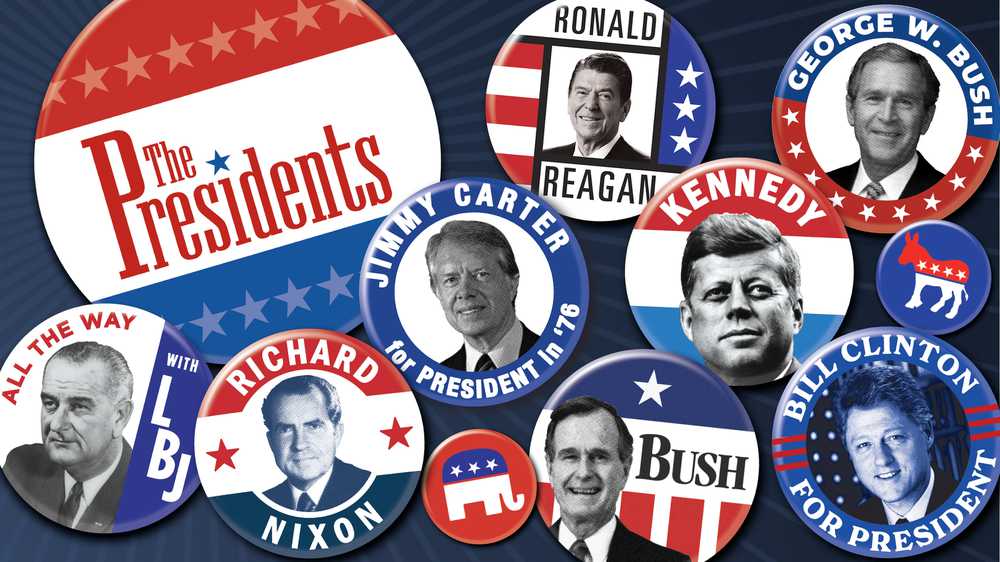
The Presidents Connect today's election issues with the past


Chapter:

Truman Defeats Dewey (9:47)
Taking his "New Deal" message on a whistlestop campaign across the country, Truman defeats New York governor Thomas Dewey.
FDR

Now
Playing

Truman
LBJ
Nixon
Carter
Reagan
G H W Bush

Related Clips


CARTER, Chapter 17

Hostages (12:39)
U.S. Embassy employees are taken hostage in Iran after a fundamentalist Islamic revolution. A military rescue mission fails.
Watch Now

LBJ, Chapter 12

Gulf of Tonkin (9:11)
Johnson claims that North Vietnam has attacked a U.S. destroyer. He uses the incident as the basis for expanding the war against North Vietnam.
Watch Now

FDR, Chapter 11

Government's Duty (6:28)
Governor Roosevelt's bold Depression relief programs position him to challenge President Herbert Hoover.
Watch Now

FDR, Chapter 12

A Better Day (5:31)
As the Depression worsens, Roosevelt is elected president and promises "a new deal for the forgotten man."
Watch Now

REAGAN, Chapter 20

Morning in America (9:11)
America's economy has improved and national confidence is renewed. Reagan wins a second term in a landslide.
Watch Now

Chapter 1

Introduction (2:58)
Part one of a biography of Harry Truman, the 33rd president.
Watch Now

Chapter 2

Early Years (14:11)
Harry Truman grows up in Independence, Missouri. He gets his first taste of politics at the 1900 Democratic National Convention.
Watch Now

Chapter 3

The Family Farm (10:22)
After working office jobs in Kansas City, Truman returns to the family farm to help his father. He woos Elizabeth Wallace.
Watch Now

Chapter 4

Love and Death (10:23)
Bess Wallace rejects Truman. After his father dies, Truman leaves the farm to make his fortune, but fails in business.
Watch Now

Chapter 5

World War I (9:52)
Truman shows leadership as the captain of Battery D, fighting in World War I's bloodiest battles.
Watch Now

Chapter 6

Marriage and Politics (13:12)
After the war, Truman marries Bess Wallace and runs for public office.
Watch Now

Chapter 7

Senator Truman, (6:45)
With the help of Kansas City political boss Tom Pendergast, Truman wins a seat in the U.S. Senate.
Watch Now

Chapter 8

Truman Proves Himself (9:07)
Truman works hard to understand the workings of the Senate and finds sucess.
Watch Now

Chapter 9

The 1944 Election (11:21)
Truman becomes the Democrats' compromise choice for vice president.
Watch Now

Chapter 10

Vice President for 82 Days (5:25)
Roosevelt keeps Truman out of his inner circle. When the president dies, Truman is nervous and unprepared.
Watch Now

Chapter 11

A Man of the People (10:27)
As president, Truman makes a show of energy and confidence. Americans warm to his straightforward manner.
Watch Now

Chapter 12

Endgame in Japan (10:04)
After the war in Europe ends, Truman focuses on the bitter battle with Japan. Bess Truman is uncomfortable as first lady.
Watch Now

Chapter 13

On the World Stage (10:27)
Truman meets with Winston Churchill and Joseph Stalin to decide the fate of Europe. In New Mexico the atomic bomb is successfully tested.
Watch Now

Chapter 14

Nuclear Diplomacy (7:06)
Truman takes a tougher stance at Potsdam after receiving news of a successful atomic bomb test in New Mexico.
Watch Now

Chapter 15

Hiroshima and Nagasaki (7:32)
The U.S. drops atomic bombs on two Japanese cities. The Japanese surrender and World War II ends.
Watch Now

Chapter 16

CreditsProduction credits for part one of the television program.
Watch Now

Chapter 17

CreditsHead credits for part two of the television program.
Watch Now

Chapter 18

Introduction (2:16)
Part two of a biography of Harry Truman, the 33rd president.
Watch Now

Chapter 19

The Post War Economy (10:59)
Truman faces domestic challenges. He takes a tough stance against striking railroad workers.
Watch Now

Chapter 20

The Mid-Term Elections of 1946 (4:47)
The Republicans gain majorities in both houses of Congress.
Watch Now

Chapter 21

The Truman Doctrine (9:04)
As the Soviets control Eastern Europe, Truman acts to stop Communism in Greece and Turkey.
Watch Now

Chapter 22

American Power (6:50)
Truman establishes the Marshall Plan and prepares the country for a new kind of war -- the Cold War.
Watch Now

Chapter 23

A Stand for Human Rights (11:21)
Before the election of 1948, Truman boldly calls for civil rights for African Americans and for Israel to be recognized.
Watch Now

Chapter 24

The Conventions (6:41)
Despite Democrats' misgivings, President Truman is nominated at a dispirited Democratic Convention.
Watch Now

Chapter 25

Truman Defeats Dewey (9:47)
Taking his "New Deal" message on a whistlestop campaign across the country, Truman defeats New York governor Thomas Dewey.
Watch Now

Chapter 26

Fighting Communism (10:10)
Facing the Communist threat, Truman shows U.S. strength with an airlift to blockaded Berlin and air strikes and infantry in Korea.
Watch Now

Chapter 27

The Korean War (5:29)
U.S. troops in Korea retreat until Douglas MacArthur's surprise attack on Inchon forces the North Koreans to pull back to the 38th Parallel.
Watch Now

Chapter 28

Crossing the 38th Parallel (9:35)
MacArthur convinces Truman to fight the Chinese in Korea. Truman denies MacArthur's demand to use atomic weapons.
Watch Now

Chapter 29

Under Pressure (6:22)
Truman persists with a "limited war." Pressure on him grows intense as casualties mount and U.S. troops are repelled by Chinese forces.
Watch Now

Chapter 30

Dismissing MacArthur (6:58)
In a controversial move, Truman removes General Douglas MacArthur from his command for insubordination.
Watch Now

Chapter 31

The Last Years (9:06)
With the lowest popularity rating in history, Truman decides not to seek re-election. He retires to Independence, Missouri.
Watch Now

Chapter 32

CreditsProduction credits for part two of the television program.
Watch Now

Related Links


TRUMAN
Learn more about Harry S. Truman.

Desegregation of the Armed Forces
Read Truman's Executive Order.

The Tokyo War Crimes Trials
The controversial trials at war's end.

Purchase Videos & DVDs

• See Comments

Loading comments...

You must log in to submit a comment. If you don't have an account at American Experience, you will need to register to comment. It's fast and easy to do!

Post a Comment (Limit 5000 Characters)

• View Transcripts •


Transcript: Chapter 25

NARRATOR: On September 17, Truman set out on what would become one of the most famous campaigns in American history.

ROBERT DONOVAN: He was saying good-bye to everybody and so forth and Alben Barkley, a very good-hearted man, came up and said, "Give 'em hell, Harry!" And Truman said something. "I'll give 'em hell. I'll give 'em hell, Alben." We had nothing to write about. The train's starting out on a Sunday afternoon, so everyone's writing about "give 'em hell".

NARRATOR: From then on, "Give 'em Hell Harry" would become Harry Truman's battle cry. During the next six weeks, Truman would travel 22,000 miles -- criss-crossing the country three times. The issues, he said, were simple. The Republicans wanted to turn back the clock, destroy Franklin Roosevelt's New Deal. Truman was going to stop them.

TRUMAN, ARCHIVAL SOUND ON FILM: "If you give the Republicans complete control of this government, you might just as well turn it over to the special interests and we'll start on a boom and bust cycle and try to go through just what we did in the twenties. And end up with a crash which in the long run will do nobody any good but the Communists."

NARRATOR: Truman kept up a grueling pace, giving no quarter to his opponents. When the Progressive party candidate Henry Wallace argued for co-operation with the Soviet Union, Truman attacked Wallace as a Communist pawn.

When the segregationist "Dixiecrat" party nominated Strom Thurmond, Truman desegregated the armed forces, winning the votes of black Americans, and changing the American military forever.

VERNON JARRETT: The armed forces, the seat of segregation, the seat of racism, and to have him issue that order, for whatever reason, was a great leap forward in history.

NARRATOR: Campaigning as if he had already won, Tom Dewey took no risks, offered no surprises.

DAVID MCCULLOUGH: His whole campaign was being run according to what the polls were telling him to do. Don't rock the boat. Don't say anything to antagonize anyone. Don't say anything controversial, just be calm smooth, speak in platitudes ...

DEWEY, ARCHIVAL SOUND ON FILM: "We believe in honesty, loyalty, fair play, concern for our neighbors, the innate ability of men to achieve. These convictions arched over by our faith in God, are the inner meaning of the American way of life."

ROBERT DONOVAN: He didn't seem to have much empathy, if that's the word. You wouldn't cuddle up to Tom Dewey.

DAVID MCCULLOUGH: The Dewey campaign was very efficient; it was very carefully orchestrated. The official drink on board the Dewey train was the martini. The card game was bridge. On the Truman train, things were quite different. The drink of the hour was nearly always bourbon, and the card game was poker.

Truman kept that train really moving ... And he traveled and traveled and traveled. But he seemed to draw energy from it. He loved it. And as he progressed, he got better. And the more he traveled, the more the crowds turned out, and the larger the crowds were.

MARIAN NORBY, White House Staff Member: Every town we'd pulled into had a high school band that played "The Missouri Waltz" before this president spoke. And everybody got so sick of that.

ROBERT DONOVAN: Always there was a Missouri Waltz. (sings Waltz briefly) And Truman, I'm told, hated the Missouri Waltz and everywhere he had the Missouri Waltz!

VICTOR REUTHER: Harry was a damned good campaigner. He loved to get out and mix with people and he knew how to talk their language. You know, he was no high-falutin' guy. He could be understood by every factory worker, every coal miner, every textile worker, every housewife.

TRUMAN, ARCHIVAL SOUND ON FILM: "I've been in politics a long time and it makes no difference what they say about you if it isn't so. If they can prove it on you, you're in a bad fix indeed."

ROBERT DONOVAN: He understood people. He especially understood people of his area, the Midwest, the farmers.

TRUMAN, ARCHIVAL SOUND ON FILM: "Vote for your farms. Vote for the standard of living that you won under a Democratic administration. Get out there on Election day and vote for your future."

ROBERT DONOVAN: You know, I covered every inch of the Truman whistle-stop campaign. I was in every farm yard and main street and the rest of it. And I'd see these big crowds and I'd think, "Well, Dewey has bigger crowds," whatever I felt, I thought Dewey was going to win. I didn't know anyone who thought otherwise, anybody.

NARRATOR: As the campaign drew to a close, the New York Times was predicting Dewey would run away with the election. The Gallup Poll was so certain of the outcome, it stopped polling before the end of October.

DAVID MCCULLOUGH: The night of the election, the head of the Secret Service went to New York to be with Mr. Dewey, because he clearly was going to be the next president. And it just looked like a sure thing. And, (laughs) the only one who didn't think it was a sure thing was Harry Truman.

NARRATOR: One evening, three or four days before the election, an anxious Bess Truman went quietly to see her husband's aide Clark Clifford.

CLARK CLIFFORD: And she said, "Clark, do you think Harry really believes that he can win?" And I said, "He gives every assurance of it, Mrs. Truman." She says, "Well, he keeps saying he's going to win." "Well," I said, "that's the way he feels." I said, "He's going to feel that way right up to the end." "But," she said, "it's so hard to find anybody else who thinks that he can win." I think she felt that he did not have any chance of winning.

NARRATOR: On election night, to escape reporters, Truman checked into a hotel in Excelsior Springs, just outside of Independence. He had a ham and cheese sandwich, a glass of buttermilk and went to sleep.

When he woke up, he learned he had pulled off the greatest upset in the history of American politics. Not one pollster or radio commentator or newspaper columnist had got it right. No one had dared predict a Truman victory.

DEWEY, ARCHIVAL SOUND ON FILM: "I've sent the following wire to President Truman. My heartiest congratulations to you on your election and every good wish for a successful administration. I urge all Americans to unite behind you."

VICTOR REUTHER: Truman came through as a feisty fighter, and we loved that you know. The labor movement came around to admire Truman. We knew that on basic issues he would stand with the people, including working people against special interests. And that he was concerned and determined to help carry through the legacy of FDR.

DAVID MCCULLOUGH: We'll never know how many people voted for him because, even though they thought he was going to lose, they liked him.

Certainly, a very great many people said later, "I voted for Harry Truman, even though I was sure he was going to lose, because I liked him." It was the high point of his political life. He had made all the smarties look foolish.

TRUMAN AT A VICTORY DINNER AFTER ELECTION, ARCHIVAL SOUND ON FILM: "I am most happy -- most happy to have together all the September Democrats, and the October Democrats, and the Monday Democrats, and the Tuesday Democrats, and the Wednesday Democrats."

ROBERT DONOVAN: He got a tremendous welcome when he came back to Washington, just tremendous. One of the biggest turnouts the town had seen. He just glowed with it. But, boy, he came to a tough second term. That's a tough second term.

back to top


Major funding provided by the National
Endowment for the Humanities and the Corporation for Public Broadcasting

NEH Corporation for Public Broadcasting


Any views, findings, conclusions, or recommendations expressed in this Web site do not necessarily represent those of the National Endowment for the Humanities.