Visit Your Local PBS Station PBS Home PBS Home Programs A-Z TV Schedules Watch Video Support PBS Shop PBS Search PBS
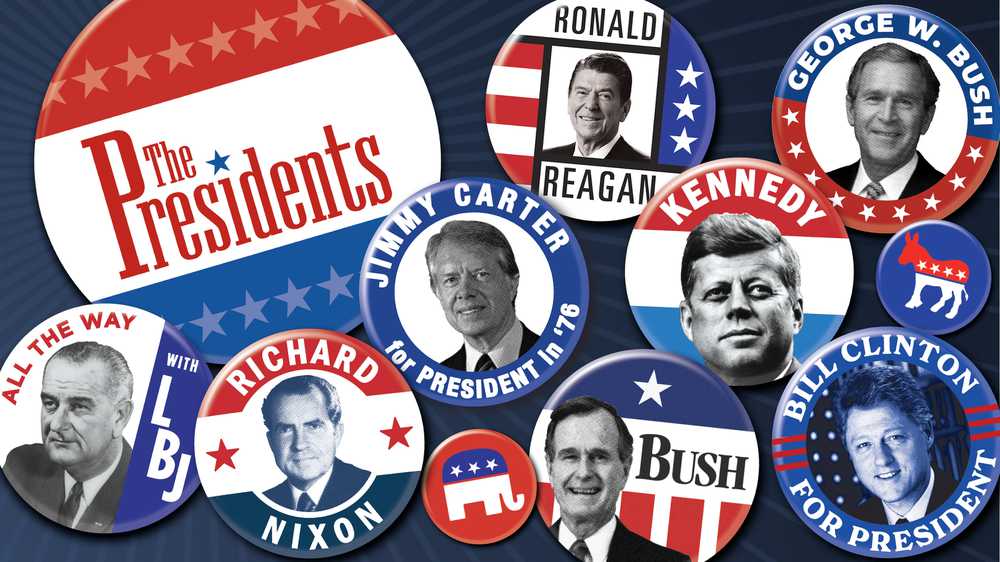
The Presidents Connect today's election issues with the past


Chapter:

Under Pressure (6:22)
Truman persists with a "limited war." Pressure on him grows intense as casualties mount and U.S. troops are repelled by Chinese forces.
FDR

Now
Playing

Truman
LBJ
Nixon
Carter
Reagan
G H W Bush

Related Clips


REAGAN, Chapter 25

The Iran-Contra Crisis (14:11)
The government's secret arms-for-hostages dealings with Iran are uncovered. Reagan learns that his staff has diverted profits to support the anti-Communist Contras in Nicaragua.
Watch Now

LBJ, Chapter 16

Johnson's "Real Presidency" (8:44)
Johnson pushes his Great Society agenda in a legislative avalanche. Advisors — the "best and the brightest" — counsel him to escalate the war in Vietnam.
Watch Now

NIXON, Chapter 5

The Pink Lady (3:52)
Implying that his opponent Helen Gahagan Douglas is a Communist, Nixon wins a seat in the Senate in 1950.
Watch Now

CARTER, Chapter 4

Finding a Community (7:08)
When his father dies, Carter leaves the Navy. The Carters return to Plains to run the family business, and are thrust into the turmoil of Southern race relations.
Watch Now

REAGAN, Chapter 4

Communists in Hollywood (9:43)
Reagan, an active anti-Communist, ends his first marriage. He meets and marries actress Nancy Davis.
Watch Now

Chapter 1

Introduction (2:58)
Part one of a biography of Harry Truman, the 33rd president.
Watch Now

Chapter 2

Early Years (14:11)
Harry Truman grows up in Independence, Missouri. He gets his first taste of politics at the 1900 Democratic National Convention.
Watch Now

Chapter 3

The Family Farm (10:22)
After working office jobs in Kansas City, Truman returns to the family farm to help his father. He woos Elizabeth Wallace.
Watch Now

Chapter 4

Love and Death (10:23)
Bess Wallace rejects Truman. After his father dies, Truman leaves the farm to make his fortune, but fails in business.
Watch Now

Chapter 5

World War I (9:52)
Truman shows leadership as the captain of Battery D, fighting in World War I's bloodiest battles.
Watch Now

Chapter 6

Marriage and Politics (13:12)
After the war, Truman marries Bess Wallace and runs for public office.
Watch Now

Chapter 7

Senator Truman, (6:45)
With the help of Kansas City political boss Tom Pendergast, Truman wins a seat in the U.S. Senate.
Watch Now

Chapter 8

Truman Proves Himself (9:07)
Truman works hard to understand the workings of the Senate and finds sucess.
Watch Now

Chapter 9

The 1944 Election (11:21)
Truman becomes the Democrats' compromise choice for vice president.
Watch Now

Chapter 10

Vice President for 82 Days (5:25)
Roosevelt keeps Truman out of his inner circle. When the president dies, Truman is nervous and unprepared.
Watch Now

Chapter 11

A Man of the People (10:27)
As president, Truman makes a show of energy and confidence. Americans warm to his straightforward manner.
Watch Now

Chapter 12

Endgame in Japan (10:04)
After the war in Europe ends, Truman focuses on the bitter battle with Japan. Bess Truman is uncomfortable as first lady.
Watch Now

Chapter 13

On the World Stage (10:27)
Truman meets with Winston Churchill and Joseph Stalin to decide the fate of Europe. In New Mexico the atomic bomb is successfully tested.
Watch Now

Chapter 14

Nuclear Diplomacy (7:06)
Truman takes a tougher stance at Potsdam after receiving news of a successful atomic bomb test in New Mexico.
Watch Now

Chapter 15

Hiroshima and Nagasaki (7:32)
The U.S. drops atomic bombs on two Japanese cities. The Japanese surrender and World War II ends.
Watch Now

Chapter 16

CreditsProduction credits for part one of the television program.
Watch Now

Chapter 17

CreditsHead credits for part two of the television program.
Watch Now

Chapter 18

Introduction (2:16)
Part two of a biography of Harry Truman, the 33rd president.
Watch Now

Chapter 19

The Post War Economy (10:59)
Truman faces domestic challenges. He takes a tough stance against striking railroad workers.
Watch Now

Chapter 20

The Mid-Term Elections of 1946 (4:47)
The Republicans gain majorities in both houses of Congress.
Watch Now

Chapter 21

The Truman Doctrine (9:04)
As the Soviets control Eastern Europe, Truman acts to stop Communism in Greece and Turkey.
Watch Now

Chapter 22

American Power (6:50)
Truman establishes the Marshall Plan and prepares the country for a new kind of war -- the Cold War.
Watch Now

Chapter 23

A Stand for Human Rights (11:21)
Before the election of 1948, Truman boldly calls for civil rights for African Americans and for Israel to be recognized.
Watch Now

Chapter 24

The Conventions (6:41)
Despite Democrats' misgivings, President Truman is nominated at a dispirited Democratic Convention.
Watch Now

Chapter 25

Truman Defeats Dewey (9:47)
Taking his "New Deal" message on a whistlestop campaign across the country, Truman defeats New York governor Thomas Dewey.
Watch Now

Chapter 26

Fighting Communism (10:10)
Facing the Communist threat, Truman shows U.S. strength with an airlift to blockaded Berlin and air strikes and infantry in Korea.
Watch Now

Chapter 27

The Korean War (5:29)
U.S. troops in Korea retreat until Douglas MacArthur's surprise attack on Inchon forces the North Koreans to pull back to the 38th Parallel.
Watch Now

Chapter 28

Crossing the 38th Parallel (9:35)
MacArthur convinces Truman to fight the Chinese in Korea. Truman denies MacArthur's demand to use atomic weapons.
Watch Now

Chapter 29

Under Pressure (6:22)
Truman persists with a "limited war." Pressure on him grows intense as casualties mount and U.S. troops are repelled by Chinese forces.
Watch Now

Chapter 30

Dismissing MacArthur (6:58)
In a controversial move, Truman removes General Douglas MacArthur from his command for insubordination.
Watch Now

Chapter 31

The Last Years (9:06)
With the lowest popularity rating in history, Truman decides not to seek re-election. He retires to Independence, Missouri.
Watch Now

Chapter 32

CreditsProduction credits for part two of the television program.
Watch Now

Related Links


TRUMAN
Learn more about Harry S. Truman.

The Atomic Bomb in the Korean War
A historian describes "the dog that did not bark."

Quiz: How Panic-Proof Are You?
Take a government quiz from the early Fifties.

Purchase Videos & DVDs

• See Comments

Loading comments...

You must log in to submit a comment. If you don't have an account at American Experience, you will need to register to comment. It's fast and easy to do!

Post a Comment (Limit 5000 Characters)

• View Transcripts •


Transcript: Chapter 29

MARSHALL SHULMAN: This was probably the worst part of the president's administration for him, the casualties we were taking, the protests from families, and the difficulty of understanding what a "limited war" meant. I mean "Why not nuke 'em?"

NARRATOR: The pressure on Truman grew increasingly intense. He was working 18-hour days, and the strain was starting to show. One morning, with United States Marines trapped at a reservoir in North Korea, Truman met with his advisers.

MARSHALL SHULMAN: We were working on a speech and Mr. Truman came in from his office and sat down, in a very dejected way, and he said, "You know, normally I sleep like a baby, but this time I could hardly sleep all night long. I was thinking about those boys up at the reservoir." And then he slumped in his chair and he said, "You know, there must be a thousand people in this town who can do the job better than I can." There isn't much you can say to that. And he took off his glasses and put them on the table. And that was a startling thing for me because I had been accustomed to seeing his eyes rather large in his face, and I realized when he took his glasses off, it was because they were very thick lenses and it magnified his eyes. And when he took his glasses off, his eyes appeared small in his face, and it changed his appearance to me. I stared at him just as long as I could politely do and then he put his elbows on the table and he sank his -- his thumbs into his eye sockets and sat there for a while. And we were all quiet. And then finally he raised his head and took his glasses and put them on. He said, "But, the job is mine to do, so I have to do the best I can. Let's get on with the drafting.

NARRATOR: Tension and exhaustion were taking their toll on Truman. Victory in Korea would have been the crowning achievement of his presidency, proof that his determination to hold the line against Communism was working. Instead, Truman faced disaster, and in the days after the Chinese attack, he drifted.

DAVID MCCULLOUGH: This was the darkest time of his years in the presidency. It was a very bleak prospect that the American people faced, and the president was being besieged on all sides.

NARRATOR: On December 5, his beloved friend and press secretary Charlie Ross died of a heart attack. Truman had known Ross since high school, and the sudden loss of his lifelong friend was a terrible blow.

DAVID MCCULLOUGH: And Truman was deeply upset, deeply distraught and that was the same night that the president's daughter, Margaret Truman, was having a first concert ever singing, in Constitution Hall, in Washington.

Margaret had studied to become a singer, and the grieving president kept his promise to hear her perform. His pent-up frustrations waiting like a stick of dynamite ready to explode.

NARRATOR: Paul Hume, the Washington Post's respected music critic, had no idea what was in store for him as he joined the sell-out crowd.

PAUL HUME, Music Critic: Here were the members of the Congress, the Supreme Court, all the big shots... and they were all there to hear her sing, which would have been wonderful had she been able to sing well. As soon as she started to sing, I could tell that she did not have the basic technical control of the voice that you need. The pitch wasn't there. The tone wasn't there. She just didn't have what it took. I would have been thrilled if I could have written a rave review.

What I wrote was... "She is flat a good deal of the time, more last night than at anytime we have heard her in past years. There are few moments in her recital when one can relax and feel confident that she will make her goal, which is the end of the song."

NARRATOR: The next day, Truman opened the Washington Post to page 12 and found Paul Hume's devastating critique of his daughter's singing. The president erupted. Furious, he dashed off a scathing response.

PAUL HUME: The letter came in and I opened it up and I couldn't believe it, and I gasped.

NARRATOR: "I've just read your lousy review of Margaret's concert..."

"Some day I hope to meet you. When that happens you'll need a new nose, a lot of beefsteak for black eyes, and perhaps a supporter below!"

PAUL HUME: That's strong language from the president of the United States.

NARRATOR: When the letter became public, newspapers across the country berated the president for his lack of self-control. The Chicago Tribune even questioned Truman's "mental competence and emotional stability."

DAVID MCCULLOUGH: He was a man who was being battered and besieged from every side. He had to blow his stack about something, it seems to me. And the something was Paul Hume's review.

NARRATOR: The White House was flooded with letters and telegrams. One letter came from distraught parents who enclosed a Purple Heart.

"As you have been directly responsible for the loss of our son's life in Korea," Truman read, "you might just as well keep this emblem... One major regret is that your daughter was not there to receive the same treatment as our son."

back to top


Major funding provided by the National
Endowment for the Humanities and the Corporation for Public Broadcasting

NEH Corporation for Public Broadcasting


Any views, findings, conclusions, or recommendations expressed in this Web site do not necessarily represent those of the National Endowment for the Humanities.