Jaglavak, Prince of Insects:
A Cameroon People's Alliance With an Ant
by Christian Seignobos
The
Mofu, who live in the Mandara Mountains of northern Cameroon,
have developed a rich lore about their insects and have a
particularly impressive entomological vocabulary. This may be
in part because insects are virtually the only other creatures
living on their jumble of boulders and terraces.
The Mofu eat certain insects, though this practice seems to
have been more widespread in the past than it is now. Insects
are also used in medicine and agriculture, serve as omens, and
are even the object of board games. And for the Mofu, certain
insects "speak" while others, like bees and mosquitoes, are
socially neutral.
The jaglavak
The Mofu are particularly interested in two types of insects,
those involved in the growth and conservation of grain
sorghum, their stable crop, and those ants or termites that
live in social groups. The Mofu relate these social insects to
their own politico-religious beliefs as well as to their
systems of kinship and social relations. Among ant species,
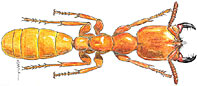
those of the Dorylus genus, a type of driver ant that
is known to the Mofu as jaglavak, hold a special place.
The Mofu associate the jaglavak with termites, which is
logical because jaglavak soldiers resemble those of certain
species of the termite order, Isoptera. The
Dorylus ants live in underground communities, sometimes
in large numbers, without building visible nests. Their
ferocity in attacking termites and the fact that no other
insects appear able to resist them have conferred upon the
jaglavak a position of eminence. Yet the jaglavak seemingly
avoids other insects that are "organized as it is," according
to the Mofu, including two species of termites that they know
as the mananeh (Microcerotermes solidus) and the
ndakkol (Trinervitermes trinervius), and
especially the gula ant (Megaponera sp.).
Chief of the massif
There are several "interpretations" of the jaglavak. In
relation to other insects, the jaglavak is defined by kinship
and relations of alliance or power. Some say the termite
mananeh is its "cousin"; others say the
mananeh is the "prince of the plain insects" and rival
of the jaglavak. The jaglavak's ndaw kuli (what the
Mofu call its "intimate friend"), who stands in for the head
of the family in sacrifices (kuli), is
singel gagazana, a red ant (Pheidole sp.), while
another ant, ndroa (Lepisiota sp.), is the
mananeh's "intimate friend." The jaglavak is considered
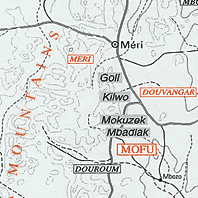
the chief of the entire massif, from Wazang to Meri (see map
at right), while other ants constitute "local chiefs." The
classification scheme is rough, and its composition varies by
region. One wonders, was it once more firmly fixed?
By virtue of an ancient alliance, the jaglavak are believed to
aid the Movo in times of trouble.
The Mofu see correlations between chiefs of the massifs and
chiefs of the animal realm. The panther and the Mofu chief are
one and the same; the chief commands the panthers. When a
panther is killed on a massif, by rule the skin goes to the
chief, who either keeps or disposes of the head and whiskers.
He is supposed to eat the eyes and give the liver to his sons.
The last act involved in the ritual burial of the massif
chiefs is the turning over of the mortuary bundle into the
grave, which is accomplished by pushing it while turning away
and imitating the panther's snarl.
In certain Mofu mountain ranges, and also among
the Jimi and the Gude, the crocodile was perceived as the chief of water-dwelling
animals. The death of a crocodile would be announced to the
chief as that of a relative would be, and people would cry
over it. When one was slaughtered, the chief would ritually
eat its tongue.
The jaglavak, for its part, held the role of "prince of
insects." In the past, Mofu mountain chiefs would closely
follow the jaglavak's movements and behavior to find omens. If
there was combat between the jaglavak and the ant
ndroa, for example, seers would interpret the
repercussions of this combat for the massif chiefdom. For the
Zumaya, the clan of the Douvangar chief, the jaglavak
furnished the
war stone, which would be found in its nest. In the absence of a
stone, in other massifs, such as that of the Meri people,
before combat people might put some jaglavak on a pointed
stone against which they would then rub their spearheads.
The "prince" and the Movo
The Mofu use the jaglavak to explain their own history, in
particular the case of the Movo. The jaglavak is supposed to
be the equivalent of the Movo people, who are now dispersed
among the Mofu. Long ago, the Movo possessed a powerful
chiefdom on the banks of the seasonal river Mayo Tsanaga, in
the foothills facing the principal point of entry into the
Mandara Mountains. This chiefdom was to give rise to the Gudur
chiefdom, installed higher up the mountain. In the 17th
century and the beginning of the 18th, the Movo dominated the
Mofu massifs and foothills and well beyond. Crushed by the
Wandala kingdom, from which they had originated, and then
dispersed by the Peuls, the Movo took refuge in the Mofu
massifs.
Today, the Movo are viewed as clans that inspire respect,
fear, indeed ostracism. Thus, the Movo are accused of sending
caterpillars into the sorghum crop and in the past have been
accused of sending locusts. And when a Movo individual is
buried, it is deemed necessary to spread ashes on the path
where the cadaver has passed, in order to prevent worms and
other granary predators from touching grain supplies.
The jaglavak is often designated as "the red insect,"
referring to the color that is the emblem of the Movo. And a
parallel can be seen in the fact that the jaglavak are
Dorylus ants, which move from place to place and do not
seem to have a territory, just like the Movo, who no longer
have their own chiefdoms. But like the jaglavak, the Movo are
feared for their power to harm. And by virtue of an ancient
alliance, the jaglavak are believed to aid the Movo in times
of trouble, including cleaning up their compounds by chasing
out undesirable insects, because the jaglavak is commonly
entrusted with chasing vermin out of infested dwellings.
Jaglavak to the rescue
The Mofu who sees his compound invaded by termites and ants
calls on the jaglavak for help. Dorylus colonies are
not easy to find. After identifying the nest or colony of
jaglavak on the move, the Mofu removes from the colony several
hundred to a thousand, or even more, Dorylus soldiers.
He puts them into a calabash or new clay pot, sometimes in
leaves of the large-leaved rock fig (Ficus abutilifolia). Among the Mofu, these leaves are used, for example, for
wrapping sacred objects, rain stones, and the meat of the
maray (the bull sacrificed at the feast of the massif).
They fear the jaglavak might kill them in the night, during
their sleep, by entering their nostrils.
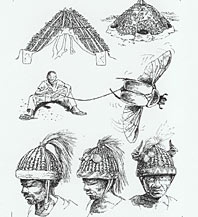
When the Mofu carrying the ants arrive at the compound, people
salute the jaglavak in different ways, clicking their fingers
or striking the head of a hoe with a stone. The head of the
family declares, "Today we have a distinguished guest," and
then asks the jaglavak to chase out these harmful
insects—such as the momok (a generic term for
termites) and Trinervitermes ants from the straw
of the roof, and Macrotermes subhyalinus termites from
the sorghum stems protecting the walls—as well as
snakes. They ask the jaglavak, however, not to touch people
and to spare their animals, for they fear the jaglavak might
kill them in the night, during their sleep, by entering their
nostrils. Yet our informants were unable to cite any specific
instances of such an act of aggression.
The Mofu put the jaglavak on the ground within an ocher circle
from which extends a path, also traced in ocher, that leads
toward the area of the most badly infested house. The Mofu
admit that they do not see the jaglavak operate, but
they claim that two or three weeks later, the harmful insects
have disappeared, and the jaglavak as well, for they do not
remain in the compound, unlike the gula ant (which the
Kapsiki, another ethnic group of the Mandara Mountains, enlist
for the same job).
One might wonder about the conduct of the
Dorylus soldiers deprived of the mass effect of the
colony. Do they disperse an odor that causes other insects to
flee?
A waning tradition?
Jaglavak lore varies from massif to massif and depends on
which clans are in or out of power. Today, however, for the
Mofu who come down to the plains and go to work in urban
areas, everything concerning insects, including the role of
the jaglavak, is seen as belonging to the past.