The Producer's Story:
Joining the Medical Tribe—in
Time-Lapse
by Michael Barnes
One afternoon in 1987, the year I began filming NOVA's doctors
series, of which "Doctors' Diaries" is the fifth installment,
I found myself standing in a lunch line at a welcoming
reception for arriving Harvard Medical School freshmen. As we
waited, I struck up a conversation with the man next to me,
who introduced himself as
Tom Tarter.
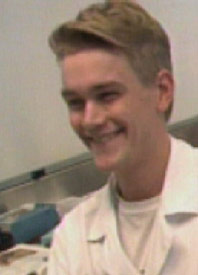
I soon learned that Tom was not your typical incoming med
student. Hailing from the Bronx in New York City, Tom was 31
years old, recently divorced, and had formerly worked as a
bouncer, psychiatric orderly, and auto mechanic. He told me it
had taken him 14 long years to get into medical school. With
his unconventional background, I knew immediately that he had
to be in our film about the training of doctors. I was
particularly intrigued to see how Tom would fit into the
rather elitist Harvard Medical School community.
I explained to Tom my motivation for making this NOVA series.
Doctors have a unique role in many of life's great dramas.
They probe our minds and bodies, both figuratively and
literally. They help us when we are most in need. Obviously,
many rewards come from being a doctor, but the journey to
become one can be long and arduous as well as expensive,
exhausting, and depressing. Would he be willing to share with
us some of his experiences along the way to becoming a doctor?
Could he handle being filmed throughout his medical
career—through medical school, hospital clerkships, his
internship, and beyond? Fortunately, Tom said yes. (Years
later he confided to me that he thought being a subject in the
film would make it less likely that Harvard would fail him!)
Finding a balance
My serendipitous lunchtime encounter with Tom was followed by
a more formal session in the school's main amphitheater with
all members of the Class of 1991. Tom had been an easy call;
he was articulate and passionate about becoming a doctor. But
now I had to find a handful of other students willing to be
filmed. To my surprise, 70 students, nearly half the class,
expressed an interest in participating despite the long-term
commitment.
Over the next two days, I conducted interviews. I was looking
for a balance of men and women, including some minority and
older students. In the end, I didn't bring much science to the
interview process but simply relied on my gut instinct to
choose good characters.
I was immediately impressed with
Jane Liebschutz,
for example. She was slightly older than the average student,
and she had only started thinking about a career in medicine
while working in a health clinic in Taiwan. In her interview,
Jane seemed extraordinarily idealistic and had already set her
sights on a career helping the urban poor. She also carried
her heart on her sleeve, and I felt that she might serve as a
bellwether for the emotional mood of the class. In this role
she was to prove superlative, alternately overwhelmed and
elated as she was by her new experiences.
Realizing the difficulty of predicting exactly how people
would react to being filmed, and knowing that a few would drop
out along the way, I decided to start off with a dozen
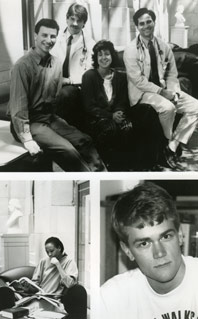
students, then narrow down from there. At the end of the first
year a core group of seven emerged: four men and three women,
with representation from the African-American and Hispanic
communities. Three of the students had Ivy League backgrounds;
two had fathers who were physicians. In short, I felt we had a
microcosm of the Class of 1991. [For more on each of these
seven people, see
Doctors' Lives Videos.]
Apart from the convenience of filming just down the road from
NOVA's home at WGBH, I had another important reason for asking
Harvard to open its doors to us. The medical school was
launching a major curriculum reform, which it rather
evangelically called the "New Pathway." The class that arrived
in September 1987 became guinea pigs in this medical-education
experiment, which stressed less information, more
self-directed learning, fewer lectures, and more small group
tutorials.
The fact that not all of the students were aware of this, and
that many faculty members were skeptical of the approach, made
for some challenging negotiations for me as a filmmaker. It
took many months of talks with various deans, a presentation
to the faculty council, and finally the formation of a special
committee to get the green light to start filming. And it came
just in time for the first rite of passage for the incoming
class: gross anatomy.
Witness to a transition
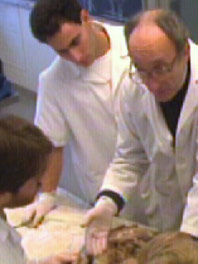
The Anatomy Department was hesitant about letting us film. It
had been entrusted with human bodies exclusively for use in
medical training, and it was concerned that we not violate
that trust. I understood its concern, but I very much wanted
to film students dissecting cadavers and talking about what
that experience meant to them. It seemed the ideal place to
document the start of the students' transition from laypeople
to physicians.
And witness that transition I did. "Now I'm beginning to see
what this alternative perspective is," Tom said, enthused
after a few weeks with his cadaver. "When I'm writing, I'm
thinking about what muscles are moving. I can actually see
them in my mind. It's an absolutely fascinating way of looking
at people, from a whole other perspective, from the inside
out."
Medicine is only for those who cannot imagine doing anything
else.
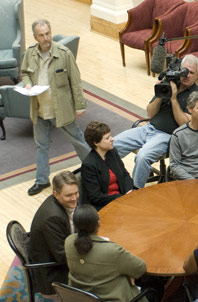
Although we promised to use "fly-on-the-wall" filming
techniques, striving to become more or less invisible to catch
the action, at times we did become a distraction to the class.
After a few weeks, a group of students complained about our
presence. In order to keep the lid on things, we agreed to
halt filming for a month. Though disappointing to me as a
filmmaker, I sympathized with the complaints. Medical school
is a pressure cooker. Students are overloaded with work, and
this burden isolates them from the outside world. Occasionally
medical students commit suicide because of the stress.
With our camera and microphone constantly lurking around, we
became a lightning rod for their collective anxiety. Indeed,
we did do a lot of shooting. In making cinema-verité
documentaries like "Doctors' Diaries," you're looking for
those gems that help define the experience and tell the story.
As such, you have to keep the cameras rolling longer than
usual, gobbling up far more footage than you'll ever be able
to use. In our case, we shot about 50 hours of tape, which
eventually took three months in the editing room to prune and
shape into the series' initial one-hour documentary. (By the
fifth installment, we had shot around 250 hours.)
Round four
As the new millennium waxed, we decided it was time to make
another program in the series, the fourth. Apart from shooting
scenes with Tom and Jane, we had not filmed with the other
students since 1994. In 2000, they were all fully qualified
practitioners working in their chosen specialties—except
for
Cheryl Dorsey,
who was then getting a Ph.D. in history at the University of
Pennsylvania.
Jay Bonnar had
become a psychiatrist. Despite several attempts to find a way
of showing him in action as a psychiatrist, the need to
maintain confidentiality with his patients made filming
impossible.
Jay told me he was training to become a psychoanalyst. Part of
that training required him to undergo his own analysis. The
therapy usually involves meeting with an experienced analyst
several times a week, during which the analyst-in-training is
encouraged to talk about whatever comes to mind.
Even though psychoanalysis is fundamentally a private affair,
Jay agreed to let us film the process. Interestingly, his
analyst squashed the idea, maintaining that Jay was not in a
position to make this decision and that filming him might
jeopardize the treatment. So we had to resort to interviewing
Jay in his car while en route to his daily session on the
couch. Under the circumstances, we felt it was the closest
portrayal of his analysis that we could get.
Fortunately, access to the work of the other five doctors in
practice proved easier, and it was clear that they had all
well and truly hit their stride.
The final chapter
I had left NOVA shortly after completing the fourth
installment of the series in 2001 to work in England, and I
imagined that would be the end of the project. But a couple of
years ago I made a separate film for NOVA, and a conversation
with Paula Apsell, NOVA's Executive Producer, at the end of
that project led to the idea of one final iteration. I
welcomed the idea, and in early spring 2008, I found myself
embarking on a whistle-stop tour to meet all the doctors.
I had not been in contact with them since producing the fourth
episode. Only
Elliott Bennett-Guerrero
had occasionally been in touch wondering if there was going to
be another show. They had all agreed to meet me, but I was not
convinced they would commit to participating before we met in
person. In the end they all signed on, but not with equal
enthusiasm.
Even more than in the fourth episode, Jay was deeply
uncomfortable about the process of being filmed. But in the
end he offered, on camera, some very thoughtful and heartfelt
insights on his life and his work as a psychiatrist.
Equally uncomfortable with the idea of appearing again was
Luanda Grazette.
She made it very clear that her personal life was going to
remain private and not be part of the film. Her new job at the
biotech giant Amgen posed other restrictions. Luanda had left
her research and transplant cardiology work at Massachusetts
General Hospital to become a clinical scientist helping to
develop new drugs to combat heart disease. Amgen is very
secretive about its R&D, and Luanda jokingly remarked, "If I
really told you what I was doing, I'd have to kill you."
As the pre-production for the film continued, it became clear
that there would be very little of the high drama that
permeated the earliest episodes. The doctors were seasoned
professionals who knew what they were doing. There was none of
the tension of performing a procedure for the first time or
learning the ropes at a new hospital.
Medicine offers practitioners extraordinary privileges, but it
can take a toll on relationships. Both Jane and
David Friedman
remarked that their tendency at home to treat their spouses
like interns had caused problems. David noted, "You can't
manage your spouse," suggesting that this was one of the
factors that contributed to his separation from his wife Boo.
When I was trying to decide what to do with my life, two
passions surfaced almost simultaneously: moviemaking and
medicine.
Tom had divorced and was remarried for the fourth time. I had
never seen him as happy as he is now with Jennifer. Sadly,
Tom's physical health had deteriorated. The prediction he gave
me the last time we'd met, that his body was "falling apart
like a cheap suit," had proved only too true. He is
overweight, smokes, and with high blood pressure is at risk
for a heart attack—all problems that Tom acknowledged.
Tom said that it has been difficult for him to get these
problems under control because of his lifestyle. Since losing
his job at Indiana's Bloomington Hospital emergency department
five years ago, he has been an itinerant doctor, working a few
weeks at a time in hospitals as distant as Caribou, Maine,
Tacoma, Washington, and St. Thomas, Virgin Islands. Tom, as
always, is a conundrum—a wonderful doctor to his
patients but woefully negligent of his own health.
I was very happy to discover that Cheryl Dorsey had found her
calling—not medicine but leading the Echoing Green, a
foundation that provides seed money for social entrepreneurs
and that, 17 years earlier, had funded her Family Van mobile
clinic project at Harvard Medical School. Medicine had made
Cheryl's career path a very circuitous route. Thinking about
that decade of one's life that medicine requires as the price
of admission, I was reminded of Luanda's wise words: Medicine
is only for those who cannot imagine doing anything else.
Why I made this series
In my late teens, when I was trying to decide what to do with
my life, two passions surfaced almost simultaneously:
moviemaking and medicine. In my early 30s, when I hit a
particularly bad patch in the film business, I reapplied to
medical school. In 2001, when the fourth installment of the
doctors series aired, I wrote, "Making this series of films
about medical training has made me realize how fortunate I was
to be turned down!"
My view has changed. Although the price is high in terms of
the time given over to medical training, it is nevertheless an
extraordinary journey, and the relationship that it eventually
permits physicians to have with patients is the most wonderful
gift. When I think about the path not taken in my own life,
I'm reminded of what Jay said to me about whether he would
choose to go to medical school if he had a chance to do it
over again: "I'm glad I don't have to consider that. I mean,
one can't live one's life over; it's just not done." But if it
were possible to press rewind, my medical school application
campaign would be a lot more organized than it was 30 years
ago.