
|
|
|
|
|
|
This two-hour program is divided into 14 chapters.
Choose any chapter below and select QuickTime to begin
viewing the video. If you experience difficulty viewing,
it may be due to high demand. We regret this and suggest
you try back at another time.
Technical Help
|
Feedback
|
Program Credits
|
Program Transcript
|
For Teachers
|

|
|
|
|

watch chapter 1 in
QuickTime
|
|
A TOWN DIVIDED
The rural community of Dover, Pennsylvania is torn apart
in the latest battle over the teaching of evolution, and
parents file a lawsuit against the town's school board
in federal court.
running time 10:50
chapter 1 transcript
|
|
|
|

|
|
|
|

watch chapter 2 in
QuickTime
|
|
WHAT IS EVOLUTION?
More than 150 years ago Charles Darwin developed the
theory of evolution to explain how the diversity of life
arose, laying the foundation for modern biological
science.
running time 7:04
chapter 2 transcript
|
|
|
|

|
|
|
|

watch chapter 3 in
QuickTime
|
|
INTRODUCING INTELLIGENT DESIGN
The Dover School Board attempts to introduce into
science classrooms the idea that life is too complex to
have evolved naturally and therefore must have been
designed by an intelligent agent.
running time 8:47
chapter 3 transcript
|
|
|
|

|
|
|
|

watch chapter 4 in
QuickTime
|
|
THE TRIAL BEGINS
The court is asked to decide whether the School Board
promoted religion or had religious motivation, and
whether intelligent design is science.
running time 9:32
chapter 4 transcript
|
|
|
|

|
|
|
|

watch chapter 5 in
QuickTime
|
|
THE FOSSIL RECORD
A 2004 discovery in the arctic of a transitional fossil
from fish to land-dwelling animals is the latest
substantiation of Darwin's theory of evolution.
running time 8:36
chapter 5 transcript
|
|
|
|

|
|
|
|

watch chapter 6 in
QuickTime
|
|
A VERY SUCCESSFUL THEORY
The ongoing scientific quest to investigate the unknown
has led to some of the strongest evidence for evolution,
including findings in modern genetics and molecular
biology.
running time 9:26
chapter 6 transcript
|
|
|
|

|
|
|
|

watch chapter 7 in
QuickTime
|
|
THE NATURE OF SCIENCE
After experts point out that supernatural causes cannot
be tested scientifically, the defense begins its case
for intelligent design.
running time 8:24
chapter 7 transcript
|
|
|
|

|
|
|
|
watch chapter 8 in
QuickTime
|
|
Defining Intelligent Design
In court, biochemist Michael Behe describes the concept
of intelligent design.
running time 1:29
chapter 8 transcript
|
|
|
|

|
|
|
|
watch chapter 8a in
QuickTime
|
|
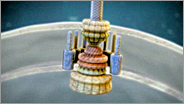
Behe Provides Example of Intelligent Design
Michael Behe explains how the bacterial flagellum
provides evidence of design because of its irreducible
complexity.
running time 3:09
chapter 8 transcript
|
|
|
|

|
|
|
|
watch chapter 8b in
QuickTime
|
|
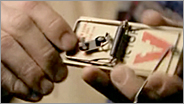
Refuting Irreducible Complexity
David DeRosier responds to Michael Behe's argument about
the bacterial flagellum, and Ken Miller uses a mousetrap
to counter the argument for irreducible complexity.
running time 4:32
chapter 8 transcript
|
|
|
|

|
|
|
|

watch chapter 9 in
QuickTime
|
|
FAITH AND REASON
As the legal teams battle it out in court, the clash
between evolution and intelligent design takes a toll on
the Dover community.
running time 7:25
chapter 9 transcript
|
|
|
|

|
|
|
|

watch chapter 10 in
QuickTime
|
|
SEPARATION OF CHURCH AND STATE
The court looks at evidence that the Dover School Board
was motivated by religion.
running time 9:49
chapter 10 transcript
|
|
|
|

|
|
|
|

watch chapter 11 in
QuickTime
|
|
A CULTURE CONFLICT
Some proponents of intelligent design would like to see
the theory permeate our religious, cultural, moral, and
political life.
running time 8:52
chapter 11 transcript
|
|
|
|

|
|
|
|

watch chapter 12 in
QuickTime
|
|
CLOSING ARGUMENTS
After six weeks, the trial concludes with closing
arguments that were as divided as Dover itself had
become, and Judge Jones renders his unequivocal verdict.
running time 10:38
chapter 12 transcript
|
|
|
|


