



Bringing Home MIAsOn September 16, 1952, U.S. Air Force Captain Troy Cope and the F-86 Sabre jet he was flying disappeared while in a dogfight with Soviet pilots. They were battling over "MiG Alley," an infamous stretch of airspace above North Korea's border with China. Search-and-rescue teams found no trace of a crash site, and for half a century his family had no idea what had happened to him. Then, in 1995, a U.S. businessman who was visiting a small military museum in northeast China noticed several American dog tags on display. One of them proved to be Captain Cope's. Later, as part of their ongoing investigations into American MIAs, the Defense Prisoner of War/Missing Personnel Office (DPMO) in Washington discovered detailed notes in a Russian archive in Moscow of a joint Soviet-Chinese investigation decades before into the crash site of a USAF Sabre in China. The plane had gone down just across the Yalu River from North Korea. The account was so thorough that it identified not only the village where the crash had occurred but the very farmyard. In 2004, DPMO led an excavation at the site. Along with his plane, Captain Cope's remains were unearthed and later identified. "We actually went into the lab to where my dad's stuff was laid out," says Cope's son Danny in NOVA's "Missing in MiG Alley." "Small piled ... fragments of ... bones," he added, haltingly. "Being with the remains and being allowed to touch them and—that was just beyond words. Can't describe it...." Keeping the promiseSuch an effort is just one piece of a much larger effort that has dozens of U.S.-sponsored search-and-recovery expeditions working worldwide each year. Many of them meet with success. From 2000 to the fall of 2007, for example, forensic anthropologists working for the Joint POW/MIA Accounting Command (JPAC), which does the actual recovery and identifications, identified the remains of more than 575 American service personnel. These are all young men who lost their lives while serving their country in World War II or any conflict since—men who have been missing in action for decades, their families never knowing what happened to them. "The men and women who ... head to war today ... are deserving of our every effort to bring them home again, safely and alive," Ambassador Charles Ray, the Deputy Assistant Secretary of Defense for POW/Missing Personnel Affairs, told an audience of Special Forces veterans in September 2007. "Our motto is Keeping the Promise. Today, that service member, his family, all those from Desert Storm, Iraqi Freedom, the Vietnam War, the Cold War, the Korean War, and World War II ... all await answers from their government. And if I have anything to do with it, they shall get those answers...." The United States wants its dead back so fiercely that it spends more than $105 million a year trying to find, retrieve, and identify them as well as give them a proper burial with full military honors. More than 600 military and civilian personnel work full-time on the POW/MIA effort. Their task is staggering, as the combined total of U.S. service personnel from World War II to the present listed either as "missing in action" or "killed in action, body not recovered" exceeds 88,000. But DPMO is not daunted, and it has achieved an enormous amount since its founding in 1993. In the fieldDPMO's first priority is to bring back live American POWs. Even today, reports of captive Americans occasionally come out of Korea, Russia, and Southeast Asia. The U.S. actively looks into all such reports. Vietnam, for example, has agreed to let DPMO officials conduct investigations, on short notice, of so-called "live sightings"—cases in which someone reports having seen an American POW or MIA alive. In recent years, investigators have carried out about 120 on-site investigations or reported live sightings in Vietnam, Laos, and Cambodia. All of these sightings have proven to be false alarms, however, and to date the U.S. has found no evidence that any Americans are still being held as POWs in any of these countries or regions. "Here's the dog tag of the serviceman, and we'll take you to where his remains are buried." DPMO's second priority, and the one that the bulk of its resources go toward, is to find, bring back, and put names to the remains of deceased American personnel. The search-and-recovery process for a missing military service member or civilian often begins with archival research in the U.S. or in the country where a serviceman is believed to have been lost. Sometimes American authorities will contact a foreign government about investigating, say, an aircraft crash site; sometimes foreign officials will contact their counterparts in the U.S. with newly uncovered evidence. It even happens sometimes that former combatants or their families will suddenly come forward with new information. "In Vietnam, we've had people who've walked into either the American Embassy or our POW/MIA detachment there in Hanoi, just walked in with a dog tag or a fragment of bone," says DPMO's Larry Greer. "They'll say, 'My grandfather has had this for years, and we want to do what we can for the American family. Here's the dog tag of the serviceman, and we'll take you to where his remains are buried.'" DPMO or other agencies negotiate with the relevant government to do so-called joint field activities. Each of these forays can last 45 days and may involve more than 100 individuals. Team members interview witnesses and inspect sites. If they decide an excavation is called for, the Hawaii-based Central Identification Laboratory, which is part of JPAC, arranges for a team like that deployed to China to undertake the work. These teams consist of members from the four service branches. An Army or Marine captain or major leads the crew, which typically includes a senior noncommissioned officer, two to four mortuary specialists, and at least one civilian forensic anthropologist or archeologist. There is also an interpreter, photographer, medic, and, where needed, experts in explosive ordnance disposal. In some rare cases, immediate family of those sought may visit the excavation site at their own expense, but such visits are discouraged due to the hazards of unexploded ordnance and, in the tropics, exotic diseases. The forensic anthropologist is in charge of the excavation. He or she follows strict procedures, carefully gridding the area to be excavated, sifting soil through quarter-inch screens to capture even the smallest bones or artifacts, and taking numerous documentary photographs. After clearance from the host country, the team flies any remains of American personnel back to the U.S. in flag-draped coffins. In the labIn the JPAC laboratory, forensic specialists try to determine the age, sex, and race of individuals. They also look for any signs of trauma or healed fractures as well as at the arrangement, number, and other aspects of the deceased's teeth. Because of the skeletal nature of most remains from past wars, experts identify many of those whose identities are restored by comparing their dentition with dental records. "Mom held on, and within a week after his remains were identified, she quietly passed away." In nearly half of all cases, however, testing of mitochondrial DNA, or mtDNA, is also brought to bear. For that, the specialists need blood samples from maternally related family members. DPMO and the military services have an active outreach program to contact families for this purpose. Details on artifacts such as personal effects or aircraft wreckage are also evaluated, as are circumstantial evidence and eyewitness accounts by, say, surviving crew members or cooperative former enemy personnel. Reaching closureWhen JPAC specialists ascertain the identity of remains, the respective military service casualty or mortuary office contacts the serviceman's family. In most cases, family members have been awaiting such a call for an excruciatingly long time. "I've had a number of younger family members tell me, 'Mom held on because she felt that our loved one's remains would soon be coming home,'" Greer says. "'And within a week after his remains were identified, she quietly passed away.'" Each military service offers the family a choice: Inter their loved one in Arlington National Cemetery outside Washington, D.C., or have the individual's remains flown home for a private burial. Either way, the government pays for the funeral and accords the serviceman full military honors. Unidentified remains stay in Hawaii in hopes that JPAC specialists will eventually succeed in identifying them. They include more than 850 unknowns from the Korean War who are buried in the National Memorial Cemetery of the Pacific in Honolulu. When returned to the U.S. a half century ago, these remains were treated with a preservative that has interfered with retrieval of mtDNA samples. But JPAC officials are hopeful that advances in forensic techniques might someday solve such problems. "There's no telling what new technologies might come along," Johnie Webb, JPAC's Deputy to the Commander for Public Relations and Legislative Affairs, told The National Amvet magazine in 2000. "We've only had DNA analysis since 1994, and with it, we have identified remains that were mysteries to us since the mid-‘80s." War by warWorld War II: By far the greatest percentage of American MIAs went missing in the Second World War. More than 78,000, or nearly 90 percent of the total number of missing U.S. servicemen, never returned from this conflict. Many were lost at sea or buried as unknowns in cemeteries across Europe. Every year, JPAC identifies more soldiers from World War II. DPMO and JPAC seek American dead from this war not just in Europe but around the world. The inaccessibility of a place where servicemen were lost is not an issue. In November 2000, for example, JPAC identified the remains of 19 marines retrieved from remote Butaritari Island in the South Pacific, where they had died in a battle with Japanese forces in 1942. Among them was Sgt. Clyde Thomason, the first enlisted marine awarded the Medal of Honor in World War II. Korean War: More than 8,100 Americans remain unaccounted for from the war in Korea; most disappeared in the North. In an effort to locate as many of them as possible and bring them home, DPMO has negotiated joint recovery operations in North Korea since 1996—a remarkable achievement, considering the U.S. is still technically at war with that nation. JPAC teams have disinterred more than 225 sets of remains believed to be those of American soldiers from within North Korea; 57 of them have been identified so far. The North Koreans granted permission for U.S. teams to search for remains around the Chosin Reservoir, scene of some of the war's most intense fighting. The sites may hold the remains of more than 1,000 American servicemen. DPMO is also seeking access to several POW camps along the Yalu River, which forms the border between North Korea and China. In the spring of 2005, however, the U.S. temporarily suspended remains recovery operations in North Korea, a suspension that continues. Scores of people just like Danny Cope are counting on them. Vietnam War: As of early October 2007, 1,768 Americans remained unaccounted for from this conflict, including 1,357 from Vietnam, 349 from Laos, 55 from Cambodia, and 7 from China. Since 1973, teams have repatriated, identified, and buried on American soil the remains of 877 U.S. service personnel who had never returned from Southeast Asia. Recently, and in a remarkable way, JPAC identified the remains of Air Force Colonel Charles Scharf, who was shot down in Vietnam in 1965. During the war, Colonel Scharf had sent his wife Patricia a series of love letters. She saved them for over 40 years, and JPAC specialists were able to use the DNA her husband left on them to identify his remains. Colonel Scharf was buried in Arlington National Cemetery with full military honors. "Last known alive" cases—those involving MIAs who are believed to have survived their initial falling into enemy hands—are a high priority. The U.S. originally identified 296 such cases throughout Southeast Asia. Intensive investigations have shown that 216 are deceased, while the remains of 68 of them have been located, flown home, and identified. The work goes on. Cold War: About 125 Americans are still missing from the Cold War. Most vanished while flying spy missions along the Soviet border. A joint U.S.-Russian commission is working to investigate both American and Russian MIAs from the Cold War. Other countries are aiding the search as well. China, for one, assisted the U.S. with a long-standing Cold War case. It involved two missing American CIA fliers, whose C-47 plane crashed in Manchuria in 1952. The Chinese captured two of the plane's four-man crew and held them until 1971 and 1973, respectively, but the other two crewmen, Robert Snoddy and Norman Schwartz, went unaccounted for. During on-scene investigations at a site in China in 2002, a U.S. team recommended the site be excavated for possible human remains. In 2004, a joint JPAC-Chinese team found aircraft debris, personal effects, and human remains at the site, and the following year specialists identified the remains of Robert Snoddy. Iraq: Remarkably, only one American serviceman is listed as "missing-captured" from Desert Storm, the first war with Iraq. He is Navy Captain Michael Scott Speicher, who was lost on the first night of Desert Storm while flying a combat mission over Iraq. But one is not too few for DPMO, which continues to seek his remains. Four American soldiers are missing-captured from Iraqi Freedom, the current war in Iraq. The search for them proceeds in the midst of deadly combat.
Fortunately, no American service personnel are currently
unaccounted for from Afghanistan. But one can be sure that
DPMO, JPAC, and other agencies of the U.S. government are
standing by, ready to "keep the promise" if necessary and do
their best to bring back any personnel that go missing,
whatever the cost. Scores of people just like Danny Cope are
counting on them.
|

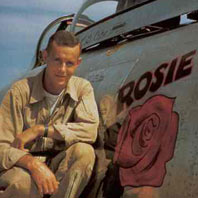
Captain Troy "Gordie" Cope crouches by his wife's name on the wing of his F-86 Sabre. He was later shot down in "MiG Alley," his fate unknown for over 50 years.
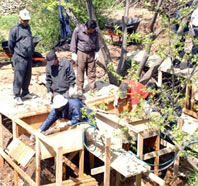
The excavation site in Dandong, China, where Gordie Cope's remains were uncovered in 2004.
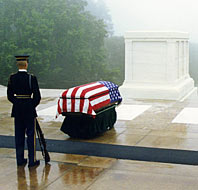
In 1998, experts used mitochondrial DNA testing to identify remains from the Tomb of the Unknowns' Vietnam crypt. They belonged to Air Force 1st Lt. Michael Blassie, who was later buried in his hometown with full military honors.
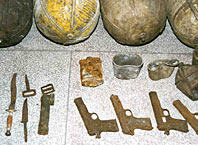
Artifacts excavated from aircraft crash sites can help forensic anthropologists identify the remains of crew members. Specialists recovered these from the spot in southern China where a B-24 Liberator crashed in World War II.
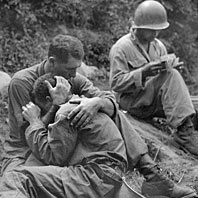
Nine out of 10 missing American personnel—more than 78,000 individuals—are unaccounted-for from World War II.

Local villagers in Vietnam assist a U.S. recovery team by collecting mud, which is then meticulously searched for any remains.
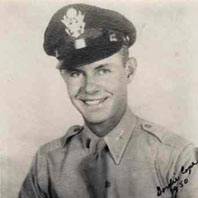
Gordie Cope's official U.S. Air Force photo, c. 1950. |


|

|
Peter Tyson is editor in chief of NOVA online. This article originally appeared, in slightly different form, on NOVA's Last Flight of Bomber 31 Web site. Missing in MiG Alley Home | Send Feedback | Image Credits | Support NOVA |
© | Created November 2007 |
