
|

|
All Alone? (Or Not?)
 By Philip Morrison
Our hunt for other worlds will find them—or exclude
their existence—only after continued growth in our
hunting skills, bigger telescopes, better precision
spectrography, more exact study of wobbly images, and maybe
new ideas. But it is worthwhile recounting the steps we
could and did take to arrive here.
How do we know there are other suns among the stars?
The sun is our star, and the old understanding that life
depends upon the sun has to be the bottom rung in the ladder
of search.
 We all see only one sun, the hot disc of every clear
daytime. It was not until the seventeenth century that there
was good reason to believe that the stars in the night sky
are really suns, although they look so different. (The
Buddhist scholars always thought so, for they used simple
analogy with real talent.) But how can you reconcile the
sun's hot and incomparable glare to the cool flicker of
starlight? We all see only one sun, the hot disc of every clear
daytime. It was not until the seventeenth century that there
was good reason to believe that the stars in the night sky
are really suns, although they look so different. (The
Buddhist scholars always thought so, for they used simple
analogy with real talent.) But how can you reconcile the
sun's hot and incomparable glare to the cool flicker of
starlight?
Naked-eye observers held that bright stars were bigger
across than the faint ones are. They do look that way. But
from the first telescopic view we saw that all the magnified
stars are still just bright points, if some show glary
haloes to the eye. Even Kepler did not believe that the
stars were suns, for by eye they were much too big.
Galileo's telescope made sense of the facts. Take the sun,
figure out how far to move it to make it look as faint as a
bright star, and its size in the sky will dwindle to a
luminous bright point. It is the optics of the eye that
surround a bright point with the dazzling artifact of those
glaring rays.
 Let me speak of my friend Carl Sagan, outstanding public
figure among all astronomers, who died in December 1996 at
the untimely age of 62. It was he who arranged—and it
took some doing—that the distant camera of a Voyager
space probe would point back toward the sun from beyond
Neptune to take a picture of Earth. Out there you do not get
a blue disc with a smear of details; you see only the color,
a pale blue glowing dot. The whole Earth is seen as a planet
among planets, just as a sun from afar is only a star among
stars. Distance alone makes planet and sun dwindle. Let me speak of my friend Carl Sagan, outstanding public
figure among all astronomers, who died in December 1996 at
the untimely age of 62. It was he who arranged—and it
took some doing—that the distant camera of a Voyager
space probe would point back toward the sun from beyond
Neptune to take a picture of Earth. Out there you do not get
a blue disc with a smear of details; you see only the color,
a pale blue glowing dot. The whole Earth is seen as a planet
among planets, just as a sun from afar is only a star among
stars. Distance alone makes planet and sun dwindle.
The more we knew of stars the more we understood that the
sun is only a star along the "main sequence" of stars, a
common long-lasting type labeled G2 V. Indeed the Galaxy has
a couple of hundred million stars of that very class!
OK, plenty of suns, but are there any other planetary
systems?
When I was a graduate student, it was fashionable to believe
that our solar system might be unique in the Galaxy. I
believed that then, too, because the picture of planet
formation was one of near-colliding stars. The theory was
that one star orbited fast and close past the sun to escape
to space, but it pulled out a lot of gas from its collision
partner. That gas over a long time condensed into the
planets, comets, etc. But you could calculate that such a
star collision was very rare, maybe very few over all the
age of all the stars. So we were likely to be alone.
I vividly recall reading the paper of 1939 by Lyman Spitzer
that disproved the conclusion. He showed that a star
collision could not make planets; solar gas was so hot that
it would dissipate long before it would condense. Planets
had to be made some other way; maybe they were as plentiful
as suns!
How do planets begin?
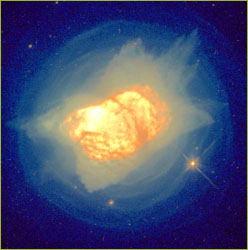 The root idea is as old as Washington, DC. A star and its
planets—if any—are made at one time by the slow
gravitational collapse of a dilute extended cloud of
interstellar gas, a nebula. This proposal is called the
nebular theory (Pierre de Laplace). It was only some fifteen
or twenty years ago that we saw by infrared light the first
such "nebular disc" of gas and dust around a young star.
(Even bright Vega has one.) That was the first confirmation
beyond the many plausible fits of the nebular theory to the
single solar system we know, the one and only family of the
sun. There are plenty of nebular discs, even if no sure
planets are yet seen in the discs. Planets take time to
form, maybe 1 or 2 hundred million years; perhaps some will
form around Vega too. The root idea is as old as Washington, DC. A star and its
planets—if any—are made at one time by the slow
gravitational collapse of a dilute extended cloud of
interstellar gas, a nebula. This proposal is called the
nebular theory (Pierre de Laplace). It was only some fifteen
or twenty years ago that we saw by infrared light the first
such "nebular disc" of gas and dust around a young star.
(Even bright Vega has one.) That was the first confirmation
beyond the many plausible fits of the nebular theory to the
single solar system we know, the one and only family of the
sun. There are plenty of nebular discs, even if no sure
planets are yet seen in the discs. Planets take time to
form, maybe 1 or 2 hundred million years; perhaps some will
form around Vega too.
Are there signs of life far beyond earth?
Only hints, but plenty of those! Gas clouds in space often
show specific radio emission lines that mean the presence of
molecules that would be at home here in the bio lab, like
formaldehyde or ether, not to mention much
 more abundant ones like molecular hydrogen, carbon
monoxide and carbon dioxide. This proves that carbon
compounds (and others) thought basic to life can form under
the natural processes of deep space. But there is no life in
those very dilute, expanded gas clouds. They span light
years and are as dilute as the very best lab vacuum. Their
formation is very slow, and nothing like a cell could grow,
only widely spaced molecules. There is a huge gap between
gas molecules or dust grains and life, even though the
molecules are essentially those of life. A test tube full of
blackish stuff is not life; see your neighborhood
snowbank. more abundant ones like molecular hydrogen, carbon
monoxide and carbon dioxide. This proves that carbon
compounds (and others) thought basic to life can form under
the natural processes of deep space. But there is no life in
those very dilute, expanded gas clouds. They span light
years and are as dilute as the very best lab vacuum. Their
formation is very slow, and nothing like a cell could grow,
only widely spaced molecules. There is a huge gap between
gas molecules or dust grains and life, even though the
molecules are essentially those of life. A test tube full of
blackish stuff is not life; see your neighborhood
snowbank.
The chemistry in and near the stars is the same as it is
here. But life is very special, very dense, very complex,
very full of change. Molecules are implied by life, but
atoms and molecules do not of themselves imply life. They
are necessary but not sufficient, as the logician would say.
Life is far more than its components.
Sun-like stars do not imply life, nor do atoms, nor planets,
nor molecules—not even those molecules essential for
the life we know, like water, carbon dioxide, and nitrogen
compounds. They are only the precursors of life; they might
abound, and life would still be absent.
What would disclose life for sure?
To find life for sure, we need a signal from living things.
Jump to the top of the time scale, and seek radio signals
made "artificially" by creatures as accomplished as we are,
or more. Long ago my partner Giuseppe Cocconi and I put
forward the notion that we might look for special
narrow-band radio emission from the stars. If we found
anything like the signals we ourselves could make, we would
probably have found life. Complex details of the signal
might make the case irrefutable. So we have been trying this
route—a jump to the very recent features of life, its
technical skills—for some 35 years, though never
systematically. We are now beginning a systematic radio
search of the Galaxy that will take many decades.
 If this gamble should win, it pays off with disclosing our
counterparts. That is unlike finding organic molecules, or
even microorganisms. They are complex, but they are not what
we are, they are more our ancestors than our partners. The
radio search, dubbed SETI, seeks a grander answer, and is
correspondingly less likely to succeed, but it is the
cheapest search. If this gamble should win, it pays off with disclosing our
counterparts. That is unlike finding organic molecules, or
even microorganisms. They are complex, but they are not what
we are, they are more our ancestors than our partners. The
radio search, dubbed SETI, seeks a grander answer, and is
correspondingly less likely to succeed, but it is the
cheapest search.
What is the present state of the "hunt for aliens"?
Planets of normal stars went unknown or only hinted at until
the fall of 1995. Out of a few hundred stars examined with
the best new Doppler techniques or by direct orbit-wobble
viewing, we now have evidence that eight normal stars have
planetary mass companions. That astonishing new sample
suggests that between ten and a hundred million solar
systems are to be found in the Galaxy around sun-like
stars.
If that sample poll holds up, we will come to believe what
Carl Sagan conjectured in his television series
Cosmos in 1980. He foresaw an Encyclopedia Galactica
listing of all the planetary systems and their details in a
huge many-volumed data base.
 Our one and only solar system does have many counterparts,
but we do not yet know how varied they may be. Do they all
have big Jupiters—the only class of planet we can now
find? Do they have earths too? Or moons like Europa that
might hold life under ice crusts? We do not know, and we
will be decades finding out. Our one and only solar system does have many counterparts,
but we do not yet know how varied they may be. Do they all
have big Jupiters—the only class of planet we can now
find? Do they have earths too? Or moons like Europa that
might hold life under ice crusts? We do not know, and we
will be decades finding out.
Long shots might pay off sooner, if we try from the Earth by
staring with computer at millions of stars to see dark
planets causing a rare drop in the starlight, or maybe
millimeter radio waves that show cool planets. Otherwise we
will need big space-borne instruments to see planet
atmospheres.
What about the chances of life similar to our own in its
awareness of the world around?
Our true counterparts are akin in awareness of the universe,
no matter how the creatures may or may not differ in looks
or limb count or size or speech. What they are like is still
mostly imaginative fiction. We simply do not know enough to
say. Some day we will. We need both to hunt and to think.
For me the most striking lesson of NOVA's
Hunt for Alien Worlds
was the wide recognition that merely wishing it true doesn't
get at truth.
 There is a big difference between an earth wobble and the
wobble of a star out there, even if they look the same at
first. Science requires that we find what is the case, not
just what we expect, hope for, or even seek devotedly and
long. That is its purest charm, and its most profound risk.
There is a sharp but subtle distinction between tested fact
and fiction, a distinction by no means obvious, simple, or
even final. There is a big difference between an earth wobble and the
wobble of a star out there, even if they look the same at
first. Science requires that we find what is the case, not
just what we expect, hope for, or even seek devotedly and
long. That is its purest charm, and its most profound risk.
There is a sharp but subtle distinction between tested fact
and fiction, a distinction by no means obvious, simple, or
even final.
Let the search go on. Hope for new means, new ideas, new
people, but with the old resolution not to fool ourselves.
We can progress, but we cannot in advance be certain of
progress. We can try.
This is a golden age for sky viewers, one not matched since
the time of Galileo, who around 1610 was professor at Padua
near Venice. He first showed stars unseen by any eye, and
showed that the moon was a rocky and mountainous place.
Maybe, maybe some day—with lots of luck, by 2100!--we
will find life, even fellow astronomers, well beyond earth.
I envy those who witness it!
Dr. Philip Morrison, Institute Professor and Professor of
Physics at the Massachusetts Institute of Technology, is a
distinguished theoretical astrophysicist and a pioneer in the
search for extraterrestrial intelligence through radio
communication. In one of his many roles as a science educator,
Dr. Morrison serves on NOVA's Board of Advisors.
Photos: (1) copyright © Donna Coveney-M.I.T.; (3),
(7), (8) copyright © NASA; (4) copyright © H.
Bond/STScI/NASA; (5) copyright © Anglo-Australian
Telescope
Worlds Home |
Alone? |
Stargazer
Constellations
| Star Map |
Planets
Life
| Resources |
Table of Contents
|
|
|