 | ||||
| | | ||
       |  | |||
| ||||


 | |
|
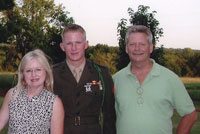
caption: In "The Soldier's Heart," airing Tuesday, March 1, at 9 P.M. on PBS (check local listings), FRONTLINE tells the stories of Jacob Martin, middle, and other servicemen and women who've returned from Iraq only to face a new battle: life on the home front. Image may only be used in editorial conjunction with the direct promotion of this film in North America. No other rights are granted. All rights reserved. Photo credit: © WGBH | |
| |
Tuesday, March 1, at 9pm, 60 minutes
U.S. Marine Rob Sarra had been in the military for eight years when the war in Iraq began. A sergeant in charge of a unit of thirty-two, he was considered part of the "tip of the spear" among the first troops to reach Baghdad. In late March 2003, Sarra opened fire on an Iraqi woman in a black burqa he suspected was a suicide bomber, prompting others in his unit to begin firing as well. Her body torn apart by bullets, the woman fell quickly to the ground. It was only then that Rob saw she held a small white flag.
"Right then and there I was just like, what the hell happened? I was crying, hysterical... this woman got killed by my actions," Sarra tells FRONTLINE. "I wasn't going to talk to anyone about it. But little did I know it kind of worked itself back up to the surface when I came home."
Sarra is one of thousands of U.S. soldiers returning from Iraq free from physical injury but haunted by memories from the battlefield. On Tuesday, March 1, at 9 P.M. on PBS (check local listings), FRONTLINE explores the psychological cost of war and investigates whether the military is doing enough to help the many combat veterans coming home with emotional problems. With unprecedented access to active duty service members at Camp Pendleton, a Marine base in San Diego, FRONTLINE uncovers one of the underreported stories from the war in Iraq.
According to Jim Dooley, a former soldier who fought in Vietnam and has counseled combat veterans for the last twenty years, "This is the most damaging type of war psychiatrically. You have no protection anywhere at all times. And therefore you're in constant death threat. And you're also witnessing death at an incredibly close range. And you're witnessing the carnage." But in most cases it's not until soldiers return from war that they begin to struggle internally with what they experienced, what they did, and what they didn't do, Dooley tells FRONTLINE.
"When you are finally back here, and you finally make connection with your safety, which is your family... that's when you begin to vibrate with the fact of where you were," Dooley explains.
In the case of Jeff Lucey, a lance corporal with the Marine Reserves of the 6th Motor Transport Battalion, coming home from Iraq was supposed to be a temporary situation. His unit was told they would most likely return to Iraq within the year. Rather than spending time on a military base, reserve marines like Lucey are returned home to pick up their lives as civilians.
But Lucey had a difficult time readjusting to life at home, those close to him tell FRONTLINE. He turned to alcohol more than he ever had before the war, isolated himself in his room, had panic attacks, dropped out of school, and even spoke of taking his life, his family says. Lucey's father, Kevin, rationalized his son's behavior.
"Because the military told us, 'He's going to go through an adjustment period,'" Kevin Lucey tells FRONTLINE. "[The military said] 'don't push. Understand that there's going to be things maybe happening you might not understand right away. Don't be concerned... just watch [him].'"
Lucey and Sarra are two of the stories of service members that FRONTLINE follows upon their return from Iraq in "The Soldier's Heart."
According to Colonel Thomas Burke, the director of health policy for the Department of Defense, nobody returns from combat unchanged. "They have expectations about what their families are going to be like. Their families have expectations of what they're going to be like," says Burke. "And the one thing that is absolutely true about all of those expectations is all of them are going to be wrong."
Combat psychological disorders among returning soldiers date back to the Civil War, when the phrase "Soldier's Heart" was first coined. Throughout the years, and through many wars, the name for the condition changed to "Shell Shock," "Battle Fatigue," and "Post-Vietnam Syndrome."
After a decade of research, psychiatrists determined that all the various names were describing the same reaction to combat. Today it's commonly referred to as Post-Traumatic Stress Disorder or PTSD. A study commissioned by the army predicts that one in six veterans from the wars in Iraq and Afghanistan will suffer from PTSD. Yet the fear of being labeled a "coward" keeps many soldiers from seeking help.
In January, the Department of Defense announced plans for a new mental health program to assist the almost one million men and women who have served in Iraq and Afghanistan. Now not only are service members required to answer questions regarding their mental health prior to their departure and upon their immediate return, but they also receive a third screening four to six months later. Insiders point out, however, that instituting programs like this one is only one part of their challenge in changing the military's culture. Stigma, many believe, is at the heart of the matter. But according to Colonel Burke, "It's not just a matter of issuing an order and saying, 'There will be no more stigma.' You just don't change the culture of an organization that quickly."
The real danger, some military experts say, is that the men and women returning home could be forgotten.
"It's not about parades, it's not about a monument, because those things get acknowledged for a day, a week, whatever," says Fred Gusman, director of the National Center for PTSD. "It's just a matter of getting people not to forget that these people are putting their life in harm's way, and they're going through hell and just because it's not on CNN every night that we shouldn't assume responsibility," Gusman adds. "Not for the war. But responsibility to take care of our own people."
"The Soldier's Heart" is a FRONTLINE co-production with A Little Rain Productions, Inc. The producer and writer is Raney Aronson.
FRONTLINE is produced by WGBH Boston and is broadcast nationwide on PBS.
Funding for FRONTLINE is provided through the support of PBS viewers.
FRONTLINE is closed-captioned for deaf and hard-of-hearing viewers.
FRONTLINE is a registered trademark of WGBH Educational Foundation.
The executive producer for FRONTLINE is David Fanning.
Press contact:
Chris Kelly
(617) 300-3500
frontline_promotion@wgbh.org
FRONTLINE XXIII/March 2005
home » previous reports » watch online » about us » teacher center » newsletter » email FRONTLINE
privacy policy » wgbh » pbsi
web site copyright 1995-2014 WGBH educational foundation