
Campaign roundup
09 Jun 2009 18:096 Comments
Iran's Presidential Election, Part VII: Green Human Chain around Tehran, Overtime for Ahmadinejad, and the Possible Withdrawal of Karroubi
This is the author's seventh article in a series on Iran's presidential elections. Part I described the political and economical landscape in Iran. Part II provided a brief history of the important political groups in Iran after the revolution, their place on the political spectrum and their present position on the issues. Part III profiled the four candidates and Part IV described the latest developments. Part V documented the growing panic in the hardline camp. Part VI was about the ascent of the reformists.
By MUHAMMAD SAHIMI in Los Angeles | 9 June 2009
[TEHRAN BUREAU] Only three days remain to voting day, Friday June 12. But, according to Iran's election laws, all the campaigns must actually end on Wednesday night, June 10. In three short days since posting Part VI on Saturday June 6, several important developments have taken place. To kick off part VII, let us begin with a warning to the Iranian people on the possibility of cheating and fraud in the elections.
'Warning to the Nation'
In an explosive open letter, copies of which were sent to all the important national figures, a group of employees of the Interior Ministry, which supervises the election, accused their bosses of trying to rig the elections in favor of Mr. Ahmadinejad. It was first reported here.
Reformists on the verbal attack v Hard-Liners' physical attacks
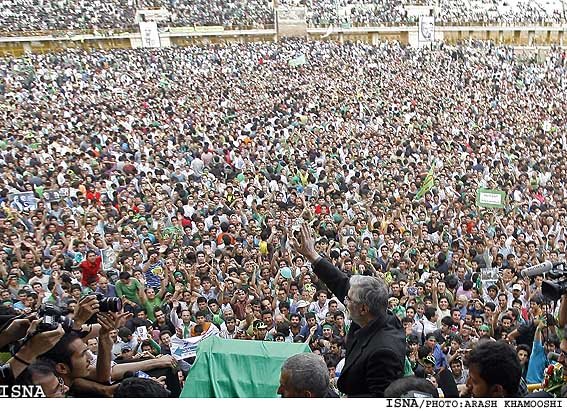
The 4th presidential debate between President Mahmoud Ahmadinejad and Mr. Mahdi Karroubi, one of the two reformist candidates, was held on Saturday evening (Tehran time). Earlier that day a campaign rally was held for Mr. Mir Hossein Mousavi, one of the two reformist candidates, in Karaj, a town west of Tehran. Tens of thousands of people attended the rally, during which Mr. Mousavi fiercely attacked Mr. Ahmadinejad's domestic and foreign policies. The number of people attending the rally was astounding, given the size and population of the town.
As in his debate with Mr. Mousavi, Mr. Ahmadinejad accused Mr. Karroubi and many others in all the past administrations of corruption. (This would of course also include the two terms Ayatollah Ali Khamenei, the Supreme Leader, served as President in the 1980s). Ahmadinejad essentially declared that his four-year administration has been the only uncorrupted one. He also argued that his administration had been the only one that has done significant work for the country. He also presented graphs and statistics that indicated that the official rates of unemployment and inflation are much lower than what his foes have been claiming.
Mr. Karroubi rejected Mr. Ahmadinejad's accusations as well as his statistics, declaring them fraudulent. He made corruption accusations of his own against Mr. Ahmadinejad, reminding him that he still has a case before the judiciary because when he was the governor general of Ardabil province (in northwestern Iran), he had used public money for the presidential campaign of Mr. Ali Akbar Nategh Nouri, Mohammad Khatami's main rival in the 1997 election. Mr. Karroubi's accusations are widely substantiated.
Mr. Karroubi also accused Mr. Ahmadinejad of hurting Iran's international prestige. He recalled that when he was Speaker of the 6th Majles (parliament), he turned down two official invitations by two countries, because he had been told that he would not be meeting with the leaders of those countries. Therefore, he refused to go because he considered not meeting the leaders of those countries an insult to Iran. He then reminded the President that when he and the leaders of many other countries attended an international conference on food in Rome last year, he was snubbed by Italy, the host country, by not being invited to the official state dinner that was attended by all the other leaders.
Mr. Karroubi also attacked the President for attending a meeting of the leaders of the Persian Gulf countries and sitting at the conference under a banner that used the Arabian Gulf, rather than the Persian Gulf. There has been a decades-long dispute between Iran and other countries of the Persian Gulf over the true name of this body of water, and Iranians are highly patriotic and sensitive about the Persian Gulf, a name that has been used for over 2000 years.
Sunday night (Tehran time) was supposed to be when the two reformist candidates, Messrs Mousavi and Karroubi, held their one-on-one presidential debate. Instead, they turned it into a fierce counterattack on Mr. Ahmadinejad, the accusations he made, and his statistics about the state of Iran's economy. In the nationally-broadcast "debate," Mr. Mousavi produced graphs that he said he had received from Iran's Central Bank indicating that the rates of unemployment and inflation were exactly what the reformist candidates had cited all along. Staring into the camera and talking directly to the nation, Mr. Mousavi accused the President of lying. He said that a lying president is a worst thing that can happen to any nation, let alone a Muslim nation since lying is one of the worst sins that any Muslim can commit. Following Mr. Mousavi's line, Mr. Karroubi also attacked the President, and responded to his accusations of the night before with well-documented facts.
After the debate, as Mr. Mousavi was leaving the television station, he was verbally attacked by a supporter of Mr. Ahmadinejad who also tried to attack him physically but was restrained by police. Then, a large mirror on the wall fell down and broke into pieces, missing Mr. Mousavi by only a few seconds.
As of the time of writing this article (Monday night, June 8), there were strong indications that the National Iranian Radio and Television, which is controlled by the hardliners, is going to take the extraordinary step of giving Mr. Ahmadinejad prime time on television on Wednesday night (the last night of the campaign) to respond to the attacks by Messrs Mousavi and Karroubi.
Fissures among Ahmadinejad Supporters
After Mr. Ahmadinejad's debates with Messrs Mousavi and Karroubi, many of his supporters condemned him for making accusations against many national leaders and prominent politicians. In particular, the entire staff of his headquarters who oversaw his campaign in the provinces resigned, issued a strongly-worded statement, and joined the campaign of Mr. Mousavi. Many of his supporters in the Majles also declared that they no longer support him. The Islamic Association of Iranian Engineers, and the United Front of the Followers of Imam and the Leader (two important conservative groups; see Part II) also strongly condemned Mr. Ahmadinejad.
At the same time, Mr. Mohammad Taghi Sobhani, a mid-ranking cleric confirmed that Mr. Ahmadinejad did claim that in his first speech at the United Nations in September 2005 he was surrounded by light (created presumably by God!), a claim that has been mocked by the reformists. The reformists has also put on YouTube a video in which Mr. Ahmadinejad is seen and heard making the claim on the one hand, and then denies making it in an interview with Mike Wallace of the CBS's 60 Minutes.
The Winner of the Debates?
The true winner of the presidential debates (as well as the entire presidential campaign) has been the Iranian nation. Many red lines on discussing sensitive political and social issues, such as corruption and nepotism, the rights of women and religious and ethnic minorities, freedom of the press and expression, execution of thousands of political prisoners in the 1980s, and the plight of the current political prisoners, have been crossed, and many taboos have now been broken. National leaders and powerful politicians have been accused of corruption on nationally-broadcast television programs by none other than the candidates themselves, including the President. These are irreversible changes that will help Iran in its rocky and slow path toward advanced stages of democracy.
Green Human Chain in Tehran
Green is the official color of Mr. Mousavi's campaign. In a show of force on Monday June 8, tens of thousands of Mr. Mousavi's supporters, mostly young people, who were wearing a green piece of cloth, or carrying a green piece of campaign material, formed a human chain on both sides of Vali Asr Street in Tehran, one of the longest streets in Tehran that runs from affluent northern Tehran to the poor neighborhoods in southern Tehran, ending at Tehran's railway station; it is about 12 miles (over 19 km) long.
They chanted, "We do not want a liar," "Say it, but do not lie" (a reference to what Mr. Ahmadinejad said in his debate with Mr. Mousavi, when he held up a folder containing education records of Mr. Mousavi's wife, Dr. Zahra Rahnavard). Mr. Ahmadinejad kept saying, 'Should I say it?' meaning should he tell the nation what the folder contains). Another chant was "Ahmadinejad left" (a reference to what the crowds chanted when the Shah left Iran in January 1979 during the last month of the Revolution). They staged one of the largest partisan demonstrations, reminiscent of the 1997 election, in which Mr. Khatami became president -- a point in time considered the birth of the reform movement.
Will Karroubi Withdraw from the Elections?
Many reformists have urged Mr. Karroubi to withdraw from the election and support the candidacy of Mr. Mousavi. He has always refused on the ground that he is the candidate of his own party, the National Trust Party. But, several months ago, he also said that it is better for several reformist candidates to campaign and then, a few days before the election, for all but one of them to withdraw in favor of the one candidate that appears to have the best chance of defeating Mr. Ahmadinejad. Speculation is rampant that Mr. Karroubi will withdraw either today (Tuesday) or Wednesday. It remains to be seen whether this will happen. If it does happen, it will be a huge boost to Mr. Mousavi, and a big setback for Mr. Ahmadinejad, who is counting on the reformist vote being split by the two candidates.
With three days left to the big vote, the author would like to emphasize once again how important a large turnout is. All indications are that the turn-out may exceed that in 1997, when 80% of the eligible voters cast their votes and elected Mr. Khatami in a landslide victory.


 via RSS
6 Comments
This particular article is a particularly lop-sided account, which unfortunately follows a series of very informative articles by the same reporter. Enough propaganda, and not nearly enough balanced descriptions, are already being sent out from Iran. An article such as this, although not without its merits, creates the illusion that the Ahmadinejad campaign has all but disintegrated -- it's a view that may or may not reflect reality, and therefore merits more careful consideration than it has been allowed here. It would be a shame for this so-far wonderful source to go down the same slippery slopes that other sources in/on Iran have traveled. A news source that sticks with all its might to journalistic standards is far more valuable to the Iranian people than any support or sympathy an article in this blog can lend to a particular candidate or party.
Houman H. / June 10, 2009 4:08 AMI appreciate the comments. The goal of the article is to report on the latest developments. Everything that is reported is factual. No one, including the author, believes that the Ahmadinejad campaign has collapsed. It still enjoys support among a segment of society. In previous articles, I reported on all the meaningful developments in the Ahmadinejad campaign. But, over the last week, the campaign has avoided meaningful debate, has presented no plan, and with the aid of the Basij and security personnel, it tries only to disrupt the campaign of the
others. The tactics, including all the allegations, have also been condemned by people across the political spectrum. So, what is there to report?
Muhammad Sahimi / June 10, 2009 10:06 AMThank you for replying to the comments. I specifically chose this article to comment on because of its clear strengths. Of course, not being in Iran yet, I would not be able to tell you what there is to report - however, in the case of the debate between Karrubi and Ahmadinejad, for example, you will notice that you have included a long list of Karrubi's attacks while neglecting to include any of Ahmadinejad's responses. This sets a biased tone that is magnified once the reader gets to the section on Ahmadinjad's speech at the UN. You also do not make any reference to the slogans, gatherings, or other activities of the Ahmadinejad campaign.
I make these observations as a concerned friend who has been following your articles closely. I am looking forward to your upcoming dispatches.
Houman H. / June 10, 2009 2:28 PMYour points are well taken. The article should have included some of the things you pointed out, but the time pressure simply did not allow it. It was not meant to be a biased report, although I certainly can see how it might be interpreted that way by some. As for Ahmadinejad's campaign rallies, the intention was to also report on the large rally that he held in Tehran. But, as of the time of finishing the article, I had received no credible report on the size and composition of the rally. So, once again, it was the timing as well as the deadline pressures.
Muhammad Sahimi / June 10, 2009 3:23 PMGenerally speaking, we try to cover as much ground as we can. We have covered Ahmadinejad rallies elsewhere on Tehran Bureau, including recently here: http://tehranbureau.com/2009/06/10/all-the-presidents-men/
tehranbureau / June 10, 2009 3:26 PMThank you for engaging in the discussion, Mr. Sahimi. I'm looking forward to your next reports.
Houman H. / June 10, 2009 4:56 PM