
Isn't it Ironic
10 Jun 2009 20:36No Comments
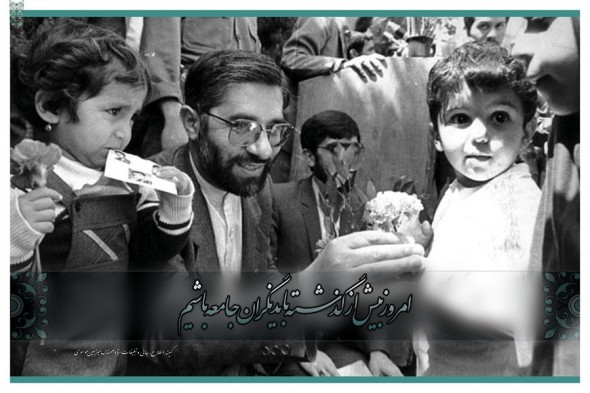
Mir Hossein, back in the day. Photo/Ghalamnews.ir Tehran | 10 June 2009
"I would like to talk to you about a lady, may I? You know her, she is at your side at rallies and when you take the stage. May I speak of her?" Mahmoud Ahmadinejad was waving a file with a photo on the first page; the document in question was Dr. Zahra Rahnavard's academic credentials. The man sitting across the table was her husband, Mir Hossein Mousavi, a presidential candidate. For a moment Mr. Mousavi froze, as did the entire Iranian nation, so it seemed. No one believed it. The old around me shook their heads with regret and disbelief; the youth were dumbfounded. What just happened on live national television?
Mr. Ahmadinejad, the principilist President, the man of the people, a man who professes to share the real values of this ancient and dignified people, defied one of their oldest traditions in a most undignified way. In a country where the reputation of a man's wife is sacred, he slandered his rival's wife's before 50 million viewers. Men have killed and died for offenses smaller than his. And yet Mir Hossein Mousavi sat frozen in disbelief.
He did not let this go unanswered, of course, as there are things you just cannot let go by unanswered in Iran. He struck back at the President's act of social indecency in another live debate, and in his last campaign commercial. When it is a matter of decency, politics becomes irrelevant.
But this is all rather ironic.
Mir Hossein Mousavi was for a long time prime minister of the Islamic Republic. Tthe challenges facing him at that time were matters of life and death. He was the third prime minister the young republic had in less than three years. One predecessor had been killed in a terrorist attack; another had resigned from his post in protest and become an opposition figure.
Mir Hossein Mousavi had to run the country and overhaul its bureaucratic system at the same time. The revolutionaries did not trust those who served in the previous regime--they could have been counterrevolutionaries infiltrating the system. The last president and his prime minister were killed by a bomb planted by a member of their own staff. No one but those with the greatest zeal for Islamic ideals and the Islamic Revolution were trusted.
Mousavi's government opened the doors to young men like Ahmadinejad, then just in their early 20s, to serve and protect the country. The new government trained and employed them as civil servants, diplomats, governors, mayors, school principals, heads of its regional offices. Committees were formed to purge the government of any employee deemed secretly loyal to the Shah. Hundreds if not thousands lost their jobs over petty excuses. Those days a photo of one's unveiled wife were sufficient grounds for dismissal--they were deemed too westernized to hold public office. Committee members were all too eager to replace the old and allegedly corrupt with the young and revolutionary pure.
Ahmadinejad and his colleagues rose quickly in the ranks of the Islamic Republic. Many received high-profile posts in the diplomatic corps or became governors of a province. With the right revolutionary credentials and ideological loyalties, one could be promoted rather quickly. Professional technocrats had to be especially careful; a wrong step, a simple label, an argument with the wrong person, or even an unwarranted rumor was all the new guard needed to strip someone of their livelihood. Ahmadinejad and his colleagues had little to worry about. They were just what the new regime was looking for. In fact it was Mr. Mousavi's political order that helped their self confidence reach new arrogant levels.
For some that moment in the debate was poetic justice of a sort. Mousavi, a professional architect, a man who holds his family and principles in such high regard, had to go through the humiliation many experienced back in the days he held power in the Islamic Republic. The righteousness and arrogance his government helped unleash has now gripped every aspect of life in Iran. Should he become the next president, as many wish him to be, let's hope he does not forget this humbling encounter. He can use it to heal many old wounds.
Copyright (c) 2009 Tehran Bureau
--------


 via RSS
No Comments