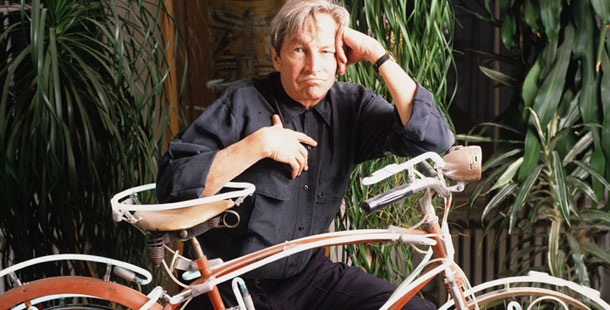
Born in Port Arthur, Texas in 1925, Robert Rauschenberg imagined himself first as a minister and later as a pharmacist. It wasn’t until 1947, while in the U.S. Marines that he discovered his aptitude for drawing and his interest in the artistic representation of everyday objects and people. After leaving the Marines he studied art in Paris on the G.I. Bill, but quickly became disenchanted with the European art scene. After less than a year he moved to North Carolina, where the country’s most visionary artists and thinkers, such as Joseph Albers and Buckminster Fuller, were teaching at Black Mountain College. There, with artists such as dancer Merce Cunningham and musician John Cage, Rauschenberg began what was to be an artistic revolution. Soon, North Carolina country life began to seem small and he left for New York to make it as a painter. There, amidst the chaos and excitement of city life Rauschenberg realized the full extent of what he could bring to painting.
Rauschenberg’s enthusiasm for popular culture and his rejection of the angst and seriousness of the Abstract Expressionists led him to search for a new way of painting. He found his signature mode by embracing materials traditionally outside of the artist’s reach. He would cover a canvas with house paint, or ink the wheel of a car and run it over paper to create a drawing, while demonstrating rigor and concern for formal painting. By 1958, at the time of his first solo exhibition at the Leo Castelli Gallery, his work had moved from abstract painting to drawings like “Erased De Kooning” (1953) (which was exactly as it sounds) to what he termed “combines.” These combines (meant to express both the finding and forming of combinations in three-dimensional collage) cemented his place in art history.
One of Rauschenberg’s first and most famous combines was entitled “Monogram” (1959) and consisted of an unlikely set of materials: a stuffed angora goat, a tire, a police barrier, the heel of a shoe, a tennis ball, and paint. This pioneering altered the course of modern art. The idea of combining and of noticing combinations of objects and images has remained at the core of Rauschenberg’s work. As Pop Art emerged in the ’60s, Rauschenberg turned away from three-dimensional combines and began to work in two dimensions, using magazine photographs of current events to create silk-screen prints. Rauschenberg transferred prints of familiar images, such as JFK or baseball games, to canvases and overlapped them with painted brushstrokes. They looked like abstractions from a distance, but up close the images related to each other, as if in conversation. These collages were a way of bringing together the inventiveness of his combines with his love for painting. Using this new method he found he could make a commentary on contemporary society using the very images that helped to create that society.
From the mid sixties through the seventies he continued the experimentation in prints by printing onto aluminum, moving plexiglass disks, clothes, and other surfaces. He challenged the view of the artist as auteur by assembling engineers to help in the production of pieces technologically designed to incorporate the viewer as an active participant in the work. He also created performance pieces centered around chance. To watch dancers on roller-skates (”Pelican”, 1963) or to hear the sound of a gong every time a tennis ball was hit (”Open Score”, 1966), was to witness an art that exchanged lofty ambitions for a sense of excitement and playfulness while retaining meaning.
Throughout the ’80s and ’90s Rauschenberg continued his experimentation, concentrating primarily on collage and new ways to transfer photographs. In 1998 The Guggenheim Museum put on its largest exhibition ever with four hundred works by Rauschenberg, showcasing the breadth and beauty of his work, and its influence over the second half of the century. Rauschenberg lives in Florida and continues to work, bringing his sense of excitement and challenge into a new century.


(66 votes)

It is interesting and very good for homework. Especially if you’re interested in art.
this should be updated, he died in may of 2008 i believe
Unfortunately he did passed away on May 12th 2008.
great for art homework wish it had just a lil mre info nd some more pictures
Please re-run this.
He is one of the great four artists…!
Robert Rauschernberg, Jasper johns, Jim Dine, and Gustave klimt…. =D al good american artists of there time..! =D
his paintings r so perverted and weird
Rauschenberg and Pollock are the two 20th century artists who best followed Kandinsky’s ‘inner spirit’. But ‘inner spirit’ was blamed ‘nameless’. As a result, you cannot tell why Rauschenberg is a great artist and what problems exist.
I developed a new theory of fine art with a new definition of art. My theory can give great interpretation to most critical issues in art history.
Please visit my website for more details: http://www.TheGreatnessSchool.com
This is some of saddest news for both the art world and humanity at large Rauschenberg not only inspired generations of young art students such as myself with his depth and nack for capturing emotion in his beutiful work but he worked tirelessy to literally make the world a better place, and thanks to him it is at least a bit more beautiful. Thankyou Sir. God bless x
His art was no better than a first grader using finger paints. Woohoo, his greatest work was erasing the art of another. Give me a break. The only type of artist this guy was, was a scam artitst. Thank goodness we will no longer be punished with cello’s painted white inside a 55 gallon drum. Puhleez!
He was an inspriation to everyonex god blessx
A GENIUS. THE 20TH CENTURY TURNER.
hello :)
i really admire this mans work
this man is a genius, his art has it’s own unique personality. :)
I love u.
We learn and talk about
u everyday in art.
Direct quote from guest book at the last showing at the Metropolitan Museum of Art, “Fred Sanford Lives!!”
im doing my gcse art early, i as soon as i got the
chance to pick my topic on my final exam peice i picked you as my artist inspiration. i love your work.
Im doing my gcse’s and i have picked this style of art for my final piece. Very interesting and amazing… Love ettt Great work!!! :D
Raushenburg and Richter are the most important and defining artists in my life…..thankyou both
nice work, never really heard of him but just started studying his work. and do have a soft spot for it. he has died a happy man im sure x
nice work, i am studying about him he has really good paintings.
beautiful inspiring and unique work. compositions are not easy to fathom and i am overwhelmed by your creativeness, as i have also picked you for my a level course being inspired by you is easy yet re-producing work like yours is a different task all together. thankyou for what you’ve given us
We learn and talk about
u everyday in art and my art teacher is obsest with you he is a great arteest
I thought his works were just a way to discover himself and start a new beggining. anywho this page helped somewhat on my homework…. Only if there were mo pistures.
[...] Jerry, Thundar the Barbarian, and of course, the Super Friends. In college, I studied fine arts. Rauschenberg and Duchamp were my favorites. That’s about the time I fell in love with Ren and Stimpy, Frank [...]
Where and when did he paint???
I love your work. You sculptures are crazy but I like them. You are awsome. I love studing your artwork because the sculptures and paintings are great.
Go Robert! Go Robert!
Robert Rauschenberg wohoo!
he is clever now isn’t he lol he must be soo famous all over the world and great for art home work
isnt he a photographer ?>
Helped me with homework
Thanks :)
[...] FP: Robert Rauschenberg because I do. Mike Giant because his line work is insane. Mars1 because he transformed for awesome to exceptional. Kelly Tunstall because she is smart and can flow effortlessly through a painting. [...]
For Pineco: Gustav Klimt was not american, he was Austrian.
********************************************************************************Plain clothes, buttons, back alley ray gun ammo, spliced paper larynx, spotted baseball bat with cocoa sprinkles, ash can rants, tv antenna painted pink, pine cone pitter patter, old people sleeping summer porches, swamp water words, tang sweet tea southern railroad back door artist.
**************************************************
I agree with some of the previous comments – PLEASE RERUN THIS – especially since Bob has passed.
this web is great for homework right
RIP
This helped me alot. I am doin a report on him.
I also belive he was married??
go rauschenberg
i really like collage so enjoy his work
love his art
Very interesting and detailed, but he has passed now, and i would like to know when and where, as now this is an error of fact as he does not live in florida anymore.
how yu doooin!
your art rocks 8-)
very good and it go for a project i get a a+ on it!
i never heard about Mr. Robert until now. Im in college and have to do a research paper on him and after reading about him and reading all the positive things people had to say about him I want to say im excited on doing this paper. He seemed like he touch a lot of people. RIP Mr. Robert
nice choice with the art biz=)
his work is amazingly deep. it inspires young artists like myself to see past the simple foregrounded conceptions of an object to see the symbolic side that further study of his works can provide.
Pineco: since when was Gustav Klimt American?