Visit Your Local PBS Station PBS Home PBS Home Programs A-Z TV Schedules Watch Video Support PBS Shop PBS Search PBS

January 1st, 2009
Introduction: Analyzing the Evidence

While creating LOOKING FOR LINCOLN, historians and researchers examined photographs, paintings, historical documents and letters. This evidence of the past—left behind by those who lived it—can be an extremely valuable tool for understanding the life and times of Abraham Lincoln.

Below is a gallery of photographs, paintings, letters and historical documents that are important in helping us to better understand Abraham Lincoln. To uncover more about these items, select one from the gallery below to begin. Note: The questions and documents increase in difficulty as you proceed from Piece 1 to Piece 5.


THE EVIDENCE
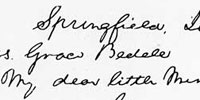


Piece 1. Letter to Grace Bedell

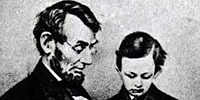
Piece 2. Images of Abraham, Tad and Mary Lincoln

Piece 3. Abraham Lincoln Autobiography / Letter to Jesse Fell

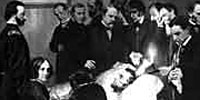
Piece 4. Abraham Lincoln Deathbed Images

Piece 5. Gettysburg Address

Bookmark    Print    Email    Comment/s (8)

(6 votes)
Loading ... Loading ...

Comments

8 comments

#1

the PBA special on Licoln was better but it still left out the fact that it was the new york Lawyers and Banks that started the war. They owed so much money to the south the banks could not repay the south for thier natrual resourwes and for agriculture. They got loans to build railroads and other infrastucture for thje the nortern states as well as stated a northen crossing of america by railrods that took away from the easy routs through the souh. I t left out many facts about how the bankers held in trust most of the southerns access and would not relinquish them. The bankers who bought and sold slaves and otherf illiegal things while forceing products from the nort. It also did not account for the munissions that were made only in the north and the southerns left without being constitutingly able to bear arms. Abraham Lincoln sold out to the northern BANKERS and Lawers to rape and pil.lage the south. Instead of following his heart of getting rid of slavery in a timely matter he was pressured by money and greed by a few slave owers of the NORTH to destroy the southerns the north was indebted. Furthermore many of the same bankers and lawers are still making wroung jugrments and really have started most of the wars. Rather that almost all wars are from socicial economic, land grabbers, or to bring down anouther human being a great wrong terriony and may all th bankers, lawers, and arrisstocrats be sitting in hell and explaining it. may all those that died in vein be forgiven for the rich mans war.

#2

the PBA special on Licoln was better but it still left out the fact that it was the new york Lawyers and Banks that started the war. They owed so much money to the south the banks could not repay the south for thier natrual resourwes and for agriculture. They got loans to build railroads and other infrastucture for thje the nortern states as well as stated a northen crossing of america by railrods that took away from the easy routs through the souh. I t left out many facts about how the bankers held in trust most of the southerns access and would not relinquish them. The bankers who bought and sold slaves and otherf illiegal things while forceing products from the nort. It also did not account for the munissions that were made only in the north and the southerns left without being constitutingly able to bear arms. Abraham Lincoln sold out to the northern BANKERS and Lawers to rape and pil.lage the south. Instead of following his heart of getting rid of slavery in a timely matter he was pressured by money and greed by a few slave owers of the NORTH to destroy the southerns the north was indebted. Furthermore many of the same bankers and lawers are still making wroung jugrments and really have started most of the wars. Rather that almost all wars are from socicial economic, land grabbers, or to bring down anouther human being a great wrong terriony and may all th bankers, lawers, and arrisstocrats be sitting in hell and explaining it. may all those that died in vein be forgiven for the rich mans war and all the wars before and since then= forever.

#3

I have not yet watched the documentary and am looking forward to doing so. However upon reading Mike Luby’s comment it is apparent that his knowledge of history is as lacking as his spelling and grammar.

1. The Southern States were committed to slavery and despite all revisionist history to the contrary, the planter class was profiting immensely from the “peculiar institution”. Because of slavery instead of the United States being looked upon as a bastion of Freedom through out the world in was considered a barbaric backwards nations by the citizens of the advanced nations of the world.

2. The Southern aristocracy committed high treason by seceding from the Union, and even if you concede the right to secede which most Americans even then did not, they committed high treason by attacking US installations and service men stationed around the South. Benedict Arnold despite his early exploits in the Revolutionary War, including the victory at Saratoga that brought the French in our side, has been rightly excoriated by history for his treason. They executed the Rosenbergs for the same crime. And the Southern secessionists are just as guilty.

3. Lincoln was hesitant to commit the country to war. (Witness his first inaugural “we are not enemies, we are friends.”) It was the secessionist congress the ordered the attack on Fort Sumter, thereby initiating the War.

4. The average southerner realized that the whole war was contrived by the planter class. The expression “Rich man’s war, Poor man’s fight.” was very prevalent. That is why they had to initiate a Draft very early on in the war to fill their armies, and they always had a major problem with desertion, whereas the north was able to rely on volunteers all the way to the latter half of 1863. That is also why a number of men from the seceding states served in the Army of the United States and in the United States Government. (George Thomas, Andrew Johnson to name two.)

#4

i like this movie haha ^^

#5

this section was very informational and very effective to the learning of the linconln. i hope to see more fantastic work. keep it up you guys

#6

If only Mr. Edward Joell’s logic was as mediocre as his sarcasm.
1. Slavery was wrong in 1861 and remains as wrong today where it’s practiced around the world (especially in Africa). Mr. Joell says that planters made a lot of profit {gasp!} — just like the yankee slave traders from New England, who as late at the 1860s (despite US law against it) were transporting slaves across the Atlantic and from the Caribbean to yankee smuggling routes. It was a nasty, filthy business. Fine ivy league places like Brown University were built on the lucractive profits of trading in human flesh. Revisionists like Joell like to pretend that all the evil-doers were Southerners and they pretend not to notice that it was and is a world-wide issue. No other country on the planet required a war to end slavery, and neither did the U.S.A.

2. Aristocrats committed treason? First, Mr. Joell, no…they were state conventions called for the purpose — just as conventions were called in each state to ratify the Constitution (by the way, any could have declined to ratify) in the first place. Southern states followed proper protocol to exercise their right to depart the compact. Any reasonable reading of the Founders intent made it clear that secession and nullification were options available to states to check abuses by the central government. Rosenbergs? Comparing apples and kiwis aren’t we?

3. It’s not the first to use force who is the aggressor, but the first who renders force necessary. It’s well documented that Lincoln sent reinforcements and ships of war to Sumter and that he had word leaked in advance that they were coming to reinforce the fort (inside the sovereign state of SC) by force if necessary. If the CSA had not fired on Charleston, Lincoln would have continued to provoke until he got his war. He was going to call for those volunteers to invade the south, with OR WITHOUT a Fort Sumter. The CSA batteries had already fired on the US STAR OF THE WEST some weeks earlier (trying to sneak in supplies). There was no formal complaint about that. BOTH SIDES KNEW that forcing supplies in was AN ACT OF WAR.

You see, it was about tariff revenue. Lincoln in his first inaugural speech said EVERYTHING ELSE was negotiable …. except the tariff revenue. No, the CSA Congress issued no orders; the Confederate President did. By the way, there was NO human LOSS OF LIFE (one mule died) in the attack. The US troops were allowed to evacuate Sumter peacefully when they surrendered.

4. Both sides relied heavily on conscription in the latter half of the war. It was the Northern cities that had draft riots (e.g., New York) in 1863. That is, by the way, when the North “all of a sudden” decided the war was about ending slavery and not just about “saving the union.” Wink, wink (the Proclamation was for foreign consumption). Everyone at the time saw through that smokescreen. It was about economic domination from beginning to end for the Tyrant Lincoln. For southerners, it was mostly self-defense. After all, it was the North that invaded the South. It was southern farms and cities that were burned to the ground.

Lincoln sent in warships, provoked hostilities, raised an army (calling for 75000 volunteers) and ordered a naval blockade (another act of war) before he even told Congress what was going on. In July 1861, Lincoln’s war was well underway when he asked Congress to rubber stamp it.

Lincoln then went on to shutdown dozens of northern newspapers, suspended habeas corpus and imprisoned over 13,000 northern civilians without due process (all while civilian courts were operating). You see, he had to first crush the Constitution in order to “save the union.” He didn’t believe in racial equality, but quoted the Declaration’s phrase about all men being created equal. He ordered troops to make war on civilians…and laughed at the tales of their suffering. Some humanitarian. Some hero.

#7

Wow. Will anyone ever understand history?

There is enough “garbage” in comments 1-6 for me to say: None of you warrant a direct reply. Never argue with closed minds.

NO ONE had pure intentions then, now or ever. All humans have their own agenda. Period.

Winners dominate the number of history books. Whiners dominate the call-in shows and internet sites.

My qualifications: There are 10,261 books written about Abraham Lincoln. My private but accessable-by-appointment library has copies of all but 12 of them. We have a reproduction of every known document written by Lincoln. We have books written by Joshua Speed, William Herndon, William Seward, John Hay, and John Nicolay – and more.

There are too many facets to Lincoln’s life, presidency, etc. to cover in a few snide comments on an internet chatboard.

Educate yourself.

J.O. Mulldoon

#8

[...] Analyzing the Evidence Examine the life of Abraham Lincoln through primary sources such as letters, photographs and paintings. Uncover clues that reveal biographical details about America’s 16th President. [...]

Post A Comment


Please note that the THIRTEEN editorial staff reserves the right to not post comments it deems to be inappropriate and/or malicious in nature, as well as edit comments for length, clarity and fairness. No solicitations or advertisements will be allowed. Users may link to other Web sites relevant to discussion, but most often links to commercial Web sites will not be permitted.

Submit

State Farm

Order the Book : Looking for Lincoln