Visit Your Local PBS Station PBS Home PBS Home Programs A-Z TV Schedules Watch Video Support PBS Shop PBS Search PBS

January 16th, 2009
Beyond Tolerance: Searching for Interfaith Understanding in America

BOOK EXCERPT

by Gustav Niebuhr

“He described the world’s major religions as being like branches of a tree, in which the trunk contained a dedication to truth and nonviolence.”

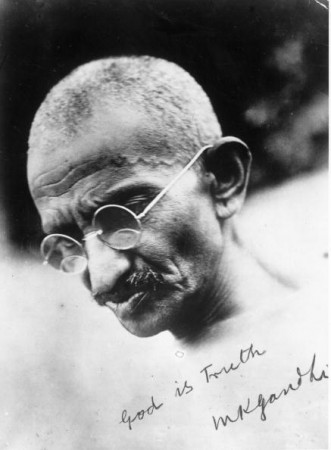
Gandhi is the gold standard when it comes to talking about interreligious respect. On the night that India became independent from Britain, the goal for which he had worked so hard, Gandhi avoided the ceremonies in Delhi and stayed in Calcutta with members of India’s Muslim minority. He had wrestled much of his life with the question of how to relate to a plurality of faiths. In his autobiography, The Story of My Experiments with Truth, he told of growing up with almost daily experience of encounters that defied caste and faith boundaries, as a result of his father’s openness to speaking with people across Hinduism’s internal lines as well as with those of other religions. The senior Gandhi served as a minister to one of India’s princes. Jain monks visited the family, accepted gifts of food, and had friendly discussions with Gandhi’s father. The elder Gandhi also had Muslim and Zoroastrian friends who, the son reported, would talk to him about their religions, to which he listened with respect. Gandhi at first felt, he said, tolerant of other faiths. But later in life, he found that insufficient as a basis for dealing with non-Hindus. Instead, he adopted a position he described as respecting all religions as equals. He described the world’s major religions as being like branches of a tree, in which the trunk contained a dedication to truth and nonviolence. “Tolerance may imply a gratuitous assumption of the inferiority of other faiths to one’s own,” he wrote, “and respect suggests a sense of patronizing, whereas ahimsa”—that is, nonviolence—“teaches us to entertain the same respect for the religious faiths of others as we accord to our own, thus admitting the imperfection to the latter.”

bookmark    print    email    comment/s (4)

(3 votes)
Loading ... Loading ...

Comments

4 comments

#1

I Love this. It was short and to the point. It had enough information that makes me want to read and learn more in this vital area. It validates the struggles I’m having at this time in my life… Thank You

#2

A lesson here too. While respecting all faiths, Gandhi continued to live and practice the Hindu faith all his life.

#3

If only all nations, political ideologues, ministers of all faiths and denominations, &c, would learn from “Mahatma – The Great Soul.”

God is Truth and God is Love are statements that lie at the heart of true religion. By ‘true’ I do not mean those who have absolute spiritual verities, but rather ‘true religion’ in that their practices are unselfish, altruistic, and involve sacrifices of time, talents, and means, for the blessing and betterment of all people, everywhere.

#4

So simple, so straightforward, so compassionate a message! Do humans have to be angels, Mahatmas, or prophets to be able to absorb the truth, and try their utmost to live by it. I WONDER.

Post A Comment


Please note that the THIRTEEN editorial staff reserves the right to not post comments it deems to be inappropriate and/or malicious in nature, as well as edit comments for length, clarity and fairness. No solicitations or advertisements will be allowed. Users may link to other Web sites relevant to discussion, but most often links to commercial Web sites will not be permitted.

Submit

Facebook Watch Now YouTube Listen Now

Produced by THIRTEEN WNET New York    ©2009 Educational Broadcasting Corporation. All rights reserved.

Funding for RELIGION & ETHICS NEWSWEEKLY is provided by Lilly Endowment. Additional funding is provided by individual supporters and by Mutual of America Life Insurance Company, The Henry Luce Foundation and The Corporation for Public Broadcasting.