On November 9, 1888, the body of 25-year-old Mary Jane Kelly was found inside a lodging house on Dorset Street. Her throat had been slashed, her face mutilated beyond recognition, her chest and abdomen cut open and her internal organs, as well as flesh from her limbs, were left on the bed where she lay. Kelly’s heart was missing and disappeared without a trace.
London Police received a series of letters from a man calling himself “Jack the Ripper” (one of the letters included a part of a human organ) and the name struck a chord with the media and the public. The crimes of “Jack the Ripper” were reported in full detail by the mass media and readily consumed by the general public—and was one of the first crimes to earn the title “Crime of the century.” Over a hundred years later, Jack the Ripper is still the subject of horror stories and films and was an important precedent in the way the media treated the case of Hawley Crippen.
“Crime of the century” was a phrase used throughout the twentieth century to describe horrific events that shocked the nation and became part of the media’s fascination. David Berkowitz, Elizabeth Short, Lizzie Borden, Leopold and Loeb, Charles Manson— — they were all the focus of crimes that shocked, and haunted us. They are remembered for their news headlines and rumors at the time as well as their cultural impact. All of the crimes and cases listed below obsessed the news media of the day and well over a century later they still generate books, movies– even the occasional PBS documentary.
The Fatty Arbuckle Scandal – 1920
 Crime: Charged for murder
Date: September 3, 1920
Place: St. Francis Hotel, San Francisco
Suspect: Roscoe “Fatty” Arbuckle
Victim: Virginia Rappe
Sentence: Acquitted
Arbuckle threw a small party in his suite at the Hotel St. Francis, during which actress Virginia Rappe suffered a fatal internal injury. Although the evidence showed the bladder rupture was not caused by external force, she claimed Arbuckle sexually assaulted her. “Fatty Arbuckle Sought in Orgy Death,” “An obese Hollywood comedy star takes advantage of a naïve young actress, puncturing her bladder during forced sex,” ran the newspaper headlines. Arbuckle went through three trials and while the third trial acquitted him of all crimes, and the jury issued him an apology, the media destroyed his reputation and film career. Arbuckle died in 1933, after falling into alcoholism, and obscurity.
The Lindbergh Trial – 1932
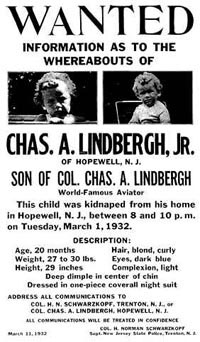
Crime: Kidnapping and murder
Date: March 1, 1932
Place: New Jersey
Suspect: Bruno Richard Hauptmann
Victim: Charles Lindbergh Jnr, age 2
Sentence: Executed by electric shock, April 3, 1936
On the night of March 1, 1932, someone snuck into the home of aviation hero Charles Lindbergh and kidnapped his baby son out of his nursery. On May 12, two truck drivers found the child’s body in the woods about four miles away from the Lindbergh mansion. “Lindy baby found dead near home,” ran the newspaper headlines. In all, there were literally thousands of leads followed by the FBI, but eventually 34-year-old German carpenter Bruno Hauptmann was arrested in his car, and tried for the crime. The trial, which the renowned journalist H.L. Mencken called “the greatest story since the Resurrection,” took place in a small town in New Jersey, with hundreds of reporters and spectators. While Hauptmann was found guilty and was electrocuted at Trenton State Prison, his guilt, to this day, remains an unanswered question. The case remains a “Crime of the Century” because it involved Charles Lindbergh the first man to fly the Atlantic in a one-engine airplane. Hauptmann’s trial, which was filmed and shown in movie theaters, began on February 2, 1935. A number of novels have been published about the trial, as well as several television documentaries including the PBS program, reliving the Lindbergh Case.
The Black Dahlia – 1947
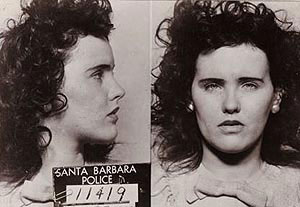
Crime: Murder
Date: January 15, 1947
Place: Leimert Park, Los Angeles
Victim: Elizabeth Short, aged 22
Perpetrator: Unknown
On the morning of January 15, 1947, a housewife was pushing a baby carriage along a residential street in South Los Angeles, when something caught her attention. She saw what appeared to be a store mannequin dumped in the grass a few inches from the sidewalk. On closer inspection, it was the body of a young woman, cut in half, and completely drained of blood. The two detectives assigned to the case determined that the murderer had used a knife to cut 3-inch gashes into each corner of her mouth. The sensational nature of the murder resulted in the victim being referred to as the “Black Dahlia” by the Los Angeles press. The victim was identified as 22-year-old Elizabeth ‘Betty’ Short. “Police seek mad pervert in girl’s death,” ran the Washington Post. In early newspaper reports, the press played up the fact that Short was a struggling actress, and very promiscuous. The Examiner went so far as to call her mother, Phoebe Short, and made up lies about her daughter. They told her that Elizabeth had won a beauty contest, and once they got the got as much personal information as possible from Mrs. Short, the paper informed her that daughter Elizabeth was actually dead. The case generated a huge list of suspects, possible motives, and urban legends. More than 60 years after Elizabeth’s body was found, the case remains unsolved. The famous murder became the subject of movie directed by Brian DePalma based on the 1987 James Ellroy novel “The Black Dahlia.” “What’s amazing about the Black Dahlia, besides the fact that her body is in two parts, and the way her mouth is slashed… she’s displayed in like a horror show,” DePalma said in 2006 ABC interview about his film.
The Murder Of Marilyn Sheppard – 1954
Crime: Murder
Date: July 4, 1954
Place: Cleveland, Ohio
Victim: Marilyn Sheppard (and her unborn baby)
Perpetrator: Unknown
On July 4, 1954, Marilyn Sheppard was bludgeoned to death in the bedroom of her home in the Cleveland suburb of Bay Village. Her husband, Dr. Sam Sheppard, was asleep on the sofa downstairs when he said he heard his wife’s screams and ran upstairs to find a man standing over the body of his wife. Within weeks after the murder, the Cleveland press turned against him, and called Sheppard a “liar.” Dr. Sheppard was charged with his wife’s murder, and he spent ten years in the Ohio Penitentiary before he was eventually acquitted. The trial was a national and international sensation in the media, but it eventually destroyed the Sheppard family. Dr. Sheppard eventually drank himself to death, in April 1970, at the age of 46. His son Sam Reese Sheppard sought to clear the family name for his father’s unlawful imprisonment, but the jury ruled that he had failed to prove that his father had been wrongfully imprisoned. The public has speculated that the case became the inspiration for the 1960s TV series and Oscar-winning film “The Fugitive” in which a doctor, who is wrongly accused of the murder of his wife, goes on the run in order to track down the killer, although the creators of the series and film deny a connection.
In Cold Blood – 1959
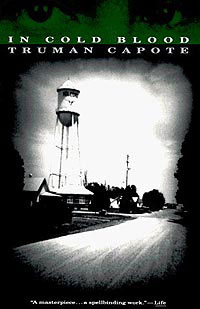
Crime: Multiple murders, robbery
Date: November 15, 1959
Place: Holcomb, Kansas
Victims: Herb Clutter, aged 48; Bonnie Clutter, aged 44; Nancy Clutter, aged 16; Kenyon Clutter, aged 15
Suspects: Perry Smith and Richard Hickock
Sentence: Hickock and Smith were hanged on April 14, 1965 at Lansing Correctional Facility
Media Coverage: more than 288 stories on the “The Clutter Family” killing to date
In November of 1959, four members of the Clutter family of Holcomb, Kansas, were murdered in their home at River Valley Farm by two small-time criminals. Herb Clutter, his wife and two of their four children were killed, and the fear and suspicion spawned by the crime almost destroyed the entire community. The writer Truman Capote saw a news account of the murders and decided to travel to Holcomb to investigate the case. He researched the town, the victims, the locals and the killers for years, publishing In Cold Blood in 1965, after the murderers Smith and Hickock were executed. Capote broke new ground in literature, and some say he even changed the face of journalism, by writing what he came to call a “nonfiction novel.” The best-selling book was the subject of a 1967 film. Actor Phillip Seymour Hoffman won the 2005 Best Actor Oscar for his portrayal of the famed writer in the film Capote, which deals with the writing of In Cold Blood.
The Zodiac Killer – 1968
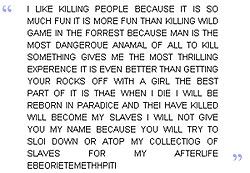
Crime: Serial murder
Date: December 20, 1968 – October 11, 1969
Place: San Francisco, California
Victims: David Faraday, Betty Lou Jensen, Darlene Ferrin, Cecillia Ann Shepard and Paul Stine
Perpetrator: Unknown
On December 20, 1968, teenagers David Faraday and Betty Lou Jensen were parked in a “lover’s lane’ near San Francisco when shots were fired into their car. While both had been murdered, neither victim had been robbed or sexually assaulted, and the police failed to identify a motive or a killer. Then, on July 4, 1969, the gunman struck again, and then again on the afternoon of September 27. Before it was all over, the killer took five lives. The killer wanted to let the police and newspapers know what he had done. Three letters were sent to local newspapers confessing to the murders and including a description of the ammunition. The San Francisco Chronicle received a letter from the “Zodiac Killer” confessing to the crime. Inside the letter was part of the victim’s shirt. Even though the murders ceased in 1969, the unknown killer continued to taunt the police with phone calls and cryptic messages. And, while the police investigated over 2,500 potential suspects, and the unknown killer claimed responsibility for as many as 37 deaths, the case was never officially solved.
Charles Manson Murders – 1969
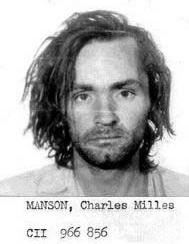
Crime: Serial murder
Date: July 27 – August 9, 1969
Place: Los Angles, California
Victims: Gary Hinman, Steven Parent, Sharon Tate, Jay Sebring, Abigail Folger, ‘Votek Frykowski, Leno LaBianca, Rosemary LaBianca
Perpetrators: Susan Atkins, Bobby Beausoleil, Clem Crogan, Linda Kasabian, Patricia Krenwinkel, Leslie Van Houten, Charles Watson and Charles Manson
Sentence: Death sentences were changed to life imprisonment
On the night of August 8, 1969, Charles Manson and friends committed several brutal and bloody murders of actress Sharon Tate and four other people in Hollywood. The leader, ex-con and failed musician, was later found to be responsible for ordering the murder spree—his name was Charles Manson. During the trial, which started on June 15, 1970, Manson’s followers—followed his every move, even carving swastikas into their foreheads. After the longest trial in US history, the members of Manson’s group were found guilty and sentenced to death, but in 1972 California revoked the death penalty—before Manson or the murderers could be executed. Right after the trial, there were a number of articles written that were favorable to Manson and his followers. For a while, it appeared that he might become some sort of cult hero. While that never really materialized, Manson still receives a large amount of mail, much of it from young followers. There have been several plays about him, movies and documentaries– even an opera.
Related resources:
- PBS: Lindbergh: The Kidnapping
- Time Magazine: Crimes of the Century
- Charles Lindbergh
- TruTV Crime Library
- Casebook
- ABC News: Ellroy’s Obsession With the Black Dahlia
- Salon.com: “In Cold Blood”
- ABC News: Still Searching for the Zodiac Killer
- University of Missouri: Famous Trials
- 101 Crimes of the Century, Alan J. Whiticker, New Holland Publishers, 2008