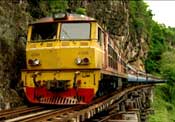
A train runs on one of the few surviving sections of the original Thailand-Burma Railway.
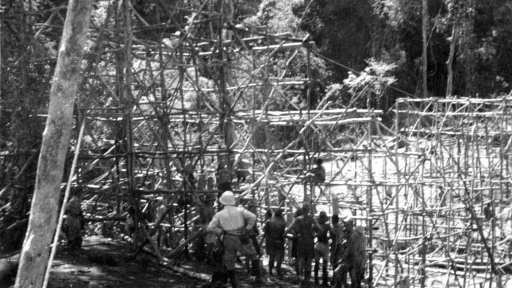
Construction of the Thailand-Burma Railway began on September 16, 1942 at two existing railroad terminals, one in Thanbyuzayat in Burma and the other in Nong Pladuk, Thailand, about 25 miles west of Bangkok, in the Ratchburi province. As early as 1939, the Japanese had drawn up plans to build the railway, which was to provide a supply line capable of transporting 3,000 tons of supplies per day to support their frontline troops in Burma. At that time, Japanese engineers estimated that the 257-mile line would take five years to build because of the harsh conditions and treacherous terrain. Much of the railway, particularly the roughly 175 miles of track that ran through Thailand, required high bridges (more than 600 along the entire line) and deep mountain cuttings. The railway was completed in just 16 months when the two separate lines joined 23 miles south of the Three Pagoda’s Pass. But the cost was incredibly high.
Though records are sketchy, approximately 61,000 Allied prisoners of war are believed to have labored on the railway, including 30,000 British, 18,000 Dutch, 13,000 Australian, and 700 American soldiers. An estimated 16,000 of those troops died, many of them from diseases like cholera, beri beri, malaria, and typhoid, most during an intensified period of construction known as “speedo” that commenced in January 1943. Another 200,000 Asian laborers, mostly Thai, were forced to work on the railway. More than 80,000 lost their lives.
The railway operated for just 21 months before it was crippled by Allied weapons, including the revolutionary radio-controlled AZON bomb. Most of the railway was dismantled soon after the war’s end with the rest lost to the Thai and Burmese jungles. An 80-mile stretch in Thailand from Nong Pladuk to Tha Sao still operates daily.