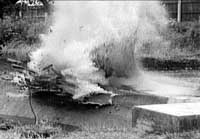
Barnes Wallis blows up a scale model of the German Möhne dam
Barnes Wallis was born in 1887. Just months after the Wright brothers made their inaugural flight, Wallis left home — he was sixteen — and became an apprentice in an engineering company. He also worked in shipyards before he became chief assistant in the Vickers Airship Department in 1913. There, while working on the R80 airship, he developed an innovative geodetic design that saved weight and allowed his next model, the R100 airship, to be the largest of its time.
As the popularity of airships faded, Wallis began working on aircraft design. His geodetic latticework was incorporated into the Wellesley bomber, which set a non-stop distance record in 1938 of 7,158 miles. The Wellesley was updated into the Wellington, the primary British bomber used during the early part of World War II. The Wellington was noted for its ability to sustain damage and remain airborne, due in no small part to Wallis’ design.
During World War II, Wallis continued his work to aid Britain’s military efforts. In his spare time, he toyed with a problem the British military had largely considered unsolvable — how to destroy the Nazis’ most important hydroelectric dams. Breaking these dams by conventional means would have required a 60,000-lb. bomb, which was far too heavy to be realistic. So Wallis devised a new kind of “earthquake” bomb — a ten-ton armament that would break the sound barrier as it fell from a height of 40,000 feet, crashing deep into the ground where it would explode, shaking the earth so violently that the dam would shatter. With this sort of bomb, a direct hit on the dam was not needed. Since the RAF had no plane capable of undertaking such a mission, Wallis also designed an enormous, six-engine bomber called the Victory that would have been larger than any other bomber in the world.
Yet the Ministry of Aircraft Production told Wallis that Britain simply didn’t have the resources to create such a plane. (Incidentally, two variations of the earthquake bomb were employed later in the war. In 1944, a six-ton version called Tallboy was used to bomb a railway tunnel, U-boat pens, naval vessels, dams, and launching sites for the German V1 and V2 rockets. In March of 1945, the Lancaster bomber was adapted to accommodate the ten-ton bomb Wallis originally envisioned. This bomb, known as Grand Slam, was used against the same targets as Tallboy, in addition to several bridges.)
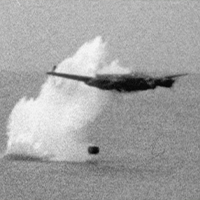
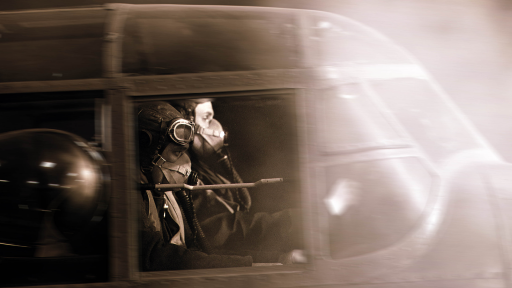
A Lancaster bomber, delivering the cylinder-shaped bomb used to destroy the Nazis’ dams
At the time, however, Wallis was limited to the use of a six-ton bomb, and he began brainstorming for a way of using such a weapon to bring down a dam. Tests were conducted on a scale model of the Möhne dam, and then on the Nant-y-Gro dam in Wales which, though it was five times smaller than the Möhne, was blown up to study how the German dam might be brought down. It turned out that fewer explosives were required to destroy a dam when the explosion took place in contact with its wall. Recalling the way Admiral Lord Nelson skipped cannon shells across water, Wallis wondered if perhaps he could deliver a bomb by skipping it across the reservoir and into the face of a Nazi dam.
He began in his backyard by shooting marbles across a tub full of water with a small catapult. Eventually, he determined that the marbles needed to be launched at a seven-degree angle in order to skip across the water. On a nearby lake, he built a larger catapult and began testing projectile materials. He tried balls made of everything from balsa wood to lead, each engraved with different surface patterns. Wallis found that dimpled balls flew the furthest and skipped more often than the other balls.
Moving to a secret government facility, Wallis began firing his balls at a wall in a giant tank of water. To prevent the balls from bouncing too far away from the mock-dam after they hit its wall, Wallis added a pin to the firing mechanism on his catapult that spun the balls backwards before they were launched. As a ball bounced off the wall, this backspin killed its forward momentum, and the ball sank right alongside the wall. [The “Bomb the Dam” interactive, above, illustrates this process.] In real life, water pressure would detonate the bomb at a depth of thirty feet. Wallis built half-size bomb prototypes to test how this would work in the field. A plane was outfitted with a special rig to spin the bomb, and the experiment proved successful — the bomb skipped.
Wallis submitted his plan to Sir Arthur “Bomber” Harris, head of the British Bomber Command, who initially referred to the idea as “tripe of the wildest description.” Yet Wallis was able to convince him that the bombs would work by showing him film of his field trial, and a squadron of Lancaster bombers — Squadron 617 — was created to fly the mission. Wallis had only twelve weeks to prepare for the mission, which needed to be conducted in spring, when seasonal rains had swelled the dams. This did not allow him enough time to construct the dimpled bombs he had originally designed. It was faster to make metal, cylinder-shaped bombs with a round wooden casing.
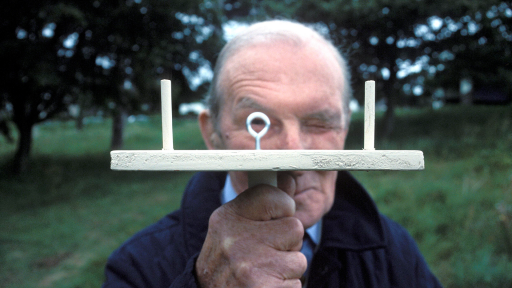
On an April 13, 1943 test run, the new bombs sank straight into the water and did not skip. Between watching the film and conducting more test runs, Wallis discovered that if he discarded the wooden casing and dropped them from a height of 60 feet, the cylinder-shaped bombs would skip like he had planned. This meant the pilots would have to fly considerably lower than the 150-foot height at which they had begun their training, but it would have to do. Since their altimeters were not accurate at such a low height, the aircrew invented a method of determining their height with two spotlights. These lights were attached to the aircraft so that they shone down on the water at a defined angle. When the two beams of light met on the water’s surface, the aircrew knew they were flying at 60 feet.
All of the planning and last minute design-fidgeting paid off on the night of May 3. Though Wallis was delighted by the reports of the destruction his bombs wrought on the Möhne, Eder, and Sorpe dams, he was devastated to learn that 53 of the aircrew were lost on the mission; three more men survived, but were taken prisoner. He vowed never again to design a project that would put so many British lives in jeopardy. In 1968, Wallis was knighted for his service to the United Kingdom.