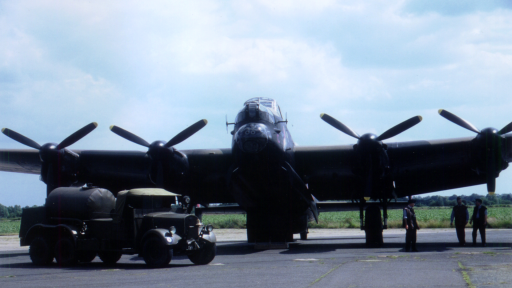
The Royal Air Force’s Lancaster bomber, being loaded with Barnes Wallis’ “bouncing bomb”
Spring rains had swelled the water dammed up in Germany’s Ruhr valley, and on May 16, 1943, Operation Chastise was about to begin. Taking off from an air base in England, nineteen Lancaster bombers manned by 133 airmen from Squadron 617 of the Royal Air Force were on a mission to destroy several of the Nazi’s major hydroelectric dams. The Ruhr region was an important industrial center for Germany, and the demolition of these dams was expected to create widespread destruction, cut off the supply of water for industrial purposes, and halt work in coal mines and factories. Each Lancaster in Squadron 617 was outfitted with a strange new weapon — a bouncing bomb that, when dropped precisely on target, would skip across the water and slam into the wall of an enemy dam.
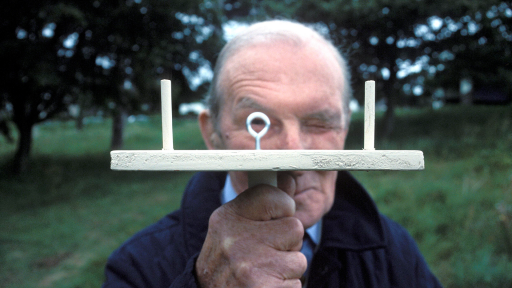
The commander of Squadron 617, 24-year-old Guy Gibson, had already completed 170 sorties by the time he was chosen to lead the mission. Operation Chastise was so top-secret that Gibson was at first told nothing of the task that lay before him, other than that he needed to train his pilots rigorously in the art of low level flying. Eventually, the pilots simulated the nighttime conditions under which they would fly into the Ruhr by fixing blue Perspex plastic into their cockpits and wearing amber-tinted goggles.
In his autobiography, Gibson recalled that their training was hampered by communication problems. The radio-telephone headsets they used were ineffective, resulting in chaos during a dress rehearsal for their bomb run. “Aircraft went astray, some nearly collided, others went home browned off,” he wrote. The communication snafus were solved when the entire squadron was outfitted with better equipment. Yet problems persisted. During another dress rehearsal, “six out of twelve aircraft were very seriously damaged by the great columns of water sent up when their mines splashed in.” Gibson concluded that the pilots had been flying too low.
The difficulty of their training only hinted at the danger that would confront Squadron 617 in Germany. “The gunners had seen us coming,” Gibson wrote. “They could see us coming with our spotlights on for over two miles away.” Before the planes even reached the dams, one aircraft hit cables and crashed and two more were shot down. In 1944, Gibson acknowledged how precarious flying just 60 feet over enemy territory could be. “I said quickly to Pulford, under my breath, ‘Better leave the throttles open now and stand by to pull me out of the seat if I get hit.’ As I glanced at him I thought he looked a little glum on hearing this.”
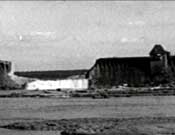
The German Möhne dam, after it had been broken by the British in May of 1943
At the Möhne dam, Gibson managed to drop his bomb unscathed, although it missed the dam. Another pilot, Hopgood, followed, but his plane was hit by flak and exploded shortly after his bomb also fell off the mark. The next plane fell prey to German anti-aircraft fire, but the bombs of the fourth and fifth Lancasters scored hits, smashing apart the middle of the dam. Gibson and four other planes then flew on to the Eder, where two bomb hits created a thirty-foot-wide hole in the dam.
Unlike the others, the Sorpe dam was constructed of earth, as opposed to masonry. Joe McCarthy’s Lancaster made nine aborted runs before finally dropping his bomb. Though McCarthy and another plane scored direct hits on the crest of the Sorpe, the dam withstood the attack. The damage caused to the crest of the dam, however, required the Germans to empty its reservoir halfway and make repairs.
Although eight of the nineteen bombing crews did not return, the mission was considered a success. Four of six targets were hit; two were destroyed. One hundred and thirty million gallons of water flooded the German countryside after the destruction of the Möhne. The Eder had held back 202,000,000 tons of water, and significant flooding took place in the wake of its bombing. Miles of factories and houses were destroyed and the Germans incurred thousands of casualties. News of the operation boosted Allied morale at a time when hopes for victory were bleak.
The pilots of the RAF’s 617 Squadron crept across Germany just 60 feet above the ground, delivering an experimental weapon with astounding precision. How did these brave airmen pull off such a feat? When Barnes Wallis — who developed the bomb that broke the German dams — presented his design to Royal Air Force officials, he was laughed at. How did he convince the air force that his weapon was powerful enough to destroy a dam and clever enough to outmaneuver the underwater nets protecting these dams from traditional torpedo attacks?