CASE FILE: The Hunt for Nazi Scientists
THE SCENE: Nazi Germany and the United States
LEAD DETECTIVE: Captain Marte Previti, Alsos Special Agent, U.S. Army
In the dying days of World War II, undercover Allied agents engaged in a desperate race against one other to capture the best and brightest of Germany’s scientific community. With Hitler’s army in retreat, American, British, and Russian forces set their sights on the architects of the Nazis’ advanced “Vengeance” weapons — high-tech airplanes, sophisticated rockets and even, perhaps, a German atomic bomb. The end goal was critical: whoever captured the scientists and the technology would gain a major advantage in the looming Cold War.
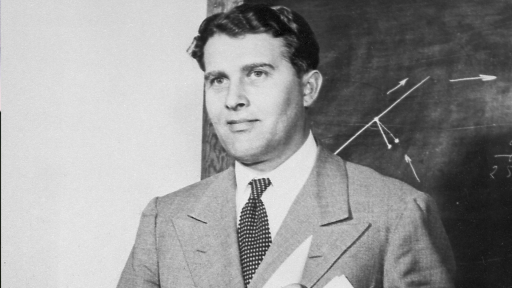
As head of the Nazi rocket program, “Wernher von Braun was one of a group of quite visionary scientists, people who had a dream of space flight, they were almost crazy people,” says military aviation historian Robert Hewson. “Because from the really primitive rocket technology that existed at the time, they were dreaming of voyages to the stars, and that’s particularly true of von Braun.”
Eventually, with certain capture at hand, von Braun and his fellow scientists grappled with a decision that would greatly impact the race to space: which country — Russia or America — would allow them to continue building their rockets? In the end, the Germans surrendered to the United States and agreed to share their secrets, hoping for VIP treatment in return.
America gave the German rocket scientists the opportunity to continue their work, but to the dismay of many, “inconvenient” facts like von Braun’s SS membership and his use of slave labor were swept under the rug in order to make the transition to America a smooth one. The Russians still beat the United States into space, although von Braun’s expertise eventually paid off when the Americans leapfrogged the USSR and landed the first men on the moon in 1969. Von Braun became an instant icon, but for some, the moment of American triumph was bittersweet.
Hundreds of German scientists lived and worked in America and Russia after the war, and both sides exploited their expertise for decades as the Cold War played out. “The Hunt for Nazi Scientists” tells the story of the scientists’ dramatic capture, and reveals startling connections between the German WWII technology and the next generation of American and Soviet war planes, missiles, and bombs.