This lesson was originally published on June 16, 2021, and was updated on June 19, 2026.
To make a Google Doc copy of this lesson plan, click here.
Overview
In this lesson, students will explore and discuss the history and context around the Juneteenth holiday in the United States. Topics explored will include the Civil War, the limitations of the Emancipation Proclamation and the history of racial injustice in the U.S. Additionally, students will be encouraged to explore the modern significance of Juneteenth and its long-term impact.
Estimated time
One 50-60 minute class period
Grade level
Grades 6-12
Background
On June 15, 2021, the Senate unanimously approved a bill approving June 19 as a federal holiday for Juneteenth National Independence Day. The House passed the bill one day later. However, many Americans are still unaware of the history and significance of June 19.
On January 1, 1863, President Abraham Lincoln issued the Emancipation Proclamation — declaring “that all persons held as slaves” in the Confederacy “shall be free.” While this may have abolished slavery on paper, the reality was much more complicated.
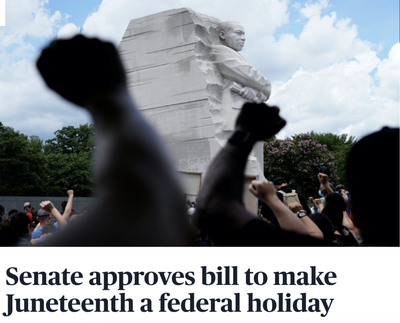
Source: Associated Press
Firstly, the Emancipation Proclamation only freed those slaves held under the Confederacy, not in border states loyal to the Union, including Kentucky, West Virginia and Delaware, where slavery remained legal. In fact, slavery was still legal in Kentucky until the passage of the 13th amendment in December 1865.
Confederate states and slaveholders resisted emancipation, with many remaining enslaved after the proclamation, even as many enslaved people fought for their freedom or escaped behind Union lines. On June 19, 1865, Major General Gordon Granger of the Union issued an order in Galveston, Texas, alerting all enslaved persons that they were legally free.
At this point in 1865, Texas was the westernmost state in America and one of the last Confederate states to be occupied by the Union. Many slaveholders had fled Union advances in other parts of the South to Texas, along with the people they had enslaved.
While it took time for the logistics of “freeing” enslaved people to come into effect, the importance of June 19, or “Juneteenth” lived on. Considering the complexity of emancipation, many dates were considered for its celebration, but over 150 years later, it was June 19 that was enshrined as a national holiday.
What originally was a holiday mainly observed by Texans has grown to be recognized all over the country. Each year on “Juneteenth,” (or more formally Juneteenth National Freedom Day), communities all around the United States gather to celebrate emancipation and reflect on the history struggles for civil rights and equality, including the work that still remains after conditional advances such as the Emancipation Proclamation.
Warm up activity
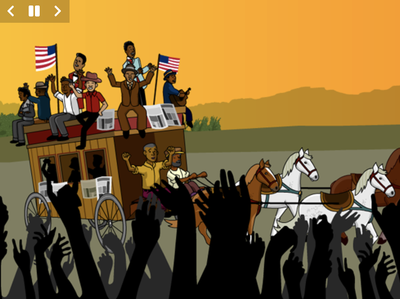
As a class, watch the BrainPop video on Juneteenth (8 minutes) below. While watching the video, answer the following discussion questions.
Source: BrainPop
Discussion questions:
- What is “Juneteenth”? What does it celebrate?
- Why did it take so long for enslaved peoples in Texas to finally be free? What obstacles remained after the Emancipation Proclamation?
- What were some of the forms of discrimination against newly freed people mentioned in the video?
- What is the Great Migration?
- How did Juneteenth become a national, not just regional, celebration?
After watching the video, separate into groups of 3-4 to discuss the focus questions (5 minutes).
Main activity:
In small groups, participants can read through the article What is Juneteenth by Henry Louis Gates, Jr. starting at the second section, “Other Contenders.” (10 minutes) After reading, discuss the following questions (5-10 minutes):
- What were a few of the "other contenders" for emancipation celebrations? Which date (other than Juneteenth) might you have chosen?
- How did the Reconstruction era erase some of the progress made following the Civil War?
- Why do you think Juneteenth has endured as the most popular day to celebrate emancipation?
Additional activities
A. Brainstorm or plan a Juneteenth celebration activity. This can involve decorating a common area, bringing in a relevant local speaker or planning a refreshment break for your school. Juneteenth celebrations can be held at home, at school or in community locations. For more inspiration see these resources:
- “How to Celebrate” from Juneteenth.com
- A beginner's guide to celebrating Juneteenth from PBS News Hour.
B. Some activists feel ambivalent about Juneteenth becoming a national holiday, or reject the idea. To learn more about the nuances surrounding making Juneteenth a federal holiday, watch this News Hour interview with Dr. Mark Anthony Neal recorded in 2020 amid the protests following George Floyd's murder by a white police officer in Minneapolis.
C. The day now known as Juneteenth was formally recognized as a national holiday in 2021, in large part due to the activism of retired teacher Opal Lee. Learn more about Lee's activism and the message of Juneteenth in this News Hour interview with Opal Lee.
If classrooms finish and plan a celebratory activity, please share your ideas with us on social media @NewsHourExtra on Twitter/X, IG and Facebook and Blue Sky at https://bsky.app/profile/pbsnewsclassroom.bsky.social.
This lesson was written by Cecilia Curran, News Hour Classroom intern, while she was a rising sophomore at Amherst College. This lesson was edited by News Hour Classroom's education producer and former history teacher Vic Pasquantonio.
Fill out this form to share your thoughts on Classroom’s resources.