NOTE: If you are short on time, watch the video and complete this See, Think, Wonder activity: What did you notice? What did the story make you think about? What would you want to learn more about?
SUMMARY
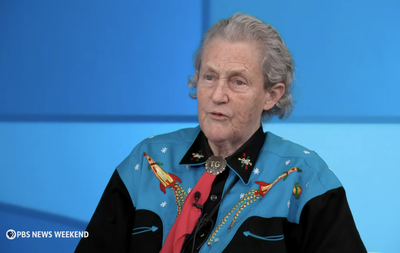
Four new portraits have gone up at the Smithsonian National Portrait Gallery, showcasing this year’s recipients of the Portrait of a Nation award for their transformative contributions to American history and culture. One of them is Temple Grandin, who has transformed animal welfare around the world and affected public perception of autism.
View the transcript of the story.
News alternative: Check out recent segments from the NewsHour, and choose the story you’re most interested in watching. You can make a Google doc copy of discussion questions that work for any of the stories here.
Key terms
autism — a condition related to brain development that affects how people interact and see others. According to Mayo Clinic, "This causes problems in communication and getting along with others socially. The condition also includes limited and repeated patterns of behavior."
WARM-UP QUESTIONS
- Who is Temple Grandin, and what is her background?
- When did Grandin first learn to speak?
- How did Grandin's inventive mindset help her make groundbreaking improvements to how cattle are treated?
- Why does Grandin advocate for early intervention in a child with autism?
- What is the significance of Grandin receiving the Smithsonian's 2025 Portrait of a Nation Award?
ESSENTIAL QUESTIONS
- What are the benefits of having different kinds of thinkers in the world, including visual thinkers and people with autism like Grandin?
- Do you know a person who is viewed as "different" by society? What unique strengths do they possess?
Media literacy: How could you learn more about autism and the different types of thinking that exist?
NEWS: THEN & NOW
The News: Then & Now section of the Daily News Lessons allows students to see connections between current and past news events. The activity provides historical context using primary sources from the Library of Congress.
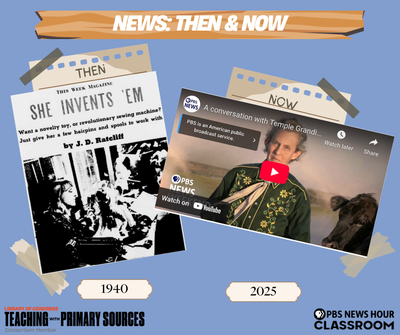
Credit: PBS News Hour Classroom
Then
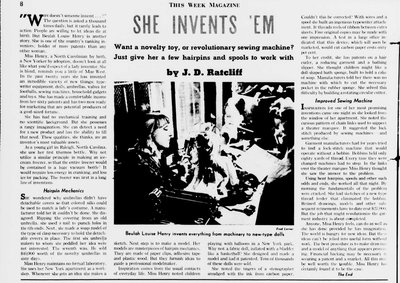
"If you could invent something to improve your life, what would it be? This wasn’t a rhetorical question for Beulah Henry (1887-1973)," wrote Jessica Fries-Gaither, a 2024-2025 Albert Einstein Distinguished Educator Fellow at the Library of Congress.
"Her first idea for an invention (a way to keep a flag from touching the ground as it was lowered) came when she was six years old; she created her first prototype (a belt with a newspaper holder attached) at the age of nine. A keen observer with a vivid imagination, Henry would spend much of her life identifying needs and developing products to meet them," according to Fries-Gaither in her Library of Congress blog post.
Take a look at the 1940 article "She Invents 'Em" about the invention process Henry used to create her inventions (Image from the Evening Star, Washington, D.C. 27 Oct. 1940. Library of Congress)
Credit: Library of Congress
Now
In 2016, Temple Grandin (right) was presented with an oversized copy of an inventor trading card showing Grandin and her cattle-handling designs by Joyce Ward (left), director of education and outreach at the United States Patent and Trademark Office (USPTO) at the USPTO Rocky Mountain Regional Office in Denver, Colorado. Grandin is seen holding U.S. patent no. 5,906,540 for her invention of an animal-stunning system.
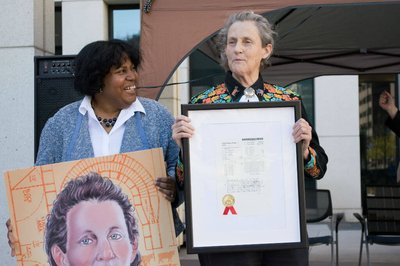
Photo by Unsu Jung/USPTO
Credit: Screenshot PBS News Hour
Discussion questions:
- So, what invention would you like to invent that could improve your life? What invention would you like to invent that could improve your community? (Are they the same?)
- After reading the article "She Invents 'Em", what are some similarities between Temple Grandin and Beulah Henry's approaches to inventing?

PBS News Hour Classroom is a member of the Library of Congress' Teaching with Primary Sources (TPS) Consortium. News Hour's TPS project, Journalism in Action, focuses on the role of journalism and civics in U.S. history. Sign up for the newsletter here.
Did you know that News Hour Classroom has its own invention education program where we create resources teachers on different ways to help students become inventors and solve problems where they live? Check out our lessons, blog posts and videos here. If you are interested in becoming part of our Invention Ed Network, sign up here.
Sign up to receive our weekly newsletter with Daily News Lessons and community events.
To provide feedback on News Hour Classroom's resources, including this lesson, click here.