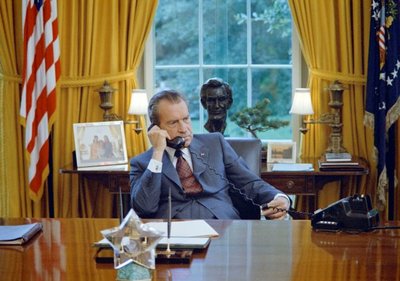
President Richard Nixon resigned from the Oval Office on Aug. 9, 1974. Nixon remains the only president in U.S. history to resign. The world had been closely watching the nationally televised Senate committee hearings about the break-in at the Democratic National Committee offices at the Watergate hotel in Washington, D.C.
The hearings revealed that the break-in had been part of a political spying campaign perpetrated by Nixon’s reelection campaign, and eventually led to his resignation.
Subjects
Social Studies, U.S. History, Government, Civics
Grades
6-12
Estimated time
One 45-minute class period
Objective
To gain an understanding of the events of the Watergate scandal and its impact on the American presidency.
Students will:
- Learn about the Watergate scandal of 1972-1974 and the events that led to Nixon’s resignation.
- Discuss the reasons why Nixon’s leadership was known as an “Imperial Presidency.”
- Discuss issues such as executive privilege and think about how much Watergate affected presidential power over the last four decades. If you are not sure of the limits placed on presidential overreach, or its staying power through the present time, how could you find out? Have the safeguards or rules that were put into place been enforced? Explain.
- Explore the ways that the Watergate scandal has changed the public perception of the presidency over the past 40 years.
Procedure
- For homework, students should read the Watergate Background handout.
- In class, as a group, students should complete the Watergate Background Worksheet together. They should discuss any terms that are unfamiliar.
- In class, students should read the excerpt on U.S. v. Nixon and the transcript excerpt from the June 23, 1972 White House tapes.
- After they read these documents, they should work in small groups to fill out the Watergate Primary Source Worksheet.
- As a class, students can discuss their answers to the questions on the Watergate Primary Source Worksheet.
- If they have time, students might read the essay, “Above the Law” from UVA’s Miller Center.
- What do they think of the idea that Nixon’s downfall was due to the fact that he imitated his enemies and put himself above the law?
Extension Activities
- Students can look at Ford’s pardon of Richard Nixon .
- Students can look at other controversial actions of the Nixon Administration, such as the bombing of Cambodia as well as the break-in to gather Daniel Ellsberg’s files from his psychiatrist’s office and the debate over the Pentagon Papers.
- Students can research a more recent presidential scandal, such as Iran-Contra during the Reagan Administration, Whitewater and the Lewinsky-Clinton scandal, the latter of which led to President Bill Clinton's impeachment and President Donald Trump's impeachment. What impact did Watergate have on the media’s investigation of these scandals and their willingness to investigate the president of the United States?
This lesson was originally published in 2013.
About the author
Stephanie Schragger teaches American and European history in New York. She has taught at The Lawrenceville School and York Preparatory School in New York City. She currently teaches at Saint Ann's in Brooklyn. Stephanie has an A.B. in history from Princeton University and a M.A. in history from Yale University.
Fill out this form to share your thoughts on Classroom’s resources.