By Katie Gould, former Teacher Resource Producer for PBS NewsHour Classroom
For a google doc version of this lesson, click here.
Subjects
Civil rights, history, Social Issues, and social studies
Estimated Time
One 45 minute class period
Grade Level
High School and Middle School
Warm-up Activity
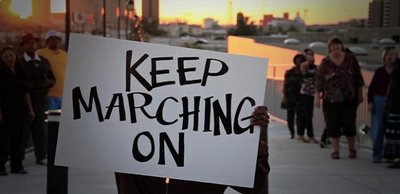
What would you march for?
- Ask students to reflect on the courage of the hundreds of thousands of individuals who participated in the civil rights movement. So many fought the injustice in so many ways—from working on the Underground Railroad, keeping their culture alive, signing up to play baseball, sitting-in, boycotting buses, riding buses, voting and participating in the March on Washington.
- Ask students to think about the question, “What would you march for?” (on the matching handout ) and have students do the following:
- Answer the question: “What would you march for?”
- Defend and explain why this cause or belief is important enough to march for.
- What would they want to accomplish and how would they know if it had been accomplished?
*Suggested song to play while students watch slide show and reflect: "Ain't Gonna Let Nobody Turn Me 'round" by Sweet Honey In The Rock
Main Activities
1. “A More Perfect Union” Speech
- Pass out the text excerpt of President Obama’s 2008 speech on race, “A More Perfect Union”. Listen to President Obama’s “A More Perfect Union” speech together as a class starting at 14:40 and ending at 18:00. This will match the text excerpt.
- Ask students, in pairs, to go back over the text excerpt and find the evidence of discrimination and the consequences of the discrimination. Have them use either two different colored pens, markers, or highlighters to mark the evidence in one color and the consequences in another.
2. Four Corners
- As a class, ask students to think about the following two questions:
- Where we are on the road to true equality of the races in our country?
- How much further do you think we still need to come?
- Show these student examples from Chicago as model responses and ideas:
- Give students four choices to choose from for their answer to the questions and tape them to the four different corners of the classroom:
- We have made no progress and we have a huge amount of work left to do. There is no racial equality in this country.
- We have made some progress, but we still have a lot of work left to do. There is some racial equality in this country, but nowhere near enough.
- We have made very good progress, but we still have a little work to do. There is mostly racial equality in this country.
- We have come all the way and achieved complete racial equality in our country and we have no work left to do.
- Ask students to go stand in the corner with the answer they believe to be true. Give students 3-5 minutes to come up with evidence to support why their case is correct and the other corners have it wrong.
- Allow each group 2-3 minutes to present their case to the other corners. After each corner has presented, allow for individuals to switch corners if they have changed their minds.
- Allow groups to work for 3-5 more minutes, and then share again for 2-3 minutes to the other groups.
- Come back as a class and debrief by discussing the following:
- What played the largest role in your belief about “How far we have come”? Personal experiences, films, friends, the news?
- Is there any particular event in recent history that has made you feel strongly about your belief?