 |
|
 |
 |
| THE EXTRADITION QUESTION | |
 December 2, 1998 
|
||
 |
|
|

|
|
|
||||||||||||
| The
debate. |
||||||||||||||
|
The arrest was prompted by an extradition request from a Spanish magistrate, Baltasar Garzon, who wants Pinochet in Spain. The magistrate is investigating atrocities committed during the "Dirty Wars" in Latin America during the 1970's and 80's. Spain is one of four European countries that want to bring charges of genocide, torture and terrorism against General Pinochet, for his alleged role in the deaths and disappearances of more than 3,000 people, both Chileans and foreigners.
PHIL PONCE: But then the tide turned. LORD JUSTICE JOHAN STEYN: My Lords, for the reasons contained in my speech, copies of which are available to the parties, I would annul the appeal. The effect of my speech is that in a correct interpretation of the law General Pinochet has no immunity whatever. |
||||||||||||||
| Reactions to the arrest. | ||||||||||||||
|
PHIL PONCE: Yesterday, Pinochet left the London hospital where he was recuperating from back surgery. Another court hearing – this one on Spain's extradition request – is scheduled for next week. But ultimately the British government – not the British courts – will decide whether to send him home or to face charges in Europe. |
||||||||||||||


 PHIL
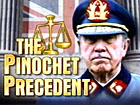
PONCE: British police took Gen. Augusto Pinochet into custody more than
six weeks ago. Great Britain was one of the few countries that would
grant the former Chilean dictator a visa. He's now a senator for life
in the Chilean legislature and traveled to London on a diplomatic passport.
He was recovering from back surgery when he was arrested.
PHIL
PONCE: British police took Gen. Augusto Pinochet into custody more than
six weeks ago. Great Britain was one of the few countries that would
grant the former Chilean dictator a visa. He's now a senator for life
in the Chilean legislature and traveled to London on a diplomatic passport.
He was recovering from back surgery when he was arrested. 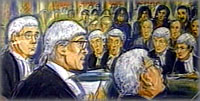 In
October, a court in London ruled that Pinochet was immune from arrest
and prosecution because he's a former head of state. He remained under
police guard while the decision was appealed. And last Wednesday, the
earlier court ruling was taken up by Britain's highest court, the Law
Lords of the House of Lords. In a traditional setting and using the
language of their chamber, they issued their opinions. The first two
upheld the lower court.
In
October, a court in London ruled that Pinochet was immune from arrest
and prosecution because he's a former head of state. He remained under
police guard while the decision was appealed. And last Wednesday, the
earlier court ruling was taken up by Britain's highest court, the Law
Lords of the House of Lords. In a traditional setting and using the
language of their chamber, they issued their opinions. The first two
upheld the lower court. 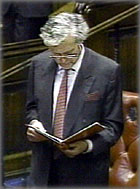 LORD
JUSTICE GORDON SLYNN: My Lord, for the reasons set out in speech, which
I have prepared and which is available in print, I would held that the
respondent is a former head of state is immune from arrest in respect
to the matters alleged in the warrant of the 22nd of October 1998, and
I would dismiss the appeal.
LORD
JUSTICE GORDON SLYNN: My Lord, for the reasons set out in speech, which
I have prepared and which is available in print, I would held that the
respondent is a former head of state is immune from arrest in respect
to the matters alleged in the warrant of the 22nd of October 1998, and
I would dismiss the appeal. 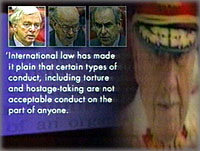 PHIL
PONCE: The three to two vote overturned the lower court decision that
Pinochet was immune. The majority opinion, written by Lord Nichols,
said, "International law has made it plain that certain types of conduct,
including torture and hostage-taking, are not acceptable conduct on
the part of anyone." This applies as much to heads of state or even
more so, as it does to everyone else. The contrary conclusion would
make a mockery of international law. News of the verdict created a fury,
first on the streets of London among relatives of those killed and disappeared
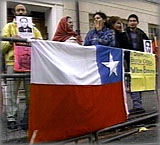
– and then in Chile, itself, as both pro and anti-Pinochet crowds watched
the Lords' proceedings on live television hookups. After the ruling,
Chile's foreign minister intensified diplomatic efforts to obtain Pinochet's
release and to prevent his extradition from Britain to Spain or any
other European nation that wants to try him. Minister Jose Miguel Insula
argued that Pinochet should be tried in Chile, if anywhere. The United
States, meanwhile, took a cautious view voiced by Secretary of State
Madeleine Albright Monday at a news conference with Yasser Arafat.
PHIL
PONCE: The three to two vote overturned the lower court decision that
Pinochet was immune. The majority opinion, written by Lord Nichols,
said, "International law has made it plain that certain types of conduct,
including torture and hostage-taking, are not acceptable conduct on
the part of anyone." This applies as much to heads of state or even
more so, as it does to everyone else. The contrary conclusion would
make a mockery of international law. News of the verdict created a fury,
first on the streets of London among relatives of those killed and disappeared
– and then in Chile, itself, as both pro and anti-Pinochet crowds watched
the Lords' proceedings on live television hookups. After the ruling,
Chile's foreign minister intensified diplomatic efforts to obtain Pinochet's
release and to prevent his extradition from Britain to Spain or any
other European nation that wants to try him. Minister Jose Miguel Insula
argued that Pinochet should be tried in Chile, if anywhere. The United
States, meanwhile, took a cautious view voiced by Secretary of State
Madeleine Albright Monday at a news conference with Yasser Arafat. 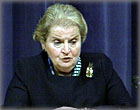 MADELEINE
ALBRIGHT, Secretary of State: I'm not in the business of giving advice
on this. And we have read the Law Lords' decision with a great deal
of interest, and I think that we are not prepared to make a statement
about the merits of the case. The United States is committed to principles
of accountability and justice.
MADELEINE
ALBRIGHT, Secretary of State: I'm not in the business of giving advice
on this. And we have read the Law Lords' decision with a great deal
of interest, and I think that we are not prepared to make a statement
about the merits of the case. The United States is committed to principles
of accountability and justice.