|
President Plans to Spend 'Political Capital' in Second Term
 Jan.
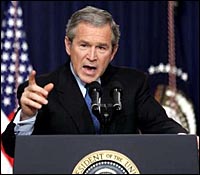
18, 2005 -- President George W. Bush entered his second term
with a sizable victory and has said he plans to translate his
electoral success at the polls into a political mandate to implement
his policies. Jan.
18, 2005 -- President George W. Bush entered his second term
with a sizable victory and has said he plans to translate his
electoral success at the polls into a political mandate to implement
his policies.
The November election made President Bush the first presidential
candidate since 1988 to win a majority of the popular vote, with
51 percent. For White House officials it also gave him a clear
go-ahead to implement the policies he espoused on the campaign
trail.
"President Bush ran forthrightly on a clear agenda for this nation's future, and the nation responded by giving him a mandate," Vice President Dick Cheney said in a Nov. 3 speech.
In his acceptance speech, President Bush outlined the goals he plans to start work on immediately and pursue over the next four years, a period he termed "a season of hope."
He pledged to "reform our outdated tax code," "strengthen the Social Security for the next generation," and raise accountability standards in the country's public schools. He also vowed to help the "emerging democracies of Iraq and Afghanistan" and continue the fight against terrorism.
"Let me put it to you this way: I earned capital in the campaign, political capital, and now I intend to spend it. It is my style," the president told reporters during a Nov. 4 press conference.
Barely taking a break after the election, President Bush has already launched an intense campaign to build public and legislative support for his priorities, which include creating private investment accounts to supplement Social Security, limiting lawsuit awards and reexamining the tax code.
These goals are part of the president's vision of an "ownership society," one that would shift economic responsibility from the government to the individual.
In mid-December, the president held a special White House conference on these economic issues. In the first week of January, President Bush appointed two former senators to head a bipartisan panel to reexamine the tax code. The very next week, the president hosted a "town hall" forum to make his case for restructuring Social Security.
The following explains some of the issues the president has said he will tackle in his second term, as well as links to additional resources on the topic and the debate to come:
Social Security
The Bush administration has proposed moving Social Security away from government-guaranteed benefits to one based, in part, on personal investment accounts. Though specifics of the reform plan are not yet known, President Bush says he wants to allow workers to be able to divert some of their payroll tax money into these private accounts.
The president, who has repeatedly called Social Security reform a chief concern, warns the Social Security system is heading toward insolvency unless some changes are made.
Despite such warnings, the president has not convinced most congressional Democrats and even some Republicans, including Sen. Lincoln Chafee of Rhode Island, of the urgency to reform Social Security or an impending "crisis."
"I regret that we're looking at this in the context of huge deficits," Chafee told the Associated Press in early December, but said he could not rule out supporting the reform entirely.
Skeptics of President Bush's plan question how the president plans to pay for it, arguing the creation of personal accounts would require borrowing hundreds of billions of dollars when the government is already running in the red. Others express concern about the security of private investment accounts.
President Bush counters that the cost of waiting to reform the retirement program will be much higher unless the government undertakes the reform effort now. During the president's forum on Social Security, President Bush added that lawmakers who ignore the system's problems will eventually "pay a price at the ballot box."
NewsHour Discussions:
Jan. 11, 2005 -- Campaign for Change Two Social Security experts debate the merits of the president's plan.
Dec. 16, 2004 -- Fixing Social Security Ray Suarez discusses the best way to fix Social Security with two public policy experts.
Dec. 15, 2004 -- The Ownership Society Two economists analyze the president's "ownership society" conference and economic goals for his second term.
Tax Reform
 As
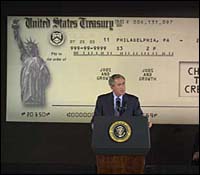
a top second-term goal, President Bush vows to streamline the
nation's complex tax system and to make permanent the tax cuts
implemented in his first term. As
a top second-term goal, President Bush vows to streamline the
nation's complex tax system and to make permanent the tax cuts
implemented in his first term.
Perhaps in an effort to bridge the partisan divide, Mr. Bush tapped two former senators, Republican Connie Mack of Florida and Democrat John Breaux of Louisiana, to head a commission to consider ways to make the tax system simpler, fairer and more effective at stimulating economic growth. The commission is set to make its recommendations by July 31.
Despite the bipartisan gesture, the Bush administration faces opposition from Democrats and some fiscal conservative Republicans, who argue the government needs to cut the current annual deficit before undertaking more tax cuts.
President Bush also must overcome objections from special interest groups, should he seek to radically overhaul the tax system by, for instance, eliminating certain tax deductions.
NewsHour Discussions:
Jan. 7, 2005 -- Online NewsHour Update: Ex-Senators Tapped to Lead Tax Code Reform.
Jan. 7, 2005 -- Shields and Brooks Columnists Mark Shields and David Brooks discuss the politics behind President Bush's bipartisan commission to reform the tax code.
Dec. 15, 2004 -- The Ownership Society Two economists analyze the president's "ownership society" conference and economic goals for his second term.
Tort Reform
During the campaign, President Bush repeatedly called for new caps on legal awards in medical malpractice cases, arguing the limits would improve the nation's medical system and reduce spiraling health care costs.
"The rising cost of health care, the number of lawsuits, the defensive practice of medicine is driving up the cost to our taxpayers. Medical liability reform is a national issue and it requires a national solution," President Bush said in a Jan. 5 speech. As one of his big-ticket items, President Bush has called upon Congress to approve new federal standards for medical liability lawsuits.
Republican leaders in Congress have signaled their support and plan to bring up the measure soon.
However, many Democrats and consumer rights groups contend such limits would unfairly protect many doctors, drug companies and HMOs (health maintenance organizations) which provide poor medical treatment. Many opponents furthermore blame insurance companies with high premiums -- not "frivolous litigation" -- for the rising health care costs.
NewsHour Discussions:
Jan. 5, 2005 -- Medical Liability Two medical liability experts discuss the president's plan and what is behind the soaring cost of health care.
Nov. 4, 2004 -- Partisan Reaction Jim Lehrer leads a bipartisan discussion about the challenges President Bush will face in achieving his second-term goals in a deeply divided nation.
Building Democracies in the Middle East
On the world stage, President Bush has said he believes the spread of democracy in the Middle East will bring peace and stability to the region and help America combat Islamic terrorist groups like al-Qaida.
In pursuing this goal, the White House has steadfastly urged Iraq to hold elections as planned on Jan. 30, despite threatened boycotts by Sunni Muslims and concerns over the ongoing insurgency.
Additionally, President Bush has said he would welcome the new president of the Palestinian Authority, Mahmoud Abbas, to Washington and said he was "heartened by the elections" there.
NewsHour Discussion:
Nov. 4, 2004 -- Partisan Reaction Jim Lehrer leads a bipartisan discussion about the top priorities of President Bush's second term and the challenges will face in pursuing them.
Nov. 7, 2003 -- Middle East Democracy During his first term, President Bush called for democratic reforms in the Middle East and said western governments should no longer back undemocratic regimes in the region.
-- Compiled for the Online NewsHour by Liz Harper
|