President Trump’s impatience was on full display over Ukraine’s unwillingness to accept his proposal for ending the war that Russia started. Trump’s vexation with Kyiv was centered on its reluctance to cede its own territory to Moscow.
Clip: Trump returns to his default position of supporting Russia
Dec. 12, 2025 AT 8:54 p.m. EST
TRANSCRIPT
Notice: Transcripts are machine and human generated and lightly edited for accuracy. They may contain errors.
Jeffrey Goldberg: President Trump has made it clear he wants to negotiate peace between Russia and Ukraine and maybe even get a prize for it, but his use of it occasionally been hard to pin down. Take a look.
Donald Trump, U.S. President: You are gambling with the lives of millions of people. You are gambling with World War III.
And what you're doing is very disrespectful to the country, this country.
It's an honor to be with a very strong leader. We've gotten along really very well.
We get a lot of bullshit thrown at us by Putin, if you want to know the truth. He's very nice all the time, but it turns out to be meaningless.
I'm so disappointed in President Putin.
We're really honored you guys came over. I mean, these are the heads of major countries and respected all over Europe.
Europe is not doing a good job.
We're talking about Ukraine. They talk, but they don't produce.
Jeffrey Goldberg: Yes, I also get whiplash. But it seems as if Trump is back in Putin's corner, and I'll explore this tonight with my guests, Anne Applebaum is a staff writer at The Atlantic, Susan Glasser is a staff writer at the New Yorker, Amna Nawaz is a co-anchor and the co-managing editor of the PBS NewsHour, and Vivian Salama is a staff writer for The Atlantic. Thank you all for being here. Amna, thank you for a very special guest star appearance.
Amna Nawaz, Anchor, PBS NewsHour: My goodness. Thank you so much. What an honor.
Jeffrey Goldberg: We appreciate it. We appreciate it.
Why don't I start with you to put you on the spot?
Amna Nawaz: Sure.
Jeffrey Goldberg: So, explain the past year in American-Russian relations. You can --
Amna Nawaz: Yes, 30 seconds or less.
Jeffrey Goldberg: 20 seconds, if you don't mind.
Amna Nawaz: Perfect.
Jeffrey Goldberg: So, we've been on this little bit of a rollercoaster. We just sort of, witnessed that a bit. Now, President Trump is back to pressuring President Zelenskyy to accept a deal that would basically carve off a piece of Ukraine. But what is the current state of play? Where are we going?
Amna Nawaz: I mean if you look at just the last month, I think it's sort of illustrative of how the last year has gone, which is that whiplash you just showed. Also, let's underscore the fact that this is still an active war, right? We saw Zelenskyy out on the frontlines today in Kharkiv, a place where I was on the ground last spring, in a place that Russians claim to have actually gained control of last month, and he was shooting selfie videos on the ground today, so very much a lot of land still being contested there.
The U.S. plan that was presented last month was essentially echoing Russian talking points, talking about Ukraine trading territory to help them get to peace, talking about them renouncing the right to join NATO. When I spoke to the Ukrainian ambassador to the U.S., Olha Stefanishyna, earlier this week, she talked about the fact that language was not final, but that they were happy that this dialogue is now moving around a structured plan of some kind. So, that's how Ukrainians are looking at this.
The new Ukrainian plan now reportedly removes a lot of that language. But remember here that, peace plan that the president is pushing for, President Trump is pushing for, is separate from the document about security guarantees, which is the critical issue for Ukraine, that there will be some kind of guardrails or protection against future Russian aggression. The last year has shown us just how far back and forth the Trump administration has gone. They came in and took many months to even admit Russia was the aggressor here in the first place.
And while there have been moments where he sided with Zelenskyy, shown some kind of sympathy for Russian strikes on civilians, by and large, this is an administration that's looking to get Russia on board, not necessarily Ukraine.
Jeffrey Goldberg: Right. And talk about that a bit. The baseline sympathy is with Putin, and it's his belief, it seems, that it's up to Ukraine to settle a war that in fact Russia started.
Anne Applebaum, Staff Writer, The Atlantic: Yes. There are two or three very bizarre things about the Trump administration negotiating a position. One of them is that one of the things they're asking Ukraine to do is something I don't think Zelenskyy can do. So, it's not just that they're saying let the Russians keep what they conquered. They want him to give up territory that they control. And I don't think the Ukrainian army will do that. And so --
Jeffrey Goldberg: The Ukrainian army itself?
Anne Applebaum: I don't think they will do it. No. And, you know, I mean, the Ukrainian army is very decentralized. There are a lot of commanders who have their own funding and they have their own status and I don't think he can get them to give away land that they've been defending for --
Jeffrey Goldberg: That's actually true. When we were in the Ukraine last, we met different operators of different drone factories and drone units, and they seem to be just improvising without direct orders.
Anne Applebaum: It's not exactly like that, but it's not -- but it's also not the case that they're fighting, you know, because they're professional soldiers and they'll -- they can be commanded in that same way. And so --
Jeffrey Goldberg: I thought you were getting at that, that the Ukrainian people wouldn't accept.
Anne Applebaum: Well, the Ukrainian people also won't accept. I mean, and Zelenskyy, you know, isn't really -- he has been weakened by the corruption scandal that I know that you'll want to talk about, and I just don't think he's politically in a position where he can say, we're giving up territory. So, that just can't happen.
The other piece of it, as you said, the really important piece, is the security guarantees. This isn't a minor thing. You know, if the Ukrainians stop fighting and they don't have any kind of security guarantee or any NATO or any western troops or anything, then their country is unviable. Because who will want to live there or invest there if they know that the war is going to start again, you know, next year or next month or in six months?
Jeffrey Goldberg: Right.
Anne Applebaum: And it's a -- because the Russian pattern is to stop fighting for a while and then to restart the war again, there needs to be some reason to think that it's really, really over. And, of course, the only way to achieve that is to put pressure not on Ukraine, but on Russia. You know, the Russians have to be convinced that the war has to end.
Jeffrey Goldberg: No Russia can stop the war anytime it wants.
Anne Applebaum: Anytime it wants. And the bizarre thing about the whole last year, you know, the back and forth and so on, is that it's almost as if the Trump administration doesn't want to admit or can't understand that the war only ends when the pressure is put on Russia and the Russians say, okay, we're not going to be able to win. And it's the most obvious solution to the problem, and it's the one they just won't take.
Jeffrey Goldberg: Right. Susan, I want to talk about the corruption I issue in a moment, but talk about security guarantees in the framework of what we know about Donald Trump and his commitment to democratic allies?
Susan Glasser, Staff Writer, The New Yorker: Well, that's exactly right. I mean, they've just re released a national security strategy that makes it very clear that they see the United States as increasingly as some separate entity from NATO, even though the United States has been the founder and pillar of NATO since its creation. And you're seeing this separation from our western allies and a president who, for his entire time in public life, has essentially been critical of our allies while praising our adversaries. That is a one through line in an otherwise at times inconsistent foreign policy.
But the security guarantee thing is really important here because that's why the prospects for a deal are so remote. Right now, essentially, we're negotiating with ourselves. You know, we're negotiating with the Ukrainians, with the Western Europeans who are desperate to get themselves back at the table. But even if we were to come to consensus and all this pressure on Zelenskyy is aimed at pressuring Zelenskyy to make a deal essentially with Donald Trump, but that deal has to involve a security guarantee that will be a non-starter for Vladimir Putin.
Jeffrey Goldberg: Right.
Susan Glasser: And that's why I see so much of what we're dealing with in last year, not as a form of backlash or whiplash with Donald Trump, but more -- he's a spurned suitor. Vladimir Putin has not been negotiating. He's not been forced really to negotiate. But the second you come to him, if you're Donald Trump and you say, here's this meaningful security guarantee that we have for Ukraine, Putin says, well, no deal.
FROM THIS EPISODE

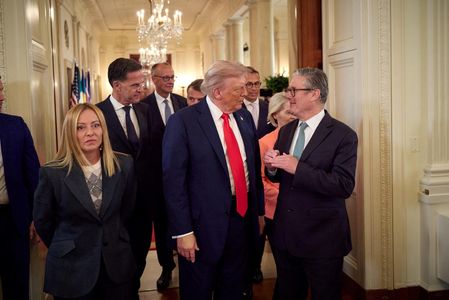
Clip: Trump's new national security strategy turns friends into foes
President Trump’s anger with Ukraine and his propensity to support Russia puts him at odds with British, French and German counterparts. But his new national security strategy suggests America’s traditional allies are actually foes, not friends.

Full Episode: Washington Week with The Atlantic full episode, 12/12/25
President Trump this week pressured Ukraine to accept his administration’s peace proposal, one that heavily favors Russia. This as his administration’s national security strategy has put him at odds with American allies. Moderator Jeffrey Goldberg, Susan Glasser of The New Yorker, Amna Nawaz of PBS News Hour and Vivian Salama and Anne Applebaum of The Atlantic discuss all this and more.


© 1996 - 2026 WETA. All Rights Reserved.
PBS is a 501(c)(3) not-for-profit organization