President Trump this week pressured Ukraine to accept his administration’s peace proposal, one that heavily favors Russia. This as his administration’s national security strategy has put him at odds with American allies. Moderator Jeffrey Goldberg, Susan Glasser of The New Yorker, Amna Nawaz of PBS News Hour and Vivian Salama and Anne Applebaum of The Atlantic discuss all this and more.
Full Episode: Washington Week with The Atlantic full episode, 12/12/25
Dec. 12, 2025 AT 9:04 p.m. EST
TRANSCRIPT
Notice: Transcripts are machine and human generated and lightly edited for accuracy. They may contain errors.
Jeffrey Goldberg: President Trump's anger and impatience were on full display this week, this time over Ukraine's unwillingness to accept his proposal for ending the war that Russia started. Trump's fixation with Kyiv has put him at odds with European counterparts. But in his new national security strategy, he makes it clear that America's traditional European allies are actually foes, not friends.
Tonight, Donald Trump returns to his default position supporting Russia and Vladimir Putin, next.
Good evening and welcome to Washington Week.
President Trump has made it clear he wants to negotiate peace between Russia and Ukraine and maybe even get a prize for it, but his use of it occasionally been hard to pin down. Take a look.
Donald Trump, U.S. President: You are gambling with the lives of millions of people. You are gambling with World War III.
And what you're doing is very disrespectful to the country, this country.
It's an honor to be with a very strong leader. We've gotten along really very well.
We get a lot of bullshit thrown at us by Putin, if you want to know the truth. He's very nice all the time, but it turns out to be meaningless.
I'm so disappointed in President Putin.
We're really honored you guys came over. I mean, these are the heads of major countries and respected all over Europe.
Europe is not doing a good job.
We're talking about Ukraine. They talk, but they don't produce.
Jeffrey Goldberg: Yes, I also get whiplash. But it seems as if Trump is back in Putin's corner, and I'll explore this tonight with my guests, Anne Applebaum is a staff writer at The Atlantic, Susan Glasser is a staff writer at the New Yorker, Amna Nawaz is a co-anchor and the co-managing editor of the PBS NewsHour, and Vivian Salama is a staff writer for The Atlantic. Thank you all for being here. Amna, thank you for a very special guest star appearance.
Amna Nawaz, Anchor, PBS NewsHour: My goodness. Thank you so much. What an honor.
Jeffrey Goldberg: We appreciate it. We appreciate it.
Why don't I start with you to put you on the spot?
Amna Nawaz: Sure.
Jeffrey Goldberg: So, explain the past year in American-Russian relations. You can --
Amna Nawaz: Yes, 30 seconds or less.
Jeffrey Goldberg: 20 seconds, if you don't mind.
Amna Nawaz: Perfect.
Jeffrey Goldberg: So, we've been on this little bit of a rollercoaster. We just sort of, witnessed that a bit. Now, President Trump is back to pressuring President Zelenskyy to accept a deal that would basically carve off a piece of Ukraine. But what is the current state of play? Where are we going?
Amna Nawaz: I mean if you look at just the last month, I think it's sort of illustrative of how the last year has gone, which is that whiplash you just showed. Also, let's underscore the fact that this is still an active war, right? We saw Zelenskyy out on the frontlines today in Kharkiv, a place where I was on the ground last spring, in a place that Russians claim to have actually gained control of last month, and he was shooting selfie videos on the ground today, so very much a lot of land still being contested there.
The U.S. plan that was presented last month was essentially echoing Russian talking points, talking about Ukraine trading territory to help them get to peace, talking about them renouncing the right to join NATO. When I spoke to the Ukrainian ambassador to the U.S., Olha Stefanishyna, earlier this week, she talked about the fact that language was not final, but that they were happy that this dialogue is now moving around a structured plan of some kind. So, that's how Ukrainians are looking at this.
The new Ukrainian plan now reportedly removes a lot of that language. But remember here that, peace plan that the president is pushing for, President Trump is pushing for, is separate from the document about security guarantees, which is the critical issue for Ukraine, that there will be some kind of guardrails or protection against future Russian aggression. The last year has shown us just how far back and forth the Trump administration has gone. They came in and took many months to even admit Russia was the aggressor here in the first place.
And while there have been moments where he sided with Zelenskyy, shown some kind of sympathy for Russian strikes on civilians, by and large, this is an administration that's looking to get Russia on board, not necessarily Ukraine.
Jeffrey Goldberg: Right. And talk about that a bit. The baseline sympathy is with Putin, and it's his belief, it seems, that it's up to Ukraine to settle a war that in fact Russia started.
Anne Applebaum, Staff Writer, The Atlantic: Yes. There are two or three very bizarre things about the Trump administration negotiating a position. One of them is that one of the things they're asking Ukraine to do is something I don't think Zelenskyy can do. So, it's not just that they're saying let the Russians keep what they conquered. They want him to give up territory that they control. And I don't think the Ukrainian army will do that. And so --
Jeffrey Goldberg: The Ukrainian army itself?
Anne Applebaum: I don't think they will do it. No. And, you know, I mean, the Ukrainian army is very decentralized. There are a lot of commanders who have their own funding and they have their own status and I don't think he can get them to give away land that they've been defending for --
Jeffrey Goldberg: That's actually true. When we were in the Ukraine last, we met different operators of different drone factories and drone units, and they seem to be just improvising without direct orders.
Anne Applebaum: It's not exactly like that, but it's not -- but it's also not the case that they're fighting, you know, because they're professional soldiers and they'll -- they can be commanded in that same way. And so --
Jeffrey Goldberg: I thought you were getting at that, that the Ukrainian people wouldn't accept.
Anne Applebaum: Well, the Ukrainian people also won't accept. I mean, and Zelenskyy, you know, isn't really -- he has been weakened by the corruption scandal that I know that you'll want to talk about, and I just don't think he's politically in a position where he can say, we're giving up territory. So, that just can't happen.
The other piece of it, as you said, the really important piece, is the security guarantees. This isn't a minor thing. You know, if the Ukrainians stop fighting and they don't have any kind of security guarantee or any NATO or any western troops or anything, then their country is unviable. Because who will want to live there or invest there if they know that the war is going to start again, you know, next year or next month or in six months?
Jeffrey Goldberg: Right.
Anne Applebaum: And it's a -- because the Russian pattern is to stop fighting for a while and then to restart the war again, there needs to be some reason to think that it's really, really over. And, of course, the only way to achieve that is to put pressure not on Ukraine, but on Russia. You know, the Russians have to be convinced that the war has to end.
Jeffrey Goldberg: No Russia can stop the war anytime it wants.
Anne Applebaum: Anytime it wants. And the bizarre thing about the whole last year, you know, the back and forth and so on, is that it's almost as if the Trump administration doesn't want to admit or can't understand that the war only ends when the pressure is put on Russia and the Russians say, okay, we're not going to be able to win. And it's the most obvious solution to the problem, and it's the one they just won't take.
Jeffrey Goldberg: Right. Susan, I want to talk about the corruption I issue in a moment, but talk about security guarantees in the framework of what we know about Donald Trump and his commitment to democratic allies?
Susan Glasser, Staff Writer, The New Yorker: Well, that's exactly right. I mean, they've just re released a national security strategy that makes it very clear that they see the United States as increasingly as some separate entity from NATO, even though the United States has been the founder and pillar of NATO since its creation. And you're seeing this separation from our western allies and a president who, for his entire time in public life, has essentially been critical of our allies while praising our adversaries. That is a one through line in an otherwise at times inconsistent foreign policy.
But the security guarantee thing is really important here because that's why the prospects for a deal are so remote. Right now, essentially, we're negotiating with ourselves. You know, we're negotiating with the Ukrainians, with the Western Europeans who are desperate to get themselves back at the table. But even if we were to come to consensus and all this pressure on Zelenskyy is aimed at pressuring Zelenskyy to make a deal essentially with Donald Trump, but that deal has to involve a security guarantee that will be a non-starter for Vladimir Putin.
Jeffrey Goldberg: Right.
Susan Glasser: And that's why I see so much of what we're dealing with in last year, not as a form of backlash or whiplash with Donald Trump, but more -- he's a spurned suitor. Vladimir Putin has not been negotiating. He's not been forced really to negotiate. But the second you come to him, if you're Donald Trump and you say, here's this meaningful security guarantee that we have for Ukraine, Putin says, well, no deal.
Jeffrey Goldberg: Right, right. Vivian, I'm going to come to you in a minute to describe the essence of the entire national security strategy of the United States. But before we do that, give me like a one minute warning. Before we do that, I just want to read something that Anne wrote about this corruption issue. In Ukraine, the state itself is investigating the government, the cabinet, even the president's closest advisers. By contrast, it is impossible to imagine Kash Patel's FBI investigating anyone in Trump's White House.
This may very well be true. It is also true that they have a serious corruption scandal and that he's been weakened, Zelenskyy has been weakened. How -- both of you handle that question. How bad is it for Zelenskyy right now?
Anne Applebaum: So, I think it's important to understand, first of all, that this is the Ukrainian state investigating itself. So the, you know, democratically-elected Ukrainian government and people appointed by it and supported by civil society, these are civil servants and they are doing the investigation in accordance with the rule of law. And it's a reflection --
Jeffrey Goldberg: Yes. But Zelenskyy has been weakened by the existence of this --
Anne Applebaum: Sure. He's weakened by it. He's lost some of his advisers and so on. But it's actually -- so inside Ukraine, it's perceived as good, like it's a positive thing. And when you -- I spoke to one of the chief detective who was leading that investigation a few days ago, and he said to me, and I asked him, don't you -- aren't you worried this will weaken the state? He said, no, it's the opposite. Our state is weakened by corruption. Corruption equals Russia.
Jeffrey Goldberg: We can come back to this because there's a certain interesting analog here to what's going on here in our investigative capabilities inside the government.
But, Vivian, I do want to come to the national security strategy because this is all being done within the framework of a pretty radical new understanding of America and its role in the world. What are the national security strategy say?
Vivian Salama, Staff Writer, The Atlantic: What didn't it say? I mean, first of all, you know, a lot of -- every administration puts out a national security strategy, lays out its policy priorities for the four or eight years that they're in office. President Trump, his strategy was released. And, first of all, just tonally, it's different. You know, you have a lot of the rhetorical flourishes that you hear from President Trump and a lot of his advisers just sort of this adversarial language that we see so much out of the White House.
But then also you have completely upended priorities, beginning with and not least of, which is this concept of major power competitions, which the previous two administrations, and when I say the previous two, I'm also talking about Trump 1.0, this was a key element for them, the power competition with China and with Russia.
This strategy does not even mention China until two thirds of the way in. He describes it as working to rebalance the economic relationship with China and not trying to push back on their efforts for global dominance, let's say. He talks about managing Europe's relationship with Russia rather than any kind of aggression that Russia may be pursuing and/or any kind of you know, tactics, it may do to subvert America's allies.
And so this was like one of the most glaring differences that we've seen, but also the language that they use about Europe was so striking. It discusses an idea -- it discusses Europe in very ideological terms. I mean, we're talking about the Ukraine conflict right now and how President Trump views it. That sort of manifested itself in the rhetoric toward Europe where it talked about this need to restore Europe's, quote, civilization, self-confidence and western identity, talking about the need to push back on immigration, the need to push back on the economic cooperation with western allies. And it is very, very striking to see the language it used in Europe.
Jeffrey Goldberg: Susan, what struck you the most about the national security strategy?
Susan Glasser: Yes, that's right. I mean, is Donald Trump repudiating Donald Trump's first national security strategy, which was all about the pivot to a great power competition between Russia, China, the United States? Now, essentially, Russia's treated as an equal of our European allies and partners.
And it's not just that. They're literally talking about intervening in the internal politics of our European partners and saying we should operate for some national security region reason to change the government in countries we don't like.
And this is very comparable to a speech that J.D. Vance, the vice president, gave at the Munich Security Conference at the beginning of this administration, which he went there. And he really shocked Europe by going to Germany and saying, you should support the very radical, far right party, the AFD, in Germany. And, essentially, this is codifying that approach in saying, we're going to advocate regime change for our own allies.
Vivian Salama: It hammered European allies for trying to, quote, subvert free speech as well. This is one of the issues that it really went after your --
Jeffrey Goldberg: Well, we can break that out. because there is some interesting differences in the way that they deal with free speech and the things that some Western European countries do that would be onerous to us. But that's ultimately a minor question compared to something I want to ask you on about, which is, it seems as if what the Trump administration is doing is saying there are spheres of influence in the world.
Amna Nawaz: Yes.
Jeffrey Goldberg: And we'll acknowledge that it's not been an American pattern. We don't recognize that China has primacy traditionally, recognize that China is primary in Asia and Russia is primary in Europe. We're a global power. But now it seems as if he's saying, okay, Xi, you take Asia, Putin, you're over there, we're in the Western hemisphere and we're not advocating for democracy or freedom anymore. It's just you do your thing. We'll do ours. Am I wrong about this analysis?
Amna Nawaz: No. And I think the latter part of what you're saying there is key in terms of the shift. And this is less about a strategy and more a statement of values, as Vivian articulated. It's America first on the world stage, which manifests itself in sort of the normalizing of anti-democratic and authoritarian regimes, that the parts of those powers that previous administrations would decry as things that western liberal democracy like America should stand up against, that language is not in here.
And so you see a mimicking in foreign policy of a lot of what the domestic political priorities have been. There's a real emphasis on trade and commerce as sort of the leading force in a lot of these. There's pushback on immigration and specifically on discouraging mass migration. They go so far as to warn against civilizational erasure in Europe as a result of migration. So --
Jeffrey Goldberg: This a projected fear?
Amna Nawaz: It is a projected fear that we've heard articulated from a number of different administration officials.
And, look, we've all acknowledged the worldview of this administration is just different than the previous one. Like they do not believe that there's a value in global alliances or the globalization, it has a benefit to it, or that America --
Jeffrey Goldberg: Previous one or all previous ones?
Amna Nawaz: Most previous ones, I guess, opposed to --
Jeffrey Goldberg: Republican and Democrat?
Amna Nawaz: Correct, yes. Or that America should be a global organizing power of some kind.
Jeffrey Goldberg: Right.
Amna Nawaz: And so I think it's fair to say that the western, liberal, small D, democratic values that dominated the post-war world order, those are gone in this administration.
Jeffrey Goldberg: And where does Venezuela fit into this?
Anne Applebaum: I mean, Venezuela is a very peculiar subject because the main reason why the U.S. was in conflict in Venezuela over the last 20 years, or. I don't know, exactly how many years, was because the Venezuelan regime was an undemocratic regime that also had poor economic policies that destroyed the country. And it was an American interest to make Venezuela into a different and better place.
But you don't hear any of that language coming from the Trump administration. They don't talk about liberal democracy in Venezuela. They don't talk about the fact that there is a legitimate democratically-elected Venezuelan president who was forced out of the country, who now lives in Spain.
And it makes it a strange kind of war. You know, why are we there? Is it for oil? Maybe. Is it because the administration needs a war to show that there's a reason why we need to fight against narco-traffickers inside the United States? Is it because we need to persecute brown-skinned immigrants in our cities? I mean, there's a kind of -- I guess it's the National security strategy at work, but it's also an illustration of what's wrong with the national security strategy. And we can't actually identify what exactly is the thing. Why are we actually going to war in Venezuela? Why are we bombing Venezuelan ships? And I think that permeates this whole strategy.
I mean, I read that strategy just a kind of long suicide note. I mean, we're not able to identify our enemies anymore. The people who are -- for example, there was just this week news of Russians trying to infiltrate American infrastructure even in places in California and different parts of the country, and we've forgotten about all that. We're not interested in cyber war. Instead, we're trying to refocus for ideological, domestic reasons on, I don't know, the Western Hemisphere, and that's why we're doing it.
Jeffrey Goldberg: Right. It's almost as if there's only the Western Hemisphere and whatever happens in Europe and Asia doesn't seem to matter anymore.
The reason I raised that is because I want to show you what the NATO secretary-general, Mark Rutte, just said about Russia's intentions, or what he believes to be Russia's intentions. Take a listen.
Mark Rutte, NATO SECRETARY-GENERAL: We are Russia's next target and we are already in harm's way.
Too many believe that time is on our side. It is not. The time for action is now. Allied defense spending and production must rise rapidly.
Jeffrey Goldberg: So, Putin was recently quoted as saying, quote, we are not planning to fight with Europe, but if Europe suddenly starts a war with us, we are ready. I bring this up because, of course, he doesn't argue -- let's put it this way. He argues that Ukraine started the war that he started, so he's perfectly capable of all that kind of verbal subterfuge. Is this a -- is he right? Is it coming sooner than we in America think?
Anne Applebaum: The Russians are preparing for a very long conflict. They are they are -- they've reoriented their entire economy to military production. They are even taking the Ukrainian children that they've kidnapped, they're training them to be soldiers. Putin himself has said half jokingly, but not entirely, that any place that there ever has been a Russian soldier in the past can be there in the future., and that includes not just the Baltic States, but East Germany.
Jeffrey Goldberg: What about Alaska?
Anne Applebaum: There's Alaska. There's -- I mean, actually the czarist troops were in France, you know? So, I mean, it could -- you know, he has a -- the Russian strategy has always been, push everything as far as you can take, what you can take, you know, only stop when you're stopped.
Jeffrey Goldberg: Yes.
Anne Applebaum: And if he's not stopped in Ukraine, he'll go further.
Susan Glasser: Yes. I mean, that's the thing is, you know, Lenin's line about, you know, press the steel forward until -- you know, press forward until you hit steel. And I think the remarkable thing about listening to the NATO secretary-general is that his great anxiety this year has been to manage not just Vladimir Putin, but Donald Trump.
And, you know, if the United States is currently, as it looks like under the Trump administration, essentially overseeing the slow creeping end of NATO, as we knew it, right? You know, the United States now talks routinely about NATO as some separate entity. Donald Trump, of course, is publicly questioned whether he would e ever go to war on behalf of a NATO ally. And I think if you are one of those countries or Russia, you have to expect that there will be a test that comes at some point in the future.
Rutte flattered over the top Donald Trump. Earlier this year, he called him daddy. And here was Donald Trump just this week mocking him because he believes that Europe is weak. That's what Trump said in an interview. These leaders are weak, and Vladimir Putin is strong and I'm for the strong. And calling him daddy, it's not secured NATO's future. It's reinforced the idea that the European leaders are weak.
Jeffrey Goldberg: The first rule of fight club, never called Donald Trump daddy.
Susan Glasser: Yes. By the way, can we just agree upon that, whoever advised him?
Jeffrey Goldberg: Vivian, I want to ask you, related to this, Denmark this week, its National Intelligence Agency warned Danish leaders, this is a NATO country, that the U.S. now poses a security risk to their own national security in Greenland, but not just Greenland, obviously. We're in a new world. Is that -- was that leaked to demonstrate anxiety or was that is that a real anxiety that the U.S. would go to war with Denmark?
Vivian Salama: I don't think it's a real anxiety that it would go to war with Denmark. I think it's -- there is this sense that the provocative language that comes out of the White House currently could bring some unwelcomed attacks, some unwelcomed threats that were not present before this. And you hear this from nations across Europe.
And the thing that I do hear from European officials constantly is that they do credit President Trump for sort of lighting the flame under their bottoms to get them to increase their defense spending during his first administration, usually through threats. But he did threaten them to increase their defense spending and they are all pushing to achieve that goal. But they still have such a long way to go.
And you heard that in Rutte's language right now, where they realize that the threats are very real and they're not where they should be yet, but they are moving in that direction.
Jeffrey Goldberg: Right. Well, this is a fascinating question because I've always been torn on this. Is Donald Trump threatening NATO simply to get them to spend more money? You know, the thing he hates most is being ripped off, right? So, is this all a ploy to just get them to buy more American equipment for one thing or does he simply not like democracies? I mean, this is what we're going to be finding out in the next three years, I guess.
Amna Nawaz: So, two things are true here. One is that this idea that people need to pull their own weight when it comes to national security defense standards, that goes back to Trump 1.0, like this is consistent, right? And to Vivian's point --
Jeffrey Goldberg: And they weren't spending enough.
Amna Nawaz: Correct. At the same time, this is a president who, both rhetorically and in action, has not done all he can to uphold democratic values. He has said outright anti-democratic things. He has praised authoritarians. So, western liberal democratic ideals do not seem to be a priority for this president, according to his own words.
What I want to underscore here in terms of what Vivian and everyone has mentioned is even if the U.S. doesn't go to war with Denmark, we are in an environment now where there's suspicion and mistrust from what you hear from European officials and the way that they view what the U.S. is saying and doing now is bad for U.S. national security as well. There was that leaked phone call with Macron and Zelenskyy, other European officials, where he was warning people that the U.S. could betray Ukraine when it comes to the security guarantees.
Jeffrey Goldberg: Right.
Anne Applebaum: Which is a real fear.
Jeffrey Goldberg: Well, we're going to have to leave it there for now. We'll discuss the future of Europe next week probably. But I want to thank our guests for joining me. I want to thank you at home for watching us.
To read Anne Applebaum's article comparing Ukrainian American corruption, please visit theatlantic.com.
I'm Jeffrey Goldberg. Goodnight from Washington.
FROM THIS EPISODE

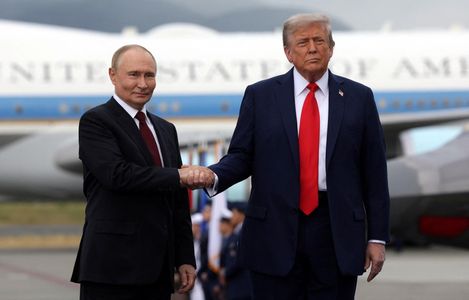
Clip: Trump returns to his default position of supporting Russia
President Trump’s impatience was on full display over Ukraine’s unwillingness to accept his proposal for ending the war that Russia started. Trump’s vexation with Kyiv was centered on its reluctance to cede its own territory to Moscow.
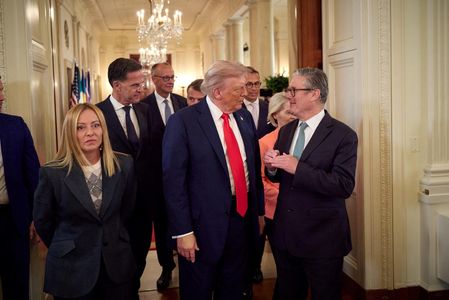
Clip: Trump's new national security strategy turns friends into foes
President Trump’s anger with Ukraine and his propensity to support Russia puts him at odds with British, French and German counterparts. But his new national security strategy suggests America’s traditional allies are actually foes, not friends.


© 1996 - 2026 WETA. All Rights Reserved.
PBS is a 501(c)(3) not-for-profit organization