Amid a National Reckoning Over Racism, FRONTLINE and Writer Jelani Cobb Investigate Efforts to Reimagine Policing
September 10, 2020
Share
Policing the Police 2020 Tues., Sept. 15, 2020 Streaming at 7/6c at pbs.org/frontline & in the PBS Video App Airing at 9/8c on PBS and on YouTube www.facebook.com/frontline | Twitter: @frontlinepbs Instagram: @frontlinepbs | YouTube: youtube.com/frontline
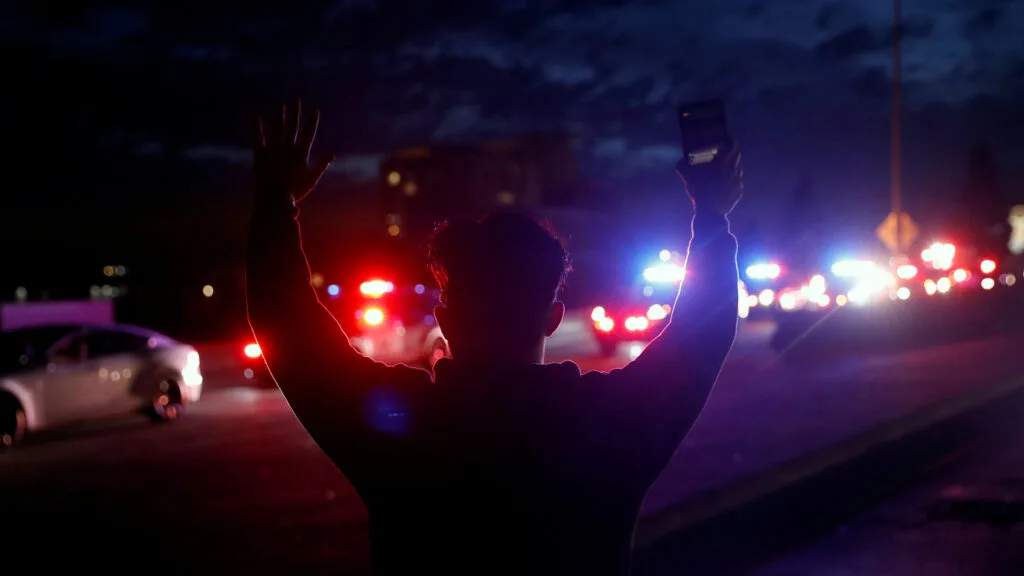
Against the backdrop of a pandemic that is disproportionately killing Black people, the deaths of George Floyd and Breonna Taylor at the hands of the police this year sparked a push for racial justice and calls for change.
On Sept. 15, in a documentary called Policing the Police 2020, FRONTLINE and New Yorker staff writer Jelani Cobb examine the realities of race and policing in America.
“In this country, race is shorthand for a set of life probabilities. The odds are different in Black America — of dying of COVID. Of being poor. Of being incarcerated. Of being abused — or even killed — by the police,” says Cobb, a historian at Columbia Journalism School who has written about issues of race and policing for The New Yorker for years. “Our new documentary asks the core question: Can policing be done differently — and is there the will to make the change?”
The film explores that question through the story of Newark, New Jersey, which has been undergoing an experiment in police reform for several years. In many cities across America this summer, police met both protesters and members of the media with force. But things remained relatively calm in Newark — whose police force was ordered to reform by the Department of Justice in 2016 after a federal investigation found a pattern of civil rights abuses, the brunt of which was borne by Black and Latino residents, and whose mayor, Ras Baraka, recently diverted five percent of the public safety budget towards social programs aimed at reducing violence and addressing the root causes of crime.
Baraka has publicly opposed calls to abolish police — he wants to keep them — but has been advocating for treating violence as a public health crisis, not a problem to be solved with policing alone. “I think defunding’s necessary, right? I think it’s necessary to begin to divert funding from police organizations to social services,” says Baraka, a former activist who went to college with Cobb and who speaks candidly in the film.
Cobb and producers James Jacoby and Anya Bourg first began examining policing in Newark for the 2016 FRONTLINE documentary Policing the Police. Now, Policing the Police 2020 traces how the reform effort has played out in Newark — where prior to federal intervention, approximately 75 percent of stops by officers were found to have no documented legal justification — and how President Trump’s Department of Justice has largely abandoned federal efforts to compel systemic change in police departments. The film is supported by Chasing the Dream, a public media initiative from The WNET Group in New York that examines poverty, justice and economic opportunity in America.
Christy Lopez, who led many of the DOJ’s civil rights investigations of police departments under President Barack Obama, says the Trump administration’s approach harms both police and the communities they are sworn to protect and serve: “If you tell police that the previous administration was abandoning you because they were insisting that you comport yourself consistently with the constitution, then you are telling police that they have a right to police without comporting themselves to the constitution,” Lopez tells FRONTLINE.
The film also examines the debate over holding police officers accountable. The U.S. Supreme Court has established that an officer can use force if they believe there’s a threat to their own life or the lives of others — a standard that activists have criticized as allowing officers to operate with near-impunity. James Stewart, head of Newark’s largest police union, says that external scrutiny of officers’ use of force is unwarranted.
“The police aren’t going out there just looking for violent encounters or looking to, you know, physically impose their will on people,” Stewart tells Cobb. “What does a cop want? We want to come to work, do our job and go home. We want a positive interaction with the community. But, you know, everybody’s piling on, everybody’s against you. There’s protests or rallies all the time, anti-police this, anti-police that. You know, it’s a difficult atmosphere to want to be a part of in 2020.”
Prior to federal reform, police officers in Newark didn’t know some elements of the law, says Peter Harvey, the federal monitor overseeing Newark’s progress. Newark’s head of public safety, Anthony Ambrose, says the federal reform process has brought about positive change, enabling the department to get its officers new and needed training: “If that’s what it takes to get it done, then I’m for it.”
Ambrose also praises the work of the Newark Community Street Team, an alternative violence reduction program that enlists former gang members to defuse conflicts and work as mentors. In July, Baraka gave $11 million to programs like the street team, money he got by diverting five percent of the public safety budget.
“We talk about overaggressive policing, and police killing our kids with impunity. I’m like, how do we deal with it? We reduce violence and crime in our own neighborhoods,” says Aqeela Sherrills, who heads the Newark Community Street Team. “Then that way there’s no need for, you know, 20 cops y’know? Because if we making the neighborhood safe, then maybe we only need five and we need to deploy them strategically. And then we can have better relationships with them, because we’re not putting all of this pressure on our cops to do things.”
Peter Harvey cautions that the national push involving defunding police should be weighed against the fact that reforming them costs money, too.
“I think you have to invest in certain components of police agencies if you want high quality policing,” Harvey tells FRONTLINE. “If you’re not going to give police agencies adequate resources for the components that matter — bias-free policing training, community engagement, use-of-force training… then you are asking for trouble.”
Cobb has the perspective of a historian, and through that lens, he finds that policing is just one of many longstanding systems in America — from education, to housing, to health care — that need to change if the goal is racial equity. It’s a view Baraka echoes.
“The police represent a larger system … they’re enforcing these people’s values, right?” Baraka says. “More African-American women die giving birth than on the streets by police, because of inequity in the damn hospital, right? And, every institution in America has the same values that the police department has in America. The police just got guns.”
Policing the Police premieres Tues., Sept. 15. It will be available to watch in full at pbs.org/frontline and in the PBS Video App starting that night at 7/6c. It will premiere on PBS stations (check local listings) and on YouTube at 9/8c.
###
Credits
Policing the Police 2020 is a FRONTLINE production with Left/Right Docs. The correspondent is Jelani Cobb. The producers and writers are James Jacoby, Jelani Cobb and Anya Bourg. The co-producer is Megan Robertson. The senior producer is Frank Koughan. The executive producers for Left/Right Docs are Ken Druckerman and Banks Tarver. The executive producer of FRONTLINE is Raney Aronson-Rath.
About FRONTLINE FRONTLINE, U.S. television’s longest running investigative documentary series, explores the issues of our times through powerful storytelling. FRONTLINE has won every major journalism and broadcasting award, including 93 Emmy Awards and 24 Peabody Awards. Visit pbs.org/frontline and follow us on Twitter, Facebook, Instagram, and YouTube to learn more. FRONTLINE is produced at GBH in Boston and is broadcast nationwide on PBS. Funding for FRONTLINE is provided through the support of PBS viewers and by the Corporation for Public Broadcasting. Major funding for FRONTLINE is provided by the John D. and Catherine T. MacArthur Foundation and the Ford Foundation. Additional funding is provided by the Abrams Foundation, the Park Foundation and the FRONTLINE Journalism Fund with major support from Jon and Jo Ann Hagler on behalf of the Jon L. Hagler Foundation. Support for Policing the Police 2020 is provided by The WNET Group’s Chasing the Dream initiative on poverty and opportunity in America, with funding by The JPB Foundation.
About Chasing the Dream Chasing the Dream is a multi-platform public media initiative from The WNET Group in New York, telling the human stories of poverty, jobs, justice, and economic opportunity in America. It aims to provide a deeper understanding of both economic and structural inequality, what has happened to the age-old dream of striving for a better life, and what is working to bring people out of poverty. Since 2014, Chasing the Dream has produced more than 500 on-air and online reports across public media, including documentaries in collaboration with FRONTLINE and WORLD Channel, news reports on PBS NewsHour and NewsHour Weekend, in-depth interviews on Amanpour and Company, and regional reporting on MetroFocus, NJTV News, and PBS member stations across the country. Funding for Chasing the Dream is provided by The JPB Foundation. Learn more at www.pbs.org/chasingthedream. Join the conversation on Twitter, Facebook, and Instagram.
Press Contact: frontlinemedia@wgbh.org, 617.300.531
Latest Documentaries



Explore
Policies
Teacher Center

Jon and Jo Ann Hagler on behalf of the Jon L. Hagler Foundation
Koo and Patricia Yuen
FRONTLINE is a registered trademark of WGBH Educational Foundation. Web Site Copyright ©1995-2025 WGBH Educational Foundation. PBS is a 501(c)(3) not-for-profit organization.
Funding for FRONTLINE is provided through the support of PBS viewers and by the Corporation for Public Broadcasting, with major support from Ford Foundation. Additional funding is provided the Abrams Foundation, Park Foundation, John D. and Catherine T. MacArthur Foundation, Heising-Simons Foundation, and the FRONTLINE Trust, with major support from Jon and Jo Ann Hagler on behalf of the Jon L. Hagler Foundation, and additional support from Koo and Patricia Yuen. FRONTLINE is a registered trademark of WGBH Educational Foundation. Web Site Copyright ©1995-2025 WGBH Educational Foundation. PBS is a 501(c)(3) not-for-profit organization.