Report: Trump to Soon Name an Ambassador to South Korea
December 15, 2017
Share
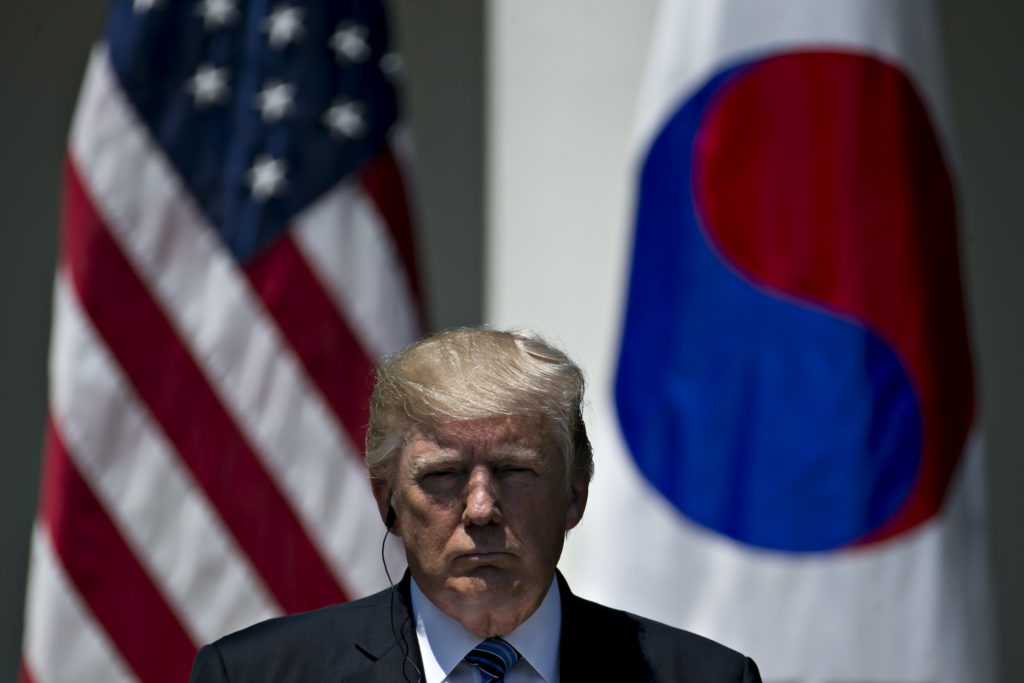
Despite escalating tensions between the United States and North Korea, the Trump administration has nearly finished its first year in office without a permanent ambassador to South Korea, a key partner in dealing with the ongoing threat.
But now, that post appears closer to being filled, according to a report this week in The Wall Street Journal.
According to the report, the administration has formally notified South Korea that it will nominate Victor Cha, a Georgetown University professor and former director of Asian affairs at the National Security Administration under President George W. Bush, to serve as the next U.S. ambassador to Seoul. If confirmed, Cha would replace Marc Knapper, the acting ambassador.
In addressing North Korea’s nuclear progress, Cha has said the U.S has to “be willing to accept more risk — both in military strategy and in diplomacy.” In written testimony before the Senate Armed Services Committee in April, Cha said that there is room for South Korea and the U.S. to cooperate more closely on North Korea, but he has also called on China to play a weightier role.
“China, rather than the United States, should be paying for North Korea to halt and roll back its nuclear and missile programs,” Cha wrote in a July op-ed in The Washington Post.
Cha’s selection comes a time of growing fear on the Korean peninsula about Pyongyang’s nuclear ambitions and its rapidly expanding ballistic missile capability. Despite international sanctions, North Korea in September staged its most powerful nuclear test to date, and has so far conducted 20 missile tests in 2017. These include the launch of an intercontinental ballistic missile in November that experts have said could potentially reach the United States.
Increased tests have fueled an escalating war of words between President Donald Trump and North Korean leader Kim Jong-un. President Trump has derided Kim as “little rocket man” and vowed to “totally destroy” North Korea against threats to the U.S. In response, Kim has called President Trump “mentally deranged” and said the U.S. will “pay dearly” for its stance.
North Korea’s neighbors have reacted to the increased threat. China is planning to construct refugee camps on its border with North Korea in case of a crisis, and this week, South Korean military officials said that the United States, Japan and South Korea would participate in a drill to track missiles that could be launched from North Korean submarines. A military strike could result in huge casualties in the capital of Seoul — a metropolitan area of about 25 million people. There are approximately 200,000 American civilians living in South Korea.
If confirmed, Cha could play an important role in the diplomatic response to North Korea, bringing experience as a deputy head of the U.S. delegation that negotiated six-party talks with North Korea. While those talks yielded early progress – including an agreement in principle by North Korea to give up its nuclear weapons program – their collapse in 2009 led to new sanctions, and a deterrence policy during the Obama administration that came to be known as “strategic patience.” Since entering office, the Trump administration has signaled that it is moving away from that policy.
Cha has spoken about the limits of strategic patience, telling FRONTLINE in an interview for the 2014 documentary Secret State of North Korea, “I do think the downside to so-called strategic patience, is that it allows North Korea patience to build nuclear weapons and their ballistic missile program.” Even though North Korea was under “the toughest sanctions backed by the U.N. that we’ve ever seen,” according to Cha, “that has not impeded them from making developments in terms of the program.”
In his interview, Cha explained the challenges the Obama administration faced in dealing with the North Korean threat, saying, “This is the hardest intelligence target in the world, and it’s not because intelligence hasn’t been trying to get it.”
“If policymaking is based on how you think someone else is going to react, but you don’t know enough about them to know how they’re going to react, it certainly makes policy[making] quite difficult,” said Cha.
Deterrence will be a challenge, he explained, noting that North Korea’s nuclear program has been motivated by U.S. interventions abroad.
“I’ve heard the North Koreans say very clearly to me, they said, ‘You attacked Iraq because it didn’t have weapons of mass destruction. You attacked Afghanistan because it didn’t have weapons of mass destruction. You will never attack Iran because they have nuclear capability, and you will never attack us because we have nuclear capability.’”
Cha did not respond to a request for comment. The Wall Street Journal reported that depending on the approval process, Cha could assume his position by the Winter Olympics in South Korea in February.

Former Tow Journalism Fellow, FRONTLINE/Columbia Journalism School Fellowships
Latest Documentaries


Explore
Policies
Teacher Center

Jon and Jo Ann Hagler on behalf of the Jon L. Hagler Foundation
Koo and Patricia Yuen
FRONTLINE is a registered trademark of WGBH Educational Foundation. Web Site Copyright ©1995-2025 WGBH Educational Foundation. PBS is a 501(c)(3) not-for-profit organization.
Funding for FRONTLINE is provided through the support of PBS viewers and by the Corporation for Public Broadcasting, with major support from Ford Foundation. Additional funding is provided the Abrams Foundation, Park Foundation, John D. and Catherine T. MacArthur Foundation, Heising-Simons Foundation, and the FRONTLINE Trust, with major support from Jon and Jo Ann Hagler on behalf of the Jon L. Hagler Foundation, and additional support from Koo and Patricia Yuen. FRONTLINE is a registered trademark of WGBH Educational Foundation. Web Site Copyright ©1995-2025 WGBH Educational Foundation. PBS is a 501(c)(3) not-for-profit organization.