‘Strike on Iran’ Filmmakers Were Closely Monitored as They Filmed in Iran for Two Weeks
Reporting on the ground under tight controls, they turned to open-source intelligence and visual forensics to help tell the story of Iran’s nuclear program.
December 23, 2025
Share
On the side of a highway near Isfahan, government minders watch over the scene as a foreign film crew speaks with a person who says he witnessed an Israeli missile strike passenger vehicles.
In a bazaar, government minders wait nearby as women hesitate and ultimately decline to be interviewed by English-speaking journalists.
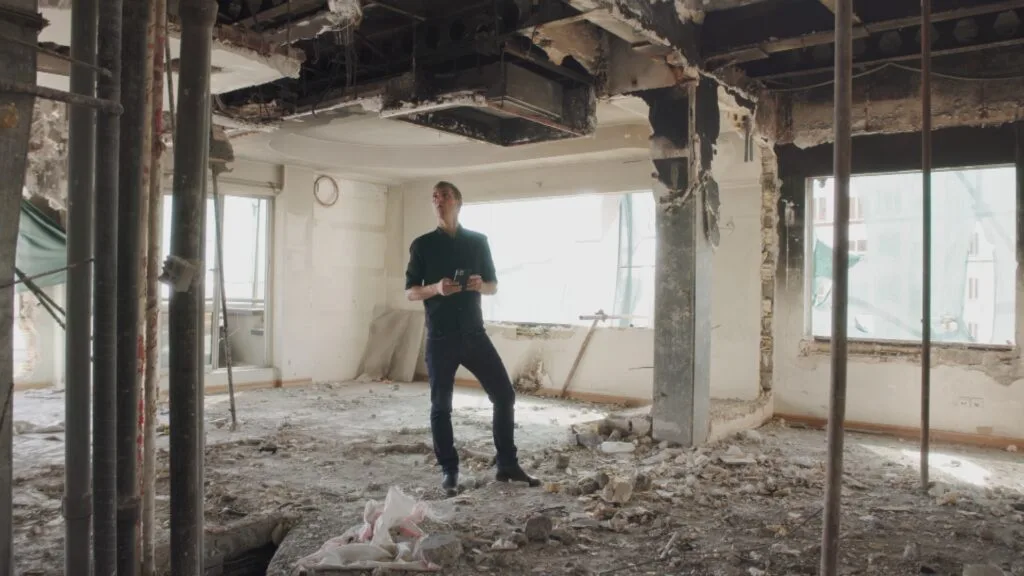
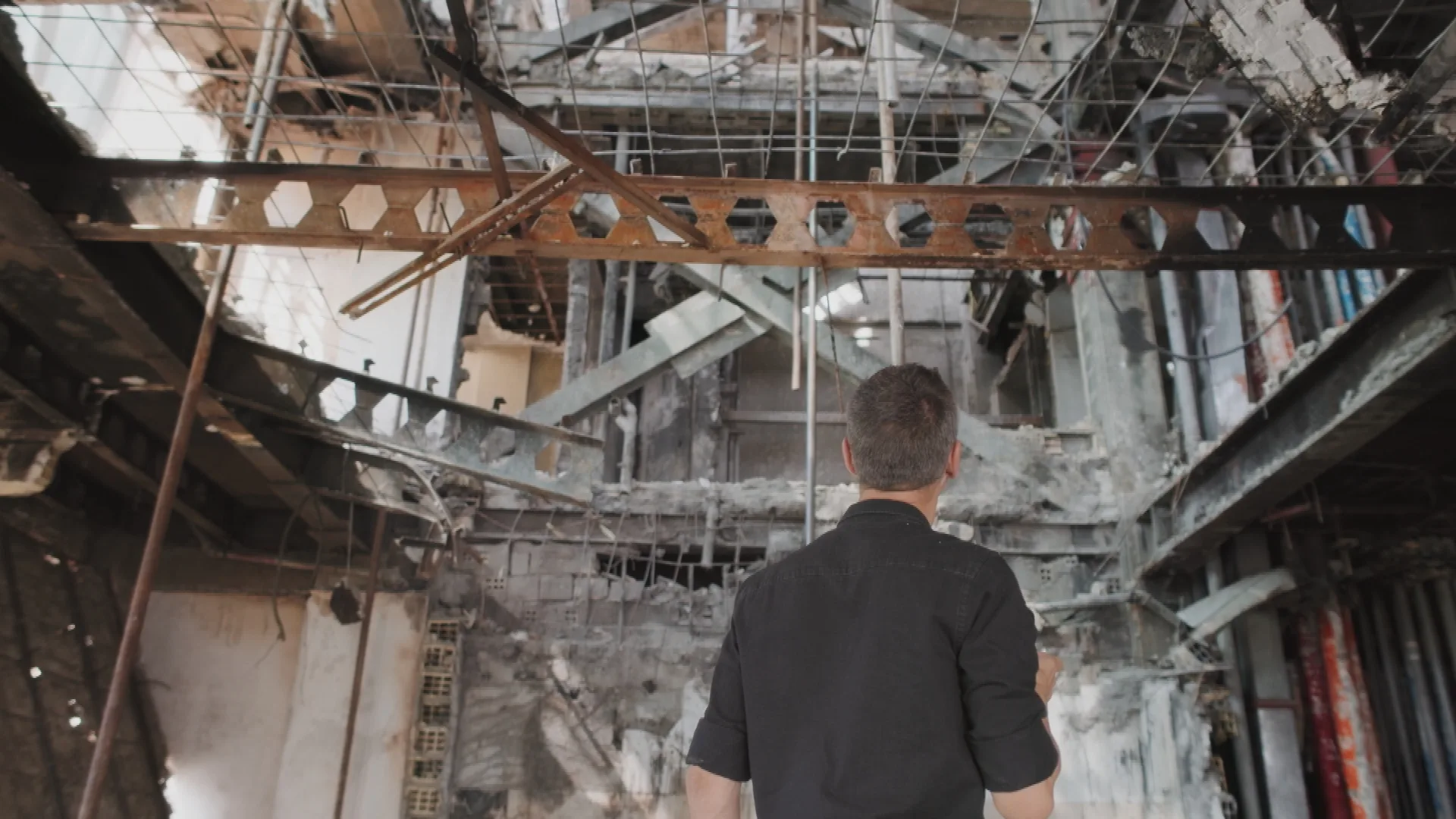
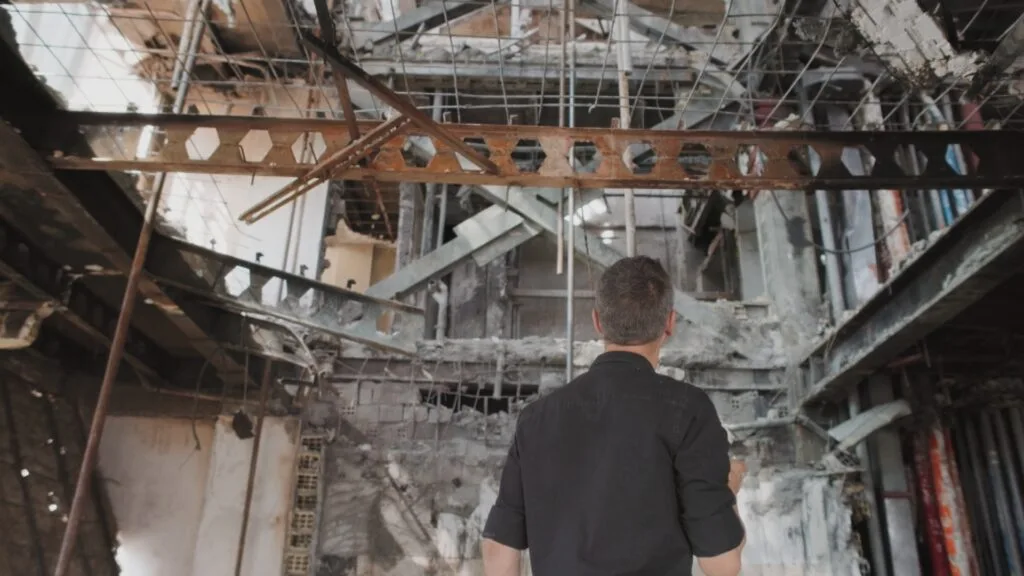
And as the journalists examine a destroyed residence, local police arrive, as well as men the journalists are told are Iranian intelligence officers.
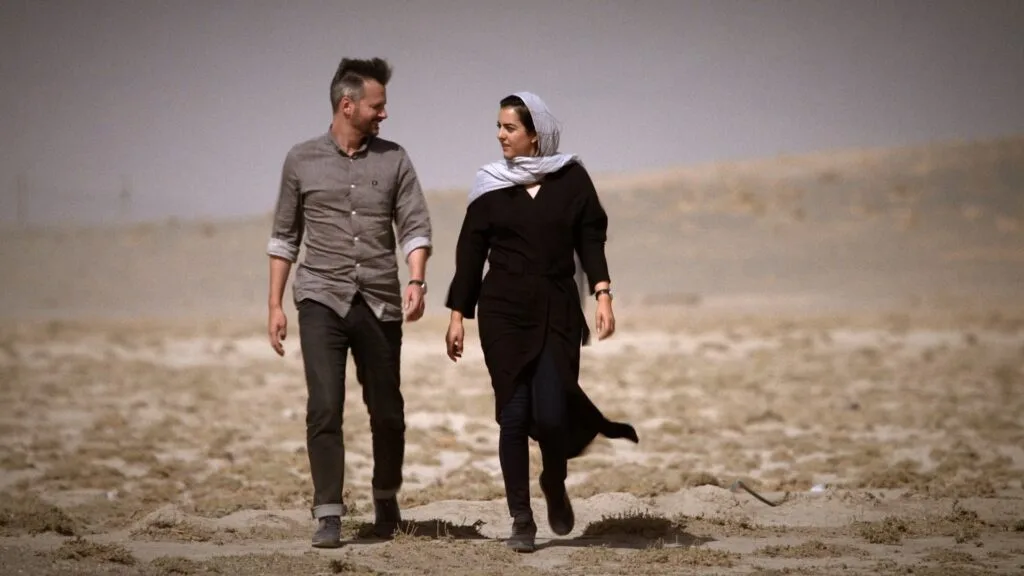
These encounters represent some of the challenges the team behind FRONTLINE’s latest documentary encountered, their movements tightly controlled as they reported from inside Iran.
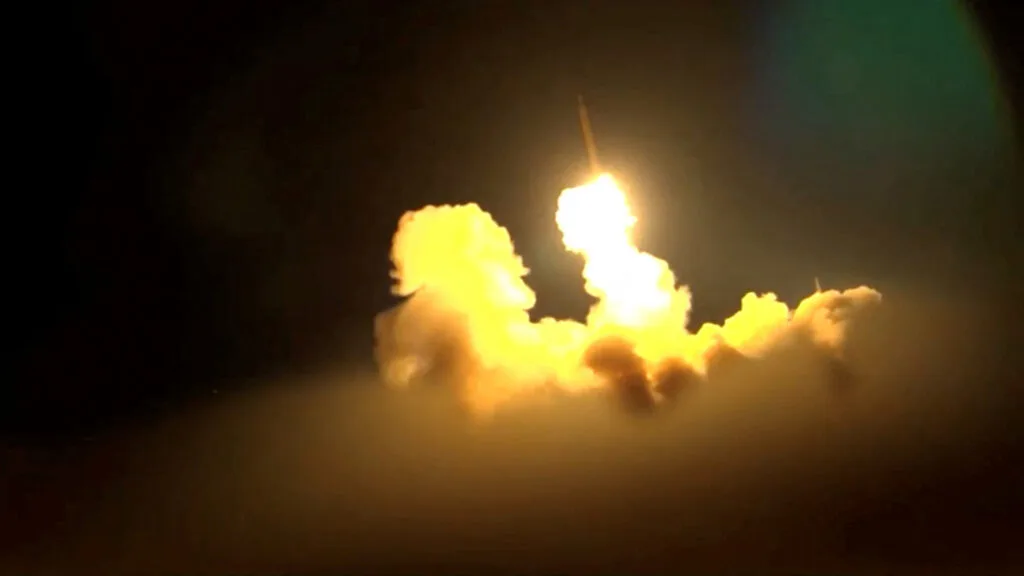
Having made previous reporting trips to Iran, Adam Desiderio and Sebastian Walker decided to return after Israel launched strikes on Iran’s contentious nuclear program in a war that drew in the United States and lasted 12 days. While their minders wouldn’t allow them to get a closer look at Iran’s bombed nuclear facilities, the filmmakers worked with The Washington Post’s visual forensics journalists including Nilo Tabrizy and colleagues from nonprofit outlets Bellingcat and Evident Media, to try to get around reporting roadblocks with the help of satellite imagery and open-source intelligence.
The resulting documentary, Strike on Iran: The Nuclear Question, takes viewers on a journey through the Zagros mountain range and inside the remains of Iranian nuclear scientists’ homes in search of an answer to a looming question: what is the status of Iran’s nuclear program?
In conversation with FRONTLINE, directors and producers Desiderio and Walker and Washington Post reporter Tabrizy discussed what it’s like to report on Iran, how collaboration helped the on-the-ground team report around tight controls, and how advances in visual forensic technology helped the team tell a fuller story.
This interview has been edited for clarity and length.
Let’s go back to when the strikes occurred in June. Can you tell me how and when the idea came together to pursue this investigation?
Walker: This happened really quickly. Adam and I have traveled as a team throughout Iran starting from around 2018, so we’ve got good contacts there. When the strikes happened, we were immediately pinging our contacts and asking for access. That’s the first thing we wanted to do. We wanted to get in.
We started talking to Nilo because the reporting conditions in Iran are such that we thought we could really benefit from having a partnership with somebody who had been reporting on this story in depth and had expertise and tools we did not.
Can you tell me what it’s like reporting from Iran?
Walker: It’s unlike anywhere I’ve reported from in the world. Even at the best of times, the challenges are getting to see authentic events. You’re constantly accompanied by government-approved personnel who are with you everywhere you go. You can’t go off and do your own thing, so it means that any conversations you have are less organic and authentic than you’d like them to be as a journalist. And Iran has never been attacked like this, so all of those considerations that you’re having to navigate on the ground were even more intense this time around.
You’re saying this trip was different from previous trips?
Walker: The attention we got from the people who oversee our movements was strong. It had just been 12 days of actual war, with bombings by Israel and the United States combined, so the timing of it meant there was an added dimension of control and limitations.
One of the main officials that we spoke to was somebody who hadn’t done an interview with international media since the strikes took place, so this was a high-stakes conversation and it was very high security. A lot was riding on this interview and we touched on a lot of big questions at hand. But then, as soon as the cameras stopped rolling, we were told to hand over a copy of the footage to Iranian officials in the room and we were told there was no choice in the matter.
"The attention we got from the people who oversee our movements was strong."
Desiderio: With a Western film crew or foreign film crew, they’re very concerned about the messaging and the stories that come out of each shoot. In the past, there were times when there would be some sort of press officer for whoever you’re interviewing that might record the interview on a cell phone or monitor what we’re doing, but never a situation where we are told flat out, “You’re not leaving this building, you are not leaving the compound unless you do a certain thing like hand over the footage.” They wanted an unedited copy. So ultimately, we didn’t hand over footage, we made copies of it, and then they allowed us to leave.
Nilo, you’ve reported on Iran from abroad in the past, notably, the mass protests that started in 2022. Did this project pose any new challenges?
Tabrizy: When I started to do work on Iran, I knew that I would never be able to do work from inside the country because I’m an Iranian dual national and Iranian dual nationals are targeted by the Islamic Republic. Knowing that, I’ve always thought about how I can still do accountability-based reporting, but do it safely and from afar.
So when Seb and Adam were in Iran, we had to think about how Seb could send information he was getting in the field back safely to me while I was in the U.S. and to be mindful of their security situation. Figuring out a safe way to communicate, keep everyone safe, but also be able to get that information back from him — which is so crucial in our reporting process — I thought that was a new challenge and something for us to work through in the process.
"When I started to do work on Iran, I knew that I would never be able to do work from inside the country because I'm an Iranian dual national ..."
This investigation relied on different technology from encrypted communication to visual forensics techniques. How do you think that technology is changing reporting on war or its aftermath?
Tabrizy: Satellite imagery is really the way many people are monitoring what Iran is doing next, whether or not it’s building up, and if it’s at all trying to clean up the sites post-strikes. Absent any type of nuclear deal that allows inspectors to come into Iran, satellite imagery is really the only way to have eyes on Iran.
Desiderio: For locations like the nuclear facilities, these are places that we couldn’t get within. So, to be able to rely on satellite imagery, you’re seeing things that you never were able to see before in close detail. It’s a whole other layer that’s added to war reporting, and being able to access satellite imagery over periods of time — before the strikes had happened, then right after they happened and up to when we were there on the ground as well — it’s a total game changer.
Walker: Adam and I specialize in very immersive, dynamic, kinetic filming in a particular place, and blending that with visual investigative reporting is a very powerful combination. Sometimes with visual investigative work you lose the experience of the place, what it looks and feels like, the stuff that comes through with filming on the ground. And I think vice versa.
These days it’s really important to have that on-the-ground material backed up by very thorough, diligent reporting — the kind that brings the receipts to what you’re seeing unfold on camera. That combination of immersive filmmaking with visually investigative reporting is a powerful fusion of reporting that I’d say is a very interesting direction for us.
You did manage to speak to many different Iranians while on the ground. Do you feel like you have a better sense of what the nuclear program symbolizes among Iranians?
Desiderio: I’m thinking about the head of the AEOI [Atomic Energy Organization of Iran], Dr. [Mohammad] Eslami. He talked about how the nuclear program is a point of national pride because they’ve had to deal with sanctions for so many years. They see it as a scientific achievement. And to use that technology and not have to rely on foreign governments is a point of national pride.
They say that the program is peaceful and that it’s necessary in order to make medical technologies, for instance. Whether that’s true or not is yet to be seen, but I think it’s one perspective we heard when we were on the ground.
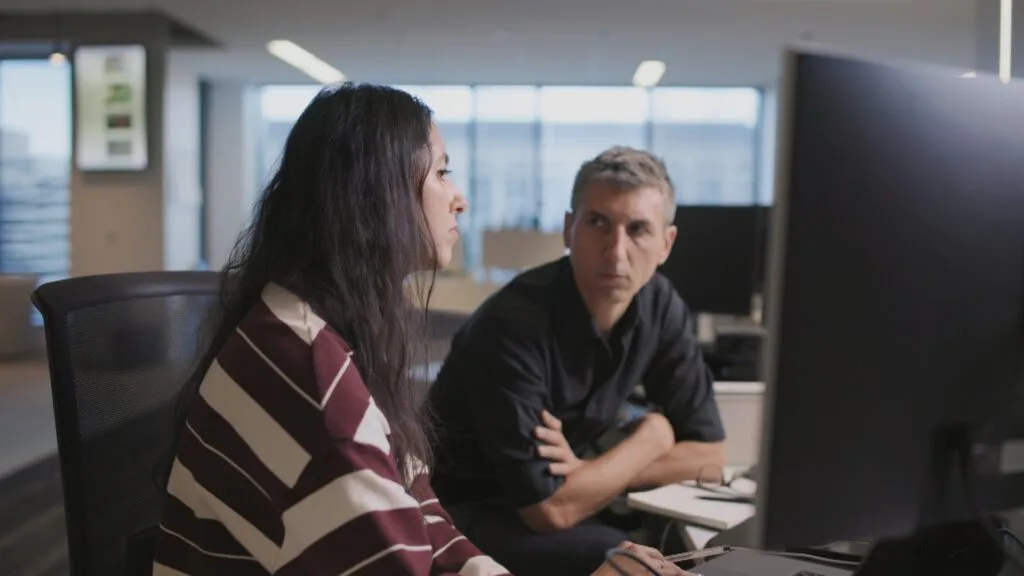
Tabrizy: It’s very hard to think about how to represent the average thoughts of a country of 80 million plus people, but for people who had loved ones that were living in residences where nuclear scientists were living, they were extremely angry. They had no idea there were nuclear scientists living there and the fact that their loved ones became collateral damage was heartbreaking.
There’s a lot of mixed feelings about how the nuclear program is received by many Iranian people. As Adam pointed out, parts of the government and certainly some average people do see it as a form of both scientific ingenuity and also resistance.
Then I’ll speak to other younger Iranians, and someone told me when the airstrikes were happening, “Poor us. We’re stuck in the middle. On one side, we’re stuck with the Islamic Republic where many of us are harmed and killed every day. And on the other side we are getting airstrikes from Israel.” Each time there’s a conflict in Iran, the value of the rial drops considerably too, making affordability a growing crisis.
The nuclear program has been a big focus for Western powers for a long time, from multilateral deals to the strikes this year. The documentary notes that there’s been a shift in strategy, particularly from Israel. Can you talk more about that?
Desiderio: The last reporting trip I took to Iran was four years ago to cover the assassination of another suspected nuclear scientist who was killed in his car on the side of the road. During that same shoot, we also happened to talk to [Fereydoun] Abbasi, who we mention in our documentary as being one of the top Iranian scientists killed that first night of strikes. We actually spoke to [Abbasi] at the Holy Defense Museum next to a car where there was huge impact — he was actually inside this car when he was shot at, and that car is now on display at the Holy Defense Museum — and at that time, he said that he had wished to be martyred.
So when we went to these sites four years later, he had been assassinated and we saw these massive bombs — these weren’t cars that were shot up, these were massive residential apartment buildings in neighborhoods with civilians living there — it seemed like a shift in tactic.
"... These weren't cars that were shot up, these were massive residential apartment buildings in neighborhoods with civilians living there ..."
Walker: Israel took responsibility for nine scientists just a couple days after those strikes began. If we compare it to the 2000s, when suspected Mossad-linked assassinations were taking place in Tehran, we saw then agents on motorbikes that would speed up and put these magnetic bombs on cars. Instead of the targeted attacks that we saw in the 2000s, they were going after a wave of several scientists in a coordinated way using airstrikes.
Having reported on global affairs, especially from the Middle East, what do you hope viewers take away from this investigation?
Tabrizy: The work that Adam and Seb did on the ground is really valuable, so I hope the viewer gets some insight into the difficulty of reporting on Iran. I hope that people also take away the civilian toll of these airstrikes as well.
Desiderio: At the time of the strikes, there were big statements made by world leaders but very little was seen from on the ground. I think the value of this story — of going months later, spending 14 days on the ground and being able to illuminate the impact of these strikes — gets at some semblance of accountability or a truer picture of what actually happened beyond these big statements from world leaders.
Walker: I think the big takeaway for me is about what’s next. There was new activity detected while we were on the ground. The fact that there is a site that Iran has taken steps to develop since the strikes raises this very important question of whether one impact from the strikes could be that it pushes the program further away from visibility for the international community. I think that’s what we should be thinking about for the next phase of this story.
Keep Our Journalism Strong. Donate Today.
Your support makes it possible for FRONTLINE to produce bold investigative documentaries on the issues that matter most. Donate today to help sustain this work through the months and years ahead.
Murray Journalism Fellow, FRONTLINE/Missouri School of Journalism Fellowship, FRONTLINE
Email:
skye_lucas@wgbh.orgRelated Documentaries
Latest Documentaries
Related Stories
Strike on Iran: The Nuclear Question
Related Stories
Strike on Iran: The Nuclear Question
Explore
Policies
Teacher Center

Jon and Jo Ann Hagler on behalf of the Jon L. Hagler Foundation
Corey David Sauer
Koo and Patricia Yuen
FRONTLINE is a registered trademark of WGBH Educational Foundation. Web Site Copyright ©1995-2025 WGBH Educational Foundation. PBS is a 501(c)(3) not-for-profit organization.
Funding for FRONTLINE is provided through the support of PBS viewers and by the Corporation for Public Broadcasting, with major support from Ford Foundation, and The Fialkow Family Foundation, as part of the Plum Bush Foundation. Additional funding is provided the Abrams Foundation, Park Foundation, John D. and Catherine T. MacArthur Foundation, Heising-Simons Foundation, and the FRONTLINE Trust, with major support from Jon and Jo Ann Hagler on behalf of the Jon L. Hagler Foundation, and Corey David Sauer, and additional support from Koo and Patricia Yuen. FRONTLINE is a registered trademark of WGBH Educational Foundation. Web Site Copyright ©1995-2025 WGBH Educational Foundation. PBS is a 501(c)(3) not-for-profit organization.