MARCY FREEMAN, Dir., New Beginnings Pulmonary Rehab:
We have an epidemic here of black lung.
ROBERT COHEN, MD, Pulmonologist, Univ. of Illinois, Chicago:
These miners are inhaling their workplace, and it stays with them forever.
NARRATOR:
In collaboration with NPR, Public Health Watch and the Appalachia and Mid-South Newsroom
HOWARD BERKES, Correspondent:
Do you have a sense of what the rest of your life is going to be with black lung?
JOHNATHAN WRIGHT, Former coal miner:
You work your whole life to enjoy the rest of it, and you can’t enjoy it.
NARRATOR:
Drawing on years of reporting, correspondent Howard Berkes investigates.
HOWARD BERKES:
Why won’t you talk to us about this issue?
HEITH REYNOLDS, Personal injury lawyer:
The numbers are astounding, how many young people are getting this disease.
BRUCE WATZMAN, National Mining Association:
If we could turn back time, we would do so to prevent this. We can’t. We’re dealing with historic exposures.
SCOTT LANEY, Ph.D., Epidemiologist, NIOSH:
These guys are being treated like disposable widgets, not human beings, and we’re watching them die right before our eyes.
NARRATOR:
Now on FRONTLINE—
DREW HARRIS, MD, Pulmonologist:
This has been going on for decades. It is entirely preventable, and we aren’t preventing it.
NARRATOR:
Coal’s Human Cost.
JOHNATHAN WRIGHT, Former coal miner:
I started noticing in mid-2023 that it was getting tougher and tougher breathing-wise to climb these hills around here.
I’d love to get my kids into hunting, fishing, stuff like that, but just having the energy and the wind to do it is almost impossible.
I used to work all day, come home and cut grass till dark. Now, I can come here and sit all day and go home and I’m beat. I mean, I just—I ain’t got no energy to do nothing. I know it’s going to get to where I can’t get around in the hills to hunt, so I’m going to have to give that up eventually. And it’s awful. You work your whole life to enjoy the rest of it, and then when you—you can’t enjoy it.
Coal’s Human Cost
NPR NEWS HOST [on radio]:
Howard Berkes has been investigating the rise of black lung disease for more than a decade.
CORRESPONDENT
Howard Berkes
HOWARD BERKES, Correspondent:
Even the black lung experts were shocked by this data.
I’ve been in and out of Appalachia going back 15 years, driving the hills and coalfields of Kentucky, Virginia and West Virginia, tracking the resurgence of an incurable coal mining disease called black lung.
PRODUCED BY
Molly Born
Howard Berkes
WRITTEN & DIRECTED BY
Molly Born
HOWARD BERKES:
I’ve interviewed dozens of sick and dying coal miners, documented thousands of cases of disease and exposed failures by federal regulators and the industry. And there’s evidence it’s getting worse.
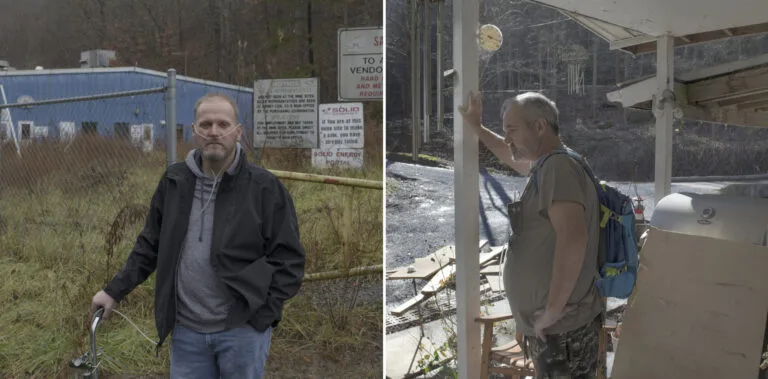
Johnathan Wright is 44 and worked underground until the mine closed last year. I met him in Pike County, Kentucky, where he now sells overstock and surplus merchandise from a small warehouse.
JOHNATHAN WRIGHT:
I worked underground in a coal mine for 25 years. I done a little bit of everything, from running a scoop to a shuttle car, miner, roof bolter. I’ve done a little bit of everything.
Every morning I’d get up, I’d cough up grayish-looking phlegm and stuff, but between that and just not having the energy to do what I used to do, that’s what prompted me to go get checked.
I’m thinking it was in August is when I had that X-ray done, and I think it took about a month to get it back, and they diagnosed me with second-stage black lung.
HOWARD BERKES:
How did you react to being told that you had black lung disease?
JOHNATHAN WRIGHT:
Well, I mean, it scared me. I’ve worked in mines for 25 years, I know what it is. I just, I really didn’t think it would happen to me, though. I guess when you’re younger, you don’t think it’s going to happen.
HOWARD BERKES:
Why do you think you got black lung?
JOHNATHAN WRIGHT:
Just eating too much dust. Just being exposed to too much dust, without a doubt. In my earlier part of my career, I was like every other young guy, at first just not knowing much about it. But then later on, just complacency. You’ve been in it for so long and there’s nothing happened yet, I believe that’s the way a lot of people look at it. You just get complacent with where you’re at and just don’t realize what damage it’s doing.
HOWARD BERKES:
One in three veteran underground coal miners tested in central Appalachia now have black lung. That’s the highest rate since the 1970s.
The disease is devastating families here, where doctors and advocates have been trying for years to sound the alarm and to get better protections for miners.
In September, I attended a meeting of the local black lung association in Big Stone Gap, Virginia.
FEMALE SPEAKER:
They’re a little bit confused on some of the steps. Can you answer a couple of their questions?
MARCY FREEMAN, Dir., New Beginnings Pulmonary Rehab:
Sure.
HOWARD BERKES:
It was led by respiratory therapist Marcy Freeman and radiologist Brandon Crum, who I’ve been in touch with for years.
MARCY FREEMAN:
We have an epidemic here of black lung, and we see tons of coal miners with advanced progressive massive fibrosis. You know, our clinics, my clinic, Dr. Crum’s clinic, Heith the attorney, Wes Addington, Marshall is at Norton Community.
And the scary thing is none of us really overlap with those patients. And the fact that we’re all seeing such an influx tells me that there’s something going on. That is not a good thing in this area.
- BRANDON CRUM, Radiologist:
I appreciate y’all having me back here. And if you don’t know me, I’m Brandon Crum. I’m a radiologist over in Kentucky and I have a clinic over there. We’ve done a ton of research on black lung, a ton of imaging, so I read the X-rays and CTs, but we’ve also took it significantly further and gathered probably the largest collection of data on central Appalachia miners.
So when you look at it, ’70s, ’80s, ’90s, all the way to 2000, 2010s, 2020s, after billions and billions of dollars has been spent, we’re right back to the same place we was when our grandfathers were mining, and our great-grandfathers. That’s pretty much where we’re at. So it’s been a failure of the entire system for our miners in central Appalachia is pretty much what you can say about it.
MARCY FREEMAN:
When I talk about black lung—you know, I’m always talking about it. I mean, it’s—I live it. My husband has it, my dad has it, everybody in my family is affected by it because, just like you all, I’m a coal miner’s daughter. And I see what it’s done to them, and I see it firsthand what it’s doing to them. And I look at Phillip, my husband, who was strong, healthy. Man, invincible. Invincible. And I watched this disease take a little piece of him, every few months I see a change. And I’ve watched my daddy, and I swear to God, my daddy was Superman, right? There’s nothing he couldn’t do, nothing. And now, he can’t even breathe and get off the couch. It’s a horrible disease.
HOWARD BERKES:
Freeman runs respiratory clinics for coal miners in Kentucky and Virginia.
All of the miners I interviewed at her clinics have what’s known as progressive massive fibrosis, or PMF, the advanced form of the disease.
That was the diagnosis for Tim Balthis after 35 years as a miner.
TIM BALTHIS:
When I went to my pulmonologist in August of ’21, he told me what it was. And I was in denial then. I was like, there’s no way, dude. I can still run miles. And went into a denial phase for probably a couple years, I guess. And then I just thought, he’s not lying to me. And with the time that I had, the years of service, I guess, in the mines, I knew it was a possibility. He just made it real.
HOWARD BERKES:
You used to work out with your daughters, running track?
TIM BALTHIS:
Yeah. They ran track and cross-country, so I would run with them through town, and it wasn’t uncommon to run three, four miles with them a day.
HOWARD BERKES:
Could you keep up with your daughters now? Your grandkids? You have grandkids.
TIM BALTHIS:
No, I could not run with them. There’s no way.
HOWARD BERKES:
You said you don’t like to talk about it because that makes it real.
TIM BALTHIS:
Yeah.
HOWARD BERKES:
What’s real?
TIM BALTHIS:
Um, the death is real. That’s going to happen. If the rest of my body stays in good shape and I don’t get killed in a car accident or something like that, I’m going to die of black lung. I know that. I try to put that at the back of my mind and stay healthy and active and all that kind of stuff. And hopefully I’ll live until I’m in my 70s or 80s, so that would be a normal life. Will that happen? Probably not. With the diagnosis that I have, I’ll probably be lucky to live in the mid-60s, if I’m lucky. If this right here stalls the progression of it, I’ll probably live to be in my mid-60s.
HOWARD BERKES:
How old are you now?
TIM BALTHIS:
I will be 58 in November.
HOWARD BERKES:
Mid-60s isn’t far off.
TIM BALTHIS:
No. No, it’s not.
HOWARD BERKES:
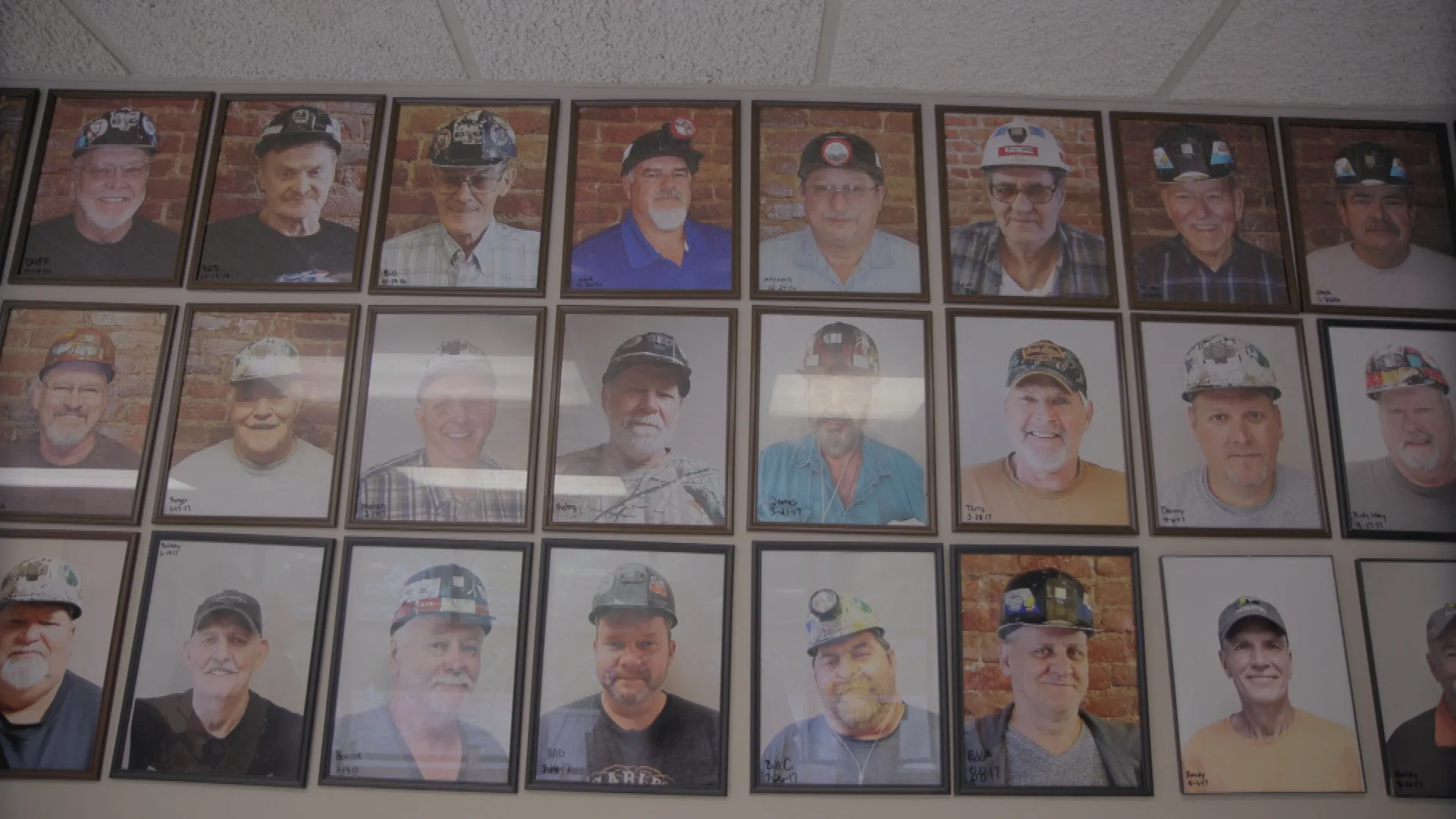
This is a stack of funeral programs and obituaries for miners who have been clients here and who have died. And these four I pulled out because these are guys who I interviewed the last time I was here in 2018. And I remember each of them. It’s Paul and Jerry and Jack. And another Jack. They were here, struggling to breathe at times, working out, trying to improve their symptoms as best they could. But they were joking with each other. They were just so full of life, even though they had this horrific disease. And, um—and they didn’t make it. And there are 40 more of these funeral programs and obituaries here. They keep track of them. They save them to honor these guys.
When I was here eight years ago for NPR and FRONTLINE, federal researchers had just reported that one in five working coal miners in central Appalachia had black lung. Basic black lung diagnoses had doubled in a decade. The advanced disease, PMF, had quadrupled since the 1980s. And it was clear that miners were getting the advanced disease younger and more quickly than in the past.
Greg?
GREG KELLY:
Hey.
HOWARD BERKES:
I’m Howard Berkes from National Public Radio. Great to meet you.
When I first met Greg Kelly in 2018, he was just 53 years old—still relatively young for a miner so sick.
GREG KELLY:
That’s me and that’s my stepdad.
HOWARD BERKES:
How long did you spend in mining?
GREG KELLY:
Thirty-one years. Here’s one. That was in ’83.
HOWARD BERKES:
And what made you stop mining?
GREG KELLY:
My health. I just couldn’t—I got sick and they said, “We don’t want you to go back to work till you see a lung doctor.” When I did get to see him, he said, “You don’t need to go back underground.”
HOWARD BERKES:
Was that the first time you learned that you had black lung?
GREG KELLY:
Right. Yeah, that’s the first doctor that ever said, “You’ve got black lung.” I’ve had two or three X-ray technicians tell me they’re the worst set of lungs they’ve ever seen.
HOWARD BERKES:
What kind of reaction did you have when you heard about that?
GREG KELLY:
You can’t work. It’s just like a light switch being turned on and turned off. All your plans that you had, hunting and fishing and doing what you want to do. When that day comes, well, all of a sudden it’s here and you can’t. You don’t have the air to do it.
You know, I still enjoy life. I have a good time. Get to play with my grandson, just not like I want to and like I used to be able to.
You catch one? There he is. You got it.
Well, I just try to pray and ask the Lord to help me to overcome it and just go on and be with my family.
You got one, didn’t you?
The whole time I’m bent over, I can’t breathe. And then when you rise up, you got to just stand still to get your breath.
Come on, let’s go show Mom what you caught.
NPR NEWS REPORTER:
The disease that steals the breath of coal miners is back with a vengeance.
HOWARD BERKES:
I went to see radiologist Brandon Crum at his clinic in Kentucky, which was overwhelmed with cases of PMF.
BRANDON CRUM:
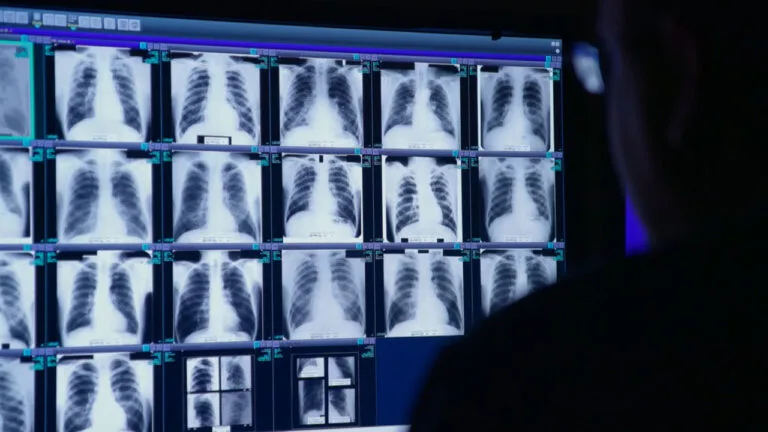
So I’ll just show you for comparison. This is a normal X-ray. And you can see all the dark area—that’s the lung because it’s filled with air. And you contrast that to this one. See all these big white areas, all the way through here? That’s all conglomerate fibrotic mass, or PMF.
The biggest concern at that time for me was seeing young men my age—and I’m 43—or younger than I am with the most severe form of the disease, which is the complicated black lung disease.
HOWARD BERKES:
Crum was so concerned he took his findings to researchers at the National Institute for Occupational Safety and Health, or NIOSH.
BRANDON CRUM:
Well, when I told them we were seeing or I was seeing a lot of complicated black lung disease, and what was most concerning is I was seeing it in individuals in their 30s and 40s, I think there was some hesitancy on their part. I’m not sure they believe me.
SCOTT LANEY, Ph.D., Epidemiologist, NIOSH:
He told us that he was seeing a lot of really advanced disease and it was concerning to him, and I guess my initial thought was that’s probably not true.
HOWARD BERKES:
The researchers had been officially tracking black lung disease for decades. But they only tested working miners, not the thousands out of work. So they hadn’t detected the sharp rise in deadly PMF Brandon Crum was finding.
SCOTT LANEY:
He invited us to show us some of the medical images from his patients. And we sat there for an entire day, one after another after another, looking at these chest X-rays, the worst I’ve ever seen.
HOWARD BERKES:
What was your reaction to what you saw?
SCOTT LANEY:
Horror. Shock. I don’t know how the—many other words to use. I was really taken aback, not only that these cases were legitimate, but just how severe they were. It indicated that we had a huge problem, and we realized immediately that it wasn’t going to be isolated to a single clinic.
HOWARD BERKES:
Researchers at NIOSH had only reported 99 cases of PMF in the previous five years. But out-of-work miners had been flooding clinics. And in calls and visits to 16 clinics across Appalachia, FRONTLINE and NPR identified close to 2,000 cases in the same time frame.
The Stone Mountain black lung clinics in southwestern Virginia reported more cases than anyone. Ron Carson directed the clinics at the time.
RON CARSON, Fmr. Dir., Stone Mtn. Black Lung Program:
We’re going to put you in a room. Come on with me.
When NIOSH reported maybe 90 or 100 X-rays—
FEMALE CLINIC STAFF:
All right, if you’ll step up real close for me.
RON CARSON:
So we came back and we started doing a study on how many we actually had, pulling X-rays back to 2014 to 2017, three years of X-rays. We quickly identified 416 during that three-year period. However, if we had went back to 2010 at a minimum, we could have probably doubled that.
FEMALE CLINIC STAFF:
Breathe in and out, deep and fast. In and out. And stop.
RON CARSON:
And I don’t know what your test will reveal today, but—and I tell everybody this for almost 30 years: Don’t get discouraged.
HOWARD BERKES:
The count at Stone Mountain rose to nearly 800, with a dozen new cases a month.
RON CARSON:
My buddy here. Give me a hug here. God bless you, my friend.
I just think that America needs to know that these miners, they have paid a price. So many years, these miners extract this coal so that you and I can—I get teary-eyed. [Sighs] I’m sorry. [Cries] They paid a price. They have paid a price so that we can have luxury. And I just feel like America has just forgotten about them.
PREACHER [on television]:
So let us trust in you and you only. Despite what’s going on around us, give us the joy and the peace that the world cannot give us. And we thank you for your love that is unconditional. In Jesus’ name we pray. Amen.
HOWARD BERKES:
Danny Smith was 46 when I met him. He’d mined coal just 12 years, but was desperately sick. He was getting help with breathing and stamina at a Kentucky pulmonary rehab clinic run by Marcy Freeman.
DANNY SMITH:
Marcy?
MALE CLINIC STAFF:
He wants to drop down.
DANNY SMITH:
Can I drop down today? I’m wore out.
MARCY FREEMAN:
Yes. Yes, you can, honey. What’s Danny’s heart rate? 96?
Let’s stop and catch our breath there for a second.
Danny, when he first started with us, he would break out in a cold sweat, literally drenched, and he would start shallow breathing. Depression, anxiety—that is as much a part of this disease as their breathing is.
It takes them approximately three to six months to build up when they start this program. At six months they’re typically maxed out. If they’re out for two weeks, they lose pretty much everything they gained.
DANNY SMITH:
We have a family cemetery, and when you already got your plot picked out, at my age it’s kind of a scary thought, you know? I hope one day I get to see my grandchildren. I don’t want to talk no more, OK? I’m sorry. Just give me a minute. I’m all right. If I can see my babies graduate from college, both of them—
ROBERT COHEN, MD, Pulmonologist, Univ. of Illinois, Chicago:
When people get the first stages of the disease, they require oxygen.
DANNY SMITH:
Can you turn that oxygen on back there? Just pull the—that little gray handle? Just pull it toward you.
ROBERT COHEN:
And then even the oxygen that you’re adding to that person so that they can do more isn’t enough. And so they’re essentially suffocating while alive.
Something seemed to change where people were more heavily exposed to perhaps more toxic dust, and we’re getting this very severe form of the disease that, from my medical school training and from my past clinical practice, was rare. We didn’t see that many cases of PMF, and it was something that we thought had been relegated to the trash heap of history.
HOWARD BERKES:
The modern era of coal mine regulation began in the late 1960s, in part because 40,000 coal miners staged a wildcat strike in West Virginia, demanding government action on black lung.
KEN HECHLER, West Virginia congressman:
The greatest heroes are you, the coal miners. You’ve taken the future, your future, in your hands and you have proclaimed, “No longer are we going to live and work and die like animals. We’re free men!”
HOWARD BERKES:
Congress responded with a tough new law. It was supposed to protect miners from the coal mine dust that poisons lungs. And in the early ’70s, a new federal research agency, NIOSH, began to monitor black lung disease among working miners.
ROBERT COHEN:
We saw a nice reduction in the rates of disease falling down to very low levels. And then that, I call it the U-shaped curve of concern. The curve went down and hit the bottom and then started to go back up again, meaning that something changed. We took our eye off the ball, something else happened, and the disease was recurring.
HOWARD BERKES:
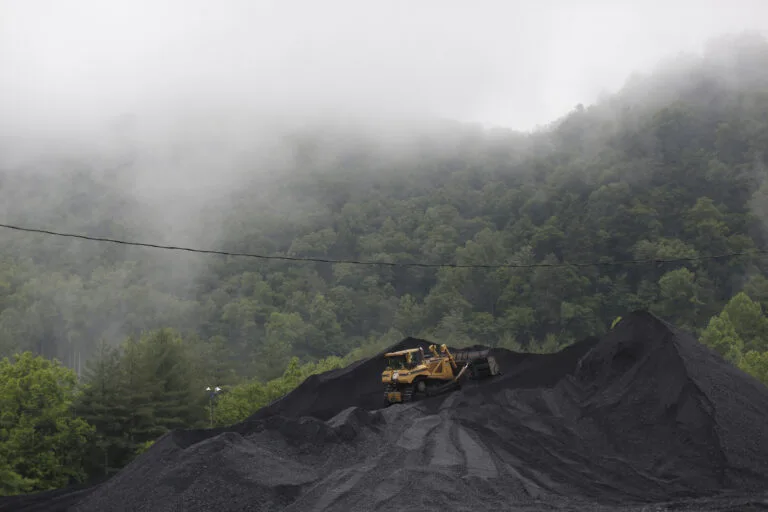
What changed was mining itself. Big and pure coal seams were mined out. Thinner seams embedded in rock were left. Mining machines cut more and more of that rock, producing fine and easily inhaled particles of silica—toxic dust that the existing mining regulations didn’t directly control.
ROBERT COHEN:
Somewhere in the late 20th century there has been a change in the composition of the dust. We’re seeing more silica, and silica is 20 times more toxic than coal. When you inhale silica, it’s retained in the lung. These miners are inhaling their workplace, and it stays with them forever.
HOWARD BERKES:
By the mid-1990s, federal regulators knew there was a problem. NIOSH recommended new silica regulation, including an exposure limit twice as tough. But the proposals didn’t go anywhere.
So you worked for the agency back in this time frame.
CELESTE MONFORTON, Mine Safety & Health Admin.,1995-2001:
Mm-hmm.
HOWARD BERKES:
Celeste Monforton was a top adviser at the Mine Safety and Health Administration, or MSHA, at the time. She says the agency ran into opposition from the mining industry.
CELESTE MONFORTON:
Now we see in miners who were, again, working at that period of time and now are the ones that are seriously ill from that disease.
HOWARD BERKES:
They’re dying.
CELESTE MONFORTON:
Yeah.
HOWARD BERKES:
Terrible deaths.
CELESTE MONFORTON:
Yeah. Had we taken action at that time, I really believe that we would not be seeing the disease that we’re seeing now.
HOWARD BERKES:
It wasn’t until 2014 that the Mine Safety and Health Administration, MSHA, put in place new restrictions on coal dust. But they didn’t set specific limits on silica dust. Instead, they continued to rely on a flawed formula that they’d used for decades to measure silica exposure.
What our data shows, what MSHA’s data shows, is that that formula hasn’t worked 9,000 times since 1986. We can see it in the data. It’s kind of puzzling why they didn’t see it in the data and why they don’t think this is important enough to have a different kind of regulatory process.
At the time, the coal mining industry actually proposed focused regulation of silica. Still, mining companies continued to cut thin seams and create toxic silica dust.
BRUCE WATZMAN, National Mining Association:
We sympathize with those individuals, with those families. If we could turn back the hands of time, we would do so to prevent this. But, you know, we can’t. We’re dealing with historic exposures. And from our perspective, what we need to be focused on today is, how do we prevent a recurrence of this?
HOWARD BERKES:
You can slow down the mining machines. You can maybe cut production a little bit so that you’re not generating as much dust. Or maybe you decide that you don’t cut so much rock, and you don’t cut those thinner seams. Aren’t those things that the mining companies could have done? You don’t need regulation to do that.
BRUCE WATZMAN:
Sure they could have done that. But again, Howard, I’m not going to speculate on why they did or didn’t do what they chose. Our focus here is forward-looking. How do we prevent this in the future? I can’t answer for those, what occurred in the past. Were we really focusing on the right thing? You know, MSHA had a mantra: End black lung. And we support that. But coal dust might not have really been where the focus should have been at that time. It might have been silica rather than coal dust.
HOWARD BERKES:
In 2018, we tried for months to interview the head of MSHA about the PMF epidemic and the agency’s decision to not directly address silica.
DAVID ZATEZALO, Assistant Secretary of Labor for Mine Safety and Health:
The MSHA mission is to prevent death, illness and injury from mining, and promote safe and healthful workplaces for U.S. miners. A very honorable mission.
HOWARD BERKES:
David Zatezalo is a former mining company executive who was the head of MSHA at the time. We found him at a rare public appearance at West Virginia University.
DAVID ZATEZALO:
Silica is toxic to your body. You hear the phrase in health circles of a progressive massive fibrosis, these sorts of things. To me, I believe those are all clearly silica problems. Silica is something that has to be controlled.
HOWARD BERKES:
I was surprised Zatezalo was so clearly connecting PMF to silica and wanted to know why this hadn’t translated into direct action.
Mr. Zatezalo, I’m Howard Berkes from National Public Radio and PBS FRONTLINE. We’ve been interested in talking to you about progressive massive fibrosis and the epidemic of disease. I’m wondering why you’re unwilling to speak with us about that. We’ve had multiple requests for interviews. Ready to talk to you today, next week, in the past.
DAVID ZATEZALO:
I don’t think the science is that well-defined on it yet, Howard.
HOWARD BERKES:
You have 2,000 miners right now with progressive massive—
DAVID ZATEZALO:
I don’t think that the science of the causation is that well-defined. I don’t know—
HOWARD BERKES:
You said yourself that silica was—
DAVID ZATEZALO:
Could you—No, I said I suspect silica.
HOWARD BERKES:
We’ve interviewed dozens of coal miners and they’ve told us about their experiences. They all have progressive massive fibrosis. They’re all dying from this disease. So they’ve talked about their experiences.
DAVID ZATEZALO:
OK, I’m supposed to go up here to this picture.
HOWARD BERKES:
Why won’t you talk to us about this issue? Why—
DAVID ZATEZALO:
Because I don’t think the science is settled on it.
HOWARD BERKES:
What has that got to do with it? You have so much experience in this field, as you just described, and you described all these deaths that are occurring.
DAVID ZATEZALO:
I won’t—OK, let me put it this way. I won’t talk to you about it because I’m supposed to go be in a picture right now.
EVENT ORGANIZER:
Excuse me, students are waiting for the secretary, please.
MALE PHOTOGRAPHER:
All right, everybody smile on three. One, two, three.
HOWARD BERKES:
It would be another six years before regulators took action on silica dust.
In 2024, the Biden administration put in place strict limits on exposure to silica dust in mines, which already governed every other industry. Violations could trigger fines and even shutting down mine sections with excessive dust.
CHRISTOPHER WILLIAMSON, Asst. Sec. of Labor, MSHA, 2022-25:
I took another look at some of the investigative reporting that you and others had done, Howard. And I knew that I wanted my signature issue and the thing that I wanted the agency to focus on while I was there leading it was improving the protections for miners—all miners, not just coal miners—from exposure to silica dust.
HOWARD BERKES:
Christopher Williamson led MSHA in the Biden administration. He’s the great-grandson of a coal miner who had black lung.
CHRISTOPHER WILLIAMSON:
For me, it was just a great injustice that coal miners, metal and nonmetal miners, every miner in this country, the thousands of them that get up and go to work and do things that we wouldn’t do, for our benefit, did not have at least the same level of protection that every other worker in this country had. And I was going to try to do something about that. And I knew that it was going to be hard. But I knew that it was also going to take channeling the agency’s entire focus and energy to do that. And that’s exactly what we did.
HOWARD BERKES:
But the new silica dust limits have never been enforced. The mining industry sued, and a federal court suspended enforcement indefinitely as the Trump administration said it would consider changing the silica regulation.
The administration has been focused on boosting coal mining, with a pledge of nearly $700 million to keep coal-fired power plants running and coal exports flowing.
At the same time, 2,000 new cases of black lung were reported by clinics last year alone. Seventeen hundred black lung deaths were reported from 2020 to 2023.
Johnathan Wright was diagnosed in 2023. He was X-rayed as part of a NIOSH black lung program.
The agency used five years of X-rays like that for a study on the most up-to-date rates of disease. Last summer with our partners at Public Health Watch, NPR and the Appalachia Mid-South newsroom, we obtained their latest findings before publication. They showed that the rate of disease in miners like Wright hasn’t been this high since 1978.
There is this new rate of disease that’s being reported for miners exactly like you last year, still working, 25-plus years underground here in central Appalachia. And at the beginning of your career, that percentage was way down to like 1 in 10. Now it’s 1 in 3. I’m just wondering what you think about that.
JOHNATHAN WRIGHT:
I think a lot of it is just because of exposure of how much rock people are—these mines are taking now. But it is crazy to think that they’ve just let it go. It seems like they’ve just not cared about it for the last 25 years to really do anything about it.
SCOTT LANEY:
Well, I have to say that I’m disgusted, but unfortunately I’m not particularly surprised.
HOWARD BERKES:
Scott Laney was the lead author of the NIOSH study. We filmed him back in 2018. This time, he wasn’t allowed to go on camera. But we had already recorded a radio interview about the study.
SCOTT LANEY:
The reporting that we’ve done in the scientific literature, the reporting that you’ve done in the media, predicted this was going to happen, and it’s arrived. And what I’m reporting now, or predicting now, is that this is not going to get better because of all of the disease that’s already in the pipeline. These guys are being treated like disposable widgets, not human beings, and we’re watching them die right before our eyes.
HOWARD BERKES:
Ron Carson is now retired from running the Stone Mountain black lung clinics. He still helps coal miners seeking federal black lung benefits. And he was stunned by the NIOSH findings when I saw him again in Virginia last summer.
RON CARSON:
It just still amazes me after all these years that these conditions have not been improved. No one should have this lung problem from something that can be controlled. It just shouldn’t be happening this way.
HOWARD BERKES:
We were in kind of the same position in 2018 when we last talked to you and filmed you. Does it feel like déjà vu to some degree?
RON CARSON:
Absolutely. That’s why a few minutes ago I said, oh, my word, I’m reminiscing what it was like eight years ago. And for us to be sitting here discussing what we are talking about over the past eight years and nothing’s been done? It just—it’s horrifying. It’s just horrifying.
Because we put the data out there, we put the facts out there, and something should have been done on a higher level to make sure that we wouldn’t be here today talking about this. That’s what’s disturbing to me right now.
HOWARD BERKES:
I repeatedly tried to get officials from MSHA to talk about the new reported rates of disease and the hold on enforcement of the silica rules. But they wouldn’t agree to an interview or answer written questions.
The leading mining industry trade group was willing to talk. The National Mining Association says it does not oppose the new limit on silica dust exposure, which is set at 50 micrograms per cubic meter of dust.
MICHAEL PEELISH, Mining industry consultant:
They were getting ready for that 50. And they’re headed in that direction. We didn’t oppose the 50. That number, the industry has agreed to. It’s how we get there.
HOWARD BERKES:
Michael Peelish is a consultant for the association. And he told me the industry challenged the silica dust regulation in court because it wanted more flexibility with compliance.
MICHAEL PEELISH:
This is a sad excuse for a rule, in my opinion. It does not give the miners what they need. It doesn’t give the operators the opportunity to comply in an efficient, effective way, period. OK? And if we had that ability to do that, that rule I think would be much more effective.
HOWARD BERKES:
Peelish says the industry has done a lot already to protect miners. What’s needed now, he says, is the ability to require miners to use dust masks or respirators when the other protections fail to keep dust controlled.
MICHAEL PEELISH:
Respiratory protection is critical. Respiratory protection in many industries, you’ve heard this before—who doesn’t wear respiratory protection in industry if you’re in a factory? Whether it’s a respirator, whether it’s hearing protection, whatever it might be. That’s what we need to focus on at this point.
HOWARD BERKES:
I have interviewed dozens and dozens of coal miners, probably more than 60, and have asked them specifically about dust masks and respirators. And almost every single one of them had a complaint. Too hot to work in, filters don’t filter out the finer stuff, they can interfere with their ability to communicate in an environment in which failure to communicate clearly could end up being killed. All kinds of complaints. So that would seem to make it problematic to require masks.
MICHAEL PEELISH:
Well, we don’t stop at things that are difficult to do. We don’t stop there. We—there are ways to get, to make that occur.
So I think it is a solution, and I think it is a workable solution, and I think it has to be enforced like any other regulation that requires it to be enforced.
DREW HARRIS, MD, Pulmonologist:
The bottom line for me is you cannot rely on respirators to protect coal miners. It is not going to be effective. It is not practical.
And you worked as a roof bolter, shuttle cart operator, scoop operator.
HOWARD BERKES:
Drew Harris is a pulmonologist and medical director at black lung clinics. He’s worked with hundreds of sick miners over the years.
DREW HARRIS:
Does that sound OK? Whenever you’re ready, you can start pedaling.
You can slow down, we can ease off the resistance there.
Every workplace should be providing for their workers a safe environment, and that requires in coal mining to have the right ventilation and have the right safety equipment and water sprays on the machines to keep the dust levels down. And we should not be relying on coal miners to wear respirators in any way, shape or form as a primary means of protection because it is impractical for coal miners to wear these respirators.
FEMALE THERAPIST:
Now I’m going to have you finish this breath you’re in. Blow out a little more. And now big deep breath in—suck in, suck in. Now blast it out hard. Keep pushing, keep pushing, keep pushing. All right.
DREW HARRIS:
You can’t imagine a schoolteacher rate of 1 out of 3 getting this disease. The public would put their arms up and scream and stop whatever exposure it was until this got better. But this has been going on for decades. And we know why this is happening, and it is entirely preventable, and we aren’t preventing it.
HOWARD BERKES:
Why do you think there isn’t more of an outcry?
DREW HARRIS:
I think there’s a lot of reasons why. The disease is entirely concentrated in central Appalachia. The vast majority of this disease is seen in eastern Kentucky, southwestern Virginia and southern West Virginia, in central Appalachia, which is rural, where there are not a lot of advocates for the people who are living in these communities. There are very few people that stick up for these folks who are suffering. That is a big reason why that this disease continues to devastate this community.
HOWARD BERKES:
At the end of September, miners and their advocates headed to Washington to try to appeal to members of Congress.
QUENTON KING, Appalachian Voices:
And we have 25 seconds, and we’re good. We’ll go in this door.
We have a big day ahead of us. If this is your first time going to the Capitol, raise your hand. Cool. Wow, half.
We were able to get over 30 people in the Black Lung Association from four states to D.C. for one day of action. Usually we do this in smaller batches, so it was really great that we were able to get this many people to take time out of their work days, out of their lives to come here.
FEMALE STAFFER:
I’m Congresswoman Summer Lee’s policy adviser, and I do want to say the congresswoman really wishes she could meet with you all today. As you may have heard, the House is not in session.
FEMALE SPEAKER:
The rules need to be strengthened to control silica.
QUENTON KING:
We could better fund the clinics so they can hire more counselors to help people.
MALE SPEAKER:
We’re making it, we’re surviving, but we need help.
HOWARD BERKES:
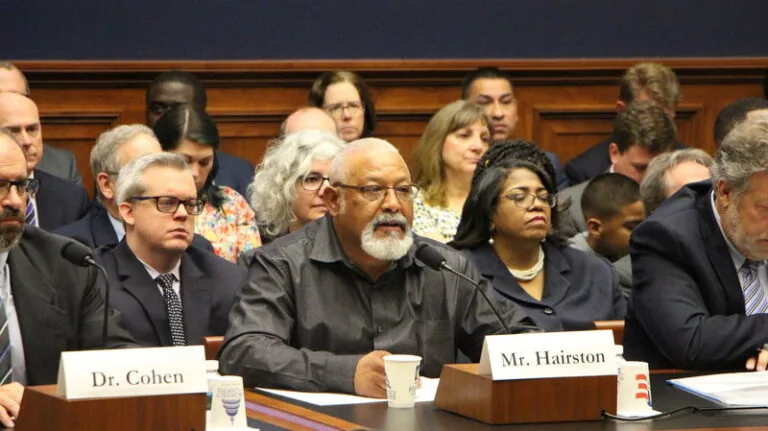
The group then gathered in a Senate hearing room for a forum on black lung.
VONDA ROBINSON, President, Nat. Black Lung Assn.:
And I’m telling you, the epidemic we got now, we’re going to see younger and younger to be dying. They’re going to leave young children behind. Young children they’re not going to be able to see graduate, get married, go to college. And we have got to do something in every coal state in the United States and say, “We got a voice, we’re going to do it and we’re not stopping.”
HOWARD BERKES:
On my most recent reporting trips to central Appalachia, I stopped in to see radiologist Brandon Crum again. He’s continued to test coal miners and collect detailed data.
Wow. What do we have here? What does this tell us?
BRANDON CRUM:
So I think this tells us more about black lung in central Appalachia miners probably than any data collection in the world. I think it’s the most complete data collection on central Appalachia miners that we have currently.
HOWARD BERKES:
It seems that the numbers that you’re showing here, which you’re getting to with your latest data over here. You’re talking—what’s the total number? Over 1,000?
BRANDON CRUM:
It’s going to be about, altogether when we get it, it’s probably going to be about 1,300 guys total. And then out of those 1,300, we’re looking at about 238 cases of complicated.
HOWARD BERKES:
So these are miners who are all sick with this disease. Some of them are already at the advanced stage. Others will likely get to the advanced stage, right?
BRANDON CRUM:
Oh, yeah. Even if they didn’t mine another lump of coal tomorrow, you would be dealing with this problem for decades to come.
HOWARD BERKES:
I also wanted to visit miner Danny Smith, but he was too sick for an interview, he told me. He was too sick to even get through a phone call. The last thing he told me eight years ago was that he wanted to live long enough to see his two daughters graduate from college, and they both have.
Greg Kelly was in much better shape.
Hi!
GREG KELLY:
Hi, how are you?
HOWARD BERKES:
Great to see you.
GREG KELLY:
Good to see you.
HOWARD BERKES:
You look great, man. [Laughs]
GREG KELLY:
I feel great.
HOWARD BERKES:
Man, you look so much better.
I like your shirt. “My lungs are Vander-Bilt. Installed 8/10/2021.”
He had a double lung transplant in 2021, something very few coal miners have had.
GREG KELLY:
The surgeon, when he talked to me, he said, “I had to scrape your lungs out.” He said, “I couldn’t even pick them up.” He said that’s how bad they was. He said, “You coal miners are extremely tough to do lung transplants on.”
HOWARD BERKES:
He had to scrape your lungs out?
GREG KELLY:
He said he couldn’t just pick them up and move them out. They take them out one at a time, but when they did this one, they scraped it up, replaced it, and then had to scrape the other one up because he couldn’t pick it up.
HOWARD BERKES:
So what have you got here?
GREG KELLY:
It’s the medication I have to take every day. It’s like 38 pills a day that I have to take. That’s the morning dose right there. There’s a lot of vitamins, and the rejection medicine. Every morning you’ve got to get up, write down your vitals, your blood pressure, what your sugar level is, because it messes with your sugar, what my spirometer is—I have to blow and see what air I’m putting out with this right here. Put it on and it reads it. And then you have to take your pulse-ox. I’ve been doing that for five years. When I get out of bed, that one of the first things I do.
HOWARD BERKES:
And how is it different now in terms of your ability to breathe and do things?
GREG KELLY:
Oh, it’s entirely—it’s like daylight and dark. Just like it happened to me, then when I got new lungs, I got a new life.
I was able to do the things that I wanted to do. When I said, well, I’m going to be able to retire, then I could go fishing, and I do my gardening, stuff like that. And I get to play with my grandkids. That’s—I got [cries] to see kids that I might not have. Because if I hadn’t got these lungs, I wouldn’t be here.
HOWARD BERKES:
You know what’s amazing to me? It’s you lived to see this. To have another grandson.
GREG KELLY:
You got it. Run. Run around the base. This way.
HOWARD BERKES:
He’s had five more years so far. But he knows the median life expectancy for coal miners with new lungs is just six and a half years.
GREG KELLY:
I mean, I ain’t got a lot of money, but I’m the richest man on this holler, because I got a family that loves me and grandbabies that enjoy me and I enjoy them. And what more could you want?
HOWARD BERKES:
Forgive me for asking this question this way. I’ve talked to dozens of coal miners who have black lung disease. Started out, some of them, with simple, developed into complicated. It got a lot worse, and a lot worse than what you’ve described that you’re thinking about.
JOHNATHAN WRIGHT:
Yeah.
HOWARD BERKES:
And they have a pretty fearful picture of their future because they’ve seen relatives die from black lung, and it can be pretty grim. You know that, right?
JOHNATHAN WRIGHT:
I don’t like to think about it, but I do know. I do know that. Like I said, I don’t want to get to where I’m a burden on everybody else, because I can’t do for myself. It’d be tough to get to that point after you’ve tried to do for yourself your whole life. But I do know what the end cause is going to be.
I know it’s coming. I don’t like to think about it, but I do know that’s the end result. I do know that.