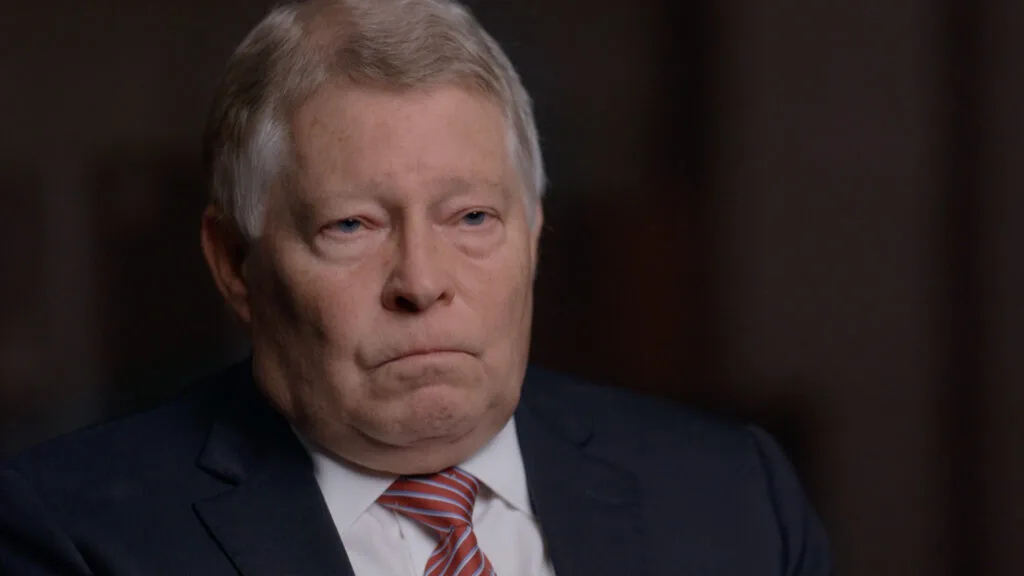
Carrie Johnson is a correspondent for National Public Radio, where she covers the Justice Department.
This is the transcript of a three-part interview with FRONTLINE’s Michael Kirk and Gabrielle Schonder conducted on May 10, July 12 and August 10, 2018. It has been edited for clarity and length. An asterisk indicates the start of a new interview.
TOP
Carrie Johnson
Chapters
Text Interview:
Highlight text to share it
Our film will start with the Jan. 6 meeting where all of the IC [intelligence community] heads roll into Trump Tower to meet with the president-elect, to deliver something to him.What is at stake for the people going into that room?Let’s start there, and then we’ll see what's at stake for him.What is at stake for those four men as they go in there?
The intelligence community has already publicly concluded that Russians interfered with the election with the intention of hurting Hillary Clinton and helping Donald Trump.But Donald Trump is not convinced.This is the first meeting where they're going to share sensitive sources and methods with the president-elect and his entire team of top advisers, trying to give Donald Trump and the new team coming into the White House a sense of why they know that the Russians did this, and to convince them, despite their protestations otherwise, that this actually happened, and it was a real and lasting concern.
When they go in, they’ve seen Trump running for president.They were surprised, as anybody, that he wins.What do they think they're up against?
Well, a president-elect who has no previous government experience at all, and the members of his team have spotty government experience.So they're dealing with people who are not used to governance, and maybe not used to getting high-level intelligence briefings about sources and methods, and people who have been out there, trying to cozy up to Russia, when in the view of the intelligence community, Russia has been an active adversary, waging an information warfare campaign against the United States of America.
One person in particular in the IC who’s coming is [then-FBI Director] James Comey.He’s already something of a celebrity in the world because of the Hillary Clinton events.He’s also carrying something toxic in his briefcase, the dossier.For him, personally, from what you can tell, what’s at stake?
Comey says this is a difficult moment for him.He goes into the meeting feeling a little wary, maybe even sick to his stomach in some respect, because he’s been tasked, among the four IC leaders going into this meeting, with talking to the president privately, with talking to the president-elect privately about this dossier and the allegations in the dossier.Comey says reporters all over town know about this.No one’s published it yet, but it’s only a matter of time.And because he’s serving a 10-year term as FBI director, he’s the guy who’s going to have to talk to Donald Trump about it.But he knows this is going to be difficult.He’s had a conversation with Jeh Johnson, the outgoing DHS secretary about it.Jeh Johnson has warned him, “Oh, be careful, man."So Comey goes in knowing this is going to be a problem.
… And the man on the other side, the newly elected president, what do you think his expectations are for why these men are coming?
I think he expects a meeting with them about the threats facing the country, what's going on with Russia, and, as with many interactions involving Donald Trump, an opportunity for dominance and control.This man is taking the reins of government very soon, going to be inaugurated.He’s the guy in charge, and he wants to convey that message to these people working for him.
Yeah, exactly, the people working for him.That’s what a lot of people tell me his perspective is.These are not equivalent government power; they're underlings.
As we come to find out from the president’s own words and tweets, he believes that the apparatus of power serves him, not the country, not the Constitution.And while the FBI director is supposed to serve a 10-year term to insulate him or her from political whims and interference, Donald Trump has openly talked about being sad and sorry he can't meddle more in the affairs of the Justice Department and the FBI.
So he’s standing there. They're in.What happens?How do they present?And what is his response?
So the first part of the meeting involves the briefing on Russia, the very sensitive briefing on Russian interference.And what Jim Comey says about it is the message was conveyed.The information was conveyed, and immediately, the president-elect’s team talks about how to spin this to their political advantage, not about the ongoing threat from Russia, not about what the country needs to do to protect the election system moving forward, but the political messaging, which to Comey’s view was completely inappropriate and not anything he wanted to be associated with.
So it’s a marketing meeting.
Absolutely.It’s a sales and marketing meeting for a very powerful Trump brand coming into the White House.
He’s been very critical about the Russian investigation as a candidate.Is there a sense from what you can tell that he’s converted to the idea that: “Well, I've been wrong about this.This is heavy-duty stuff.These are heavy-duty guys.This is an American apparatus that gathers and collates and comes to conclusions about things.These guys really believe this, and maybe I've been wrong."
Donald Trump, according to Jim Comey, doesn’t really give much back in that briefing about his concerns, his thoughts, his feelings about Russia.In fact, all the public evidence is that Donald Trump continues to vacillate over how involved Russia was and what should be done.In fact, Comey and others say what they're struck by, not only in January but throughout the year, is how Trump refuses to criticize Vladimir Putin, the Russian leader.He’ll criticize anybody and everybody else, but publicly or even privately, he doesn’t say a bad word about Putin.
Then it’s Comey’s turn.How do they clear the room?How do they decide who stays and listens?Let’s start there.
Comey talks to Trump, says: “Mr. President-elect, I need to brief you on something.Probably best to do one-on-one."There's an exchange about whether Reince Priebus, the incoming chief of staff, should stay in the room.It’s decided Reince will go.And then Comey and Trump talk briefly.Comey says he didn’t get into all the salacious details, salacious and unverified details in the dossier, but he conveyed enough information to the president-elect to know there was something involving prostitutes, allegations at the hotel in Moscow and the like.And Trump denies it immediately, and vociferously; says, “Do I look like the kind of guy who needs to hire prostitutes?,” to which Comey kind of doesn’t respond.
Trump continues to deny, deny, deny anything like this happened.Comey leaves the meeting, somewhat awkwardly, returns to his SUV, his government SUV downstairs, and immediately pulls out an FBI laptop and starts taking notes about this exchange, because it is so bizarre and disturbing to him.
The dossier had had some currency in Washington before this moment.A lot of reporters had it.A lot of it, people were trying to verify it, especially the salacious parts, or maybe primarily the salacious parts for many reporters.What makes Comey decide a, to even talk about the dossier—that must have been a controversial decision; and b, especially to talk about the salacious parts of it?
There's really salacious information in this dossier which may or may not be true, and a lot of people want to talk about that.But from an intelligence community and FBI perspective, the real concern here is the president-elect may be subject to blackmail, because there is this information out there that may or may not be true, but he may feel very sensitive about and not want to get into the public sphere.So the whole point of briefing Trump and his team is, “You could be compromised here, and you need to think about that, and you need to know about it so you can act accordingly."The president-elect, though, denied everything about this, and he, in fact, wanted Comey, throughout the course of 2017, as long as Comey kept his job, to publicly declare Trump innocent.
Trump says: “Tell the public I'm not under investigation and I'm not a target of an investigation.There's nothing to this."And Comey says, “You know, I don’t think you want me to do that."… Comey also says that Melania Trump came up in the conversations, that the president-elect said, “Well, I don’t want my wife believing this is true."And Comey says: “I've been married to my wife for a long time.There's no way in hell she would ever think anything like this about me were true, so what kind of marriage did these two people have?"
When he goes down to the car, what makes him—as far as I can tell, he’s never—I mean, he’s been a prosecutor, and he’s run the FBI; he obviously keeps notes.But what makes him, while it’s still fresh in his mind, do you think, go down and start typing as soon as he leaves the presence of the president-elect?
OK, so this is really sensitive stuff, right, and Comey’s already a little unsure about Donald Trump.He’s already had conversations with the outgoing Homeland Security Secretary Jeh Johnson about the difficulty of this assignment of briefing Trump on the dossier.Comey also says President Obama looked at him, and his eyebrows went all the way up to the top of his head, thinking, hey, man, watch out here.So he knew he was going into a sticky situation.
But it got even stickier in the room.First, Trump and his campaign advisers didn’t ask any questions or maintain any interest at all in the Russian adversary and the threat to the elections.And then Trump vigorously denied the allegations in this dossier and acted kind of strange.Comey says in all his interactions with George W. Bush and Barack Obama, he never once felt the need to take notes, but he did immediately upon that first meeting with Donald Trump.
Yeah, but from what we can tell, what happens inside the Trump bubble is that [then-Chief Strategist Steve] Bannon and others are angry at Trump for having touched the document, for having received the dossier.They say: “Now you own it.Now that you know it, you own it,” and these guys are the enemy; they're not somebody you should trust.They play on that part of Trump.And almost as if it was planned, a few hours later CNN runs a story that says there was a meeting; this thing happened.This dossier rolls out.And then BuzzFeed hits, whatever it is, print, send, whatever you do when you're BuzzFeed.And Trump picks up the phone and calls Comey.
Trump picks up the phone and calls Comey and says: “You’ve got to get out there.You’ve got to deny this.You’ve got to tell people I'm not under investigation.There's nothing to these allegations.Get out there and defend me, man."And Comey says there's a vigorous debate inside the FBI about what to say among Comey’s top advisers.If you argue that the president is not under investigation and that changes, do you have an affirmative obligation to tell the public, “That’s changed”; in other words, confirm the president of the United States or the president-elect is under a federal criminal investigation in some form?
Remember, Comey’s already bruised after talking too much about his investigation involving Hillary Clinton, and he wants to tap the brakes here a little bit with respect to the president-elect and his team.
Yeah.I guess it’s at this moment—you can tell me—that Trump begins to … call what the IC coming in and talking to him was a shakedown, you know, and that what Comey was doing was applying leverage, letting him know, “I've got something on you."
That’s the real concern here, right.Comey’s first interaction with the president-elect is presenting him with information in a private meeting about hookers in a hotel in Moscow?Whoa, not great.Not a great start to this relationship.And Comey worries about that.And the president-elect seems to think that Comey and the FBI are out to get him, in some form, from day one; that Comey is disloyal to Donald Trump and Donald Trump’s goals, and disrespectful of the election results.It sets the entire relationship off on the wrong foot from day one.
So you would say, Carrie, that this is—I mean, it feels like, to me, like a truly significant first interaction, but maybe in some ways representative of the whole story that’s going to happen for a couple years after this.
This private meeting that they had in January, even before the inauguration, colored the entire relationship.And Donald Trump could not get it out of his head that the FBI, in some way, was trying to leverage him or was trying to get him in some fashion, and that James Comey, the FBI director, would not publicly affirm his innocence or exonerate him.In other words, Comey was the enemy.
The next time they see each other, I think, is Jan. 22nd, in the Blue Room.Comey is trying to hide in the drapes, as he says, and he’s beckoned to cross the room in front of lots of other law enforcement people and White House officials.
Yeah.I don’t understand how a guy who’s 6’8” tall thinks he’s going to hide from anybody.Jim Comey kind of stands out in the room.But he tried, with some success, for part of that interaction.Comey says he didn’t even really want to go to the White House, but his staff convinced him that he had to go, as a show of support for law enforcement.It was an event to support law enforcement and law enforcement leaders, so he shows up in the meeting.
The president beckons him from across the room.Comey tries to give the president a stiff arm, because he’s taller than Trump.But Trump pulls him in and whispers something in his ear.But to the camera, it looks as if Trump is giving him a kiss on the cheek.And Comey says: “Pardon me.My wife watched this and thought, ‘Jim is giving me the ‘Oh, s---!’ face, like, ‘Oh, no, something really bad is going to happen here.’” And Jim knows it, and he can't prevent it from happening.And then Donald Trump says, famous last words, “This guy is more famous than me,” which Comey knows, even then, is going to be a problem.
It’s the kiss of death.
Indeed.
Yeah.What do you think Trump is doing?Why did he do that?Why did he pull him across the room like that?
Donald Trump wants everybody to be on the team, and he seems to, early on, not understand the FBI director’s historic independence from the White House, from the president himself, and keeps trying to draw James Comey into his inner circle.Comey describes this as a kind of mobbed-up situation, where the don wants everybody to profess loyalty and be in the tent, and Comey’s always slightly resisting.
… Who is Jim Comey in the eyes of the law enforcement Justice Department community in Washington?
Jim Comey is one of the most highly respected and charismatic law enforcement leaders of his generation.He’s a guy who served as the U.S. attorney in the Southern District of New York, prosecuting all sorts of violent crimes, prosecuting terrorists, prosecuting Martha Stewart, famously and controversially.He also, earlier in his career, was a prosecutor in Virginia, where he cracked down on violent crime and helped improve the streets there.He’s a guy who loves his own rectitude, but he’s also a guy who inspires incredible loyalty among the people who work for him.And he’s a rare figure in law enforcement circles, because he really does inspire leadership and devotion among the men and women who work for him.
Straight shooter, altar boy, Boy Scout: That’s what they all call him.
Yeah. Republicans who don’t like Comey because of his dust ups in the George W. Bush administration tend to call him “St. Jim,” a guy in love with his own rectitude, something that Hillary Clinton admirers came to believe as well.But by and large, people believe Jim Comey may be wrong, but he’s not disloyal, dishonest, and [he is] motivated only by the right things.
And interestingly, other than J. Edgar Hoover, the first real FBI director, maybe other than Hoover, who’s not afraid of a microphone or the spotlight, he’s not Louis Freeh; he’s not Bob Mueller.He’s ready to talk, sometimes when the attorney general should be doing the talking.
There was a lot of that at the end of the Obama administration.Comey says he had a pretty good relationship with Eric Holder, who was President Obama’s attorney general for about six years.But when Loretta Lynch, a former U.S. attorney in Brooklyn, ascended to become the attorney general, Comey often took the mic from Lynch, and it was a very awkward interaction.Comey says, in his book, that he didn’t have a lot of confidence in Loretta Lynch, and he, for a lot of reasons, wanted to speak for the Justice Department instead of the attorney general, which is generally not the role of the FBI director.But Jim Comey went ahead and did it anyway, and Loretta Lynch didn’t do much to stop him.
Fair to say he’s loved, admired and whatever by the rank and file of the FBI.
Very much so. His departure was a great shock to the people in the bureau.After many, many years of serving under Bob Mueller, a brilliant guy, a tough guy, a drill sergeant-type guy, they were very happy to be serving under Jim Comey, who was in some ways everybody’s pal, waiting in the lunch line along with the rank and file.And it was a great shock, great shock when he was fired by President Trump.In fact, there was a bit of a bootleg operation inside the bureau, where people made and wore T-shirts like, “Comey’s Homies."I got a coffee mug from somebody inside the FBI that said, “Comey’s Homies."People were passing around artifacts of his tenure there and showing their support in very quiet ways.
When he leaves the Blue Room and goes back to his office at the headquarters, what’s open on his desk when it comes to this investigation?What does he have as he begins to go down the road to find out, to make the case?
The FBI and the Justice Department have not yet publicly confirmed that they are investigating Russian interference in the election and whether any Americans were involved.That has not yet happened.That’s some weeks away.But what the FBI director knows is that there's a team looking into these matters; they're working very quietly, it’s very close hold, and that they’ve reached out to people who had contacts with Russians during the campaign.It’s going to be many, many months before the American people or people in the White House understand exactly how far along that investigation is.
One of the names that emerges is Gen. Michael Flynn.It’s right there waiting for him.…On the 22nd or 23rd of January, what does he know about Mike Flynn?
Mike Flynn is about to be interviewed by FBI agents, who call him up at the White House as the incoming national security adviser and say, “Hey, Gen. Flynn, you got a few minutes?"And Flynn says, “Come on over."So Mike Flynn is interviewed by FBI agents who later conclude that Flynn is lying to them.Flynn has lied to FBI agents.Whether under oath or not, lying to the FBI is a federal felony crime.
And before they go, they have something he doesn’t know they have.I'm not sure why he doesn’t know it, but they have an intercept, right?They know what he said.
That’s the tricky thing about Mike Flynn.He has his critics, but he was a very good intelligence officer.He headed the Defense Intelligence Agency under President Obama.So no one can understand why, on vacation in the Dominican Republic, during the transition and otherwise, he seemed to not be aware that his conversations with the Russian ambassador were being intercepted in some fashion, and maybe other conversations, too.His tradecraft for a career intelligence officer was awfully shoddy.
So Flynn is talking.Flynn lies.Comey knows it.He has a meeting with Acting Attorney General Sally Yates.Who is Sally Yates?
Sally Yates is a career Justice Department prosecutor, 27 years in the department, the first woman U.S. attorney in Atlanta ever, the woman who prosecuted the corrupt mayor of Atlanta, [Bill Campbell].She prosecuted the Olympic bomber Eric Rudolph.A tough cookie, but a genteel Southern woman; a woman who comes from a family of lawyers.Her father, her uncle, her grandfather and her grandmother were all attorneys.And she told me she resisted the idea, but when she went to law school; she fell in love with it.
Sally Yates ascends to the number two position in the Justice Department.And after the election, the attorney general, Loretta Lynch, leaves, and Sally Yates thinks, hey, I’ll stick around in the department, be the acting attorney general, as is the normal course of business for four to six weeks, until the new team is confirmed.And we’ll ride on out this term."It didn’t work out that way at all.Sally Yates is in charge, and she realizes that there's a problem with Mike Flynn, and she grows very, very concerned about it.
Why?
Because he’s the national security adviser.He’s the keeper of the secrets of the entire administration, and he’s getting briefings all over the place from the intelligence community, including about Russia, and the thing he lied about involved Russia.So Sally Yates does what she thinks the right thing to do is.She calls up the White House counsel.That’s the point of contact between the Justice Department and the president, the White House counsel, Don McGahn.Says, “Don, we need to meet."McGahn calls her over to the White House.They have a meeting.
Hang on.Who’s Don McGahn?
Don McGahn is an interesting guy.He’s a kind of a shaggy-haired guitar player who went on to become a top election lawyer, led the Federal Election Commission here in Washington, D.C., and, according to Democrats, paralyzed that commission politically, to the point where it couldn’t get very much done at all.Don McGahn also served as the top lawyer in the Trump campaign, in part because his uncle, an old lawyer in New Jersey, had a long relationship with the Trump family.
McGahn comes in as the top lawyer in the White House.This is an enormously important job, huge responsibilities on national security, judge picking, advising the president on all matters, domestic, legal and national security.
So Ms.Yates goes up, goes right to McGahn’s office.Went in and got a pass.Lets her in, goes in, sits with McGahn.And what does she say?
She says that there's a problem with respect to National Security Adviser Michael Flynn.And she says McGahn asked, “Well, did he lie?"And Yates will not talk about the specific details of the investigation, but she says she conveyed to him there was a big problem, which most lawyers would take to mean: “The guy lied.The guy lied to the FBI, and now he’s really jammed up.Do you really want this guy in this sensitive job in the White House?"
She says McGahn asked, “Well, can I see some of the materials in the underlying investigation?"She thinks about it.She goes back to the Justice Department and talks with her advisers about that and decides” “Yeah, yeah, yeah, yeah. You could come by and see them, or we’ll bring them by, or we’ll make it work."And that never happened.…
… I think the 27th—this is Friday—is one of the most momentous early days, because, as she’s riding back to the office to pick up the stuff and go to Atlanta, she gets a call that’s about the travel ban breaking all over the country.
I had been hearing from inside the Justice Department that there was a concern that documents the new administration was preparing were not being fully vetted inside the Justice Department.This matters, because you’ve got to have some legal review before you put out an executive order or make a plan.Typically, there is an office inside the Justice Department that does that, but I've been hearing that week, bubbling up from inside the DOJ, that there was a concern that maybe Sally Yates and the holdovers were being kept out of the loop in some fashion.And everything broke out into full force that Friday afternoon.
Yates is getting ready to fly back home to Atlanta for the weekend, and she gets a call from her top deputy, who says, “I'm reading The New York Times, and it says Trump has just issued a travel ban."And she says: “Say what?Send me the stuff right away."And it breaks into focus that she’s been totally kept out of the loop about this executive order that would ban even Green Card holders from coming into the country while people were in flight, in transit to the United States, which touched off an enormous series of protests at airports around the country, unbelievable chaos, legal challenges all weekend long.
And Sally Yates thinks, boy, we’ve got a mess on our hands.We’ve got to think about what to do about this and whether we can defend this travel ban in court, because of course the Justice Department is supposed to defend the administration’s prerogatives, and she’s not clear it can do that.
As it happens, as Ms. Yates is flying to Atlanta, there's dinner for two at the White House.President Trump has invited a special guest to come over and have a romantic evening.
Was it the same day?
Yes.
Are you sure? OK.
It's the same day.
Jim Comey is sitting at his desk at lunchtime, and he gets a surprise call, surprise call from the president.“Want to come over for dinner, Jim?"And Comey says, “Yeah, sure, Mr. President."Comey thinks to himself, you know, I was supposed to go out with my wife, Patrice, for Thai food tonight; I'm going to have to cancel the date with her.But we'll do it.And anyway, it will be fine, because there's probably going to be some other people there, and I'll just try to blend into the woodwork like I tried to do last time.
Comey arrives at the White House.He's taken up into the Green Room, and Comey sees a table set for two—two.Nobody else is going to be there.He and the president, the bromance, attempted bromance continues.And they sit down.The president starts talking about what they're going to eat and asks Comey, in a roundabout way: “You going to be loyal to me?Are you on my team?"
Comey gets very uncomfortable with this and thinks, don't move.Don't say a word.Do not respond to this entreaty.He can't get away with that for long.Trump keeps hounding him, in Comey’s recounting of this: “Are you going to be loyal?Can you give me some loyalty?"And Comey says: “I can give you honesty, Mr. President.I can give you honesty."They go back and forth and back and forth.And finally they agree that Comey will demonstrate honest loyalty to President Trump, whatever that means.Very, very strange interaction.
… Flynn gets fired eventually.
It took 18 days, I think, for Mike Flynn to leave the White House.First, the White House line was that Flynn had resigned under pressure, and eventually the White House began to say that Flynn was fired.But the reason that he left the White House has vacillated over time and vacillates to this day.The president says Flynn was let go because he lied to the vice president, Mike Pence, about his conversations with Sergey Kislyak, the Russian ambassador, during the transition.But it's not at all clear who in the White House knew that Flynn was having these conversations with Kislyak, or whether that was the real reason he was let go.And if it was a real reason, it was like, oh, why did it take 18 days to fire the guy who's in charge of briefings from the intelligence community and the nation’s secrets?
There's a moment in the Oval Office—maybe this was the grandfather clock moment—where Trump excuses the people sitting around the desk, including shooing out the attorney general, and asked Comey to come.“Let’s just you and I talk again."So here we are in another, “Let's have a private conversation."Tell me about it.
A number of advisers are sitting around with the president in the White House delivering a counterterrorism briefing.Pretty typical.The attorney general, Jeff Sessions, is there; presidential adviser and son-in-law Jared Kushner is there; Chief of Staff Reince Priebus is there; and President Trump is there, and so, of course, is the FBI director, Jim Comey.After this meeting wraps up, the president signals to Comey that he wants to meet with him alone, and Comey says this is bizarre; this should not be happening.Yet once again, he's in this situation of being leaned on by the president.
What's weird about it, especially weird about it according to Comey, is that two people linger in the room.Jared Kushner kind of lingers near Comey’s chair, and he's dismissed by the president.And Attorney General Jeff Sessions kind of lingers near Comey’s chair, and Comey thinks that's because Sessions knows the president should not be meeting alone with the FBI director.And yet both those guys are ushered out of the room through the door.The door closes, and the president launches in with a series of questions about Mike Flynn and Comey’s loyalty.And the president, according to Comey, says: “Mike Flynn's a great guy, a good guy.I hope you can let this go.I hope you can let this thing go."
Comey thinks to himself, is he asking me to dismiss this ongoing investigation of Mike Flynn, who's already lied to the FBI investigators in the White House?Comey doesn't know what to say to that.He doesn't want to get into the ins and outs of the investigation with the president.What he does say is: “Yeah, Flynn's a good guy.I agree Flynn's a good guy."But he makes no promises about that investigation.And he leaves the White House extremely rattled, because he thinks the president may now be involved in a campaign to obstruct justice and jam up the FBI for investigating Mike Flynn.
Let's talk about who Jeff Sessions is and how he finds himself as the attorney general.
This is an extraordinary story.Jeff Sessions is a United States senator for 20 years from Alabama, who was not in the mainstream of thinking inside the U.S. Senate.He was one of the most vigorous opponents of immigration measures in the Senate, almost single-handedly stopped one or two bipartisan immigration proposals from becoming law, and a guy who has a 1980s era view of crime and punishment.
Jeff Sessions is a former U.S. attorney in Alabama in the early ’80s, during the Reagan administration.He reveres Ed Meese, the attorney general in the Reagan years, who was very close to the president.And he has adopted a series of ideas about immigration, about criminal justice, about drug sentencing, and other policies that were much reversed by the Obama administration.Jeff Sessions becomes the first and most vocal supporter in the U.S. Senate for Donald Trump, appears on the campaign trail with Trump, even wears a red “Make America Great Again” cap next to Donald Trump.
And when Donald Trump gets elected, beyond all odds, Jeff Sessions is the first in line to become the U.S. attorney general.Jeff Sessions, whose ideas of crime and punishment were rooted in the drug wars, in the crack cocaine epidemic of the 1980s, is now in charge of almost the entire immigration and criminal justice apparatus in the government.
Let's talk about McGahn and Sessions and the lawyers right around him.
All of them serve the president.Don McGahn has had kind of a complicated relationship with the president over time.He’s tried to tell the president no.He issued a memo early on in the White House days trying to limit contacts between the White House and the Justice Department as previous administrations had done, to prevent political interference in law enforcement operations.That memo has been widely disregarded, not just by President Trump, but also by the former Chief of Staff Reince Priebus and a whole bunch of other people.Don McGahn has tried to be a break on the president's worst instincts.In many respects, the president is not listening.
Let's talk a little just for a moment, before we move on through the narrative, about the idea, because it's far enough into the Trump story, vis-à-vis the Justice Department, to begin, especially with Sessions there, to begin to ponder the question of Trump's law versus rule of law.
Trump's law is loyalty to him and what he wants to do.As he famously said, “Where is my Roy Cohn?"Donald Trump has berated in public and in private his attorney general, his closest ally from the campaign, Jeff Sessions.Donald Trump wants somebody to protect him.He thinks that Eric Holder, President Obama's first and longest serving attorney general, was President Obama's wingman and insulated him from any number of political and other controversies.
Donald Trump wanted a Bobby Kennedy, a brother like to his lawyer and President Jack Kennedy.And Donald Trump got Jeff Sessions, who, for all his flaws, came up in the Justice Department as a U.S. attorney, and there are things that Jeff Sessions apparently won't do for Donald Trump, and Donald Trump won't forgive him for that.
Why did it take 18 days [to fire Mike Flynn]?What do you know?What did you hear?
… The president appears to not want to dismiss Mike Flynn.He wants to keep him onboard.Flynn stays onboard 18 days after these problems emerge.The Justice Department is flashing red on Mike Flynn.He's already lied to the FBI investigating Russian interference in the election.And when push comes to shove, President Trump says the reason he let go of Mike Flynn was not because of anything Mike Flynn did, but because of reporters and the relentless onslaught of questions and what he perceives as “fake news” being propagated about his national security adviser and friend, and loyal friend, Mike Flynn, a guy he’s had to cut loose despite all his best instincts….
When you look at what's happening through March and April, one of the things that is happening is the noose is getting a little tighter publicly.CNN runs a report about [Trump’s son-in-law and adviser Jared] Kushner.It’s about Kushner.Suddenly “Javanka” is in the news, and it feels like, if they're covering it and Trump is getting a lot of his information from cable television, [that] this sense that they're moving in the direction of the family has an effect.
Donald Trump is a control freak.He likes to control everything, and the notion that there's this investigation, this somewhat independent investigation at the Justice Department and the FBI that could encompass his children, his son-in-law and possibly his business interests, is getting him very, very nervous.
… You know enough about the way the FBI works to know that, during this time period [spring of 2017], what are they doing to build a case?They're calling people who know people.They're tracking every phone call.It's not really possible to be at the center of all that and not kind of feel the footsteps of the FBI out there somewhere.
Well, one of the things the FBI does first is work through the Justice Department to get subpoenas for information, either to ask in a nice way for all sorts of financial records, phone records, and documents, and if you don't get them in a nice way, to issue a grand jury subpoena for them.Often those documents form the basis of investigatory leads and trails down which the FBI won't go.And often, by the time they knock on somebody's door, they already know an awful lot about their business, their operations, who they've been talking to and possibly why.
So this is one of the reasons Trump, and I assume Kushner and everybody else who might be targets, are anxious.They feel the icy breath of the Justice Department and the FBI coming in their direction.
This family has had an interesting history with law enforcement.Remember Jared Kushner's father actually went to prison, and Jared famously visited him there often on the weekends, and remains very loyal to his father, an experience he, under no circumstances, wants to undergo himself.Of course, Jared Kushner denies wrongdoing.And Donald Trump has been investigated a time or two himself, dating back to his real estate dealings with his father, many, many years ago, civil rights investigations into the company and how they were conducting rental agreements with customers, numerous regulatory interactions regarding Trump casinos and business interests in Atlantic City and elsewhere.Donald Trump has been in the courthouse a time or to.He's testified a time or two in depositions.He knows what this means, and he's very concerned about it.
I feel like this is probably different and even more awesomely scary to him, because it seems like in New York, you could buy somebody off.You could do a favor; you could trade through things.These people, if Comey is the personification of the attack, are not fooling around.This is not something, even as president of the United States, that you can ward off with a Michael Cohen or a somebody, having a meeting with somebody and something getting fixed.
Jim Comey is a guy who does what he thinks is the right thing to do, and he's not going to be moved by campaigns and bromancing from the president of the United States or anybody in the administration.He's not going to give you the loyalty oath you're demanding, under no circumstances, and that's why the president grows increasingly uneasy with him over time.
… Comey testifies [before Congress], does the Clinton stuff.Trump has a Tivo, and he goes back and forth rewinding it, looking at it.This is right before he goes to Bedminster, [N.J., to his Trump National Golf Club], and writes up a firing document or whatever it is.That testimony from Comey, why does it light him up so much?Do you know?Why does it light Trump up so much?
He's offended by Comey talking about the fact that Comey was allegedly sick to his stomach over what happened with Hillary Clinton and the campaign, and Comey’s alleged holier-than-thou attitude about the whole thing.And he's really upset about the confirmation on the record, on camera for the first time, that the FBI and the DOJ are investigating Russian election interference.This is a threat to the legitimacy of the Trump election.This is a threat that the President perceives has been coming at him for a long time, that he wasn't elected by the will of the voters.
Remember, he's out there talking again and again on Twitter and elsewhere about the popular vote, misstating on Twitter whether or not he won the popular vote, misstating the vote totals.Donald Trump deeply believes that Hillary Clinton was a flawed candidate, and he won this election fair and square, and any challenge to that, any sense that the Russians were meddling, or people in his campaign were involved in conspiring with the Russians to meddle, offends him to his core, and offends this historic result, the biggest upset in modern political history, Donald Trump, a guy with no political experience anywhere, winning the White House.
He goes to Bedminster, and he doesn't have the usual lawyers around.McGahn isn't there. Jared is there, and [senior policy adviser] Steve Miller is there.And they write what is … writing down their grievances about what Comey is doing and why Comey should no longer be the director of the FBI.
One of the things that Jeff Sessions brought the Trump campaign was an aide named Stephen Miller, who was a close aide of Jeff Sessions during his Senate days, and a very, very, abrasive guy, and a guy who does not like the idea of immigration.Stephen Miller has joined, if not the inner circle of the president, at least the outer circle.Stephen Miller is in the room at Bedminster, and Jared Kushner is in the room at Bedminster, and Kushner advocates that maybe James Comey, the FBI director, should be let go.
And Donald Trump starts dictating a screed, indicating the reasons for Comey’s dismissal, and Stephen Miller dutifully writes this all down.Word gets back to the White House counsel Don McGahn that this document has been prepared, and he freaks out.There's no way, he says, that this document can be used as the basis for firing Jim Comey, no way, no how; give me the document.And McGahn starts work on a way to sanitize this document, or rewrite it in a way that would make it more lawyerly and less problematic, from his point of view.
The President and family return to Washington, and return to the White House.Somehow Rod Rosenstein writes a memo.What's up?
The president calls the DOJ leaders to the White House to discuss this idea of firing Jim Comey.Jeff Sessions, the attorney general, and Rod Rosenstein, the deputy attorney general, march over to the White House, and they talk about their list of grievances involving Jim Comey.The list of grievances is pretty long for all three of the men, and it's agreed that Sessions and Rosenstein are going to have write a document or a memo indicating some reasons to fire Comey, or reasons about their displeasure with Comey.
Rosenstein prepares a memo.It cites criticism from former Justice Department officials, bipartisan former Justice Department officials about Comey’s interactions with Hillary Clinton during the 2016 campaign, how he allegedly took responsibility from the attorney general, Loretta Lynch, and subsumed it into his own.Then he talked twice in October, days before the election, about the Clinton email investigation.Rosenstein says he was particularly offended by Comey’s testimony recently, by Comey’s testimony in March, that he thinks he would do the same thing again.Rosenstein is infuriated.
Rod Rosenstein, this guy who served 27 years in the Justice Department, a Boy Scout, he looks like a Boy Scout,… and he thinks that Comey has violated the Justice Department norms by talking too much about Hillary Clinton during the election, and Comey’s testimony in March 2017 saying he'd probably do it all again, means to Rod Rosenstein that Comey learned no lessons.He's unrepentant, and it's a big, big problem.
Is anybody in the room that you know of, or that we've heard of, saying: “Wait a minute.It makes no sense to fire the director of the FBI, especially at a moment like this.[It is] going to look like obstruction of justice for sure”?… Who is making that argument at that moment?
Of all people, [Chief Strategist] Steve Bannon is the one in their room, or in the room next, who’s saying: “You can't get rid of this guy, Jim Comey.This would be a terrible, terrible mistake.It's going to cause a firestorm."Reince Priebus, then the chief of staff, who does not really have the respect of President Trump, is also saying, “Eh, maybe not the best idea right now."But President Trump is dug in.He is siding with Jared Kushner, his son-in-law, and other people.He really, really wants Comey gone.
So Jim Comey goes to Los Angeles, and [Trump’s bodyguard] Keith Schiller goes somewhere else.Take me through the events of that particular day.
Comey goes about his business.He's trying to, among other things in his 10-year tenure at the FBI, make it a less white-guy kind of environment.He's on this big push to diversify the ranks of the FBI, which is not very diverse.He goes to L.A. to talk to a group of agents and other people, kind of a job fair, a hiring diversity event.He's in the room, making some remarks as he does, off the cuff.Jim Comey almost never scripts out what he's going to say in advance, and he gets interrupted.There's a TV in the room, and CNN is reporting that Comey has resigned, and he said: “Oh, I don't know anything about this.Let me go in the other room and make a call."
So Comey calls his secretary, his assistant, and says: “Do you know anything about this?What's going on?"And soon the story changes from “Comey resigned” to “Comey is fired."And his secretary gets this letter which has been hand-delivered by Trump's body man, chief security guy, dating back more than a decade, Keith Schiller.And the secretary scans the letter and sends it to Comey, who's in the other room in L.A., totally unprepared for any of this.So the question becomes—Comey starts getting calls from his friends.He gets a call from his friend, Pat Fitzgerald, former U.S. attorney, former prosecutor with Comey, prosecuted major terrorism cases together.He gets a call from his wife: “What's going on, Jim?What's going on?"“I don't know what's going on."
So Comey learns he's been fired from the television, and he's in LA. How is he going to get back home?There is a big question about whether the fired FBI director can use the FBI plane to get back home, and it's decided that of course he can use the FBI plane to get back home.There are still security considerations here.
So Comey goes to the airport.One of his top aides reminds him, “Jim, you know, in situations like this, on normal days, you normally take a picture with some of the guys who have helped protect you all day, and some of the guys on the airfield."So Comey said, “Oh, yeah, yeah,” and he decides to take this picture with these guys.He gets on the plane, and he opens a bottle of red wine he's bought in California to take home.He drinks a glass of red wine from a paper cup and thinks about the end of his brilliant career over in one moment.
What's the justification from the White House?What did they say it’s about?
Rod Rosenstein’s memo from the Justice Department said that James Comey committed a multitude of sins regarding the Hillary Clinton investigation in 2016.Jeff Sessions says he believes that Comey has lost the trust of people in the FBI and the Justice Department, and he needs to go.It's time for a change.And the message from the White House is, “We fired Comey because he botched the Hillary Clinton investigation, period."
But there's a big problem with that, and the problem with that is, in the course of the campaign and elsewhere in public, in a number of press conferences, public speaking engagements and tweets, Donald Trump has praised, praised James Comey for his handling of the Hillary Clinton investigation.He said that Hillary Clinton deserved all the treatment she got from the FBI and more.And it turns out that Rod Rosenstein, the deputy attorney general, becomes very concerned about this messaging from the White House, and that Rod Rosenstein says: “It cannot stand that you are using my memo about the Hillary Clinton investigation as the basis for dismissing James Comey.Don't do that anymore."
Rosenstein goes on to say: “I wrote this memo because I believe it.I stand by it.But it wasn't a personnel document.It wasn't the basis for firing the FBI director, and don't say that it was."The White House seems to get the message from the Justice Department, because the next thing we know, President Trump sits down with Lester Holt, the NBC News anchor, and tells Lester Holt he fired Comey because of “the Russia thing."Hillary Clinton didn't come up at all.Now the president is on the record with multiple motives for firing the FBI director, who's leading an investigation of Russian election interference in the middle of the investigation.Obstruction of justice or not?
The very next day, … who appears in the Oval Office?
The White House had a previously scheduled meeting with Russian officials, including the ambassador, Sergey Kislyak.So the president is in the Oval Office with these Russian officials.No U.S.-based reporters, no American White House reporters are in the room.But the White House, for some reason, has invited reporters from a Russian outlet who are there taking photographs.And the president tells these Russian leaders that his fired FBI director, James Comey, the guy he got rid of one day before, is a “nut job,” and he's really happy that he's gone, because it's going to lift the cloud of the Russia investigation.
Within hours, this Russian camera crew has disseminated photos of this meeting in which the Russian officials are laughing, laughing in these pictures with glee, pictured next to Donald Trump.
There is a statement—I don't know how…; is it a tweet?—where Trump says something about audiotapes.“Comey better hope there's no audiotapes,” or something.What happened there?
So Comey, who's not known for staying silent in the face of controversy and unrest, begins to defend himself.His friends are out there defending him, saying there was no reason for firing the guy.The White House is saying Comey was unpopular and that the press secretary, Sarah Sanders, is saying FBI agents are calling her up and saying, “Gee, we're glad to have this guy go."
… But things change when the president comes down and tweets that there may be tapes of his meetings with Comey, which in Trump's view would support Trump's version of events and not Jim Comey’s.Comey says he's thinking about this.He’s stewing about it.He's obviously got a lot of time on his hands, given he doesn't have to go to work to his 18–hour-a-day job anymore.
He wakes up in the middle of the night and thinks, “Well, what if there are tapes?What if there are audiotapes of these meetings?If there are tapes, it would support the notes I took.After all my meetings with President Trump, those tapes would confirm my account of the situation, not the president’s, and they could change this whole dynamic”
“Lordy, I hope there are tapes,” or whatever he says, right?And Comey says in his colloquial “Lordy, I hope there are tapes."The White House goes on to say, “No, there are no tapes."But it's too late, because Comey has decided that if there are tapes, he needs to get them out in the public, or at least in the hands of investigators, and Comey says, given the way Jeff Sessions and Rod Rosenstein have treated him and contributed to his firing, Comey has no faith anymore in the senior Justice Department leadership to do an independent investigation of these matters.
Comey thinks that if he's able to get some of his notes or some of his account into the public, it will trigger the Justice Department to appoint a special counsel.So he authorizes his old friend, Dan Richman, a professor at Columbia, to share with a reporter parts of his notes of his conversations with President Trump.And lo and behold, Jim Comey, who says that he's above politics, actually knows way more about political dynamics and the way Washington works than most people in this story. …
In so many ways, [the appointment of Special Counsel Robert Mueller] feels like a revenge moment for Rosenstein.
Rod Rosenstein is under enormous personal and political pressure during this period.He's written a memo that's being used publicly by the president to justify the firing of the FBI director in the middle of this Russia investigation.People inside and outside the Justice Department are saying the firing of Comey was deeply botched and really a bad way to treat a guy who'd spent most of his life in public service.And moreover, what is going to happen with this investigation of Russian interference in the election?
Rod Rosenstein is getting it from left and right, including from people he really reveres, in and outside the Justice Department.He's under tremendous personal pressure, and he feels, perhaps I've been rooked by the White House here; perhaps they're trying to pin this on me.And his response is that there needs to be more public confidence in this investigation; there may be more going on here than I knew about, and that he needs to appoint somebody to investigate and get to the bottom of these matters, somebody who has a demonstrated history of personal integrity, and somebody who can get this job done.
Somebody told us he used the word, when he picked Bob Mueller, that the word around the FBI and the Justice Department was, “Be afraid.Be very afraid."
Here's the thing about Bob Mueller.Bob Mueller was the FBI director for 12 years, two more than he was supposed to be, because Obama had some complications and decided to keep him around.Congress actually passed legislation to keep the guy on the job for two more years.Bob Mueller is the indispensable man.He's the man of his generation that you turn to when you have a really bad problem and you want somebody to get to the bottom of it.
Bob Mueller was so indispensable that a few days before Rod Rosenstein named him special counsel, I report he was in the White House, meeting with the president and other people, as a possibility to return to become the FBI director.There was a problem with that, which is that Mueller had already served 12 years.Those extra two years required special legislation.And Mueller told folks in the White House, “I don't think I can do this job again as FBI director, because the Senate made an exception last time around, and I don't know that they want to make this exception."
But within a period of hours after that interview inside the White House to become the FBI director again, Rod Rosenstein, in desperation, turns to Bob Mueller to become the special counsel investigating Russia, which completely hoodwinks the White House counsel Don McGahn.The attorney general, Jeff Sessions, doesn't know about it, and President Trump didn't know, and he went nuts.
Because?
Because he knew Bob Mueller was not going to give him any loyalty oath, and that Bob Mueller was not a guy who was going to be disturbed by Twitter campaigns, public attacks or any other thing the White House might throw at him.
As a prosecutor, he sounds like everything that is Donald Trump's worst nightmare.
You know, these guys are actually not that far apart in age.They're both in their early 70s, and they both went to prep schools or military schools.But they could not be more divergent.Bob Mueller is a guy who could have been a drill sergeant at Parris Island had his career turned a different way.He volunteered to serve in Vietnam as a United States Marine, highly decorated, wounded in action—a guy who doesn't talk about his service that much; he just does it—whereas Donald Trump, of course, got some deferments from Vietnam, talks a lot about and likes to be photographed with military officials, but did not actually serve himself.And President Trump is his own best PR man.Bob Mueller doesn't like PR. He shies away from reporters.It was hard to get him to do exit interviews when he left the FBI after 12 years.His staff had to force him into doing exit interviews after his government service ended.
Trump takes it out not on Rosenstein, and certainly doesn't attack Mueller right away, but he does attack Jeff Sessions almost immediately.He begins to say, “I got you there to protect me."
The president doesn't understand why Jeff Sessions, who was one of his top allies in the campaign, has recused himself from the Russia probe.Jeff Sessions, as part of his confirmation hearing to become the attorney general, took himself out of any investigations of Hillary Clinton or the Clinton Foundation or anything else, because he had been such a close ally of Trump during the campaign.But it took Sessions a bit longer, some weeks later, to announce he would recuse himself from the investigation of Russian election interference.
Inside the Justice Department, to lawyers who follow policy, this was a no-brainer.Of course the attorney general's going to have to take himself out of the running of the Russian investigation, because the campaign and aides in the campaign are under investigation themselves.People went on to plead guilty.Jeff Sessions can't credibly supervise that investigation.But Donald Trump says: “If I had known that Jeff Sessions was going to recuse himself, I never would have made him attorney general in the first place.It's a terrible mistake.Sessions should have told me this from the get-go.He's not doing his job.He's not protecting me.He's not acting like Eric Holder,” who in Trump's view protected President Obama.“He's not acting like Bobby Kennedy,” who in Trump's view protected his brother Jack Kennedy.“Jeff Sessions has taken himself out of the game, and now Rod Rosenstein is in charge, and Bob Mueller is on my trail."
Sessions, in the midst of a berating over there at the White House, says, “I'm out of here,” and he basically heads out for his car to go away.Priebus chases him down.You remember this story, and [he] sort of tries to—well, just tell me the story.
The president is infuriated at Jeff Sessions.There's profanity, and there's yelling and screaming inside the White House.There are all sorts of statements to reporters.There are tweets.Jeff Sessions, who's kind of a nice guy, can't take this treatment.He thinks to himself, if we're so south on this, maybe I should leave.So he offers to resign, and he writes a resignation letter to the president.
Reince Priebus, the chief of staff, gets wind of this and realizes this cannot happen.If Jeff Sessions leaves the Justice Department, we're in really big trouble.We've already fired the FBI director, and it got us a special prosecutor.What will Jeff Sessions ouster get us?So Reince Priebus finds out about this and tries to intercept Jeff Sessions before he can leave the White House.Reince Priebus runs down the stairs, races to the car.The attorney general, of course, has FBI agents who drive him around, a special security detail.He bursts into the car, Reince Priebus, and says: “Jeff, Jeff, you can't.You can't resign.Please don't do this.Please don't do this."
And Reince Priebus isn't the only one.Steve Bannon, a presidential counselor, calls Jeff Sessions into his office in a different time, and Bannon says: “Jeff, do you believe you were put here for a reason?Have you always wanted to be the attorney general?"And Sessions says, “Yes, yes."And Bannon says, “Do you believe God put you, the good Lord put you here for a reason?"And Sessions says, “Yes, yes."And Bannon says, “Then you know what you need to do, and what you need to do is not resign."
So Sessions continues to be mistreated by the president.Every time they're in a room together, there's an awkward—a more than awkward moment.And yet Sessions has remained on the job.I asked Sessions about this, what it felt like to be in the middle of this barrage of angry eruptions from the president.All he'll say is, “It hurts my feelings,” and then he moves on. …
Up Pennsylvania Avenue, … Bob Mueller sitting at the desk, reading everything, getting ready.This is a prosecutor who knows how to do this.Take me there.What's he doing?What are the building blocks?What's laying on his desk at this moment?
Bob Mueller has made one statement about this investigation.The statement came in writing the day he was appointed to serve as special prosecutor.He said he would carry out this responsibility to the best of his abilities, and that's all he said about it.And Bob Mueller got to work really fast.What he got to work doing was resigning from his law firm, where he'd been investigating businesses and serving his own independent monitor for judges, and assembling a team.And the team he has assembled may be the A-team of prosecutors for an entire generation.
This guy has chosen, Bob Mueller, some of the best prosecutors in public corruption, terrorism, counterintelligence all the world over, and he's assembled as well a crack team of special lawyers who helped protect criminal convictions on appeals.But they're in the room at the start of the case as the investigation is building to try to prevent any mistakes that could unravel the cases as they move through the courts.These folks have been acting very quietly and very determinedly, for almost a year now.
* * *
Shortly after this, some of Jeff Sessions’ good friends from the Senate rush to his defense in many ways.Sen. [Chuck] Grassley (R-Iowa), Sen. [Lindsey] Graham (R-S.C.), make it very clear that the president’s aggression, opposition toward the attorney general is really—it’s gone too far.Grassley announces that, in fact, he won't call—
No more hearings.
No more hearings.Can you tell me a little bit about this time?
Jeff Sessions may not have been the most effective United States senator, but he was a member of the club for 20 years, and he’s a pretty genial guy.He’s pretty well-liked on the Hill, so when Donald Trump signaled that he wanted to get rid of Jeff Sessions, his allies, Jeff Sessions’ allies in the Senate stood up for him, actually very strongly, in a way that they had not stood up to the president on other issues.
* * *
Why are the Republicans after [FBI agent] Peter Strzok?What's the big idea here?
Pete Strzok is the embodiment of the president’s defenders’ case, that the FBI and the Justice Department are biased against Donald Trump, and the people surrounding him, and this whole investigation is tainted because of these text messages by Pete Strzok.Witnesses have a couple of different paths when they go in to testify to Congress.They can sit on the ground and let lawmakers roll over them, or they can fight back.And Pete Strzok fought back, and fought back hard, for 10 hours or so.He gave very little ground to a lot of the Republicans.But they were able to use him, sitting in the chair, as a whipping boy.
I thought the Republicans were the law-and-order party.
This is the confounding thing.The Republican Party, which had made its name for the last 30 or 40 years as the law-and-order party, is now the Donald Trump law party, and that includes a whole category of behavior like criticizing the FBI and criticizing the Justice Department. …
Take yourself to this split-screen moment in politics.Trump is walking around with the queen [of England], and Rod Rosenstein is delivering indictments [of] about 12 Russians.Tell me the story.What was Rosenstein doing?What were the indictments about?
We were sitting in the seventh floor of the Justice Department waiting for this news conference to begin, because we had gotten a one-line email announcing there would be a press conference on a law enforcement matter, and the last time we got one of those emails, it was another set of charges against Russians.People were frantically calling around wondering, has somebody pleaded guilty?What's going on?And the thinking was, this was another case involving Russians.
We sat upstairs in the Justice Department waiting and waiting, because it took a little while for the formal indictment paperwork to be signed and returned before Rod Rosenstein would come out and tell us what had happened.The mood in that room was very tense.There was a lot of excitement.People were wondering what would happen.And then Rod Rosenstein came out and said, “We have identified Russian GRU officers, down to the offices where they sat, and their exact names, and we’re charging them with those offenses against the United States of America."It was a remarkable moment.
… And on the screen was CNN footage.We saw the president in Europe, and then moments later, Rod Rosenstein unveiling this enormous indictment against Russian GRU officers.
The importance of the indictment?
I think it delivered a very powerful message that the U.S., in connection with its foreign intelligence partners, can find out exactly who was doing wrong and exactly where they were at the time.The amount of detail in that indictment is highly unusual, especially in such a sensitive national security case.It was clearly intended to send a message that “We know who you are, and we can find you."The open question is whether any of those individuals will ever come to the United States to face justice.It seems like they won't.But the deputy attorney general is holding out the hope that if one of those men ever decide to travel to a European country with which we do have an extradition treaty, there may be a way for them to come here.
… Any sense that Rosenstein, when he’s delivering it, what's his affect?Is this just “Just the facts, ma'am”?This is business as usual, or is there anything else that you picked up from the way he acts that makes this feel truly momentous, and that he feels that he’s doing something, maybe even his last big act or something?
Rod Rosenstein’s been on the public stage for a while now.He’s been under enormous pressure basically every day since he became the deputy attorney general of the United States.He handles it rather well.He still seems to be able to crack jokes and hang out with his daughters and socialize with his wife whenever he has time outside of work.
But at that press conference, I did notice on a couple of occasions that his body language was such that he clearly understood what this moment was and what it meant.And they did open up Rosenstein to a few questions.I remember asking him a question about whether there was any evidence of not vote tampering in the election, but intent to manipulate voters.He answered the question kind of carefully, and he took a moment to think about what he wanted to say.I felt, at that moment, that he knew his audience was not just the reporters in the room, but the people in the White House and the people across Washington.
The stakes for him at that moment?
The stakes for him are enormous.This is a guy who knows, in any given moment, he may be out of a job, and he’s prepared for that.He lives his life in that way.He also has prepared all his life to be basically the top law enforcement officer in the United States, and he thinks he’s doing a good job, and his friends support him in that effort.It’s not like he wants to get fired, but I think he’s prepared to be fired.
The Trump moment in Helsinki, what was the response of the people you report on to the president’s press conference?
Shocked.Shocked and dismayed.This was somebody who, only days after an indictment against Russian military officials, appeared to be siding with a foreign country as opposed to the conclusions of U.S. intelligence and U.S. law enforcement.People could not understand why that was happening.Even people who have been skeptics about the idea that Trump is somehow compromised, or something else is going on with the campaign and Russia, began to raise questions about why the president decided to behave in that way next to Vladimir Putin on that day.
… How stirred up was Washington, even the Republicans in Washington, in the immediate aftermath?
This was the first time that official Washington reacted with unity about something, I think, since Donald Trump became president.Everyone seemed shocked and possibly disgusted at the performance in Helsinki.The White House knew it had to do something, and it sent out the president to try to clean up the remarks.The problem is, if you take a close listen to what Donald Trump said, he still allows for the possibility that somebody else did it, not the Russians, even though his own Justice Department and his own FBI had traced this activity to specific GRU officers only a few days before in criminal charges.
What is Mueller doing [at the time]?
Bob Mueller is such a figure of interest that a photo of him at an airport creates an international sensation.I've got to tell you that across Washington, I have people who send me emails with pictures of him when they see him on the street or in a parking garage.People are intensely curious about what he’s doing, because nobody really knows, and everybody would like to know.… They haven't, by any means, given us a full picture of what they know and what they're going to do about it, at the highest levels of U.S. intelligence.
… And the back-and-forth about the interview?
If somebody really wanted to sit for an interview, they wouldn’t negotiate through CNN and The New York Times and The Washington Post.There would either be an interview, or there wouldn’t be an interview.I understand the intense interest in whether the president is actually going to sit down with Bob Mueller, but if you look at what has actually happened, as opposed to the words, all of the behavior has been no or a stall, not a “yes, but."
Right.And you know enough about investigations to know that the interview is important, but not central, in many cases.
An interview can really help investigators get to the bottom of what somebody was thinking and what they knew at the time they took a particular action.In that way, it would be enormously valuable to have in terms of somebody’s intent for purposes of the law.But it’s not absolutely necessary in a lot of cases either.You can figure that out by talking to people who were in the room with them, emails, text messages and other documents.
I suppose its true value is the perjury-trap quality of it, especially if Donald Trump is the person you're trying to have an interview with.
It’s only a perjury trap if you lie.
… If the Republicans lose in November, what are the stakes for Trump?What happens then?
… If Democrats take control of the House, they are going to be a subpoena-generating machine aimed at every federal agency and specific Trump appointees, and the White House itself.And this White House is going to find itself playing permanent defense for the rest of the Trump presidency.
While people like me have been laser-focused on the Justice Department, the FBI and the White House, there are untold numbers of other agencies where a lot of things have been happening.Some of them are concerning.Some of them may be criminal.And if Democrats win subpoena power after November, that’s all going to start coming out.Get ready.Eat your Wheaties.