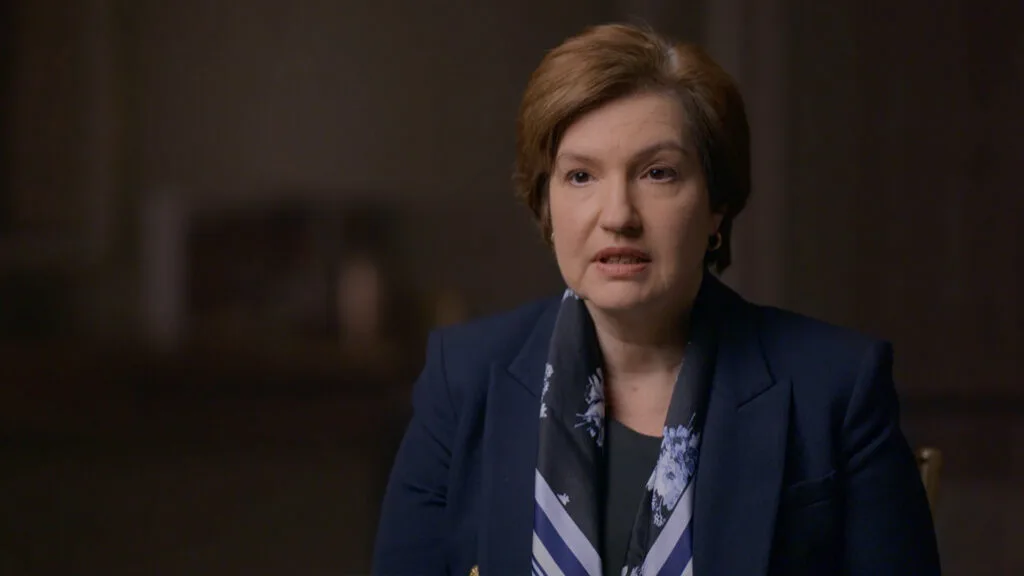
Celeste Wallander served from 2013 to 2017 as Special Assistant to the President and Senior Director for Russia and Central Asia on the National Security Council in the Obama administration. Prior to her time in the White House, Wallander was the Deputy Assistant Secretary of Defense for Russia, Ukraine and Eurasia from 2009 to 2012.
This is the transcript of an interview with FRONTLINE's Michael Kirk conducted on July 26, 2017. It has been edited in parts for clarity and length.
… Let’s talk about what you thought the Munich speech by Putin in 2007 signaled.
It was clearly a statement of what Russia under Putin would seek to achieve in the international sphere, [in] what was perceived, at least by the Kremlin, to be a period in which Russia would be taken advantage of; that Russia was operating from a position of weakness, kind of a rule taker, [and] was ready to assert that it could be a rule-maker, and it would make its unhappiness with the rules of the game clear.I think what you saw with the Munich speech was the beginning of what is now a constant in President Putin’s public persona and in Russian foreign policy, which is creating a narrative of what really happened.
This is part of the being a maker of history and not just a taker of history.Even more than the specific content of that speech, I think it was a turning point in a more assertive, proactive, going on the offensive.I mean that mostly in a neutral way, but going on the offensive rather than sitting back and being an object of history, actually being an agent of history under the Putin leadership.
… By the end of the Bush administration, [then-National Security Adviser Stephen] Hadley says, “Well, we threw the relationship in the toilet.”Had they?Can you give us a critique of where Putin was about America and his second American president that he dealt with?
Well, you know, I wouldn’t want to contradict somebody like Steve Hadley, who was in the middle of it all.And you know, I think that’s probably fair.I think that the Bush administration had come in with the idea of finding out where you could cooperate with Russia.How do you renew what I think has been a bipartisan foreign policy toward Russia since the end of the Cold War and since the dissolution of the Soviet Union, which was a focus on integration of Russia, modernization?Whether that’s economic, political, security, cultural, social integration and modernization, the assumption was that there was a Russian leadership and a Russian society that sought that as well.
I think that was a good assumption going in.That’s what the Russian leadership in the 1990s did seek.It was the mission.It was the objective, and it had a lot of support in Russia, too.I wouldn’t criticize the Bush administration for renewing that commitment, because that was the strategy.The idea was that a Russia that was integrated and modern would be good for Russia, but also in the American national security interests because that would help contribute to a global order in which the United States’ interests were secure and advanced in cooperation with countries like such a Russia.
What the Bush administration learned, [what] we all learned in the 2000s, was [that] the emerging Putin leadership wasn’t so sure that they bought into that integration project, that it wasn’t quite as willing to play by the international rules of the game that the Russian leadership in the 1990s had accepted, had signed onto.You began to see fractures in that along the way.I think that the frustration that the Bush administration leadership experienced was understandable.There was more and more evidence of how difficult that relationship was, which culminated in the Russian invasion of Georgia in August 2008.I wouldn’t necessarily criticize what the Bush administration’s assessment [was], because I think it was probably a hardheaded assessment of how difficult it had become.
Putin Asserts Himself on the World Stage in his Third Term
… Let’s jump forward to 2012, in the post-protest ’11 and ’12 years.That Vladimir Putin, freshly ascendant Putin, … who is that man in 2012, and how different is he than the man who received the job from Boris Yeltsin?
By 2012, we’re always struck by Putin’s power and his authority inside Russia, assertive foreign policy abroad.But I think part of the story is exactly what caused that reaction against the Bolotnaya protests, which was the vulnerability of Russian leadership that was facing a society that thought it could make choices.A lot of Russians believed that presidential elections should mean that the citizens of Russia get to choose who their president is and get to hold him accountable.
What the protests showed is that the switch back from President [Dmitry] Medvedev back to President Putin, which wasn’t a result of anything close to a democratic process, a process in which the Russian citizens made their own choices, was a surprise to the Russian leadership, and then shook the Russian leadership.That’s why you saw that reaction.I think very clearly, the reason why you saw immediate blame being cast on the United States, and in particular on Secretary [of State Hillary] Clinton, was—I mean, it couldn’t be from a President Putin point of view that the Russian people didn’t want him.I mean, that clearly can't be the explanation.
So what must be the explanation?Aha. If there's something bad out there, it can't be the fault of the Kremlin.It can't be because the image and the model and the plan has some flaws in it.So it must be the United States.We've seen that again and again and again, not just with the 2011 and 2012 protests, but the loss of Russian influence in Georgia, the loss of Russian influence in Ukraine, the difficulties that Russia was experiencing in Syria by supporting the [Bashar al-] Assad regime.It can't be that there's something wrong with the Kremlin’s plan and the Kremlin’s ability to control domestic and foreign policy, so the narrative always points to the United States.
… Who is that man standing on the podium at the Sochi Olympics, waving to the world?What does that event represent to him? …
What you have by 2014 is a Putin leadership that’s trying to find a different basis for asserting Russia’s stature as a great power on the international stage.If you look at China, China is reaching great power status based on an incredibly dynamic, growing economy and growing military power.European Union, through its integration, through its leadership and international organizations and the transatlantic relationship, those things weren’t working for the Russian leadership.
Russia wasn’t a part of NATO.NATO enlargement, in principle, was open to Russia, but in practice, [it] was not a path.So the form of greatness that the Kremlin set upon was a greatness based on a lot of status, certainly a reassertion of military power, big international business deals, brokered by the Kremlin; this model in which it’s not economic growth bubbling up because of competition and innovation and the choices of businesses and business people, but it’s mediated, moderated, blessed and orchestrated by the Kremlin.
Sochi brings that all together.You have an extravaganza.It’s the Russia show, the Putin Russia show at which he’s the main focus.The images of Russian history, which is a great history, and Russian culture, which is a wonderful culture, and the ability of the Russian society to produce beauty and strength and contribute to global culture, all of that is there.But it’s not really Russia that’s doing it; it’s Putin that’s doing it.
You see that combination of those two elements really in Sochi, in a way that was meant to make the world stand up and take notice.And the world did stand up and take notice, because it was quite a spectacle.But it also was a spectacle like much of television, or much of media: for the moment.Then the next morning you're going to have to wake up, and it really matters how good your economy is and how dynamic it is and how your citizens are able to contribute to the greatness of your country.Sochi really was, in that sense, very, very symbolic of what Russia under Putin and the Putin leadership is.
… Help me understand what he is up against when the first people take to the streets, all the way through what happens at the end of Sochi.
The roots go back into evidence in 2012 and 2013 that the Russian economy was actually slowing down, long before the drop in oil prices, long before the imposition of sanctions.The Russian economy actually was running out of steam largely because of the failure of the Russian leadership to create the political and market conditions to wean Russia off its dependence on natural resource extraction and sales.
The extraordinary growth rates that had fueled the early years of the Putin presidency in the early 2000s, the increase in production, much of which was attributable to the return of many oil companies to private ownership, all of that had kind of worked its way through and wasn’t a source of economic growth.So the Kremlin was casting about for a new model: How do you generate some kind of economic growth?Russia had successfully acceded to the WTO [World Trade Organization], which was the Obama administration’s bet on creating incentives for Russia to become more market-oriented, more competitive, more integrated in the international system.But that requires, again, following the existing rules of the road, the rules of the game, and that creates political problems inside of Russia for favored industries and favored oligarchs around the political leadership.
It’s around this time that the Kremlin comes up with its model of the Eurasian Economic Union, which is going to create, supposedly, increase in growth in the economies of the former Soviet Union by better linking together the economies that had been lashed together during the Soviet period.Ukraine is key to this in the Russian plan, because Russian and Ukrainian economies are so complementary, partly naturally but partly because of the effects of the Soviet period and the creation of an industrial integration and an agricultural integration between Russia and Ukraine.
When Ukrainian President [Viktor] Yanukovych is marching toward living up to his election promise, which was to pursue a European Union Association Agreement, therefore a free trade agreement with the EU, and visa-free travel with Europe, this is viewed in Moscow as a threat to this new initiative to try to re-jump-start the Russian economy in the face of its decline.
The stakes became very central to the Putin leadership, because if the Putin leadership can't generate economic growth, it can't generate the kinds of goods that show the Russian people that the Putin leadership is delivering.It can't deliver the kind of wealth that the Putin Kremlin political power is dependent on, the set of cronies and oligarchs around the political leadership, who both support the political leadership and are dependent on it.That money was drying up.
The stakes of Ukraine joining not NATO, right, so NATO is pretty much off the table at this point.Too many members of NATO are leery about NATO enlargement and Ukraine as a candidacy, so the fallback for Europe was this very innocuous-looking free trade agreement and visa-free travel, which looked very European, very values-based, very win-win.Ironically, it actually was viewed entirely in zero-sum terms by the Kremlin.
That was the start in the fall of 2013 about why Putin and the Kremlin went on a no-holds-barred attempt to stop the Ukrainian leadership, Yanukovych, someone who has identified himself as being very pro-Moscow in business terms.But also in terms of his leadership style, shall we say, his actual commitment to the Ukrainian people to sign onto that European Union Association Agreement was a much greater threat to Putin, what you could call “Putinism," than many realized at the time.Those were the stakes, beginning in 2013.
Putin and Hybrid Warfare
So into that fray, Putin does things that we’ve seen happen historically.I mean, he lies about what he’s doing.There's a lot of fake news.There's a lot of info wars stuff.There's everything you can imagine, the “little green men,” the entire thing.What does it demonstrate to you?What do those tactics demonstrate to you?
I think those tactics were meant to do two things.They were meant to—They did one successfully and the other not so successfully.The first was to tell the story to the Russian people about what was going on.Russians generally actually were very positively disposed toward Ukrainians.Many Ukrainians and Russians share heritage, have close family ties.The idea of Slavic brotherhood is genuine in Russian culture and was genuine, I think, in Ukrainian culture.
So you had to explain why this was happening, what was going on.Then you got all the narrative about fascism and Nazis and killing children, I mean, the whole set of stories to justify what was going on to the Russian people.And that continues today.If you watch Russian television, this is a constant drumbeat, that Ukraine is entirely to blame.The United States was interfering and was behind it the whole story.That was a big part of it.
… The other target of that entire operation was to fracture any kind of unified reaction against the Russian intervention, the attempt to persuade many in the international community, but particularly try to fracture the unity in the transatlantic relationship, to argue that this is to react against fascism; the Ukrainians shot first; these are just freedom fighters; no Russian soldiers here.It was an information operation, not for the sake of an information operation, but in order to gain certain political objectives, which was to prevent Russia from experiencing or suffering the costs of the foreign policy choices that the leadership had embarked upon, had chosen.
It worked to some extent at first.There was a lot of debate in Europe, in February and March and April of 2014, a lot of, “Well, on the one hand; well, on the other hand.”You could see the Russia Today [RT] narrative seeping into European and even American media.But as the intervention—as the fighting escalated in eastern Ukraine, and as the evidence about direct Russian intervention became clearer and clearer and culminated, unfortunately, in the shoot-down of Malaysia Airlines [Flight] 17, I think that narrative fell away on the—the coherence of that narrative fell away on the international scene, even though it still pretty much held inside of Russia.
Frankly, the Kremlin lost that information war at that point.They continue to try to shape that narrative, but the conflicting evidence between direct Russian intervention in eastern Ukraine and that narrative of “We’ve got nothing to do with it, and it’s all these other bad guys on the ground,” didn’t stand up to Western media standards and to the ability of Western governments to see what was before their eyes and explain it to their populations.
From the Obama White House perspective, … is it he knows nobody is going to reach out and stop him, or is it, in other words, arrogance?Or is it he had to do it?In some way he felt, no matter what the consequences, he had to go?
What happened from February, when the intervention in Crimea started, up until the fall of 2014, the first major escalation that resulted in the first Minsk agreement in September of 2014, was you saw a set of pretty impressive successes.Crimea was pretty easy.It was done very quickly.It was clear to us exactly what was going on.But there was that public persona that the Kremlin successfully advanced, local people taking over buildings.It’s freedom fighters; it’s not really the Russian military.The Russian military gets to be in Crimea because it has a base in Sevastopol, which actually doesn’t explain why you had all these unapproved reinforcements and all these trucks out on the streets.So there is a sort of, “Hey, this is working.”
Then it started to happen also in the Donbas.You had suddenly armed men showing up taking over buildings and localities in eastern Ukraine and successfully fighting against Ukrainian security forces, which, for the most part, weren't deployed in the east of Ukraine.Historically, Ukrainian security forces had been deployed in the west, because that was left over from the Cold War.That’s where the military bases were.
It took the Ukrainians some time to move their security forces to the east.There was this sort of march of success and deniability that they had been experiencing.Then, as the Ukrainian military forces did move, did improve their capabilities, did improve their tactics and began to push back, including Ukrainian air support to their ground forces—so helicopter reinforcements, some aircraft reinforcements—then the Russians started sending in air capabilities, not aircraft, but air defense capabilities, to be able to shoot down Ukrainian air forces.
… It’s in that context that the Russians supplied that advanced missile system right around that time, because they were clearly determined to inhibit the ability of the Ukrainian military to have a combined arms operation with air support to its ground forces, because they were succeeding at that point in pushing the Russian and so-called separatist forces back.They were on the defensive.They were losing.They were pulling back, the Russian forces were.
It is a tragedy of history that, at that moment, the Russians decided to supply a more advanced air defense capability.To this day, we don’t know exactly who pulled the trigger, whether it was a local Ukrainian or it was a Russian military team, but it was definitely a Russian-supplied system, and it was in order to shoot down Ukrainian military aircraft, and they got it wrong, and they shot down a civilian airliner.
And then they lied about it.
They immediately lied about it.And they created false film, which they put out on the Internet.Then they created false stories about a Ukrainian Sukhoi, air fighter in the air.That was the first instance in which I clearly understood that Russian information operations were not really about trying to convince everybody of an alternative story, but it was about throwing up so many multiple possibilities that you confuse everyone, because Westerners, Americans and Europeans, are reasonable people; we question our governments.We have independent media who will go and ask government officials, to probe the official narrative and point out inconsistencies.We’re always skeptical about what that official story is, which is healthy in a democracy and certainly not something to be criticized.
But what has happened now is that the Kremlin uses that healthy skepticism and that questioning of authority and authoritative narratives not to advance a different story that everyone has to accept, because in the end, those narratives are full of holes, but to make everyone throw up their hands and say: “Well, who knows?Sure, it could have been the Russians.But maybe it was the Ukrainians, or maybe it was the Americans.”That has become especially pernicious.
I would say the MH-17 shoot-down was maybe not the first instance, but it’s the first moment I really understood what we were dealing with, and how really difficult that was going to be to cope with going forward, and having a sensible foreign policy in dealing with the leadership that uses information in that way.
Putin Asserts Himself on the World Stage in his Third Term
There is, around this time, the other examples of what they're actually doing.I know there's a debate inside the American government, from the State Department, we talked to Toria Nuland and others about.We need to arm these people; we need to bring lethal weapons to bear.Where were you on that argument?
I thought the argument was fundamentally misframed, because it was focused on what kind of weapon and are they lethal.All weapons are lethal.The issue is whether they are well-designed or well-suited, I should say, toward improving defensive capabilities.It’s not just the weapons; it’s the training, the formation, the tactics, the operations, the deployments that make for a robust defense.Unfortunately, the debate became, do we give them this weapons system or that weapons system?The debate wasn’t where it should have been, which is, what should we be doing to help the Ukrainians over the long term be able to defend themselves in the Donbas, to deter further Russian escalation, because this problem is not going away.This is not a problem for the summer of 2014.The Russians are occupying Crimea; they’ve got forces in the Donbas.This is a long-term problem.
Unfortunately, that debate, I think, deflected from what should have been the real discussion, which is, what do you do in a broader defense effort to help the Ukrainians learn how to build defensive positions?Their defensive positions in 2014 were really flawed.They were as good as they could do at the time.They were trying to create this while they were fighting very capable Russian-backed and Russian forces.But we didn’t focus enough on not just what would make us feel good to give the Ukrainians in July of 2014, but what are they going to need in what turned out to be February 2015, the next time there's going to be a major escalation and assault on Ukrainian lines?
So we weren't ready and the Ukrainians weren't ready when the Russians escalated in January and February in 2015 in Debaltseve and took that major railroad head.I regret and I feel that I didn’t do enough to make that a constructive discussion and a constructive debate.It almost became a “prove how tough you are” debate, as opposed to “What do Ukrainians really need?” debate.I do think that was one of the mistakes we made.
… Of course a lot of people [who] in hindsight say because we didn’t stand up there, he felt comfortable coming here in 2016 and messing around in the election.What do you think about the— and then of course the president said, “We don’t know where this is going to end if we start stepping in there.”Where are you on that?
There's this specific question of, if we had provided, say, anti-tank weapons to the Ukrainians in the summer of 2014 or maybe the fall of 2014, would that have stopped the Russian intervention in Ukraine?While I did think we should be improving the Ukrainians’ defensive capabilities, including weaponry,… to improve the ability of the Ukrainians to defend, and therefore increase the costs that the Russian military would have had to pay, and make it harder to decide to exploit their weaknesses later on as they did, I do think that was a mistake.I do think we should have been willing to do that.
I don’t, in the end, think it would have caused an end to the Russian intervention in Ukraine.It might have helped the Ukrainians sustain a more defensible line.It might have saved lives.It might have caused a stasis on that line of conflict earlier.But it wouldn’t have resolved the crisis.I think you can make an argument that it would have helped the Ukrainians in their defensive capabilities; it would have made them less exploitable.But I don’t think there's any evidence to believe that it would have ended the conflict.Putin was not going to say, “Oops, sorry.Shouldn’t have done that.Yeah, it was us all along.We’re going to get out now,” especially not after creating the narrative inside of Russia.What is he going to say?“Sorry, Etch A Sketch.Shake it all up. We were wrong.Pay no attention to the man behind that curtain. We’re just going to walk away.”He wasn’t going to walk away.
Again, on the merits of the case, I think there was an argument to help the Ukrainians build their defensive capabilities, but then to claim that somehow that led to everything else, and if only we had done that, he would have ended the Ukraine crisis, and Putin would have learned his lesson, I think there's no evidence to that, and I think it fundamentally misunderstands, first of all, why the Russians were intervening in Ukraine.I've already given you my view on that.And then second, the notion that Putin was going to give up on the mission of asserting Russia’s strength abroad is wishful thinking.
Were you in meetings where others argued forcefully with the president about this and made their case?What is he like around these arguments?
There was a long period of discussion of the options at multiple levels, at my level, the assistant secretary level, at the deputy level, at the principal level, and then fully discussed, full range of options for the president.It was a well-thought-through, well-discussed process.I do think that some options were not as well developed as they should have been.As I suggested, I thought that the full-defense-capability option wasn’t as well developed as it should have been.But those who had arguments for why providing specific weaponry in a particular moment to the Ukrainian defense forces had every opportunity to make their argument and, for good or ill, were not persuasive in making the argument.
One of the counterarguments that I think was important in the discussion was that if you escalate the capabilities of the Ukrainians, what makes you think the Russians won't put in more forces?Because at the time, as I've suggested, what we saw was as new requirements on the ground presented themselves, the Kremlin figured out a way to put those forces in.Whether those were air defense forces, long-range artillery, battlefield artillery, tanks, the Russian military was up to the task of meeting the needs on the ground.
There was a debate about, well, if the Ukrainians have better capability, will the Russians be deterred by the prospect of higher costs, which was some were advocating.And that’s a fair argument.It’s a reasonable—it often happens in conflict that, when faced with higher costs, an adversary will step back.But there was a view on the part of a lot of Russia experts that Putin wouldn’t be deterred.The pattern of behavior supported the argument that, in fact, they’d put in more.I think that the pattern of Russian behavior in Ukraine and then subsequently in Syria really is reason to doubt that Putin would have been deterred and would have stepped back just because the Ukrainians now had a new kind of weapons system.
What does that tell you about him?
I think the Russian intervention in Ukraine was, in a sense, impulsive; that Putin saw Yanukovych losing control.He saw Yanukovych sign onto an agreement and then disappear and run away and lose control in Kiev.I do think that it wasn’t an orchestrated intervention.It was, however, a well-planned and well-thought-through intervention in the sense that obviously there were military plans on the shelf for being able to move in quickly to Crimea, and they quickly did.
In that sense, it was impulsive, but—It was an impulsive tactical decision, but it was rooted, as I have suggested, in Putin’s long-term understanding of the stakes and the Kremlin’s interests in Ukraine.That’s why I don’t think there were marginal costs that would have changed that course of action.
Marginal costs often altered how Russia intervened.After the MH-17 shoot-down, the Russians withdrew those particular highly capable ground-to-air attack missile systems.They also, in Syria, adapted the kinds of aircraft they had in Syria, based on battlefield conditions.They're highly professional, highly capable military.But the political commitment didn’t change.
I think that the calculation that battlefield conditions would affect the political calculation is a misunderstanding, and I would disagree with those of my friends who might have argued—and I did argue and disagree with them at the time—with friends who argued otherwise.
Now, sanctions were meant to impose those kinds of costs, because instead of causing battlefield deaths, cold-blooded as this may sound, which wouldn’t really matter that much to the Kremlin, sanctions cut at what really mattered to the Kremlin, which is money of the people in the companies around the Kremlin, and the ability of the Kremlin to pursue that economic growth, which it was increasingly worried about.
While they weren't substitutes, you could do both.You could do reinforcing Ukrainian defense capabilities and affecting Russian battlefield costs, and you could do sanctions.I was of the view, and remain of the view, that sanctions cut much more to the heart of what the Kremlin really cared about, and therefore were a much more effective instrument for imposing costs on the Kremlin for its intervention in Ukraine.
I think that was the prospect of facing escalating sanctions.That was more of a constraint on Russian military intervention from 2015 up until the current moment, because the sectoral sanctions really did hurt the Russian economy.There's plenty of evidence that the Kremlin and businesspeople around Putin are very worried.Despite the bravado and claiming sanctions don’t hurt, they are very worried about the effects of escalating sanctions.
The economic sanctions, and the willingness of Europe to join with the United States in those sanctions, once it became clear that Russia was directly intervening in Ukraine, became a constraint on the military intervention.It didn’t stop them from intervening, but it pushed them toward more covert and deniable methods, which are the methods that we see to this day. …
Intervention in the U.S. Election
It’s the summer of 2016, and here you are at the White House.You know so much about all these people, and this Ukraine business has been on the front of your desk, I would assume.Then the word is out that the Russians are doing more than just espionage and gathering information from the DNC [Democratic National Committee] and other people.But they do seem to be weaponizing, or at least it seems like they're about to.When do you hear about this?
The concern about Russian activities in the cyber realm came to my level of the government in June of 2016.I am not a cyber expert.It wasn’t an area that I had direct authority for monitoring within the U.S. government.But some of my colleagues who did have direct authority in that area began to call on me to say, “You know, we’re kind of trying to make sense of what we’re seeing,” so we started a series of meetings to figure out: “What's going on here?This is kind of puzzling.What does this mean?”
… Early on, there was clear guidance from our leadership that we should be tracking this; we should be making sure that the U.S. government has an understanding of what is going on and is able to report to the leadership, including up to the president, what was going on, but/and that this is a political campaign, an election campaign, the White House and in particular the NSC has no role in politics.Stays out of issues of law enforcement, counterintelligence, anything of that sort.That guidance was consistent until the election.
It was important to make sure that the work we were doing to understand what we were seeing in this cybersphere did not lead anybody in a policy role outside of the appropriate legal authorities of the policies they were working on.
Had you known or had much familiarity with what the Russians had been doing all the way back to Estonia and all the way up to the Democratic National Committee?Was it part of your brief?
There is a lot of evidence, and has been for many years, about Russian espionage and intrusion into cyber systems, into emails, into telephones, meetings of many countries, not just Estonia—European countries, countries outside of Europe—this was just generally known.There didn’t have to be a meeting where everyone kind of went, “Oh, wow.”It’s just known [that] it’s part of their capabilities.It’s part of the world you live in when you know about Russian capabilities.And not just Russian capabilities—a number of countries have these capabilities.
The activities of various Russian agencies in seeking information is not particularly surprising, and is not particularly surprising, I would say, along the way.The bigger issue becomes how those capabilities were then used in the election. …
It’s in June and July, whenever the DNC, whenever the convention is.By then, WikiLeaks has released—and it’s out there; stuff is out there in the open.They weaponized the information.Does that feel like an important change to you from where you sat?
I think what was different about that is that the U.S. was the target.Release of embarrassing information is something the Kremlin would do periodically inside of Russian politics.It is something that it had done in other countries.It was less the willingness to use information that was embarrassing, potentially, against particular targets, … but it felt like a new stage in the willingness of the Kremlin to use that information in the United States, yes. …
It’s June.Not all the Intelligence Community even agrees that it’s Russia yet, but the CIA does, and information is starting to flow.You're watching television, if nothing else, and getting some information.Based on your own understanding of Putin and how he acts, what do you think is going on?
The Kremlin had long been angry and pretty vocal in claiming that the United States was interfering in Russian internal politics.… and [in] regime change, which, again, was this obsession that the Kremlin had.It thought it saw a pattern in Serbia, in Georgia, Iraq, Libya.The Kremlin was very obsessed that Russia would be next and that somehow successive American presidents had it out for President Putin.
In addition to taking measures internally to protect against that, countering political opposition, countering independent media, being worried about protests, it began to look like what the Kremlin was doing at this point was retribution.It’s "You interfere in our politics, we’re going to show that American democracy is not so solid, that American exceptionalism is not so pristine, and that you, too, can be vulnerable to interference and chaos and embarrassment in your political processes."
That was an emerging picture in the middle of 2016, which in retrospect was long grounded in this resentment that the Kremlin had about regime change and color revolution.We saw them complain about it in places like Ukraine, that we were trying to overthrow Yanukovych despite the fact that what the United States had done was try to negotiate a way for him to stay in power.But that frame was really powerful.I think it’s in that frame to understand the emerging evidence of Russian involvement in electoral processes and in electoral systems and in the WikiLeaks information.
It’s a revenge impulse.
It’s a revenge, and it’s an equalizer.You're just as vulnerable as we are.Your democracy also can be manipulated, also doesn’t look so pristine and so strong.There was a lot of commentary actually—if you follow the Russian media at the time, there were a lot of Russian government spokespersons, the Russian media, Russia RT [Russia Today], Sputnik, were just gloating after the release of the WikiLeaks, the DNC emails, about how ridiculous American democracy and American democratic processes looked.
That’s really useful to the extent to which you could talk about what they were doing, how they were talking about it and how that looked to you, that resonated with you and resonated in the White House.
Well, I can't remember specific transmissions of RT or Sputnik, but there was a clear follow-on to the reporting in the United States about concern about the intrusions and the release of materials and a growing concern about, was this being done by the Russian government or orchestrated by the Russian government?There was a lot of commentary in Russian media about specific emails that were embarrassing.I mean, it was all played out in great detail in the Russian media, speculation about the effects on the campaigns and American voters, and the exposure of American voters to the truth of American democracy as portrayed, of course, by Russian media.
It was a major focus of Russian media.The official comment from—I wouldn’t say constant, but pretty consistent comment from the Kremlin, noting: "Well, it looks like you have your own problems with your own democracy.Maybe you should worry about American democracy."
The U.S. Response to Russian Measures
There is in the White House … a sense of, we can't get involved in the politics of this.It’s too important.Our instinct may be to come out forcefully and do something about this, but we have to be a, certain that it’s Russia, and b, careful.Am I fairly characterizing what the impulse was inside the White House?
I think that there were multiple concerns, some that you’ve articulated, but also, again, I wanted to reiterate the sense of, you know, we are bound by the Constitution, by American law, and we’re not going to do anything that is not consistent with our duties and obligations and to the Constitution and under American law.And I’ll just leave it at that. …
And that relationship [between Putin and Obama] and those phone calls is very you say candid and frank.What does that mean?Can he call BS on Putin?And does Putin push back?Is that how it works with these guys?
They would regularly contest one another’s presentation of facts and either dismiss them if—you don’t want to spend too much time on a phone call kind of going through history and point by point.But sometimes you need to push back and say, “No, that’s not how it happened,” and “No, we didn’t do that,” and “Yes, you did do that.”At times, that is part of the content of those meetings, partly to lay the groundwork for them talking about “What do we do about it?,” but also to make clear to the other side that you're nobody’s fool. …
… [On Oct. 7, the day the joint statement is made regarding Russian interference comes out], so where are you when now, in the development of your thought process about what is happening with the Russian hack, the back-and-forth—it’s a week before the election.Where are you in your mind?
Not on Oct. 7.You mean—that’s a month before.
Yeah, a month before.
At that point it still wasn’t clear what the scope of the Russian intervention might be.There were pieces and elements that were referred to in the Oct. 7 statement by the Intelligence Community, and there were varying views about whether it was focused on the cyber activities, whether there was a broader media element, a messaging element.There was now concern about, was American electoral infrastructure itself at risk to some kind of malign actions?
Some of the focus was on trying to figure out whether state electoral systems understood that they needed to take seriously resilience and protection, given how much some electoral systems are dependent on the Internet, on electronic methods for tabulating and conveying votes.So there's a whole slew of issues all—I wouldn’t say coming together, but there were lots of pieces that you were trying to figure out, again, what to inform leadership, what they needed to pay attention to, what could be done to make sure that on Nov. 8, the United States was able to conduct appropriate free and fair elections under the Constitution.
I would say there were still a lot of questions at that time, and a lot of focus on what the situation was and what could reasonably be done to make sure that those elections took place as they should on Nov. 8.
You know what's amazing, when you go back and you read the tick-tock of events that happened through there, the idea of [Secretary of Homeland Security] Jeh Johnson tries to get to the States and say, “We have FBI information that says 21 of you are in peril,” right?[CIA Director John] Brennan goes up, and then finally, 12 people go up to Congress to try to convince the Gang of Eight and others, “This is a real thing that’s really happening, and it’s Russia in the middle of it.”Were you by then one of those who still had doubts, or were you one of those who said, “No, this is actually happening, and this is a real thing”?
… I had no doubts that the Russian government—which is to say, the Russian leadership—had decided to intervene in the election.The parameters and the full scope of what that intervention consisted of I can't claim that I understood at the time.But I was not among the skeptics, and not since the summer was I among the skeptics.I felt like I understood and had seen enough how the Kremlin operates to know an operation when I saw it.
… So then there's a period of time, five or seven weeks, before the analysis is done of what actually happened, and the president announces the sanctions on Dec. 29 in Honolulu.In that period of time, I would assume lots of Monday-morning quarterbacking, lots of people saying: “Did we do enough?Could we have done something else?”To the extent that you had a role or had a position or had a dog in that fight, can you talk about it?
… That wasn’t what occupied my time, because at that point, then the focus became, “What should we do to prevent the Russians from ever doing something like this again?”We actually began a policy process, which was run by the NSC and run by me, by my office, to develop options for a variety of options to prevent this from ever happening again.
Actually, that felt right, because this wasn’t about attacking one political campaign or another campaign.It was about undermining the core of what America is, which is a functioning democracy in which the American people freely get to choose who their president is.I think that we all took a lot of energy from that.The Obama administration, we were going to be going out of office on Jan. 20, but how could we use our remaining time to help protect America going forward?That’s what we spent our time doing, not so much—I mean, maybe some regrets, some blame.I don’t remember being preoccupied with that.I remember working with really smart, wonderful people, some political, some career, all together, to figure out what you could do.
What were the options?
I don’t want to talk about private discussions, some of which are classified, but I will say they resulted in the actions that were taken, that the president announced at the end of December.There was a very long list of options, of many varieties and many forms, that were fully vetted by responsible, excellent, professional people inside, career people and political people, the Obama administration, in November and December.The package that was agreed to was the result of many meetings and a lot of work and very serious thought and involvement at all levels, resulting in the president’s decision. …
So you weren’t holding your breath, wondering what Putin would do in response to that?
… The measures that were decided upon were chosen and decided upon in full recognition and expectation that the Russians would at least reciprocally retaliate, at least.Given past practice, diplomatic practice—which is a funny thing to say, because it’s not very diplomatic—but given past diplomatic practice, [Russia] probably would asymmetrically retaliate, kick out more people from the U.S. Embassy and so on and so on, close more U.S. facilities, impose their own sanctions, and so on and so on and so on.
We were fully expecting that.Russian officials indicated at the time that “Get ready; retaliation is going to be big.”In fact, Foreign Minister [Sergey] Lavrov said it publicly.So we were fully braced for that and actually planning a series of meetings to figure out how we cope with the retaliation that we expected to be unleashed the next day or in the next coming days.We were very surprised—I was surprised to come in the next day and find out they weren’t going to do anything.Putin said, “No, we’re not going to do anything.”That was surprising.
What did that tell you?
It was puzzling.Why would they not do what they said they were going to do, which is retaliate?Why would they not do a common diplomatic practice, which is to retaliate?Why would Putin not do what he normally does, which is hit you back harder?It was puzzling.
So when you look back on all of it, did Putin win?Or has this been a big loss for him?
I think that, in two ways, the Kremlin didn’t get what it may have been aiming at by intervening in the election.Substantively, U.S. foreign policy on Russia is not a function of just one guy or girl—but so far guy—at the top of the American political system.They mirror-image.They think U.S. government is run the way the Russian government is.Putin can decide to intervene in Ukraine and cover it up.He can decide all kinds of things, and everyone has to just jump in and execute his choices.They don’t really understand that there are checks and balances, that the president of the United States represents the whole country and the national interests of the whole country, not just his own momentary preferences or ideas, and that the foreign policy of the United States is really the foreign policy of the whole United States.
The problems that exist between the United States and Russia in our foreign relations are now fundamental and probably going to be longstanding, and are going to be a challenge for successive administrations in the United States.I think that that has taken them by surprise.And we’re seeing that in the daily reports of Congress asserting its authority on budgets, on sanctions bills, on a whole host of issues.I think that that was surprising [to Russia].
I think also—I don’t know if this is that I think it or I hope it—I think that the Kremlin is going to find out that, while it was embarrassing, probably, to individuals or Democratic Party or many to expose some of the information or behaviors of individuals or actors in the U.S. elections, in the end, actually, the American electoral system and political system is resilient and will continue and protect itself and rebound.The processes of the U.S. Constitution will make sure that we have free and fair elections again in 2018 for congressional elections, and in 2020 for presidential elections.
In that sense, there was a tactical victory, but there isn’t a strategic victory, because the challenge that the Kremlin faces of a United States that is capable of balancing policies and national interests and investing in American strengths is still there.I think they're actually beginning to see that.You're beginning to see that in a lot of the Russian commentary and concern that many of the challenges they were facing that they didn’t like aren’t going away, whether that’s Ukraine, whether that is the difficulties of the Russian economy in coping with the globalized competitive environment.
I don’t take any particular pleasure in that.I continue to believe that the United States would be best served by a Russia that was integrated, modern, successful, active member of the WTO, all of the package that was on the table at the end of the Cold War.I continue to believe that would be the best Russia that’s good for Russia, too.But we’re just not going to get there for a while, because this Russian leadership doesn’t embrace that project.They're going to have to sort it out, and it’s going to take a while.It’s not going to get done quickly.
Putin Asserts Himself on the World Stage in his Third Term
… You’ve told us, though, that Putin, apparently for 18 years, has had this obsession, you called it, and has believed this untrue thing about the West, and specifically the United States, that we are meddling and interfering and trying to get regime change.How could he have held onto such a thing for so long?Didn’t we ever try and tell him, “Look, this isn't true”?
Yes, President Obama told President Putin multiple times: “It’s not true.The United States doesn’t foment color revolutions.The United States is not trying to overthrow the Russian government.”But President Putin probably doesn’t believe foreign sources of information as much as he believes his own internal sources of information, and if his own system is telling him that this is going on, and we have public evidence that that’s the case, that there's discussions in the Russian Federation Council and in the Duma about supposed evidence, for example, that the United States was involved in the overthrow of Yanukovych, despite all the evidence that Yanukovych wasn’t overthrown, he ran away, it doesn’t matter if that’s what the Russian political and intelligence system is feeding him.
This is why the Victoria Nuland phone call sort of matters in some way, because he hears that, and it’s prima facie.
Yep, that’s right.
Yep, what?
It goes through a filter of, well, what does this mean?And the frame is, well, this means the United States is trying to overthrow the Yanukovych government, which wasn’t true, but that’s the frame in which it is filtered.You're absolutely right.It’s a huge challenge.Eventually the challenge gets addressed through more interaction.We did advocate and push for strategic stability talks with the Russian government because of the concerns about miscalculation in the military sphere, specifically, but we were not successful in getting Russian agreement by the end of the Obama administration.I actually really hope that the Trump administration continues that effort, because strategic stability talks aren’t arms control discussions.It’s not about agreeing to a new treaty, although that should be an end goal, of course, of any kind of talks like that.But simply being able to share information, which may not be believed the first time around, but building on a base of sharing information about military activities, really is important.It’s something that we tried to achieve but weren’t able to achieve in the months that were left to us in 2016.
What does it say about Putin in the 21st century?This guy holds on for almost two decades of something that’s not true?What does it say about the system that he exists in? …
I think it’s a vulnerability of all authoritarian regimes.They don’t have independent sources of information.If leaderships go after those in their own societies who tell them things they don’t want to hear, the tendency is to not try and go and tell the leader that they're making mistakes, or it’s not the way they think it is.That’s one of the advantages in a democracy.We may not like the messiness of independent media, may not like being reported on and being questioned as a government official.But it means that governments and democracies can self-correct because they're accountable, and because they can be confronted with facts and not just narratives or convenient stories.
Authoritarian governments, including Russia, but not only Russia, are very vulnerable to this sort of echo chamber, where good info—you can't make good policy if you don’t have good information.That is a long-term vulnerability of many, many authoritarian governments.It helped bring down the Soviet Union, because the Soviet system refused to recognize the flaws of the Soviet economy.It took a long time for the Soviet Union to recognize the costs of the intervention and the failures of the intervention in Afghanistan.That helped to undermine the Communist Party and lead toward the end of the Cold War.
So absolutely, that is a flaw, a danger.Ironically, it’s a danger to the Kremlin, but it’s a vulnerability that the Kremlin itself has built.