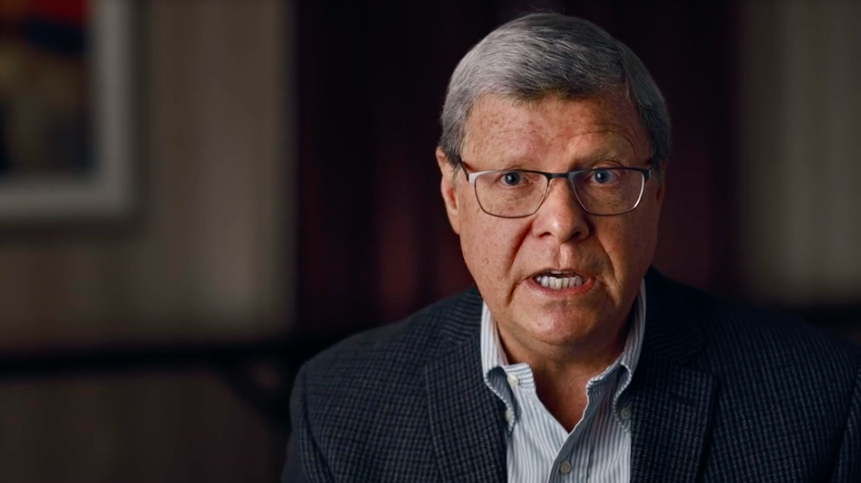
Charlie Sykes is a contributor to NBC and MSNBC, and is the founder and editor-at-large of The Bulwark. He is also the author of several books, including How the Right Lost Its Mind.
The following interview was conducted by FRONTLINE’s Jim Gilmore on Dec. 8, 2021. It has been edited for clarity and length.
So starting off, Charlie, talk about Pelosi.How is she viewed early on?She comes in as speaker in 2006 the first time.What's the view of Republicans towards her back then, and what's she like?
Well, I can't speak to what she's like, but I will say that when Nancy Pelosi first became speaker back in 2006, she unified Democrats because she became the symbol of what they regarded as the aggressive, partisan wing of the Democratic Party.She was a very polarizing figure, and I think that Republicans felt that they could nationalize all of their campaigns by running not necessarily against a generic Democrat but against Nancy Pelosi.Nancy Pelosi became a fixture in every single Republican ad.She became a talking point on every single talk show because she was the lightning rod.She became the face and the symbol of an aggressive, progressive Democratic Party.
Talk about her.So she comes from, of course, Baltimore, and her dad in politics, her brother in politics.She then moves to San Francisco, both very Democratic necks of the woods.She's never had to really worry about Republicans very much.So talk a little bit about her sort of view towards—how her partisanship, the fact that her heart and soul is in the Democratic Caucus no matter where she is.I mean, how do you define her as far as her sort of partisan attitude?
Well, I think initially, people thought of her as a San Francisco Democrat, so not just as a partisan Democrat, but as somebody representing that wing of the party.I think what Republicans tended to underestimate was her, I think, political pragmatism, her savvy, her ability and willingness to use the process.And I think that's one of the reasons why Republicans over the years have consistently underestimated Nancy Pelosi.I think they thought of her as a firebrand partisan, became the lightning rod.But it's only later that I think they began to appreciate that she was very much an institutionalist, very much a creature of the House of Representatives, an amazing vote counter.If you would have told me this back in 2006, I would have been very, very skeptical, because she was seen as not just a partisan but as an ideologue.And I think we've learned that's not a complete picture.
I mean, her focus has always been on Democrats.That's a natural thing.But the Republicans saw her as partisan.What was her focus, and why can that be seen as a partisan point of view?
Well, I think when she initially came in, she was the perfect foil for Republicans between the face of the Democratic Party.And I think a lot of us looked at her as a San Francisco Democrat, which meant that she was not only fiercely partisan but also an ideologue who represented, you know, an aggressive, progressive wing of the party.I think what a lot of us missed, or maybe things evolved over time, was the fact that she was, yes, partisan, but also a very, very skilled institutionalist and a very, very skilled herder of cats.Initially, I think, Republicans underestimated her because they thought that she could be the face of the party that they could run against, that she could be on every ad, that she would be a talking point on every single talk show.But her ability to wrangle votes, her ability to manage the legislative process I think was underappreciated by Republicans for many years.
Pelosi and Bush
… From the very first time that she's in leadership and she's dealing with presidents—I mean, we're dealing with four presidents during this program—she has always considered herself an equal, and she has always carried herself in that way, and she has always been very strong in putting out her positions.And it starts with Bush, where she goes after the Iraq War very early on.What was the danger, what was the risk in taking the stand that she did, and how does that sort of again focus the ire of a lot of Republicans against her, thinking that in some way she's using the issue as a political tool?
Well, any time you go up against an incumbent president in a time of war, it's highly risky.And I think you go back to the first Bush term and you see the risk the Democrats ran by opposing, for example, the Department of Homeland Security.And they paid a price for it during the midterms.This is something that Republicans have long used to question the patriotism of Democrats, your commitment to national security.So the real risk was for Nancy Pelosi to become the face of a Democratic Party that might have been squishy on the war on terror, that might not have been as strong on national security as they should have been.And during that first year, she really was the face of the opposition.This was before Barack Obama had secured the nomination.So in Republican world, it was Bush versus the opposition in Congress personified by Nancy Pelosi.
So why does she do it?
You'd have to ask her.I mean, by 2006, I think she sensed the public opinion was turning against this war, that it had become a quagmire, that the Bush administration had perhaps lost its way.The war had dragged on for too long.So Nancy Pelosi is always this interesting, I think, interesting puzzle.How much of it is raw partisan advantage, and how much of it is based on principle?There's no question that she's a committed partisan who wants to win elections, who wants to beat Republicans.On the other hand, she obviously has core beliefs, and she's willing to sacrifice power to achieve those ends.And I think that's one of the extraordinary things about Nancy Pelosi, is that she can be aggressively partisan but also willing to say, "I'm going to do this even if it may cost me an election."She literally put her speakership on the line by pushing through Obamacare.
Now, did she do that because she thought there was a political advantage?Maybe on some level.But on another level, she put the public policy ahead of her electoral prospects.And that's what, again, I think distinguishes her from some of the other speakers; that she was not only a very powerful speaker who was able to keep her caucus in line, unlike her Republican successors, but she was willing to use that position to accomplish things even if she knew that it might cost her that gavel.And again, I have a hard time imagining that from some of the other successors who were unable to wield the power of the speakership in the same way that she's been able to do.
… So the second thing during the Bush years is the financial crisis in 2008.It's a turning point for Pelosi in some ways.… The leadership knows how dire the situation is for the country, and even though it's a Bush administration, she basically agrees to hold hands to jump off the cliff….What happens during that?And if you want, if you remember the moment that she's on the floor and this vote is held, it goes down while somebody in the networks and everybody reading the information about what's happening in the stock market—an amazing moment.
Well, it was an amazing moment.And I think that in her career, you have a number of these turning points.But her tenure overlapped the end of reasonable bipartisanship in Congress.I think that there are moments when everybody held hands and jumped off the cliff, and I think we ought to be grateful for that.But I also think that she's looking across the aisle and seeing a Republican Party that a) is not always willing to do that, to cooperate on major legislation; and secondly, she's looking at a Republican leadership that can't necessarily deliver the votes.So the entire calculus of the way the House of Representatives is changing in real time over that decade.And obviously that's going to affect her approach to the job, and it's going to reflect the way that she handles both her leadership role and being speaker.
Does it make her more partisan?
I think everybody became more partisan.I mean, there was a period at which you could feel everyone choosing their teams and ratcheting up the tribal loyalties.So that's going to have an effect.So yes, but she was always a partisan.And yes, she was partisan, but especially when you're in a Congress where the other party is explicitly saying that their goal is to cause the presidency to fail, then it's hard to see how anybody comes out of that unaffected.And so yes, she became more partisan, but so did everybody else around her.
But the interesting thing about TARP [Troubled Assets Relief Program] is George Bush is president, and she's agreed to be bipartisan, and she sees a Republican Party that can't get it together to agree with their own president and to actually try to save the country.How does that affect the way she looks at the GOP for future events?
Well, keep in mind that George Bush is the president, but he's a lame-duck president.And Barack Obama is about to take office.So it's a strange interregnum.And I think it was—what she was seeing was kind of the prelude to a Republican Party that was going to go into complete nihilistic opposition.And so that obviously colors your relationship with that party.The Republicans were prepared to see the economy go down, were prepared to torpedo their incumbent president because they were getting into that mode of being against everything; that they were going to be in the mode of being opposed to everything the Democrats were going to do.
And so it had to become very clear, or it should have become clear to the incoming Obama administration and to Nancy Pelosi—I think she realized it before Barack Obama recognized it—that there was no doing business with the Republicans.I think that there was a sense among the Obama administration—"OK, let's spend months negotiating.Let's spend months trying to get some Republican votes."Nancy Pelosi, I think, early on understood that was a fool's errand.It was just not going to happen.If you were going to get this legislation through, you were going to have to do it with Democratic votes, and that maybe you would go through the motions of trying to put together a bipartisan package, but that era was over.It was done, and they were on their own.
Pelosi and Obama
And so Obama comes in.And in fact, that is what she's advising the president.She's going—you know, when ACA is coming up, she's going, "We have the majority in the House.We have a supermajority in the Senate.You are president, a Democrat, Mr. President."She's advising them that, you know, go big, go fast, get something done that we as Democrats have wanted for years and years and years.Are they listening?
Well, they didn't listen initially, but ultimately that was what they had to do.I mean, initially they had to recognize that she was right about all of this.And I mean, it left behind a lot of bruised feelings.I mean, I can remember talking to some of the Republicans who were in the room at the time, and it began to dawn on the Republicans that the Democrats were going to push this through without them.That was one of those moments where I think you saw the increased partisanship.But this was the new reality.This was a recognition—and I think the thing about Nancy Pelosi is she always knows where her caucus is.She knows where the votes are.She knows how to count votes.She knows what deals can be made and what deals can't be made.And I think that it took the Obama folks a while to fully understand how well she understood this process.But also it took them a while to realize the way in which politics had fundamentally changed in Washington.And sort of parenthetically, it's kind of interesting that even Biden comes into office with various delusions about how the process works, as if somehow he had slept through that last decade not understanding this.Nancy Pelosi knows how it actually plays out.
And back with ACA, how do the Republicans view her role there?… When we talked to [Eric] Cantor, Cantor basically says, "Listen, we could have worked with Obama.It was Nancy Pelosi that was the one that was sticking this down our throats, and that had repercussions."Now, that's his point of view.But what was the view of the Republicans on Capitol Hill about Nancy Pelosi and ACA?
Oh, well, that was the sense that I had as well.There was a lot of anger that she was really the villain of the story.If you were putting a face upon the ACA, it was as likely to be Nancy Pelosi as it was to be Barack Obama.And they were very angry, and they were very bitter about it.But the reality was, and as prickly as you look back on it, they weren’t going to work with her.There were no Republicans that were going to ultimately support this.The dynamics of the Republican Party had already switched to the point where it would have been political suicide for any Republican representative to vote for ACA, to go along with Barack Obama in that first year or with Nancy Pelosi.
And she understood that.And look, you can understand the bruised feelings when—I also remember the story when Barack Obama's sitting in a room with leading Republicans, including Paul Ryan, and they're talking about I believe the stimulus bill, and Obama reportedly said, "Well, I won the election."Basically "I won; you lost."And they took that as an indication that they weren’t going to be at the table.Well, the reality is they had just lost that election, and they had lost it badly.And elections have consequences.And anybody that doesn't understand that is awfully naïve.I've heard that story so many times, I keep wondering, well, was Obama wrong to say that to you?Did Paul Ryan and Cantor, did they actually expect that they were going to sit down and they were still going to be able to write the budget and the health care bill after the 2008 election?Did they really think that's the way the process worked?No, that seems naïve.
And Nancy Pelosi's reaction to that, do you believe [that's] what she would have thought?
Well, I think that's exactly what she thought.We have the majority.If not now, then when?This is the moment for us to strike, to do what we have to do because majorities are temporary.And I think this is another one of her insights, is she understands that power is fleeting; that you may not hold that speaker's gavel for 20 years; that you're not just there to keep the seat warm; that when you have the votes, you vote.When you have the caucus behind you, you go to the floor, you cast those votes.That seems to be her mentality.And so, obviously, she's a fierce opponent.And Republicans, again, especially Republicans who may have underestimated her, had kind of a wakeup when they saw what she was prepared to do, even at the risk of her majority.
… [Scott] Brown wins in Massachusetts also, and all of a sudden the supermajority is gone.And there's discussions in the White House: What are we going to do now?And Rahm Emanuel and others are sort of saying, "Well, we go small.We can go small."And she in this one meeting says, "Listen.Number one, Rahm, you're undercutting me with my caucus by saying that that's a possibility.That's not where we're going.If you want us to get this thing done in the House, I'm going to get it done for you.If you want to go small, then count me out."The pressure that she brought even on Obama and such, how amazing is that?
OK, I think that that was actually one of the real decisive moments, because Republicans thought with the Massachusetts election that Obamacare was pretty much over; that it was either going to die or it was going to be watered down beyond recognition.And I think a lot of Democrats thought that as well.So when Nancy Pelosi says OK, the ball's at the five-yard line, and I am not going to blink on all of this, that was really remarkable.I think it took Republicans by surprise.And clearly she was driving the agenda, the aggressiveness by the Democrats.
Now, when you think about the political implications for the rise of the Tea Party and the 2010 election, this was also a crucial moment, because I think this ramped up the emotional reaction, this sense that you were ramming this legislation through; you were steamrolling it.And it created a backlash, and it did cost Democrats control of the House of Representatives the next year.But I think it's an indication of the role she played in the Democratic Party that she was the driving force, not the sitting president of the United States.
Republicans Campaign Against Pelosi
And in the 2010 election, the GOP didn't hold back on her either.There's all these famous stories of the millions and millions of dollars spent and the bus running around with her name on the side of it that needed to dump her.Was that a smart move?It was a very productive move, it seemed.It raised lots of money for the Republicans.Was it surprising?
No, not at all.I mean, she had been the lightning rod for Republicans since 2006.She was the face of the party.There's no Republican around the country that did not want to run against Nancy Pelosi.It was easier to run against Nancy Pelosi even than Barack Obama, who was also not that popular in 2010.So Nancy Pelosi was, for Republicans, the perfect foil.She was the perfect lightning rod.And they drove it to the max.And obviously it was very effective in nationalizing the election.And this is one thing that Republicans had been increasingly doing going back to the [Newt] Gingrich years in 1994.They turned the adage that all politics is local on its head, and they nationalized these congressional elections by making them referendums on people like Nancy Pelosi.And it was extraordinarily effective.
Pelosi and Trump
So let's talk about Trump.One of the things Cantor said which was kind of fascinating—he said the reason basically that Trump won was because people saw Nancy Pelosi's partisanship and the increasing amount of partisanship in Washington, and she represents the thing that people hate the most, and that's why it was used, and that's why of course somebody like Trump could win.Your point of view on that?
Well, Trump didn't run against Nancy Pelosi.He had the advantage of running against Hillary Clinton.But I think that from a Republican voter point of view, the stereotyping of Democrats as San Francisco Democrats was very, very effective, and Nancy Pelosi played into that, not as much the partisan issue as the issue that you are out of touch with the country, that you are far to the left of the country.So the San Francisco Democrat had a very specific, formulaic role in casting these issues.And of course, she was central to that.
So the 2018—she's very effective in this strategy that she brings.And she's basically telling her caucus that—don't go after Trump, you know, in some specific districts; sell what we've done; sell health care.She's very effective raising funds and money as she always is, and the big win that happens and the majority is taken back in the House.But there's still a lot of angst against her.The Republicans had been very effective that even a lot of Democrats are sort of saying, "Hey, listen, Nancy Pelosi's time is over.She's a danger to us."And of course, the Republicans feel that.And at that point, you felt that, thinking that maybe her time is over.Talk about that sentiment at that point.Why did so many people believe that even after the election that this was the time maybe for her to give up the speakership?
Well, I was particularly skeptical before the election.And part of it—it felt like—I think I was on Bill Maher's show when I said this, that it felt like the definition of insanity, doing the same thing over and over again; that Nancy Pelosi was already very, very damaged; that she was such a—she was the perfect talking point for Republicans and created headwinds.And also I think age had something to do with it.It's like, wouldn’t it be time now for the Democrats to turn the page to allow a younger generation of leaders to come up?We had not gone full into gerontocracy yet in our politics.So, I will say that as late as late 2017, early 2018, I was among those who very much underestimated Nancy Pelosi.
And it was Democrats as well, though.
Right, and Democrats did as well….But what we saw from Nancy Pelosi—and this is where I think my take on her began to change—was now we began to see her pragmatic side that, for years, I had thought of her as being the icon of the progressive wing of the Democratic Party, and instead she became very much a moderate force.She was focusing on the need to move to the center, the understanding that control of the House would be decided by these swing districts, not necessarily by the electorate in San Francisco and Burlington, Vermont.So we began to see that.
I think she framed the issues in a very savvy way.And then once she got into office, you could see that she did not immediately align herself with the left wing of her party.She became very much the institutional anchor that said that OK, the Democratic Party is not represented necessarily by the Squad.And I think that that's been an interesting development, to watch her triangulate within her own caucus after that and also be kind of the voice of prudence, because there were a lot of folks who were saying, "Move ahead with an impeachment right away."And I think that Nancy Pelosi had been around long enough to understand the secondary and tertiary consequences of the action.She very much had evolved into a chess player who understood that it was not just about this news cycle, that you had to think of the long-term consequences.And I really got the sense that she was not only a very pragmatic politician, but that she was a much savvier legislative leader than perhaps she was the first time around.
And also—we've gotten this from a lot of Democrats, so I'd like to get your point of view about what the Republicans were thinking about it—she was also someone who stood up to President Trump in a way that other politicians, leadership did not.I mean, there's that famous meeting where Trump keeps the cameras rolling, and they're talking about immigration….We've heard from the Democrats how this was a moment where a lot of people felt, OK, finally there's a strong leader, somebody, this 79-year—whatever she was at this point—woman who's willing to stand up to this guy.What was the point of view of Republicans looking at things like that? …
Well, I think that this was still a continuation of underestimating Nancy Pelosi, you know, that they thought it was going to be Nancy Pelosi from a decade ago or Nancy Pelosi who was 79, 80 years old who represented the far left wing of the party and was sort of last year's news.And so I don't think that they actually understood how much power she could wield or the way in which she was going to be able to leverage her speakership to undermine President Trump.I mean, they disliked her intensely.This did not change.But I think that the incident you just described where Trump is sort of sneering at her lack of power was an indication that he didn't fully understand who he was dealing with.He didn't understand her relationship with her caucus or how she viewed the power of the speakership.This is one thing that Donald Trump never understood from an institutional point of view.He never appreciated the power of Congress.He never respected this coequal branch of government.And this is where the partisan instincts and the institutional instincts of Nancy Pelosi sort of come together, where first of all, she's not going to be rolled over as a Democrat, and she's definitely not going to be rolled over as speaker of the House of Representatives in a way that Republican speakers had been rolled over.
And the other side of it, of her going after impeachment of the president, the fact that she would stand up to him and call him a liar, was there an effect within the base, within the Republican leadership, that this was disrespectful, that she was out of her lane?Was there also some blowback in that way?
Well, obviously I can't really speak to what they were thinking.Obviously I had a different reaction to that than, say, the Republican Trump wing of the party.But it was very clear that she achieved a completely different status among her fellow Democrats, that having been very much an establishment figure with a big question mark over her head, she became very much a resistance warrior during this period.But at the same time, she was not driving the push towards impeachment.If anything, she was being something of a brake.She was tapping the brakes.She was telling her caucus, "Let's not be hasty; let's not be premature."You almost had the sense that she was being pushed into impeachment somewhat reluctantly because she understood the risks of it.So on the one hand, she became a symbol of resistance to Trump.On the other hand, she was able to sort of pull down precipitous action that might have been over at the top.
Pelosi and Biden
So let's turn to the Biden years.Biden comes in.They're about to push forward a very aggressive group of laws, changes that we haven't seen in a generation or more, since FDR, really, that she has been counseling the candidate, Biden, that we have to go big; we have to go fast; remember what we learned from ACA.And she certainly has that ingrained in her DNA at this point.And she's going to do it differently this time.What's going on there?
Well, I think this is actually the most remarkable chapter of her career, which is that she comes into this particular Congress with this incredibly narrow majority.She doesn't have the majority that she had during the Obama years.She doesn't have the kind of majority that Democrats enjoyed under President Johnson or under President Roosevelt.It is razor thin, and it's a formula for failure because many of these bills, she can't afford to lose more than three or four votes from a very fractious caucus.And anybody that pays close attention to this knows that Democrats are not unified on a lot of different things, the whole Democrats-in-disarray narrative out there.You have an emboldened, activist Progressive Caucus.You have a large class of centrists who are very vulnerable.So it becomes really difficult to go big and bold at the same time you're holding together this disparate caucus.And I will tell you that this is the moment where I step back and go, we had underestimated Nancy Pelosi as the vote counter.This is where as a master legislator, you see her at her best.I honestly as an outsider don't know how she pulls it off, how she gets people with such dramatically different priorities on the same side on these really complex pieces of legislation.
How differently does she view where they need to go and how they need to do it and how fast and how big compared to the president?Is there a difference of, do you think, views on this?
I don't sense a big difference in the views on this.But again, what's extraordinary is that she does feel the need and does want to go big and bold while she has, what, a five-, six-vote majority?This would be the perfect example where, a perfect moment for her to say, "Look, I'm just not able to put together majorities for anything that's sweeping.You don't actually have a working majority in the Senate.I don't have a progressive majority in the House of Representatives.You try to get AOC on the same side as Abigail Spanberger."These folks all have their own constituencies.
And again, the contrast of what's happened to the Republican Caucus is really what was interesting, because Paul Ryan and Speaker Boehner both saw their speakerships implode because they couldn’t keep their caucuses together.And in part, that's because of the nature of politics, where each one of the various factions of their party have their own constituents; that they didn't have to necessarily listen to the speaker as in the days of old.They could run to Fox News or talk radio.If they broke with leadership, they could raise money from the grassroots, so they had their own constituencies.And as a result, Republican speakers were not able to deliver the votes that they wanted to.They were not able to hold their majorities.
And so here comes Nancy Pelosi, also with a very divided, fractious caucus and this razor-thin majority, and somehow she has pulled off these major legislative wins, which, given the failures of the past, were pretty remarkable.And as I said, I can't explain it.As somebody that's watched Republican speakers fail to get things done, it's rather remarkable to watch Nancy Pelosi succeed.
You know, you said something before which I'd like to follow up here on, which is that when Biden came to power, he didn't quite remember all the lessons that Nancy Pelosi had learned in the past to direct them where they were going now.Talk a little bit more about that.
I think if there's a real difference between Joe Biden and Nancy Pelosi early in this term, it's that Joe Biden still has this nostalgic view of the way politics worked in Congress.Joe Biden seemed to think that the rules would be different for him, that somehow he would be able to get some sort of bipartisan cooperation.And Nancy Pelosi, who'd been there all this time, is going, no, this is not the Congress you remember, Mr. President.
But I don't know that they had that conversation.But I don't think that Nancy Pelosi was under any illusions that we were going to have this golden age of renewed bipartisanship.I think that Joe Biden was very hopeful, in retrospect perhaps a little naïve about his ability to put together those kinds of majorities.But Nancy Pelosi, I think, had become much more comfortable working along partisan lines, knowing that the Democrats, if they were going to get things done, were going to have to do it on their own.And so I think that there was probably a push-pull between her and the Biden administration on all of this.And clearly now, you're seeing that they've gone with her strategy.
It's interesting.As you're saying this, I was thinking that president after president are naïve in a lot of people's points of view.I mean, Obama was naïve about the bipartisanship.Trump was naïve about the power of the Congress.Biden was naïve also about what could be done.It seems that Nancy Pelosi is always the one in the room who's the one who's very practical and not at all naïve.What does that say about her?
Well, I think you just said it.I think that over the years, Nancy Pelosi has become the ultimate realist about what can be done and how to get it done.And she does not come to this process with any illusions, including the possible political fallout from some of the legislation that they're pushing.And again, this makes her, I think, somewhat unusual because she remembers what happened back in 2009 and 2010 and how it cost her the speakership.And that had to be very, very painful for her.And in our modern political culture, most politicians are very risk-averse.And here's Nancy Pelosi who once again has the speaker's gavel and is pushing strategies and legislation that very well might cause her to lose that majority again, and yet she is willing to do it.So it is this really interesting balance of pragmatism, institutionalism, but also a willingness to roll the dice that makes her, I think, just a fascinating and in many ways kind of enigmatic figure from my point of view.
One of the things you had said, and I think we need to make this clear, is that she's no softy.She uses the carrot and the stick.You had said that she knows how to use the knife to get what she wants.Talk about that.Talk about the fact of the reality of what she as a politician brings. …
Well, this is actually what I wonder about the most, because I don't know how it works internally.But obviously she has mastered this formula of being able to win affection but also to be feared at the same time.So I'm not sure, when some recalcitrant freshman comes into her office, does she bake them cookies, or does she have the knife on the table?And I'm guessing it's a little bit of both, that she understands how to use power and to use it aggressively, but she does it in a way that keeps people together.And again, the success in herding the cats of the Democratic Caucus together shows that she is a gifted politician in a way that's kind of a throwback.
She's not necessarily the most gifted communicator.She's not necessarily the person who is going to be the most effective talking head on cable television.But behind closed doors, she's figured out the way to keep people in line either by motivating them or making them afraid to buck her.And again, that's something that she's successful at in a way that other speakers have not been successful.
As far as what's going on and what we've recently seen in her ability to push through the bills that she's pushed through, the Republican point of view is an understanding that she's willing to take and drive the agenda.If she has the votes, she's going to overwhelm and go for what she wants.Again, this is legacy, too.She's getting close to leaving power.And these are things that she's been trying to do for decades.Do the Republicans understand the reality of what's going on and feel one more time that she's very willing to stuff stuff down their throats no matter what?
Yes, yes.And I think that's driving a lot of the alarm and the pushback that—look, these people are—they’ll describe it as radical and socialist, but what they also understand is that it's going to get done and that there's not much they can do if you have somebody who is as skilled as Nancy Pelosi in driving those votes.Again, it's not a given that another speaker would be able to push this through.You could certainly imagine a scenario in which they think that Joe Biden is a weak president, that the Senate is completely stuck in its own quagmire, and that the House is broken up in disarray.So the fact that you have Joe Biden in the White House, a 50/50 split in the Senate, and this narrow majority in the House but which will be passing such consequential legislation is alarming and obviously aggravating to Republicans.And it's certainly going to be motivating her base going into the midterm elections.
Exactly.And McConnell coming out after Build Back Better goes through and gleefully sort of saying, "She's marching her troops off the cliff, folks, and we're going to use it against her," got to be remembering what happened after health care.Is there an understanding in the Republican leadership that, you know, here we go again, guys?
Among Republicans right now, there's very much a 2009, 2010 vibe.They feel that this is going to play out in the same way, and they know that they're going to campaign against what they regard as Democratic overreach.What the Democrats think of as going big and bold, the Republicans will characterize as going too far.And they may not be wrong about the way this plays out.
So again, this goes to Nancy Pelosi's willingness to bet big on all of this in an era in which most politics seems to be driven by the desire to keep and maintain power no matter what.If you want to explain a lot of what's going on in the Republican Party and the unwillingness to stand up against the crazy and the bigots, etc., it's because people are saying to themselves, "Well, if we keep our heads down, we will be able to stay in office."It's all about power.Kevin McCarthy, clearly motivated by the desire to get that speakership back.Mitch McConnell, obviously motivated by maintaining power, getting the majority back.Nancy Pelosi is obviously very ambitious, very motivated by power, but also willing to use the power, even at the risk of losing it.And again, I think that separates her from some of the other folks.
There is a sense of déjà vu all over again.
It feels very much—I actually remember the mood in 2009, 2010.I was on the, obviously, other side of this.Republicans were motivated.They were galvanized.They were focused on all this, could not wait for the election to take place.And that's kind of my sense.The mood right now is pretty much the same among the Republicans.So they are very much thinking this will work in their favor.
But what if they had failed?What if she was not able to have gotten this through?What if she was not able to have divided off the infrastructure bill first and pass that first?What was at stake here for the Democratic Party, and what was at stake for Nancy Pelosi and her legacy?
Well, obviously defeat is never a good thing for a political party, but what the Democrats did early on was they raised expectations.And once you’ve raised expectations, it's very risky to disappoint your base.So in a sense, they were stuck with this.Having promised a lot, they had to deliver a lot.I also think that there's a possibility that the Republicans are overplaying this because I think they are so assuming that this will be a replay of 2010 that they feel that they don't need to worry about what's happening to their caucus; they don't need to worry about the crazy; they don't need to distance themselves from the Lauren Boeberts or the Marjorie Taylor Greenes or the Paul Gosars or the Louie Gohmerts or anything.That may prove to be a mistake on their part because they are just simply assuming that they're going to be using the same template, so therefore they don't need to address the bizarre spiral into crackpottery in their own caucus.So we'll see how this plays out.
Pelosi’s Legacy
You already talked about this a little bit.She overlapped time between a Congress when people worked together and there was bipartisanship, and one that is very different now, and she happens to be good at both of them.What's your point of view on that?
Well, Nancy Pelosi's tenure has overlapped these different eras of congressional politics.I mean, she was there during a period in which there was bipartisan cooperation, when you could get things done, but she was also there when the entire tradition was eroding.So she saw that moment when you could work across the aisle to get major legislation passed, but she also has lived through the period in which the other party was going to engage in nihilistic opposition, was not going to cooperate, and if you're going to get anything done, you're going to have to do it with your own votes.So she has proven that she can be bipartisan if it's necessary, but she also understands what the new reality is and will go it alone if she has to.
… Have we ever seen anyone like her?Will we ever see anyone like this again?
I don't know.This is the thing that's kind of surprising, because I certainly would not have said this a few years ago.I think that she's ending her career in a way that's going to define her career.And so we may look back on this, and on one level, here is somebody who lost the majority twice as speaker and yet was one of the most consequential, effective speakers in American history.And I think in part, it's because she's been around for so long and involved in so many really transformational and consequential moments, in many ways defining the era.But also I do have the sense that Nancy Pelosi also represents a generation of congressional leaders that is passing from the scene, that our politics has changed in such a way that we won't have figures like Nancy Pelosi in the speakership again, that it's become—that both parties, I think, are going for different styles of leadership.