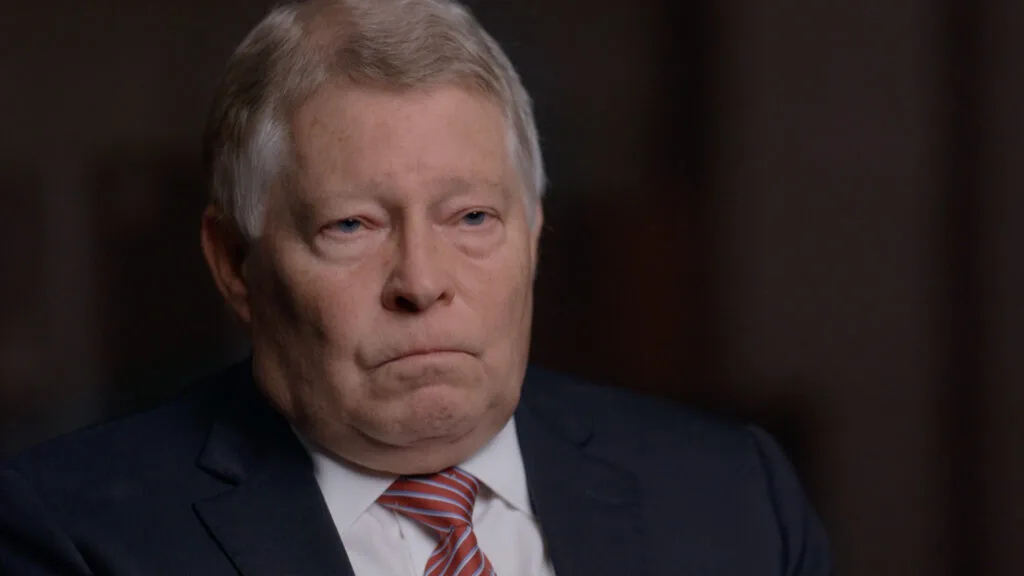
Chris Whipple is a journalist, filmmaker and author of the book, The Gatekeepers: How the White House Chiefs of Staff Define Every Presidency.
This is the transcript of an interview with FRONTLINE’s Jim Gilmore conducted on July 11, 2018. It has been edited for clarity and length.
TOP
Chris Whipple
Chapters
Text Interview:
Highlight text to share it
Let’s start with the relationship, the view that Trump had toward [FBI Director] James Comey from early on, when he comes to Washington.There's an animosity that is clear and that you write about a little bit.Why?Is it because he’s just a showboat?Is it because of the IC [intelligence community] briefing in early January?Is it because of the investigation?What's your overview of that?
Well, there's no question about the fact that Trump’s dislike for James Comey was visceral.It was a combination of factors, I think, partly, of course, that Comey was investigating the Russian collusion, and that made Trump extremely nervous.Partly it was the infamous briefing about the dossier that drove Trump crazy.But interestingly, [former Chief of Staff] Reince Priebus told me that it really was personality, that Trump couldn’t stand Comey because he was a showboat; that he turned everything into a federal case; that he had to be the center of attention.It was almost as though this town isn't big enough for the two of them.
Interesting.How unusual [is] that first meeting, the dinner date for two, where loyalty is an issue that comes up?[Tell us] how interesting [is it] that that took place; how Donald Trump viewed loyalty and how Comey would have reacted, and how Comey viewed loyalty?
Of course it was completely inappropriate for a president of the United States to have a one-on-one private dinner with his FBI director and then look for a loyalty vow.This is the White House; it’s not a crime family.It’s not what you do.What was also completely inappropriate, and to my mind, it really showed that Reince Priebus failed as White House chief of staff from day one, … no competent White House chief of staff would have permitted that dinner to take place.The idea that a president who is under federal investigation would be meeting one-on-one with the director of the FBI, and the chief of staff knowing full well that Trump would be likely to ask inappropriate favors, that really just showed that Priebus didn’t know what he was doing as White House chief.
There's an argument that they make that of course the president expects loyalty from his top officials, from his AG [attorney general], from his head of the FBI. They work for him.
They don’t work for him.They work for you and me.I mean, they work for the American people.Their fealty is not to Donald Trump.It is to the Constitution of the United States.So it was completely inappropriate for a president to ask for loyalty from an FBI director, especially a director who is in charge of an investigation of his administration, his campaign.
The other meeting, … where [President Trump] asks, basically, that the Gen. [Michael] Flynn investigation be slowed down, or whatever words that he uses, to back off of it, take us to that meeting, how surprising that that took place and how Trump would have viewed it and how Comey would have viewed it?
Again, it was just completely inappropriate for the president of the United States to tell his FBI director to cut somebody some slack, give this guy a break because he’s a nice guy.That’s just completely inappropriate for the president of the United States.The FBI and the Justice Department should be following the evidence, wherever it leads, without fear or favor, and certainly not cutting slack to somebody who happens to be a friend of the president or somebody he wants to go easy on.
What's the attitude of Washington when Comey is fired, the surprise, the attitude people had toward what had just taken place?
Donald Trump’s firing of James Comey on May 9, 2017, was stunning to everyone, especially the Washington establishment, because it was so obviously inappropriate and surprising.Of course, subsequently, Donald Trump said to NBC News that it was because of the Russia investigation, and later, of course, he told the Russians in the Oval Office that this guy was some kind of nutcase, and that this had taken the pressure off of him.
But even at the time, before we knew any of that, it was shocking to the Washington establishment.… Interestingly, this was shocking, even within the West Wing, in the inner circle of the Trump administration, because Jared Kushner had supported the decision to get rid of Comey.And on the evening that they were being torn apart by all of the network and the cable stations, Kushner, in frustration, walked into Priebus’ office, confronted him, and said, “Why can't the staff defend this?"Now, this is according to [then-White House Chief Strategist] Steve Bannon.
And Bannon wheeled around on Kushner and said: “Listen to me.Nobody could defend this.P. T. Barnum couldn’t defend this.This is indefensible.And it’s all because of you, Jared Kushner."And Kushner, according to Bannon, turned on his heel and walked away.Anyway, there was high tension within the White House.
… Of course Bannon thought it was the worst mistake since the firing of [special prosecutor] Archibald Cox by Richard Nixon during Watergate.It may well turn out to be, because of course, it did trigger the appointment of a special counsel, and Donald Trump might not be in the mess he’s in today had he not fired James Comey.
OK, let’s tell the story in detail of the [attorney general, Jeff] Sessions, in the Oval Office.[White House Counsel and Assistant to the President Don] McGahn gets a call from Rosenstein that there's a new special counsel that’s been appointed.Can you take us from there? …
On May 17, eight days after James Comey has been fired, Don McGahn, the legal counsel, bursts into Reince Priebus’ office and says: “We've got trouble.Not only do we have a special counsel appointed, but Jeff Sessions has just resigned."Priebus says, “You're kidding me."… Priebus goes running down the staircase into the West Wing parking lot.He finds Jeff Sessions sitting in a car that is idling.He opens the door, jumps into the back seat and confronts Sessions, drags him out, drags him back up into the West Wing, into his office, where Vice President [Mike] Pence and Steve Bannon come in, and the three of them persuade Sessions to stay on.He had been humiliated by Trump.Trump had yelled at him, called him an idiot, was very unhappy about the fact that he had recused himself.They managed to talk him into staying temporarily.He did subsequently write a letter of resignation which Priebus was able to get back from Trump, but it was a night of high drama in the West Wing.
So when Priebus first hears this, what does he realize?What is he afraid of?
Priebus realized that firing James Comey was bad enough, but that having Sessions suddenly resign would be a calamity for the White House.And as he put it, he told me that he told Trump that this is going to be a calamity that makes firing James Comey look like a picnic.Once Sessions is gone, you’ve got real problems.… At that point, Rosenstein probably resigns, and the next person below Rosenstein.You really have a chain reaction much like the Saturday Night Massacre during the Watergate days, so Priebus realized that they had to keep Sessions in place, or all hell would break loose.
So he goes down to the parking lot into the limo.How emotional is Sessions?What does he find when he gets there?What does he say to him when he gets into the limo?
Sessions is distraught at that point.And they're sitting in this car, idling in the parking lot of the West Wing.Sessions is about to depart, and he’s resigning as attorney general.He’s distraught, and he’s had it.He’s at the end of his rope.He’s been insulted by Trump.He’s decided that that’s it.And Priebus essentially almost has to drag him back up into the West Wing, to his office, manages to do that.He manages to do that, where Vice President Pence and Steve Bannon then come in and join Priebus and talk Sessions off the ledge.They persuade him not to quit, at least not right then.
Did they say what they said to Sessions?Do they describe the calamity to come?
He didn’t.Priebus didn’t tell me exactly what reasons they gave, so I can't really tell you.
So what happened in the Oval Office?Who tells the president, and what ensues, including what he says to Sessions?
… Trump was, at that point, furious with Sessions for having recused himself from the investigation and obviously felt himself endangered by a special counsel and lost his temper, and took it out on Priebus—I'm sorry.
That’s okay.
Trump was furious and took it out on Sessions, and humiliated him.I think Sessions, at that point, just decided he’d had enough.
Does the president have a point that—and they argue this—that he deserved the loyalty of his attorney general?That John F. Kennedy had the loyalty of his brother.Other presidents have had the loyalty, including Obama.Is there anything there?
No, I don’t think that there's a legitimate argument that Sessions should not have recused himself.It was the appropriate thing to do when you’ve got a president who was under investigation, under those circumstances.It was really the only thing Sessions could do that was faithful to his oath of office.
And how does it, as you write about this, “ritual humiliation” that happens repeatedly, how is that a tool that President Trump uses?Why does he use that as a tool?What does it accomplish?
I don’t know.We've never seen anything like this, so it’s hard to know how that serves Donald Trump.It’s hard to believe that it will serve him well in the long run.It certainly turned the chaos candidate into the chaos president, and I just don’t think it serves him well.
The other thing you talk about is that there's a paranoia from day one about the Russia investigation and about the investigation of the leaks, that the leaks keep coming out.Eventually Bannon is the one, I guess, that is blamed.Talk a little bit about the feeling in the Oval Office of how the Russia investigation took a toll.
You know, Donald Trump is someone who, as Priebus put it to me, fears no one and nothing.Yet at the same time, he’s somebody who is very needy, and he needs affirmation, and to some extent, he wants to be loved by people.I think that’s what the inauguration photo flap was all about.I think that Trump is frustrated when he doesn’t get approval.
… So I think to some extent, Donald Trump is baffled by the fact that he’s not more respected, that he’s not loved.At one point Bannon had to sit him down and say: “No, you know, these people who are out there marching in the streets right after the inauguration, they don’t love you.They hate you."And this came as some kind of a surprise to Donald Trump, according to Bannon.
There's a period of time where he lets up, and then he goes on the attack [against] Sessions again by the time, by the summer, by July.He wants him fired.He wants him fired, and he tells Priebus that.He’s tweeting that he’s weak, and he goes after him.… Can you tell me that story of what took place?
Trump confronts Priebus and says: “Look, I want Sessions fired.I don’t want any of your bullshit.I don’t want you to slow-walk this.I want it to happen."And Priebus, of course, as he told me when I first interviewed him off the record, and he subsequently put it on the record, “Take everything you’ve heard and multiply it by 50."This is the kind of thing that Trump would ask him to do.And for every cockamamie, ill-conceived thing that actually happened, like the executive order on immigration, for example, Priebus was able to stop 10 other things that might have been worse.Bannon joked with me and said: “No, it was 20 things.And ten of them were things I wanted to do."
… In fairness to Priebus, he was able to stop some things, was able to talk Trump off the ledge from time to time.That’s what every chief of staff has to do, and in Donald Trump’s case, perhaps more—much more often than others.But Priebus was able to stall, to come back to the Sessions case.Priebus was able to stall that demand by Trump, which is what White House chiefs of staff do.Donald Rumsfeld would famously staff things out, as he put it.When Gerry Ford had a really bad idea, he would say, “OK, well, let’s staff that out; get everybody to give us their input,” and of course it would never happen.That’s what a chief of staff has to do, and in Donald Trump’s case, quite often.
And you’ve got a situation here where also senators stood up….What was the blowback, and how did that affect the White House?
Well, there was a lot of blowback, and I think that Trump probably realized that, at the end of the day, he would not be able to confirm a replacement for Sessions.That was the reality.Priebus knew that, and I think that that’s why Priebus was able to stall, in this case, and ultimately to prevent Sessions from being fired.
And it showed what about the Republicans in Congress at that point?
Whatever you may think of Sessions, he had a lot of support in Congress.And I think for that reason, Trump ultimately realized that he probably would not be able to have a replacement confirmed if he actually went ahead and got rid of Sessions.
It’s around this time also that Trump sort of takes a turn in the strategy used.He goes to some Washington lawyers.He goes to [John] Dowd, he goes to Ty Cobb, who are brought in, who are Washington establishment lawyers, who understand the ways of Washington more than the New York lawyers that previous[ly] Trump had been using, and they counsel patience.… What was going on in the summer, spring/summer of 2017?
Well, I think if Trump’s lawyers were telling him, “Look, relax; let’s cooperate; let’s not make a huge deal out of this; it’s all going to go away,” clearly Trump was not listening to them, because he was constantly tweeting his paranoia about the investigation, constantly attacking Mueller, and has ever since.I think that this is the problem, when you have a president who doesn't listen to lawyers or chiefs of staff, or anyone else for that matter.
And it’s a real weakness.You know, the model for a White House under siege with scandal is the Clinton White House.In that case, you had a White House chief of staff, Erskine Bowles, when during the Monica Lewinsky scandal, who kept Bill Clinton focused like a laser on governing, and you had a deputy chief, John Podesta, who was running a war room full of lawyers who dealt with the scandal.So Clinton would deal with Podesta, who called himself the “secretary of blank” when he had to, but the rest of the time he was focused on governing, thanks to his chief of staff, Erskine Bowles.
We see nothing of that discipline in this White House, nothing resembling it.But if they were smart, they would emulate that example.
Then there's a period of time where at least the lawyers are counseling patience and work with Mueller, and then that ends.And they eventually leave, because they're frustrated.By the time of 2018, in April of 2018, when Michael Cohen’s apartments and houses and offices are raided, there's a big turn coming in the way that Trump and his lawyers, soon to be Giuliani, are going to deal with the Mueller investigation.What happened in the White House, and sort of how big a turn [was that]?
Well, there may have been a turn, but it’s not clear to me that there's any strategy whatsoever.It’s not even clear to me what Giuliani is.Is he the president’s lawyer?Is he a talking head?Is he just a pal who goes out and complains about the investigation and sticks up for Trump?Nothing Giuliani says is either a, accurate, or b, strategic.So it’s hard.If there was a turn, it seems to me it was a turn right off the rails.I don’t see that there's any effective strategy whatsoever at this point.
The other adjustment that has been made is in the Congress, the GOP in the Congress has seemed to line up behind the president on these latest issues of attacking Mueller, attacking Rosenstein, attacking this whole Spygate story that the president wants to have investigated.This is the same Congress that was, until the year before, was standing behind Mueller, talking about the importance of the investigation, was making sure that Sessions wouldn’t be fired.Why the transition?
It’s hard to know, but it’s ugly to watch.And it may well be a case of, you know, profiles in cowardice, because this Republican Congress has decided that it will sell its soul for judicial appointments or a Supreme Court post.And it’s hard to watch; it’s sad to see, and I think it’s troubling.
How has Trump, in the way he’s dealt with the judiciary, the way he’s dealt with the DOJ in general, the fact that he has pushed forward judicial nominations that have been successful, how is he changing America?What do you think the long-term effects here are of his attitude toward the judiciary, toward the rule of law?
Well, again, it’s dangerous and it’s troubling when you have a president who has no respect for constitutional norms or democratic institutions or the rule of law, who continues to chip away at that.It’s dangerous.So far, democratic institutions have been pushing back, and we can only hope, at the end of the day—we've been through something like this before in the Watergate era, and we’ll get through it again.But it’s harmful.
You write that Priebus told you that people underestimate how much Trump has undone the Obama accomplishments.What do you mean by that?What did he mean by that?
Well, I think Reince Priebus would argue that the president has accomplished more than meets the eye, that he’s succeeded in ripping up regulations that Obama had put in place.He’s had success, obviously, with the economy and with judicial appointments.But I think it’s worth remembering that no matter how many Supreme Court justice nominations fall in Donald Trump’s lap, that this is still the most dysfunctional and broken White House in modern history.It’s a White House that still can't do anything right.It can't pass legislation.It can't issue executive orders that are enforceable.It can't execute its agenda on the border.It can't really do anything with trade.The president seems unable to explain, to give any kind of rationale for the trade wars that he’s embarked on.It’s a broken and dysfunctional White House.
Talk a little bit about his relationship with Jared Kushner and the role that Jared Kushner is playing.
I'm not sure that I can tell you very much about that relationship, but let me try to give you something about Kushner and where I think he fits in the White House.
Rahm Emanuel, Barack Obama’s first White House chief of staff, told me that he said, “Show me a White House where you don’t have a battle for the soul of the presidency, and I’ll show you a White House where nothing interesting is getting done."Well, I think there is a kind of battle for the soul of this White House.I think there are ideological factions that are really at each other’s throats here.That certainly was true when Bannon was there, but I think that you’ve got some pragmatists in the White House as well, fewer and fewer.But I think there's a real tug of war going on right now between the hard-right ideologues, the Stephen Millers and, to some extent, even the John Kellys of this White House, and the more pragmatic factors like Jared Kushner and Ivanka Trump.
I think it’s a moment of truth for the Trump White House.I think they're probably on the verge of having a third chief of staff before too long.And I think it’s a real watershed for this White House.You know, lately it’s been in the grip of ideologues who have no idea what they're doing.When you look at the fiasco on the zero tolerance on the border, you look at the trade wars that Trump has embarked on right now, the ideologues have no idea even how to execute their agenda.I think this is a really pivotal moment for the Trump White House.
Stephen Miller’s role: Explain that.
… I think that as we've seen pragmatists heading for the exits, moderates heading for the exits in the Trump White House, and we've seen [former National Security Adviser H. R.] McMaster is gone, [former Deputy National Security Adviser] Dina Powell is gone, [former Secretary of State Rex] Tillerson is gone, I think that the Stephen Millers and the hard-right ideologues in the White House have gained more and more influence.We’ve seen that with the border policy and with the trade wars and a lot of the recent decisions.So I do think that Miller has become more influential as a lot of the pragmatists have left.
You’ve seen the workings of quite a few White Houses and how they operate.Just compare this White House and how it operates to many of the half a dozen or whatever other White Houses that you’ve investigated and researched.
Without a doubt, this is the most dysfunctional and broken White House in modern presidential history.Every president learns, often the hard way, that you cannot govern effectively without empowering a White House chief of staff as first among equals in the White House, to not only to execute your agenda, but to tell you what you don’t want to hear.That has not happened in this White House.
Presidents who have tried to govern on their own, who have tried to run the White House by themselves, have learned that it’s a disaster.Gerry Ford tried it, and he called it the “spokes of the wheel."It lasted about a month, and he turned, in desperation, to Don Rumsfeld to whip his White House into shape.
… The lesson of the first year and a half of the Trump presidency is not that Donald Trump should somehow be unchained to govern and run the White House by himself, without an empowered White House chief of staff.The lesson is the exact opposite: that he needs, desperately, to find a White House chief who, with gravitas that he respects, who can walk into the Oval Office, close the door, and tell him what he doesn’t want to hear.John Kelly has failed completely in that respect, I think.He’s been politically inept.He’s somebody who really has reinforced all of Donald Trump’s worst partisan instincts.